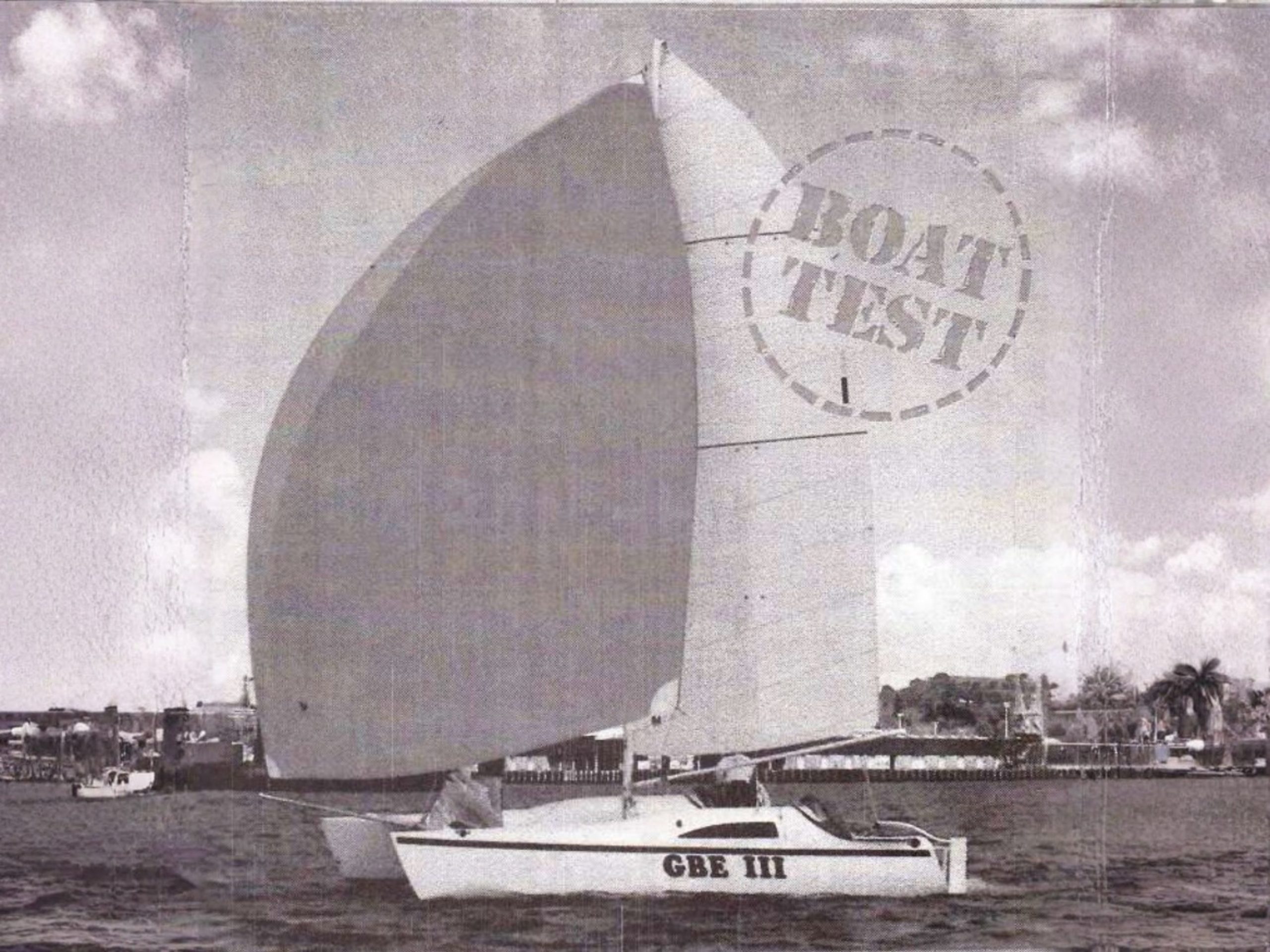
Like a true sports classic. the basic design of the Great Barrier Express has not not changed in nearly 20 years. The just launched Nark 3 is bigger and faster than its predecessors-and when we hear its hit the water, there’s a stampede from the office to test fly the GBE Mark 3.
With designer Malcolm Tennant selling more than 100 plans, there are obviously scores of GBEs still giving exhilaiating service around New Zealand, Australia and the Pacific.
But now, nearly 20 years since this significant design lifted Tennant’s name to multihull prominence, it is pleasing to hear that the class is poised to spring back to life with a vengeance. The main catalyst for the renewed growth has come from New Caledonia’s world-leading Hobie fleet, whose skippers, in getting a little older, are looking for bigger toys.

GBE Mk III is the first of an initial half-dozen expected to be shipped to Noumea. With just a few days to go to the ship’s departure, the Boating test team arranges to meet builder Richard Pilkington and longtime crew member Jim Roskvist at Auckland’s Westhaven Marina.
Even from the marina, it is clear that this is a new-look GBE. The Mark III is readily distinguished by a number of new features, from the vertical rudders mounted on stern brackets to the 300mm extra beam and the fuller bows. As well, there is a 500mm taller rig, a longer, roomier centre pod for stowage and a roomier interior.
The original Great Barrier Express was designed in 1972 with the express purpose, as the name would suggest, of commuting at speed from Auckland to Pilkington’s section on Great Barrier Island, 50 nautical miles out in the Hauraki Gulf.
Since then the GBE has created its own slice of nautical history around the Pacific, sailing at indecent speeds and creating for its occupants sensations previously unexperienced (not a reference to the legendary nocturnal trampoline activities boasted about by so many GBE owners).
In 1974, Excalibur, sailed by David Knaggs, broke the New Zealand measured half-mile sailing record by achieving 21.5 knots off Auckland’s Point Chevalier Beach. Other owners have reported speeds of up to 27 knots. After our test, we believe them.

We begin the day with a thorough dockside inspection of the new catamaran, the first to be visited being the left-hand one.
Accommodation
Climbing down from the cosy two-person cockpit, the companionway step is onto the tread of the quarter berth. Ahead of us is a long narrow tunnel. Firstly, we encounter a fold-down chart table to port capable of handling a folded chart. Handily positioned is the Uniden VHF while a fluorescent overhead provides ample night illumination.
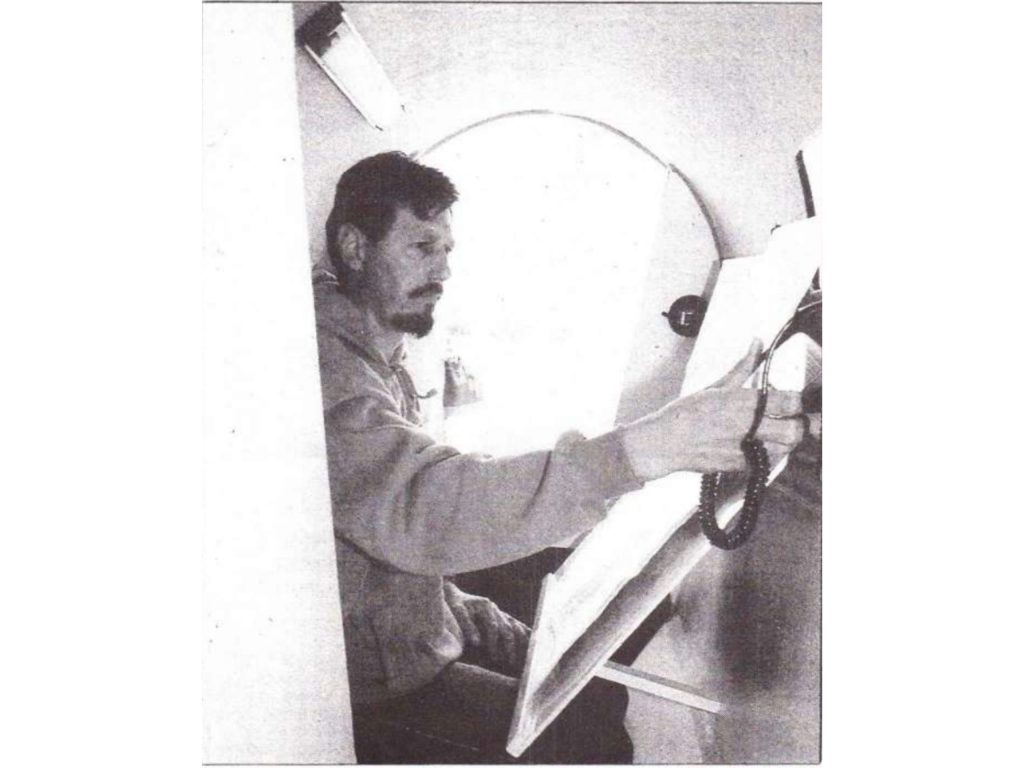
Just for’ard of this is the imposing centrecase, running from cabin sole to deckhead, and alongside this is the switch panel that controls the yacht’s very simple electrics.
Through the main bulkhead is the port hull’s second single berth.
The interior is very clean and simple, and very well finished. There is non-skid underfoot, the luxury of Frontrunner synthetic carpet on the deckhead, with the remaining surfaces smartly finished in white lacquer.

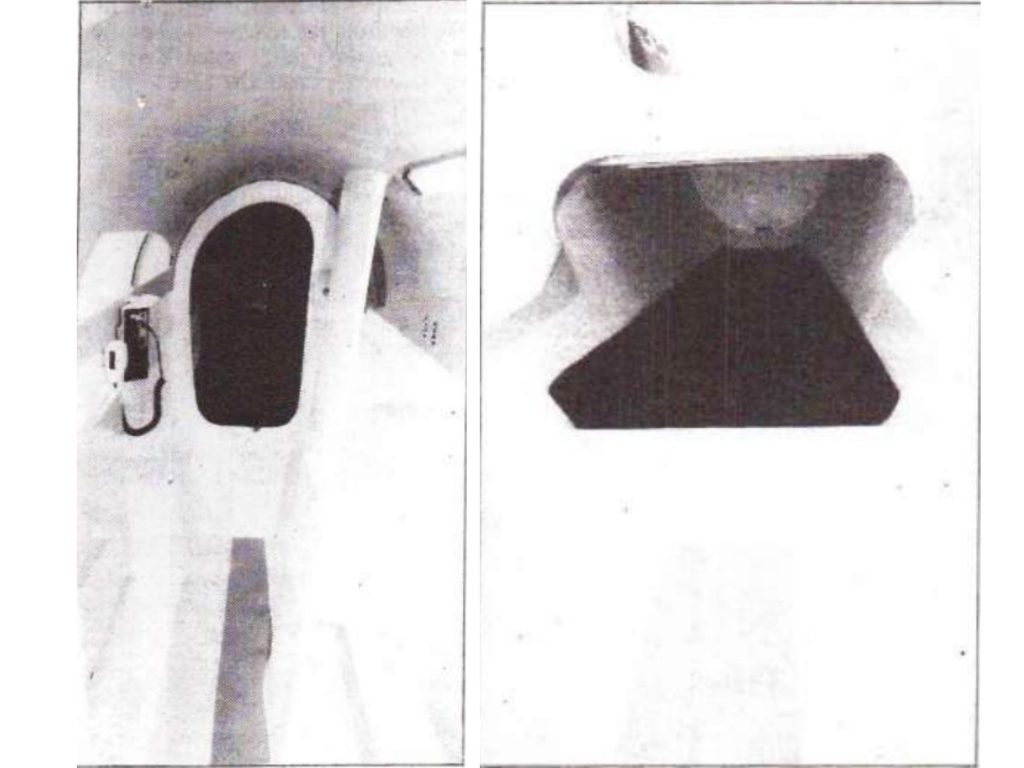
Strolling across to “the other boat” we discover an almost identical layout, although instead of a navigation station there is provision for a small two burner cooker. Storage is limited, not encouraged on such a performance sailboat, beneath each of the four berths.
Deck
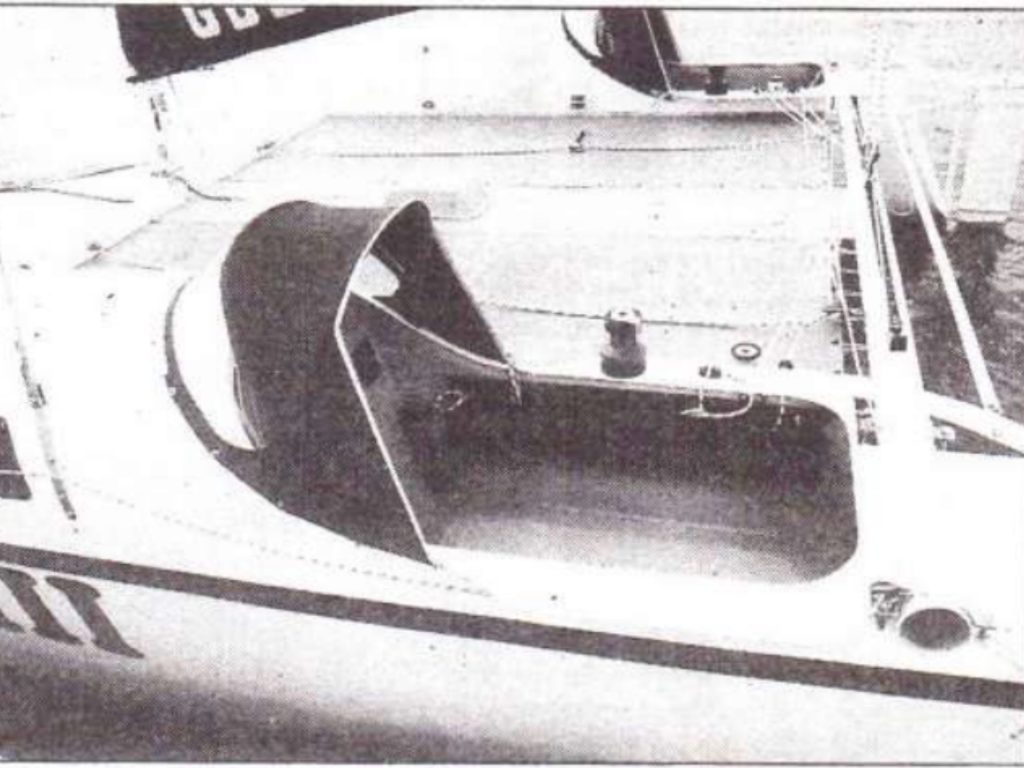
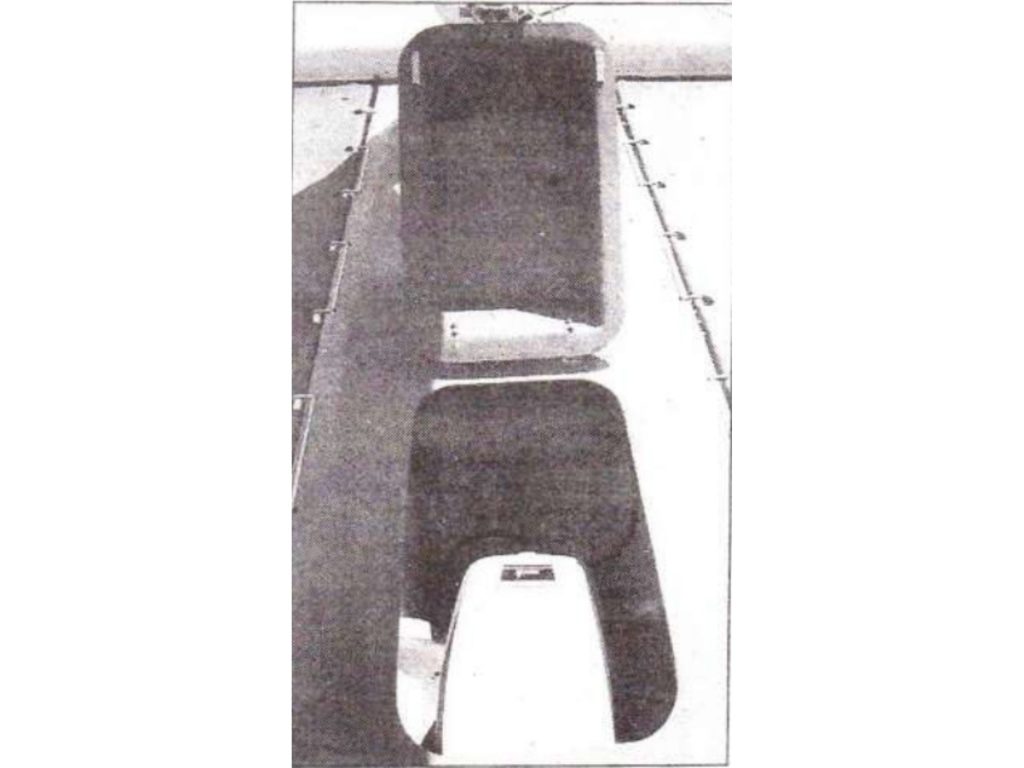
The most striking new deck feature is the extended outboard pod which, in this new design, runs from the main beam to the aft beam. As well as housing the Evinrude 9.9hp long shaft outboard and fuel tank, the pod has a separate compartment for’ard to house halyard tails and the battery. Meanwhile at the aft end of the pod there is another compartment for lifebuoy, sheet and cruising gear stowage.
Another new aspect with the Mark III is the use of different trampoline materials for’ard and aft. For’ard of the mast is the well-proven Fabloc mesh while the aft tramp is of sheet PVC, painted with a non-skid. The use of PVC not only gives a surprisingly firm and sure-footed surface to work on but also eliminates spray from the dolphin striker and outboard pod.
The Ronstan mainsheet traveller runs full-width across the aft beam, the 6 to 1 purchase being cleated in either cockpit using a Maxwell 14 single speed winch and servo cleat.
The No 3 genoa sheets to the main crossbeam, then aft through the No 1 block on the secondary beam and a double foot block on the rear beam before running up to the windward cockpit.
The gennaker sheets, meanwhile, run directly onto the rear beam and are again cross-sheeted so they can be worked from the windward cockpit. The tack line for the gennaker and the jib cunningham run aft to the port cockpit.
The primary winches, Maxwell 22 two-speed self-tailers, are mounted on the for’ard inboard cockpit coaming. The centreboard up-down controls are cleated just for’ard of each cockpit on the cabin side, a vast improvement on the old spade handle adjustment system. All sheets are handled by tail bags the length of the cockpit, eliminating tangles and underfoot mess.
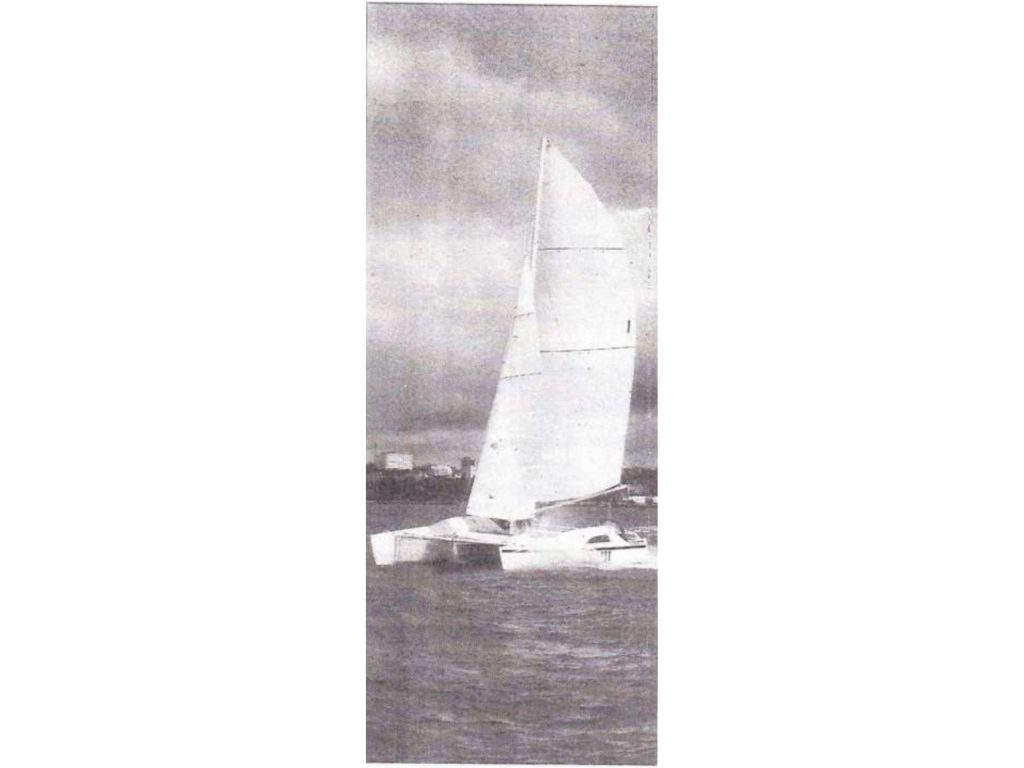
The mast is a Foster’s section supported by only three stays. The mast also features a set of diamonds to support its middle section and a pair of masthead stays for support when the masthead gennaker is set.
The gennaker prod is permanently mounted to the fore beam, 18-footer style, loosely supported by two wire stays to the bows.
An appreciated ease-of-handling feature is the boom, set up with lazyjacks, which also double as topping lifts when the mainsail is dropped. The outhaul on the boom is not the conventional slide and car arrangement but simply a webbing strop shackled around the boom, the same arrangement being used for the mainsheet attachment.
The two reef lines run internally to the front of the boom and are handled by another Maxwell 14 single speed winch.
With the crew itching to harness the increasing southwesterly, we are treated to a demonstration of the manoeuvrability of the yacht, courtesy of its new rudder system, by sailing off the marina.
Sailing
Under mainsail, easily hoisted with the 2 to 1 reduction halyard with a cunningham for luff tension, the GBE III picks her way easily through the moored yachts at Westhaven. Once out onto the Waitemata, the jib is hoisted and the GBE demonstrates an acceleration which becomes more and more dramatic throughout the day.
With the wind initially blowing at just 8 to 10 knots, the GBE achieves 10 to 11 knots, having shifted the apparent wind from 90 degrees to around 30.
After a rapid ride from Westhaven to Compass Dolphin, we prematurely hoist the gennaker. With the 10-knot wind well aft the yacht accelerates spectacularly, throwing one of the test team off his feet. The GBE III quickly hits 16 knots which forces the rapid removal of the gennaker as we have chased the apparent wind so far for’ard that further progress is about to be impeded by Devonport Wharf. Handling the gennaker on a boat of this size is a real breeze, easily handled by a crew of three.
The jib rehoisted, a course is set for North Head. Gybing around this landmark proves less fuss than tacking the average keeler.
With the plan being to run the catamaran up on Takapuna Beach for lunch, there lies ahead a powerful two-sail reach in flat water. This is one of the most exhilarating legs of the test, the yacht hitting and holding 18 knots for prolonged bursts.
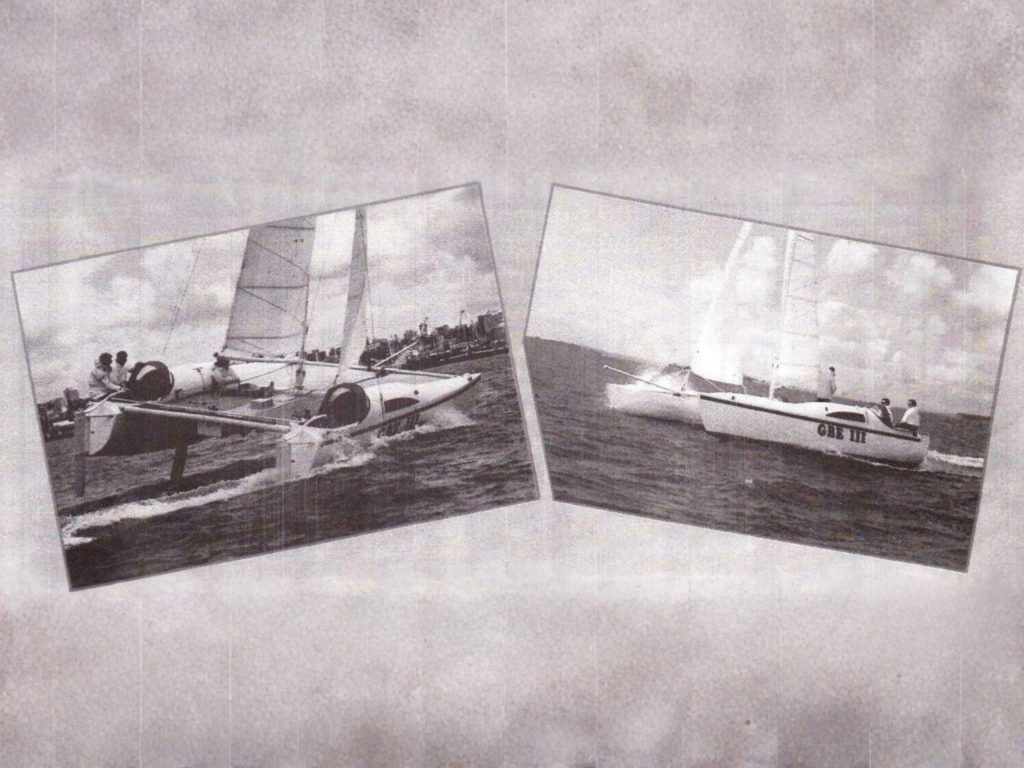
At this speed the helm response is fingertip, the leeward bow throwing up sheets of spray while small whispers of wake hiss from the rudders. So easy is the passage through the water that it is easy to underestimate the speed until we check the log.
One joy of multihull ownership is underscored as we run the GBE gently onto Takapuna Beach for lunch. Another advantage is quickly realised as we lounge out on the trampoline to enjoy the spring sun.
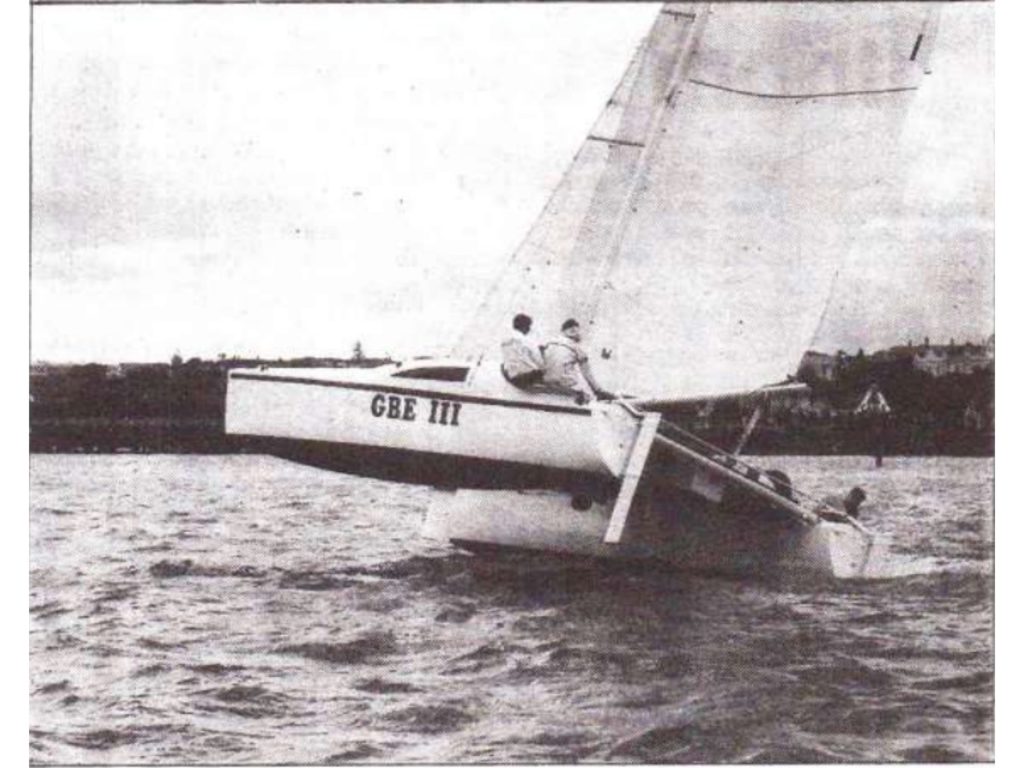
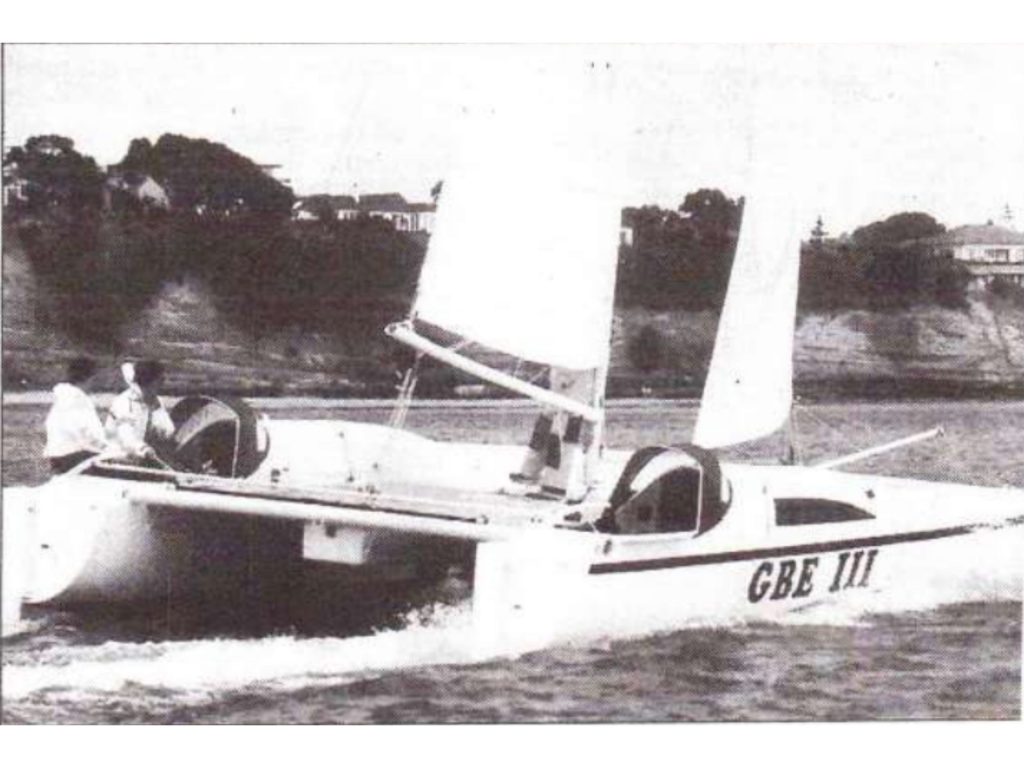
The return upwind sail fully tests the efficiency of the Mark III rig. At 9 to 10 knots on the wind we fly the windward hull well clear of the water, strictly for photographic purposes as this is definitely not the fastest way to sail to windward.
Tacking is not the chore it was on older generation multihulls, the GBE flicking around almost as easily as a keelboat.
By now the breeze has lifted to 20 knots, ideal for demonstrating the performance of the yacht before the Boating cameras. For those on the chase boat, this yacht requires fast reflexes to ensure the cameras keep up with the fast-accelerating action.
There is no doubt that aboard the GBE the helmsman has the best seat in the house. All the controls are readily to hand, the visibility is unrivalled while the sheet trimmer sitting on the cosy gunwale ahead provides an effective spray screen (nice guy). Any additional crew have the arduous task of lounging on the trampoline.
On the subject of deflecting spray, the Boyd and McMaster mini harbour “dodgerettes” prove very successful. The Ritchie compass and the 0–40 knot Midas analogue speedos are easily read from the helm position. These speedos are cross-linked so that when flying a hull, the speed of the leeward hull is displayed in the helmsman’s windward cockpit.
Our test GBE Mark III was built in the same moulds as the original fibreglass GBE 15 years ago, the only difference being the reshaping of the bows by spreading the moulds 25mm.
The yacht was built by Pilkington using 300g/m² Ultimate glass cloth either side of 6mm Divinycell. Timber and foam ring frames and grid take the loading from the centrecase and crossbeams. The crossbeams are alloy tubing. While the overall construction is high tech, it is also not high priced and enjoys proven reliability. The centreboards and rudders are fibreglass with a timber web inside.
Summary
There is no doubt that aboard the GBE III the fun-and-performance-to-dollar-spent formula is close to the red line. To match the GBE’s performance figures on a monohull would require at least twice the length and more than three times the budget.
As the photographs demonstrate, this is a real speed machine, ideal for harbour and short coastal passages. The GBE is easy to sail and enjoyable after a brief outing. Novices to the class will quickly become proficient.
This is a yacht for those not wanting a floating gin palace. It has no showers, double berths, enclosed toilet compartment, fridges or freezers. After all, this is a performance yacht, a sports car of the sea.
The vitals
LOA: 8.5m (27ft 10in)
Beam: 5.3m (17ft 5in)
Draft (boards down): 1.34m (4ft 5in)
Draft (boards up): 340mm (1ft 1in)
Displacement: 1077kg (2374lb)
Designer: Malcolm Tennant
Builder: Pilkington Boats
Rig: Foster
Sails: Lidgard Sails
Winches: Maxwell
Sailing instruments: Midas
Engine: Evinrude 9.9hp long shaft
Paint system: Strata
Antifouling: Altex
Dodgers: Boyd & McMasters