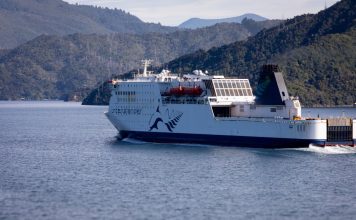
You may have met them in the channel: long stacks of metal boxes towering over your little boat like a mobile apartment building. They need speed to push an enhanced water flow over the rudder for maneouvrability and can be an awesome sight as you edge out of their way. Story by Lindsay Wright.
They’re container ships – or ‘box boats’ in the maritime vernacular – and the great wall of steel that throbs past is one of 5,434 such ships trading around the oceans of the world.

The concept of carrying cargo in standardised containers was first formulated by US truck driver Malcolm McLean.
Born on a North Carolina farm in 1914, he left school in 1931 and bought a secondhand truck to carry produce to market. By 1934, he was running a fleet of five trucks but was frustrated by the time they spent sitting at shipping ports waiting to be unloaded.
Freight was carried in boxes, bales, crates, trunks, rolls, barrels or other packaging, all of which had to be loaded and discharged by gangs of men – a process that was labour-intensive and time-consuming.

So McLean got together with engineer George Tantlinger to design a strong, stackable, standardised container that was lockable and easy to load and discharge.
He sold his trucking business in 1955 and borrowed $US42 million, $US7million of which went towards buying The Pan Atlantic Steamship Co. Next he bought a US Navy war surplus tanker, Portero Hills, and had it converted to carry 58 containers. McLean had wooden shelter decks, known as ‘Meccano Decks’, fitted to the ship.
The containers were fixed to the chassis of trucks and driven to the ships to be lifted aboard. At their destination they were again fixed to trucks and delivered to the consignee.

The ship was renamed Ideal X and made the first modern container ship voyage from New Jersey to Houston in 1956.
McLean’s idea was brilliant. Within a few years freight charges had dropped from $US6 a tonne to 16 cents and fast, reliable international freight was about to become a reality.
The first trans-ocean container ship voyage was from the US to the Netherlands in 1966, but McLean had retired by then and sold his business for $US160m.

Containers come in either 20 feet (6.16m) or 40 feet (12.33m) lengths and are 8ft (2.5m) wide and 8’6” (2.6m) high. A 20-foot container holds about 33m2. The IMO (International Maritime Organisation) says that 226 million containers are shipped around the world every year.
The ships that carry them are built in seven sizes: Small Feeder; Feeder; Feeder Max; Panamax; Post-Panamax; Past-Panamax; and ULCV (Ultra Large Container Vessel).

Panamax denotes a vessel which is built to be the maximum size to fit through the Panama Canal, but the canal is in the process of being widened; the Feeder ships are coastal carriers delivering containers to main ‘hub’ ports. The Maersk Line may operate up to six of these ships around the New Zealand coast if its attempt to establish a local service comes to fruition.
The largest container vessel currently trading is the Ever Ace, a 400m long behemoth which can carry 23,992 containers. A 70950kW Wartsila 11-cylinder two-stroke diesel powers the ship to a 22.6-knot cruising speed.
The Evergreen Marine, which blocked the Suez Canal for several weeks, is another giant freighter at 337m with capacity for 20,000 containers.
Shipping containers are regularly repurposed to become homes, workshops, offices or storage, but there is a dark side to all this freight efficiency.

The IMO also says that between 2008 and 2019, over 1,382 containers were lost at sea. The containers are not airtight, it says, so they take in water and sink within a few days. But if they are filled with buoyant cargo they can float for years. In 2013 alone, a container ship called MOL Comfort broke in two and sank with the loss of 4,293 containers. Maybe containers could be fitted with bulletproof AIS transmitters to warn other vessels of their presence?
But even with recent high global freight rates, shortages and supply chain issues, just imagine life without shipping containers. It could have been so much worse. So, let’s give thanks to Mr McLean.