In a bold move for the future of green shipping, Tasmanian shipbuilder Incat has launched the world’s largest fully electric ferry—marking a global turning point in sustainable marine transport. Built for South American ferry operator Buquebús, the 130-metre catamaran—officially named China Zorrilla—will soon begin operations between Montevideo, Uruguay and Buenos Aires, Argentina. The vessel is not only a technical advancement but also a powerful symbol of what’s possible in zero-emissions maritime transport.
Originally designed to run on LNG, Hull 096 (China Zorrilla) was transformed mid-construction into a 100% battery-electric ferry, showcasing the pace of change within the sector. The ship is fitted with more than 250 tonnes of batteries, storing over 40 megawatt-hours of energy—four times more than any other maritime battery system to date. That power feeds eight electric waterjets, enabling the vessel to carry up to 2,100 passengers and 225 vehicles across the Río de la Plata.

Charging infrastructure is under development on both sides of the river, with each port set to enable fast recharging in just 40 minutes. With a 90-minute range per charge, the ferry is well-suited to the 240km route between Argentina and Uruguay. The choice of lightweight aluminium construction also reduces energy consumption and charging demands, providing a blueprint for other electric vessels to follow.

Inside, the ferry is no less ambitious. It will house a 2,300-square-metre duty-free retail space—the largest onboard shopping area on any passenger ferry in the world. This commercial feature demonstrates the vessel’s dual-purpose role in transporting both people and economic activity, a nod to the rising importance of passenger experience in ferry design.
The vessel’s creation marks a high point for Incat Tasmania, which has nearly seven decades of shipbuilding under its belt. Founder Bob Clifford describes China Zorrilla as the company’s most challenging and significant project yet. In his words, it “sets the benchmark” for future electric shipping. The sentiment is echoed by the Tasmanian Premier Jeremy Rockliff, who lauded the ship as a “global showcase” of the state’s capabilities and a catalyst for economic and environmental progress.
This project is already rippling through the global maritime industry. Incat has announced it is ramping up production, with plans to build a second electric ferry by year-end and target two new builds annually. Meanwhile, work is underway on a new 78-metre hybrid-electric ferry, offering flexible propulsion modes—fully electric, hybrid, or generator-assisted. This adaptability is designed to help ferry operators transition at their own pace, supported by scalable technology.
And this isn’t just about Tasmania. In several countries, similar green maritime efforts are afloat, with Norway, New Zealand, and Singapore being prominent examples. The US, including the San Francisco Bay Ferry, and the UK (Wightlink) are also developing and deploying electric ferries. Even India, through Kochi Metro Rail Ltd., is introducing electric ferries.
Auckland is in the process of modernising and decarbonising its ferry fleet as most current ferries approach the end of their service life. The city is transitioning from diesel-powered ferries to electric and electric-hybrid vessels to reduce public transport emissions. These new ferries will improve capacity, accessibility, and service reliability while being powered by locally generated electricity, cutting fuel consumption and carbon emissions significantly. The fleet includes two fast electric ferries, designed for short and mid-harbour routes, and two electric-hybrid ferries for longer routes, all featuring eco-friendly materials like carbon-fibre composites.

Auckland’s first two electric ferries are being constructed by EV Maritime at McMullen and Wing. These 200-seat, carbon fibre ferries are part of a 10-year programme to replace the city’s ageing, diesel-powered fleet with zero or low-emission vessels. The government has funded $27 million for the project. The ferries will serve mid-harbour routes and have a range of 37 km, travelling at 25 knots. Auckland Transport is also developing fast-charging infrastructure, and these ferries will be joined by two diesel-electric hybrids expected by 2025-2026.
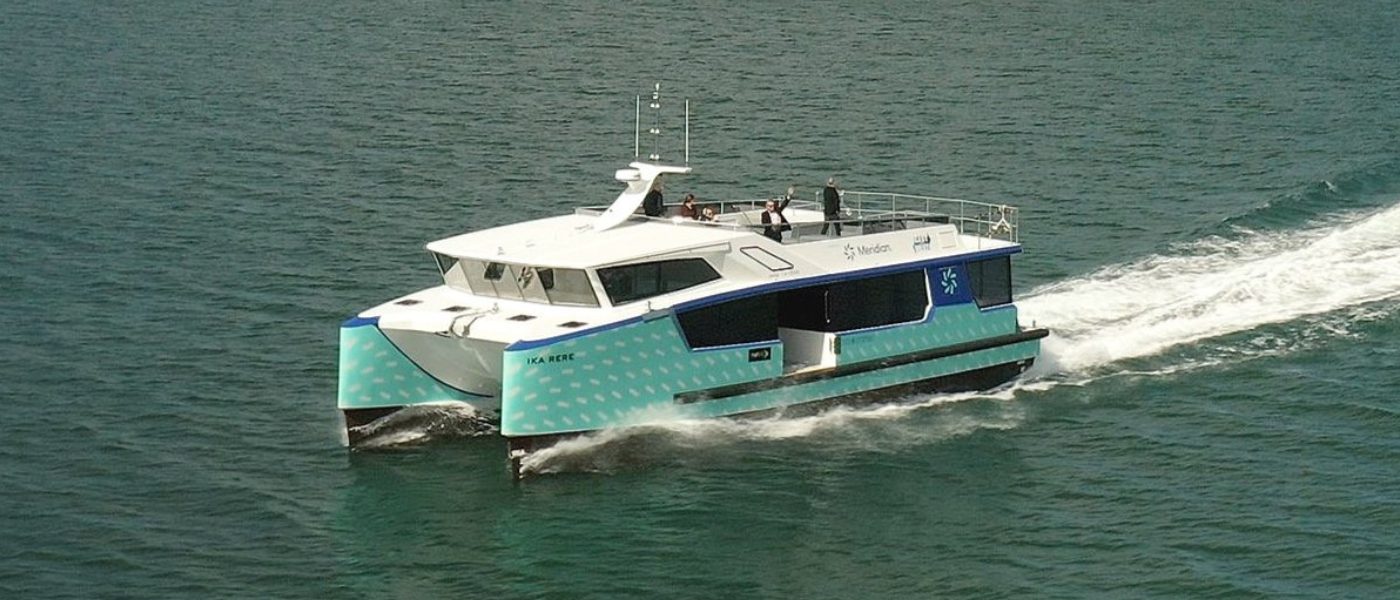
Wellington’s Ika Rere is the Southern Hemisphere’s first electric passenger ferry. McKay’s marine and engineering divisions, in collaboration with Wellington Electric Boat Building Company (WEBBCo), delivered Ika Rere in December 2021. Unfortunatey it has been out of service since July 2024 due to a mechanical fault, but is set to return to Wellington Harbour mid-way through this month. After delays with replacement parts, final tasks and sea trials are underway. This marks a return for the Southern Hemisphere’s first electric passenger ferry.
Back in Auckland, Fullers offers a unique, emissions-free journey aboard Kermadec, the world’s first electric hydrofoiling ferry. The Kermadec electric ferry, also known as the Vessev VS-9, was built by Vessev, an Auckland-based start-up, in collaboration with Fullers360. It was designed and built as a prototype/proof of concept and later gained commercial approval for use with Fullers360. Vessev is a company focused on sustainable marine innovation. Operating from Auckland’s Viaduct Harbour, passengers glide above the water, enjoying panoramic views of the city skyline, Harbour Bridge, and Hauraki Gulf. The 40-minute tour includes expert commentary on hydrofoiling technology and Auckland’s marine environment. The experience features a premium setting, with seating for up to six guests, and includes Moët champagne and gourmet cheeses.

The China Zorrilla launch doesn’t just put Tasmania on the map—with delivery scheduled for late 2025 and sea trials on Hobart’s River Derwent underway, this vessel represents a giant leap forward in the electric age of maritime transport.