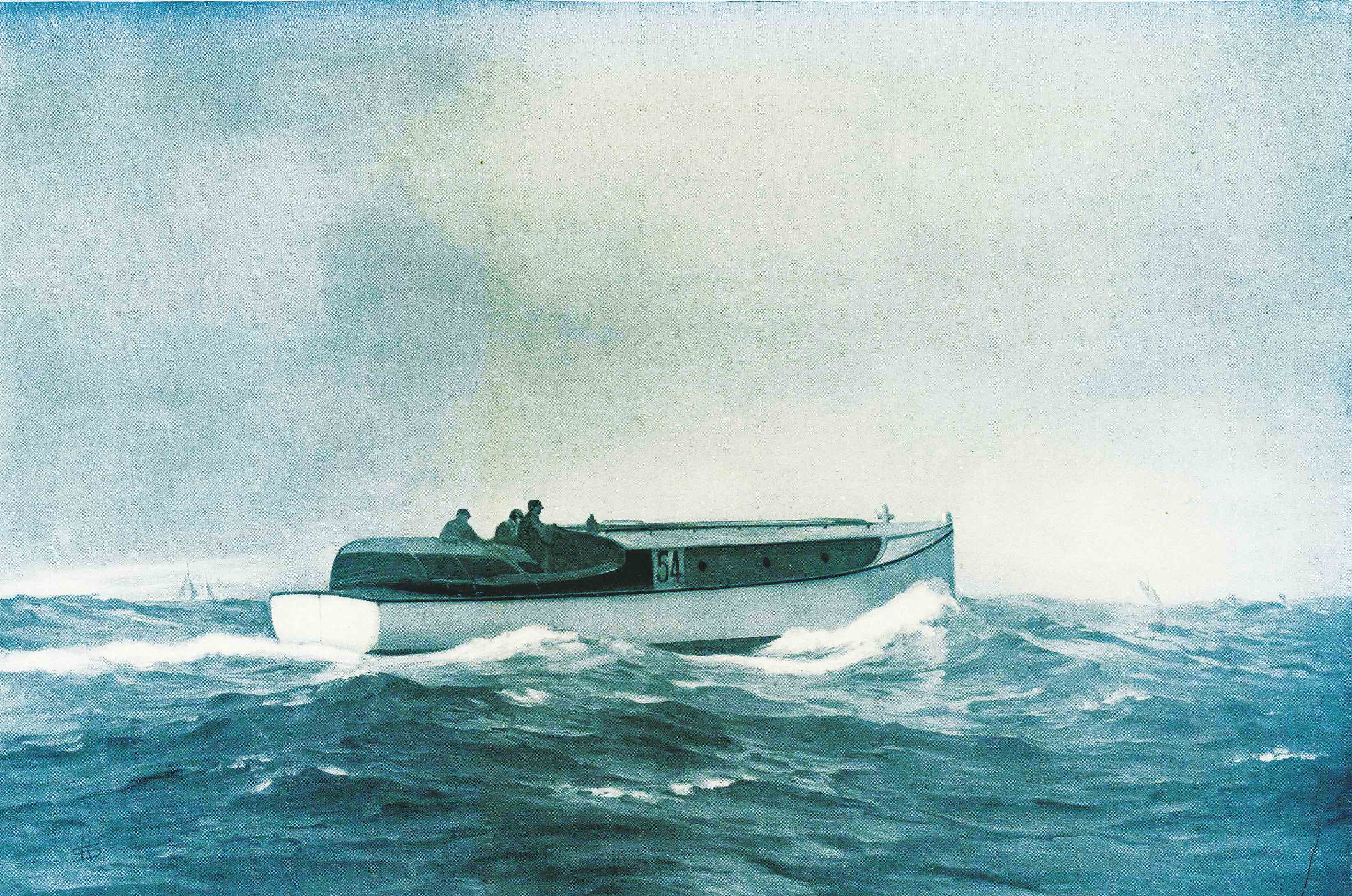
In the last two issues I have described, in the order of their entry, the builders, the engines, and the owners of six of the 14 launches entered in the Royal New Zealand Yacht Squadron’s race for launches held on December 12 and 13, 1908 from Queen’s Wharf on the Waitematā, around Sail Rock and back for the Rudder Cup.
ALLEYNE was the seventh entrant. She was almost new. She left the yard of Tyler & Harvey in Customs Street West in the first week of November 1908, another husky double-ender in the style made popular by the Logans. She was described in the press as “a very high-sided boat and should be dry in a seaway…….her equipment is very complete, even including a piano.” She measured 42ft loa by 9ft beam and had a 20hp Lozier marine engine. Her owner was journalist Arthur Roland Brett of the Auckland Star who was currently Commodore of the New Zealand Power Boat Association.
Brett had an earlier launch, Alleyne, named after one of his daughters, which was a simple Milkmaid type, built for him by Chas Bailey Jr in 1906. His father, Sir Henry Brett, had arrived in the country in 1862 as a nonconformist settler but chose to remain in Auckland to work for the New Zealand Herald instead of following the bulk of his companions to Port Albert like my own maternal great-grandparents. Eventually, he became the sole proprietor of the Auckland Star newspaper and Auckland’s Mayor in 1877.

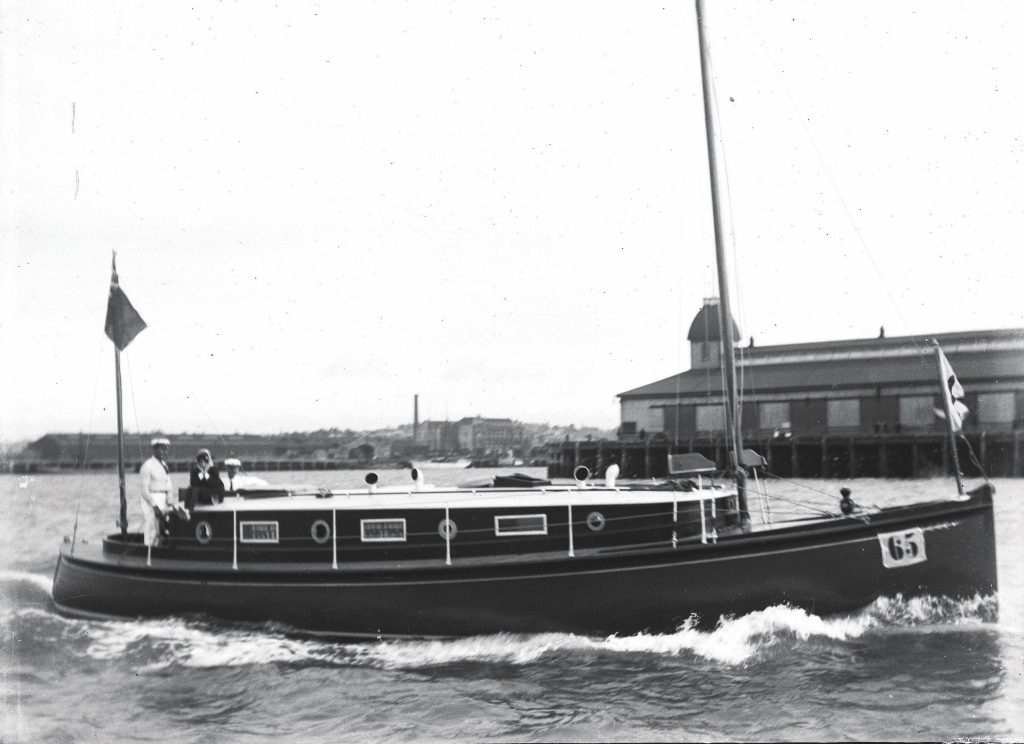
George Tyler & Alf Harvey had set up as boatbuilders next to Chas Bailey Jr in Customs Street West in early 1908 and immediately had a good trade in commercial craft and centreboarders, probably as the result of Tyler’s recent time as a prominent All Black, especially on the 1905-6 tour of England and France. Among the many vessels they built were the mullet boats Varuna and Calypso and the launches Virginia, All Black and Oleo. Tyler left the firm in October 1910 when he was appointed the Auckland Harbour Board’s Dockmaster. Alf Harvey was soon joined by Dick Lang.
The Lozier engine in Alleyne was built in Plattsburgh, New York. The Auckland agent was W.R. Twigg. At this time the Lozier company was concentrating on building well-finished two-stroke and four-stroke engines of considerable sophistication. The 20hp Lozier in Alleyne was their four-cylinder four-stroke with a bore of five inches and a stroke of six inches for a capacity of 471 cubic inches, designed to run at 600rpm. At the same time, Logan Bros were installing an identical engine in the similar launch Kirita they were building for W.H. Worrall. Shortly before 1908, the Lozier company had re-entered the car market with a high-quality vehicle modelled on the contemporary Mercedes. Development of their marine engine range stalled. By 1912 Alleyne had been re-engined with a locally built 18hp Twigg.
KOTIRO was another Logan Bros high-quality double-ender, built for Alf Gifford in late 1906. By the time of the race Gifford had just sold her and Logan Bros were now building the famous racing cutter Rawene for him. The new owner was W.J. Harper of Ring Terrace. Kotiro was 35ft loa by 7ft 6in beam and was fitted with a 15hp Union. In hull form she was very similar to Dacre’s entrant Wanderer.
As explained when I discussed Matareka, W.S. Whitley’s entrant in the Rudder Cup race, Logan Bros favoured the San Francisco-built Union engine. The engine’s agents, W. A. Ryan and Co, were handy, next door to Logans’ yard on the Railway Wharf. The 15hp Union was a twin-cylinder side-valve unit with three main bearings and built to run a 28-inch propeller at 400 rpm forever.
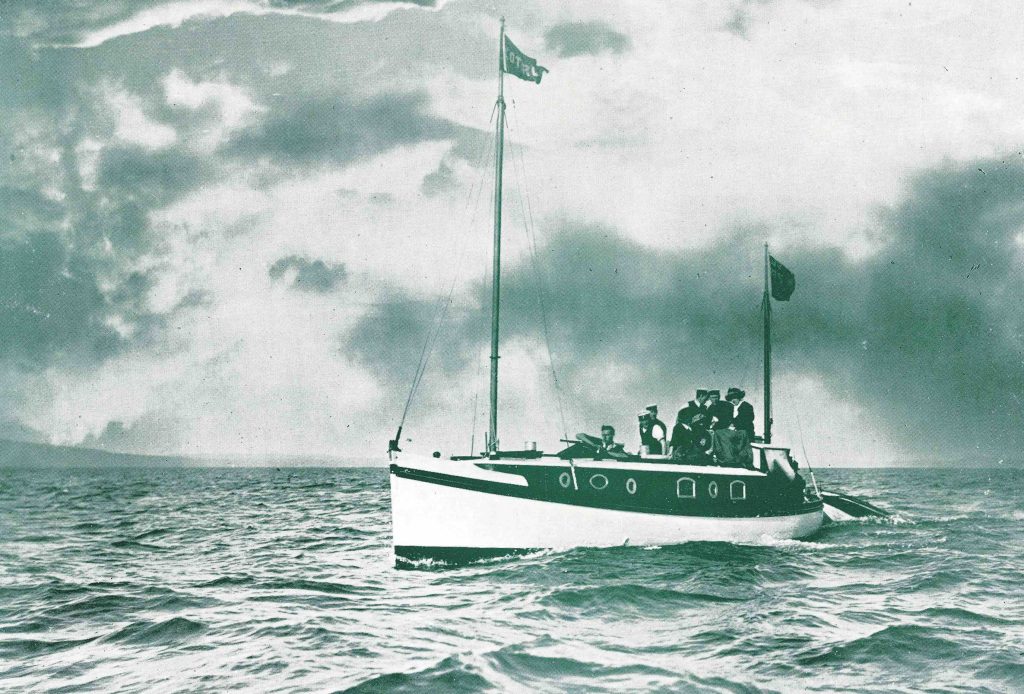
SEABIRD was built by James Reid for himself, intending to win the race. At this time Reid was in the business of boatbuilding as Central Boating Co. from a yard at Breakwater Road on Auckland’s waterfront near the Railway Wharf. His launches were considered of equal stature to Bailey & Lowe’s, although with lower volume. Seabird was a new tuck stern 38-footer with a beam of 8ft 9in and driven by a 14hp Regal engine. When first launched in late October, he jokingly referred to her as Lager (Regal backwards) but her eventual name, Seabird, was a nod to Rudder magazine’s most famous Alleyne.
Around the waterfront, she was regarded as likely to take line honours.
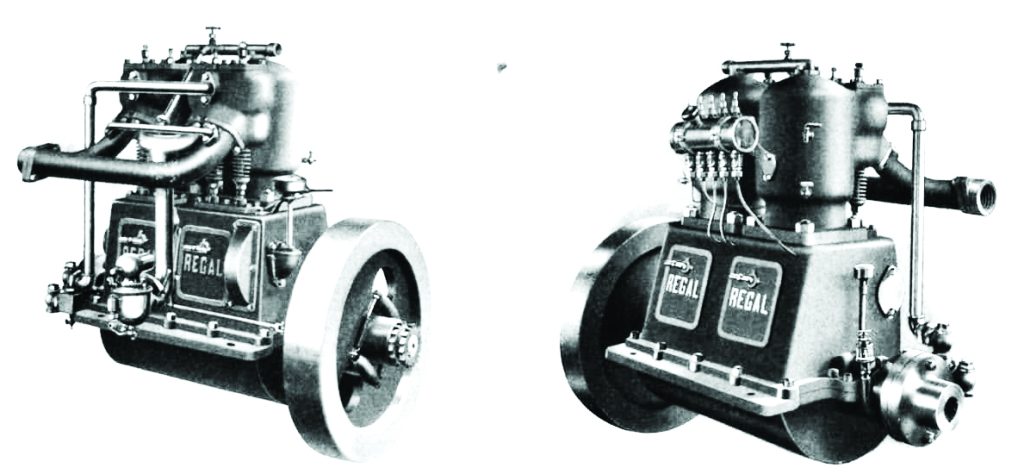
James Reid was the local agent for the Regal marine engine, another American engine with a solid reputation. Regals were built in Coldwater, Michigan, and were well made and powerful for their weight with a closed crankcase and forced lubrication. Seabird had a Model EB 14hp twin-cylinder ‘Medium-Duty’ unit, a fixed-head side-valve four-stroke with a bore of 6½ ins and a stroke of 7 ins, giving a capacity of 464 cu ins (7½ litres). It operated at 400rpm and swung a 28-in three-bladed propeller. It weighed 1300lbs with reverse gear and cost just a little more than a contemporary new Model T Ford.
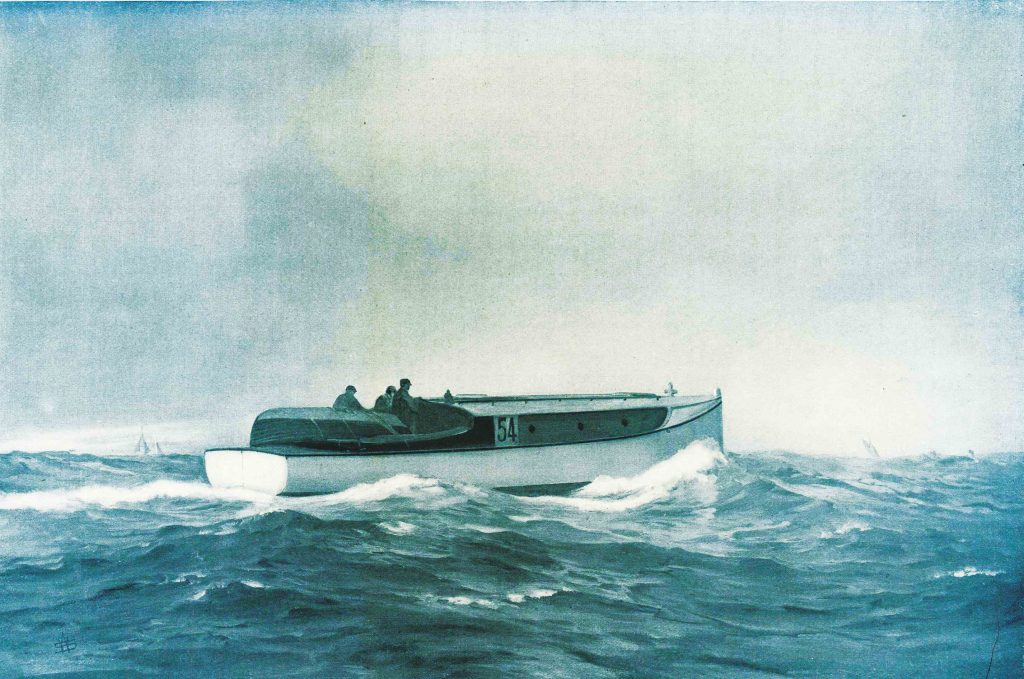

ALICE was a 35-footer built by Chas. Bailey Jr as a flagship launch for himself in May 1908. Bailey built her to replace his personal launch Laurel which he had built in March 1906. He named both boats after his daughter Laurel Alice May Bailey, born in 1894. Alice was a little old-fashioned for 1908 with a ‘turtle deck’ and a ‘torpedo stern’ but was undeniably handsome. Like the entrant Petrel, she had a Model F 15hp ‘Frisco Standard’ engine, three cylinders displacing just under 700 cubic inches. In such a lean launch she was not underpowered.
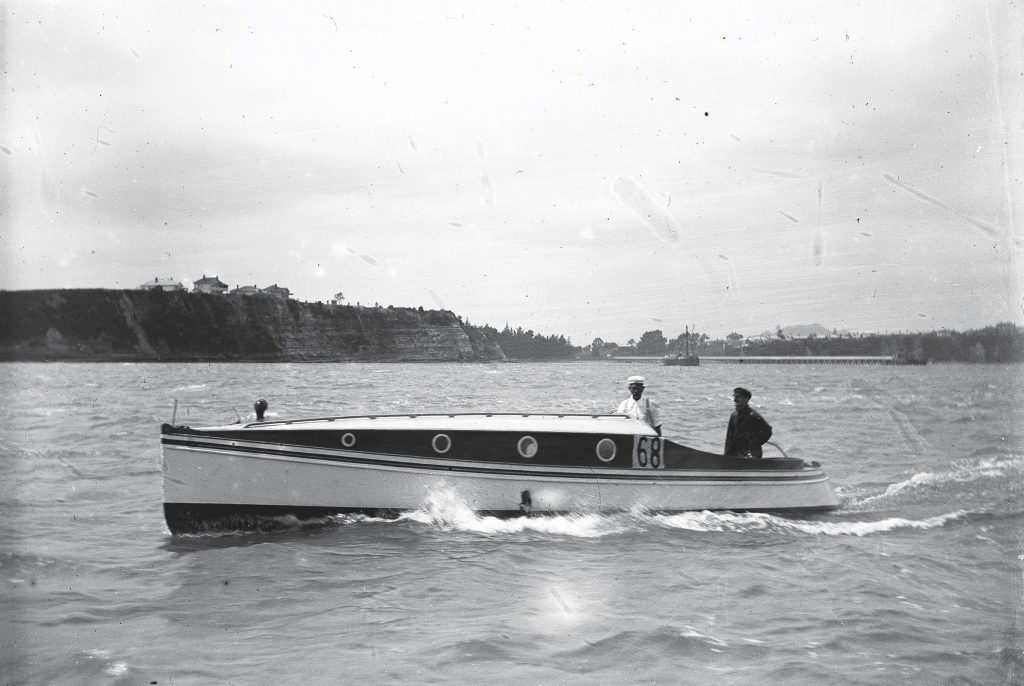
ELIZA was built for Henry Hopper Adams by Bailey & Lowe in October 1905. Adams was a colourful character, a mining engineer and speculator who owned Moturoa Island in the Bay of Islands. He used Eliza to transport produce to Auckland, so she was well set up for an ocean race in the waters she plied continually. She was a 40ft x 10ft canoe-sterned launch, originally fitted with an Oakland, California-built 18hp Atlas engine but had recently been fitted with a three-cylinder 30hp Kiwi, designed and built in Auckland by engineer J.H. Adams. Adams had been in partnership with R.J. Laird until the partnership was dissolved in May 1907. Their works were at 14 Lower Albert Street, Auckland, formerly occupied by Napier engineers J.J. Niven & Co. The big Kiwi in Eliza was undoubtedly a one-off. For a brief period around this time, the Adams company made Kiwi engines in Auckland, and a number were fitted to launches, mainly 5hp singles. We do not know how long the Kiwi lasted in production, but it was a brief appearance. Incidentally, H.H. Adams was apparently not related to the Kiwi’s manufacturer, J.H. Adams.
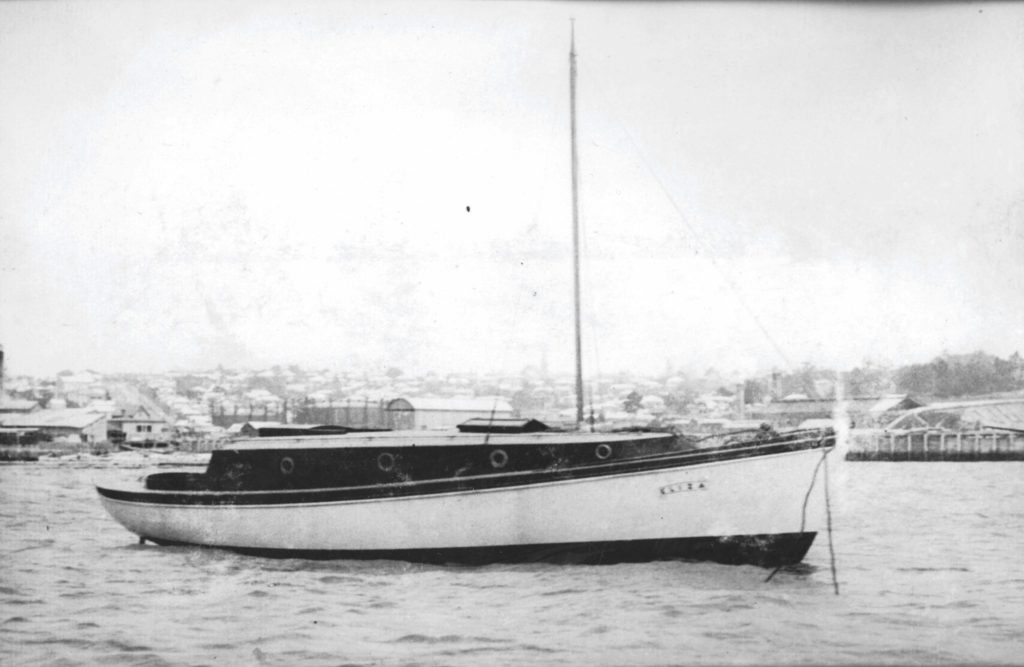
WAIPA is a mystery. She was entered by Collings & Carrigan, which raised a possible connection with Charles Collings of Collings & Bell. Charles Collings made no such claim but yet was pleased to claim in Rudder magazine that he had supplied and fitted the Doman engine in another entrant, Maroro. Since Waipa was not in Auckland before the race and disappeared from Auckland after it, it is likely she was built for work on the Waipa River. Whatever her pedigree, Waipa was the second-smallest launch in the race at 31ft loa by 7ft 2in beam and had a 10hp Imperial engine. Imperial marine engines were built in San Francisco by the Imperial Gas Engine Co from 1906. They were quite sophisticated, with a single overhead camshaft and an intricate make-and-break ignition system typical of California-made marine engines.
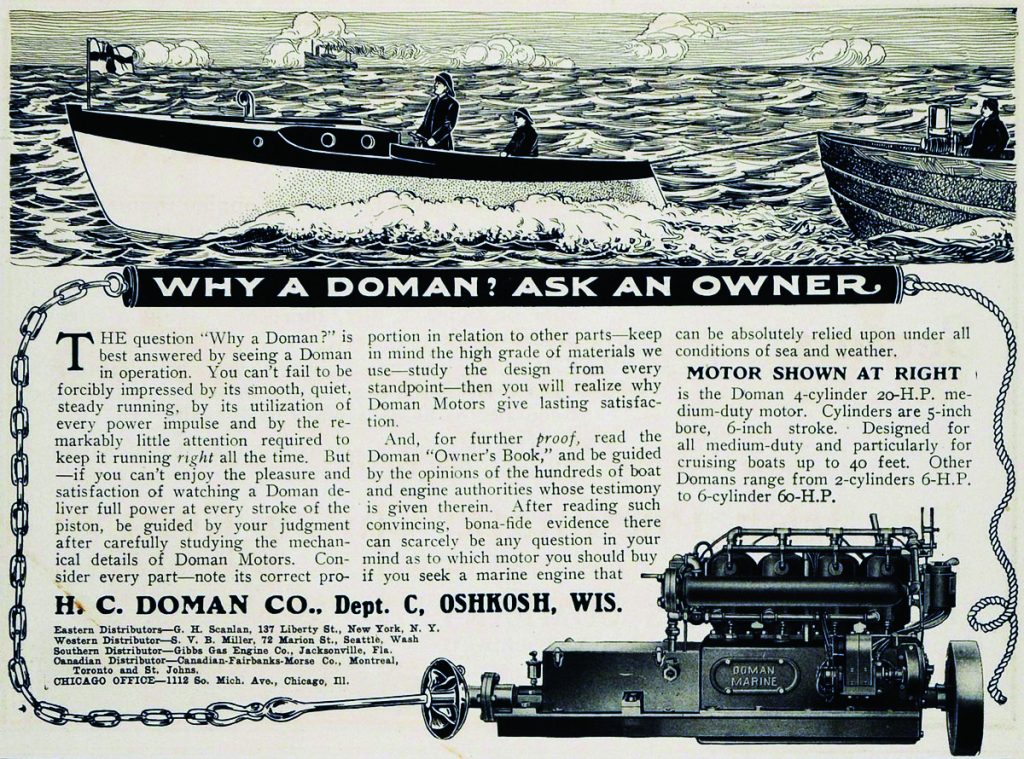
MARORO was built in December 1907 by talented craftsmen Angus Matheson and his brothers of Vermont Street, Ponsonby, to a design from Rudder magazine, for their own use. Collings & Bell supplied and fitted her with a 15hp Doman engine for which they were the local agents. At 32ft loa by 7ft 9in beam, she was one of the tiddlers in the race. She was very contemporary American-looking, quite unlike the indigenous Auckland designs. For one thing, she had a transom that was vee-shaped in plan which was briefly considered very smart on Yankee launches of the time.
Collings & Bell (or Collings & Martin as they were then) had obtained the agency for the Doman marine engine in early 1907. The three-cylinder 15hp Doman in Maroro was one of their first sales for this new US engine built by the H.C. Doman Company of Oshkosh, Wisconsin. The Doman was a T-head four-cycle engine with the cylinders cast individually. The bore was five inches and the stroke six inches to give a swept volume of 353 cubic inches. By 1914 Collings & Bell had switched agencies to the Red Wing motor built in Minnesota.
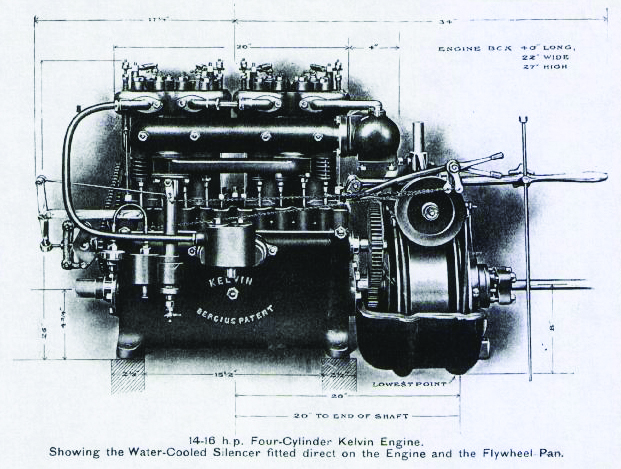
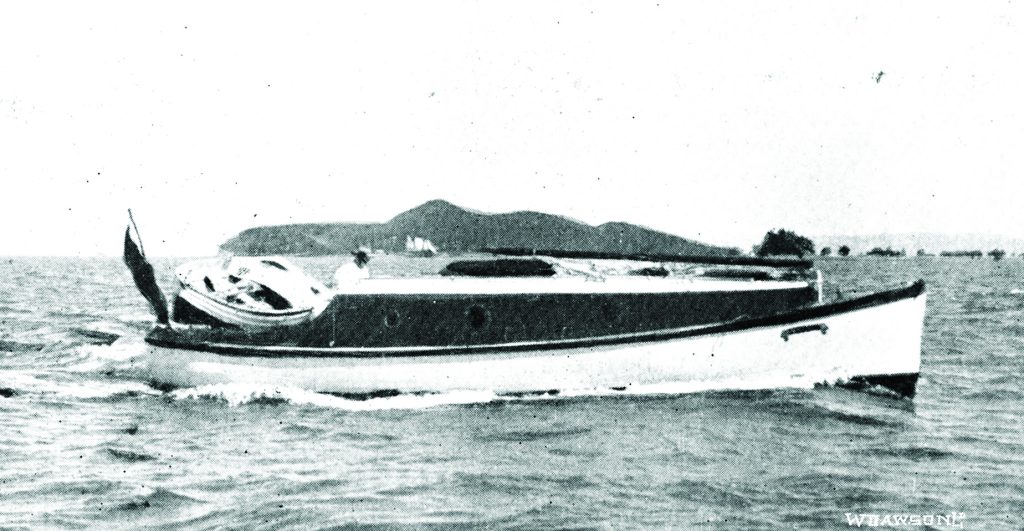
KELVIN was a 30-footer with 7ft 6in beam built by Chas. Bailey Jr for Leo Walsh, the New Zealand agent for the Kelvin engine. She was fitted with a 14hp Kelvin and launched only days before the race. She was one of at least three launches named Kelvin that Walsh had Bailey build to promote the marque, as well as at least two others of the same name built in Dunedin. This 1908 Kelvin had a deep-front separate cabin top and a ‘cruiser stern,’ in effect a canoe stern with an elliptic plan.
The Kelvin engine was built by the Bergius Car & Engine Co of Glasgow who had produced their first Kelvin motorcars in 1904. After the company installed a 14hp four-cylinder car engine in a motorboat in 1906 to great success, it developed a marine version, which was of pure automotive origins, and lighter and much more efficient than the American slow-revvers then in almost universal use here. The Kelvin engine immediately became popular with the many Scottish inshore fishing boat owners in the form of a two-cylinder 7hp and the 14hp four. The 14hp was a side-valve four-cylinder with the cylinders cast in pairs. It had a bore of 3½ ins and a stroke of 4¾ ins for a capacity of 183 cubic inches (three litres) and developed 14hp on the brake at 900rpm. The success of the Bergius Company was founded on this engine.
The Rudder Cup launch race was a showcase for the engine importers because reliability was still the biggest issue and because the cost of the engine usually amounted to more than 50% of the total cost of the launch. Eleven of the fourteen entrants had American powerplants, demonstrating the dominance of US-built marine engines in New Zealand at this time, despite the 20% import duty imposed on them compared with zero duty for British-built engines through ‘Empire Preference.’ But the little automotive-type Scottish Kelvin was showing the way to the future. BNZ
NEXT MONTH: The life and times of centerboard sailor and Harold’s good friend the late John Chapple. He will return to the Rudder Cup for the March edition.
WATCH IT HERE
www.youtube.com/watch?v=DfzdDgNzcpQ