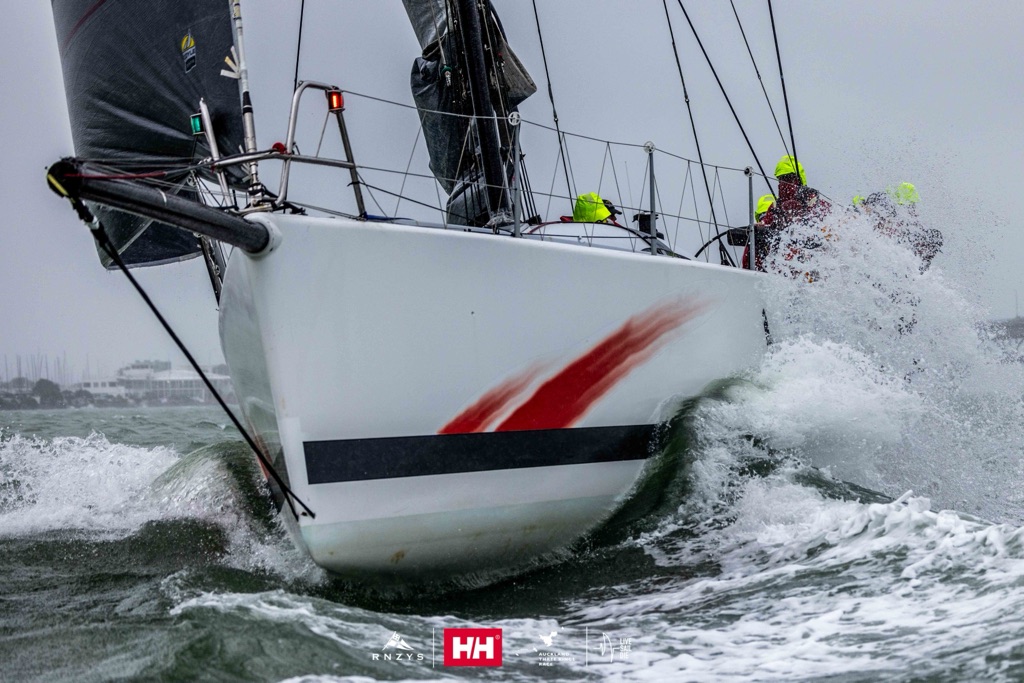
One of New Zealand’s toughest offshore challenge returns, with a compact fleet and a tight entry window still open.
The Three Kings Offshore Yacht Race is approaching fast, with the 2026 edition now less than three weeks from the start line. Hosted by the Royal New Zealand Yacht Squadron, the race remains one of the country’s most demanding offshore tests, and is recognised as a key stepping stone for campaigns targeting races such as the Rolex Sydney to Hobart Yacht Race.
The course spans 500 nautical miles. It begins off Auckland, runs north past Cape Reinga, rounds the isolated Three Kings Islands, then returns south to finish back in the Waitematā. It is a course that organisers say will test crews across the full range of conditions, from light air tactics through to demanding offshore sailing.

Entries to date
This biennual event continues to attract a mix of experienced offshore sailors and competitive club racers.
With just eight monohull entries confirmed so far, the 2026 fleet is compact but capable. Boats range from performance cruisers to outright race designs, including Equilibrium (Graham Matthews’s Marten 55), Clockwork (Steve Mair’s Shaw 12), Flyer (Mark Findlay’s Elliott 1350), and Persevere (Aaron Young’s Hanse 545).
Notably, Motorboat III (Damon Jolliffe’s Thompson 1150), Vixen Racing (Sharon Ferris-Choat’s Verdier 40), Akonga (Nick Robert’s Dehler 41), and Higher Ground (John Seely’s Ross 1066) fresh from strong offshore performances in the 2026 Doyle Sails Round North Island Two Handed Yacht Race, adds further depth to the line-up.
The smallest boat is Higher Ground, the Ross 1066; while the largest is Equilibrium, the Botin Carkeek 55 at 16.7-metres.
The standard entry deadline has recently been extended to 29 March 2026, three days from today, giving crews a final opportunity to commit. Late entries close on 2 April, alongside the release of sailing instructions.

Scoring pathways
The race accommodates a wide range of boats through several handicap systems. Fully crewed monohulls will race under PHRF passage ratings, while two-handed entries use short-handed (SH) PHRF. Multihulls—if any are to enter this year—are scored under handicaps issued by the New Zealand Multihull Yacht Club, and boats with IRC certification can compete within that system. Divisions under these categories might still take place but depend on final entry numbers.
Times to beat
Recent history shows just how tough this race can be. In 2024, only seven boats finished, while eight retired. Two years earlier, in 2022, conditions were more favorable, with 15 boats completing the race while 5 boats retired.
Wired (BW52), skippered by Rob Bassett, holds the race record from 2022, completing the course in 2 days, 3 hours, 42 minutes, and 39 seconds. This is the time to beat on speed alone. In 2024, in more shifty conditions Wired came in first again but a little under three hours later than their record, in a time of 2 days, 5 hours, 24 minutes. Still, impressive sailing.
Overall results are ultimately decided on PHRF, whether fully crewed or shorthanded. In 2024, Equilibrium, the fully crewed Marten 55, secured the overall win on corrected time with 2 days, 11 hours, 9 minutes, and 36 seconds. The smaller two-handed Dehler 41, Akonga, followed closely, finishing a tad under nine hours later on a corrected time of 2 days, 20 hours, 4 minutes, and 18 seconds. They’re both sailing in the 2026 event. The 2024 results showed just how tight the race was, with the first six of seven finishers completing the course within the nine-hour elapsed time window.
In 2022, Wired set the benchmark, winning on corrected time in 2 days, 3 hours, 42 minutes, and 39 seconds. The Shane Bellingham skippered 11.58-metre Thompson, Titanium, followed with a two-handed corrected time of 2 days, 16 hours, 38 minutes, and 5 seconds—just a tad under 13 hours between them.


A race that still bites
Despite its relatively short distance compared to global offshore races, the Three Kings course carries real weight. The northern section, particularly around Cape Reinga and the Three Kings, is exposed and often unpredictable.
For many crews, the appeal lies in that balance. It is achievable, yet demanding enough to test preparation, decision making, and endurance.
The race starts at 11am on 16 April with the warning signal scheduled for five minutes earlier. This is expected to be another tightly contested edition of one of New Zealand’s classic offshore races.