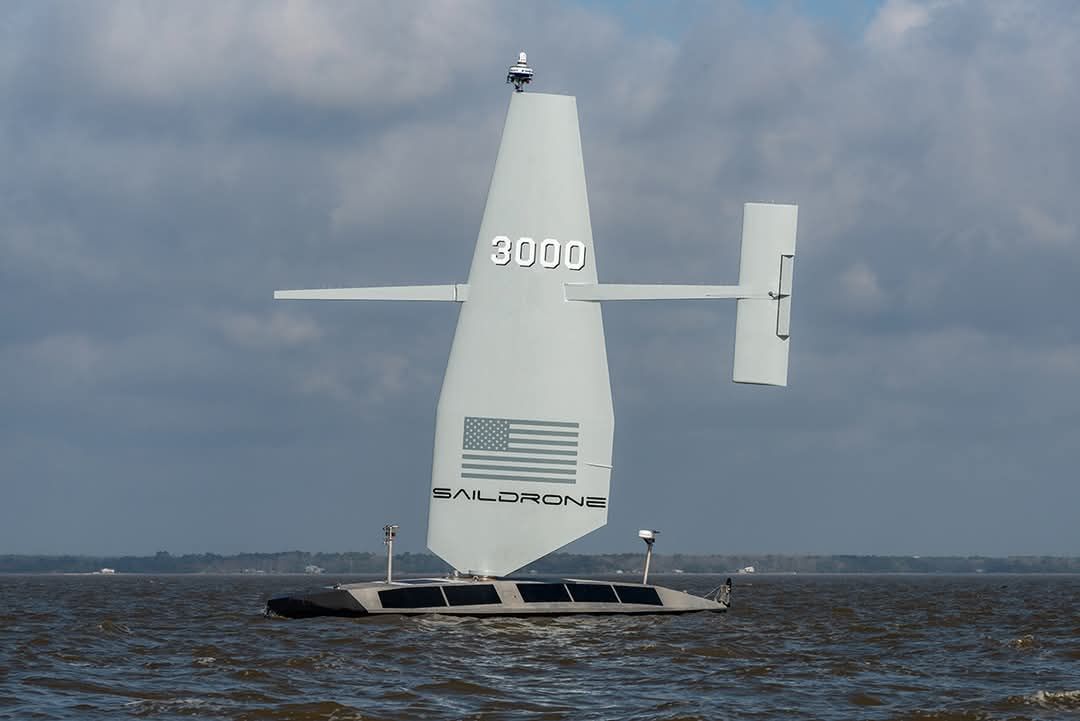
Founded in 2012, Saildrone designs, manufactures, and operates the world’s largest fleet of uncrewed surface vehicles. These vessels carry mission-specific payloads for ocean mapping, weather monitoring, maritime domain awareness, and national security applications. Powered primarily by renewable wind and solar energy, Saildrones can stay at sea for months at a time without resupply, covering vast areas autonomously.
To date, Saildrone USVs have sailed more than 1.6 million nautical miles and accumulated over 46,000 days at sea, operating from the Arctic to the Southern Ocean.
Saildrone is no stranger to New Zealand. In 2019, Saildrone achieved the first autonomous circumnavigation of Antarctica by Saildrone USV SD 1020 in 2019.
Launched from Southport in Bluff on January 19, 2019, the seven-metre (23-foot) wind-powered USV completed a 22,000-kilometre journey over 196 days. It endured extreme conditions, including 15-metre waves, 130 km/h winds, and collisions with icebergs (Saildrone Antarctic Mission Summary, 5 August 2019).

During that mission, the Saildrone collected vital data for organisations like NOAA, NASA, CSIRO, and NIWA, helping to close critical data gaps about the Southern Ocean’s role in carbon cycling and climate regulation.
This Antarctic expedition proved Saildrone’s technology could survive in some of the planet’s most hostile environments—an early indicator of the resilience the company has now adapted for security missions.
A game-changer for autonomous operations
The recent technology upgrade follows increasing threats to satellite-based navigation systems. In recent years, adversaries in conflict-prone regions have deployed GPS jamming and spoofing techniques to disrupt unmanned systems. This has particularly affected US Navy operations in the US Central Command area of responsibility, where Saildrone’s unmanned surface vehicles are tasked with enhancing maritime domain awareness.

To counter this, Saildrone engineers developed a new resilient positioning system. Instead of relying solely on GPS signals, the system uses a fusion of onboard inertial navigation systems, celestial navigation techniques, machine vision (landmark recognition), and dead reckoning algorithms to maintain accurate positioning even in fully denied or spoofed environments.
During IMX 2025, Saildrone’s Voyager unmanned surface vehicle (USV) was the only unmanned platform capable of autonomous navigation and persistent surveillance in contested waters without satellite guidance.
According to Richard Jenkins, Founder and CEO of Saildrone, the ability to continue operations without reliable satellite links is now considered essential for future conflicts.
“Satellite positioning and connectivity can no longer be relied upon in potential future conflicts. It is essential that our unmanned systems can continue to operate in denied environments, and Saildrone once again leads the way with demonstrated resilience in real operational missions with the US Navy.” (Saildrone Press Release, 25 March 2025).
Operational context and strategic importance
The upgrade comes at a time when the US Navy has placed heavy emphasis on integrating autonomous and AI-driven systems into its fleet operations. Since establishing Task Force 59 in 2021, the US Navy has pushed forward with unmanned maritime innovation within the Fifth Fleet area, headquartered in Bahrain (US Navy, Task Force 59 Establishment, September 2021).
Ongoing regional operations, including Operation Prosperity Guardian—initiated in December 2023 to protect commercial shipping from emerging threats—have highlighted the necessity for resilient unmanned systems. Saildrone’s USVs have been pivotal in these efforts, providing continuous wide-area surveillance across critical shipping lanes despite adversary attempts to disable GPS systems (Operation Prosperity Guardian Overview, US Fifth Fleet, December 2023.)
Saildrone’s new technology not only ensures the success of US missions but also represents a broader evolution in autonomous maritime technology: preparing for a future where satellite denial could become the norm in conflict zones.