Barry was the resident marine electrician at Hobsonville Marina for more than 30 years, beginning when the marina was named Westpark Marina and had only about 10 berths occupied. Barry often saw money wasted on replacement batteries that could have lasted very much longer if they were the appropriate type and correctly maintained.
Only deep-cycle batteries should be used for ‘House’ battery applications, and only starting batteries should be used for engine starting, sheet winch, windlass, etc. applications.
This article was prompted by a comment made by a supplier of auto electrical equipment with whom I frequently used to deal. After a discussion with the manager of the company about correct battery use and maintenance, the manager said, “Do you know that, of all the people who come in here and deal with us, you are the only one who actually understands how it works!”
One reason for the average auto electrician’s lack of understanding of this subject probably arises from the fact that, in the main, automotive batteries do not get ‘cycled’ (discharged and recharged) but are used for a few seconds to start the engine and are then immediately recharged and kept on charge by the vehicle’s alternator. In other words, they are almost always fully charged, which ensures the longest possible battery life.

Marine batteries and caravan batteries are used without always being fully charged. Some caravans or boats have solar charging systems, but that only provides battery charging when the sun is shining. On an overcast day the sun is often insufficient to maintain a full battery charge, and little or no charging is available at night. This means that battery discharge at night is often unavoidable.
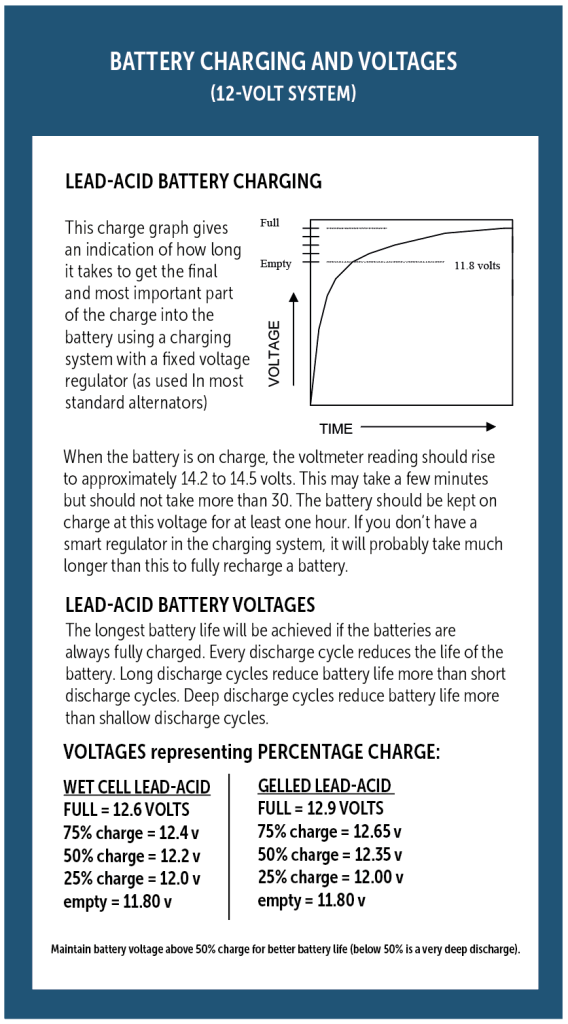
The longest battery life will be obtained by keeping batteries fully charged. Every discharge will take something from the battery’s life. Long periods of discharge will shorten a battery’s life more quickly than short periods, and deep levels of discharge will shorten the life of a battery quicker than shallow levels of discharge.
Just remember six volts is not a half-full 12-volt battery! In fact, a 12-volt battery must never be allowed to be discharged below 12.2 volts. Allowing a 12-volt lead-acid battery to go down to 12.2 volts represents a 50% discharge. A 12-volt electrical system requires at least 12 volts to operate.
Every time a battery is discharged and recharged is referred to as a ‘charge cycle’. Any battery is good for a limited number of discharge cycles. The longest-lived battery will be one that is never subjected to any discharge cycles at all – provided it is not overcharged. The longer the period of time a battery spends below full charge, the more the battery’s life is shortened. Likewise, the deeper the level of discharge, the more the life of the battery is shortened.

Periodically ensure your battery is fully recharged. Without use, some batteries discharge up to 10% of their capacity each month (flooded, or wet cell, type). Failure to keep a battery properly charged will cause sulfation, leading to a shorter battery life and poor performance.
Ensure battery terminals are clean and secure. If corrosion occurs, pour boiling water over the terminals then cover them with vaseline, grease, or a battery terminal protectant.
Battery electrolyte levels should be checked monthly. Top up with distilled water.