A world first for clean marine power
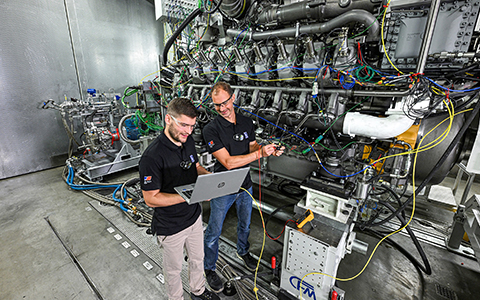
Rolls-Royce has achieved a major milestone in marine engineering, successfully running the world’s first high-speed, single-fuel methanol engine for ships. The 2,000-kilowatt prototype, tested in Friedrichshafen, Germany, is the result of the meOHmare research project, a collaboration between Rolls-Royce Power Systems, Woodward L’Orange, and WTZ Roßlau, funded by the German Federal Ministry for Economic Affairs and Energy.

“This is a genuine world first,” said Dr Jörg Stratmann, CEO of Rolls-Royce Power Systems. “No other high-speed engine in this performance class runs purely on methanol. It proves that sustainable, low-carbon propulsion with internal combustion technology is viable today.”
Reinventing the combustion engine
Because methanol does not ignite spontaneously like diesel, Rolls-Royce engineers had to redesign the injection system, turbocharging, and combustion process entirely. The company developed new methanol injectors, mixture-control systems, and adapted test-bench infrastructure to handle the fuel’s unique properties.
Early tests show the engine running smoothly, combining diesel-like performance with a far cleaner burn. “We’re now fine-tuning the response under load and optimising acceleration,” said Dr Johannes Kech, Head of Methanol Engine Development.

Methanol: fuel for the maritime transition
Green methanol—produced using renewable electricity and captured CO₂—is viewed as one of the most promising marine fuels. It’s CO₂-neutral, biodegradable, and far safer to handle than LNG or hydrogen. Although its energy density is about half that of diesel, methanol’s liquid state at ambient temperature makes storage and bunkering straightforward.
According to Denise Kurtulus, Senior Vice-President for Global Marine at Rolls-Royce, “Green methanol is a future-oriented fuel, and the technology for it is here. The next step is building the infrastructure to make it widely available.”
Bridging today and tomorrow
While methanol supply chains mature, Rolls-Royce is also developing dual-fuel engines capable of running on both methanol and diesel—offering flexibility during the transition. The long-term aim is clear: CO₂-free shipping powered by clean combustion.