The world of marine forecasting just took a significant step forward. PredictWind has rolled out three new global weather models designed to lift accuracy and deepen confidence for recreational and offshore sailors alike: PWAi, AIFS and ICON.
For Kiwi boaters planning coastal cruises, offshore deliveries or complicated passages, this is more than tech-talk. It’s about better decision-making, tighter timing, and fewer weather surprises.
What’s been launched and why it matters
At the heart of the upgrade is PWAi (PredictWind AI) — a proprietary model built by PredictWind that combines the strengths of the established heavy-hitter models from around the globe. It blends data from the European Centre for Medium‑Range Weather Forecasts (ECMWF), AIFS, GraphCast, and Fengwu. What makes it stand out for boaters is the 1-hour time-step coverage for the first 3 days of each forecast, giving finer temporal granularity than many earlier models.
Complementing PWAi are two other major additions:
AIFS: ECMWF’s next-generation AI-driven model. It excels in medium-to-long-range forecasting, helping pick up broader patterns and storm systems out beyond the usual three-day window.
ICON: The German Weather Service (DWD) global model, employing an icosahedral grid for more even global coverage — recently extended beyond Europe to full-globe availability.

Together, these three models create a new benchmark for marine forecasting: high-resolution detail in the short term (PWAi), strong medium-range performance (AIFS), and robust global physics-based coverage (ICON). For boaters in New Zealand, where weather can shift fast and terrain effects count, this is a meaningful upgrade.
Why boaters should care
Better time-step precision
Imagine departing from Auckland for Great Barrier Island or heading offshore for the Bay of Plenty run. Key wind shifts, sea-breezes, and frontal passages often pivot within hours. With PWAi’s 1-hour stepping early in the forecast, you get finer clues about when changes will occur, not just that they will.
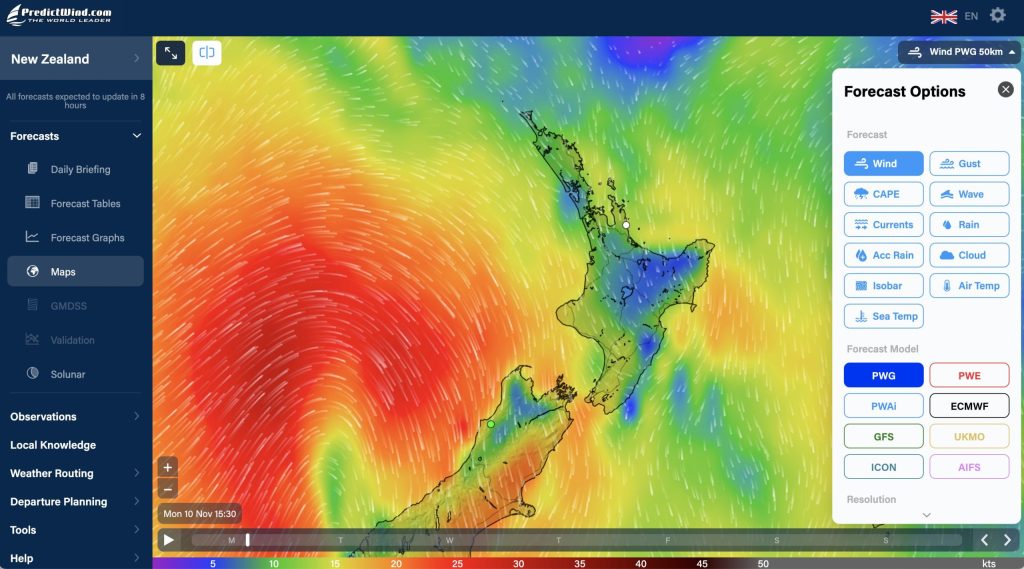
Multi-model comparison = greater confidence
PredictWind already offered numerous global and regional models. The addition of these three means you can compare outputs from models with different strengths and physics. When several models ‘agree’, your forecast confidence goes up. If one model diverges strongly, you know to probe further — ideal for critical decisions such as offshore legs or departure timing.
help.predictwind.com
Longer-range coverage into the offshore game
For those planning longer voyages or passages beyond sight of land, AIFS’s extended range (up to 15 days) helps with initial routing and weather window planning. ICON adds global consistency across regions that might not be covered by high-resolution local models, giving you a safeguard when you’re heading into less-charted waters.
help.predictwind.com

NZ coastal and terrain advantages
New Zealand’s coastal geography is complex — sounds, fjords, islands and peninsulas all play havoc with winds, waves and squalls. Having a model suite that emphasises both resolution and frequency means better detection of locally-driven weather events, funnelled winds and island-shadow effects.
A few practical pointers
Don’t rely on a single model. Use the new suite to do a “model-cross-check” — if PWAi, AIFS and ICON all point similarly, you’re in strong shape.
Pay attention to the first 72 hours in PWAi for fine-grain timing, especially if you’re making a coastal leg or departure window.
For voyages 4–10 days out, lean into AIFS and ICON outputs to spot broader system changes, then fine-tune closer in with PWAi plus regional models.
If you’re working a tricky harbour entrance or narrow passage, use the models to assess how local terrain effects may alter expected winds and seas.
The arrival of PWAi, AIFS and ICON within the PredictWind ecosystem marks a clear evolution in marine weather forecasting. For New Zealand boaters, it delivers sharper timing, broader outlooks and better tools for confidence when the sea is calling. Use the models not as a crutch, but as decision-enhancing instruments — comparing outputs, probing disagreements, and aligning your passage plan with the best data available.
With weather windows often tight in NZ waters, a more precise forecast could be the difference between smooth passage and unwanted – or unsafe – surprises.