


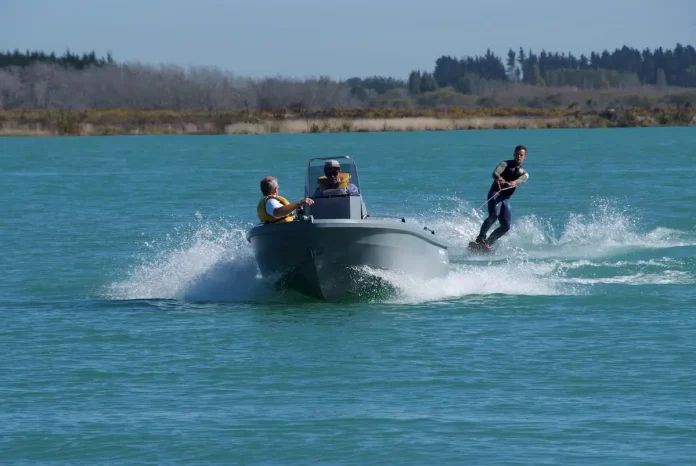
Our Smartwave 4200 centre-console came in a serious-looking but sensible battleship grey, but is available in eight different colours ranging from white through to bright primary colours.
|
Originally published in August 2014. Specifications and model details reflect that period. Smartwave’s polyethylene boats were already well established in New Zealand waters when we conducted this review more than a decade ago. Known for their toughness, buoyancy and low-maintenance appeal, the brand carved out a niche among families, clubs and coastal users looking for something practical and durable. While the range has evolved and pricing has shifted since 2014, this review offers a useful snapshot of Smartwave’s 3500, 4200 and 4800 models as they stood at the time. We have retained the original text below as an archival reference for readers researching the development of polyethylene boats in New Zealand. |
A three-way comparison
Smartwave makes great little poly boats (boats made from polyethylene plastic). We got to test three variants of this innovative plastic design.
We spent a lot of time trying to organise a boat review of the Smartwave 4200 centre console. After several false starts, we finally got around to testing this new poly boat. On the day we also grabbed two of its sibling boats: the bigger Smartwave 4800 and the smaller Smartwave 3500. It turned out to be a very interesting exercise in comparing three very similarly configured boats but of different sizes.
Smartwave Poly Boats
Smartwave makes poly boats, plastic boats moulded out of linear medium density polyethylene (LMDPE). This makes all Smartwave boats UV-stabilised, exceptionally strong, and durable.
LMDPE itself floats, and the double-skinned hull is foam-filled—so, even if the boat were to be cut in half, both parts would continue to float. All models of Smartwave have undergone CE certifications, so these are phenomenally safe boats.
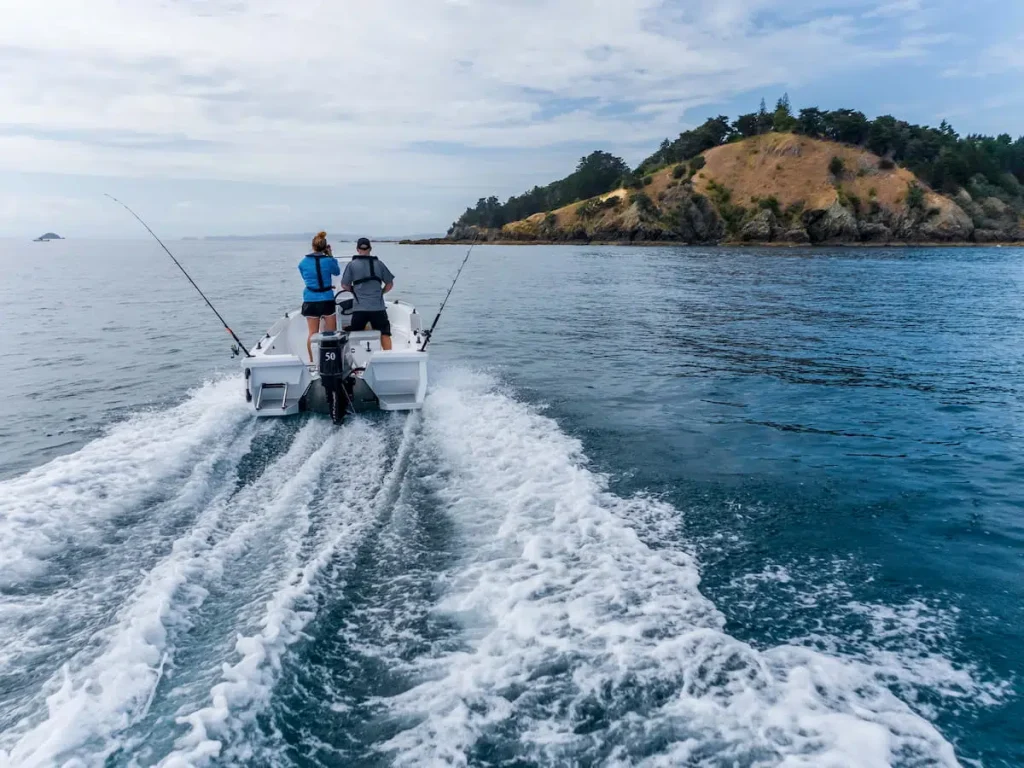
The Smartwave 4200 Centre Console
Our Smartwave 4200 centre-console came in a serious-looking but sensible battleship grey, but is available in eight different colours ranging from white through to bright primary colours. The boat was configured as a centre console fishing boat, with a large chilly bin camouflaged as a bench seat providing seating for two amidships. A tiller-steered configuration is also possible for this hull. The hull is 4.2m in length, with a maximum beam of 1.93m.
Passenger seats are moulded into the stern corners, with another double-width seat in the bow. All the seats hide further storage lockers and are topped with padded squabs. Grabrails are mounted along the gunwales and, on the review boat, a couple of Railblaza rod holders had been mounted to these.
In the bow area, a moulded anchor well holds the anchor and rode when not in use, with a roller to safely feed it over the bow. A cleat at the rear of the well provides a place to secure the rode. The flat floor inside the boat hides all the steering controls and cables, and is lined with marine carpet to ensure a secure footing even when wet.
The wide console unit sits exactly amidships, providing great stability even when lightly laden. The review boat had the engine gauges installed in the middle of the dash, but moving these to either side would create enough dash space for a reasonable chartplotter or fishfinder to be fitted. A windscreen is topped off with a stainless grabrail all around its edges, with two further handles on either side of the console to provide security when throwing the boat around.
Hanging off the back was an electric-start Tohatsu 40hp two-stroke outboard motor, a modest yet reliable little unit that well suits the ethos of no-nonsense economy and practicality. This motor is right in the middle of the recommended range of 30 to 50hp, but felt just right with two occupants. A small boarding step moulded into the hull either side of the motor has a non-slip moulded surface, with a stainless steel boarding ladder on the port side. Rod-holders are fitted into each corner of the gunwale.
Heading out from the ramp and putting the hammer down saw the boat leap onto the plane quickly and easily achieved speeds of well over 20kts. Fuel is provided in a tote tank and there is enough space to store a second tank to extend the range.
The hull is a gullwing design that provides stability and performance. At rest it behaves like a tri-hull, with the waterline width almost the full beam. This gives enough stability for the boat to be rated for five people, despite its modest size. Yet at speed, the hull lifts enough to smooth out the ride without losing stability. The hull acts to contain the spray generated by the bow, turning it down to create a relatively dry ride.
The foam-filled plastic hull absorbs most of the water noise and the boat feels smooth, safe and remarkably quiet. Throwing it around sharply was comfortable, although you need to hang on tight in a sharp turn as the gullwing does not lean steeply into the turn like a conventional vee-hull.
This is a great, safe family boat at a modest price and well worth a look.
Our verdict
All the Smartwave boats have their strong points, with very few vices. They are extremely well priced, arguably the safest boats you will ever buy and virtually indestructible.
The new design 4200 with its gullwing hull is the most radical design and has managed to pull that off well, delivering a dry and smooth-running boat. We rated the ride quality of the 4200 as being better than the 4800 although there is, of course, less space. The 3500 is definitely best-suited to sheltered waters rather than open sea, although on a good day could certainly be taken out wider.
All three have the same ultra-safe reliability due to the construction material, and choosing one to suit your budget and preferred style of boating should be an easy decision..
Highs
- Toughness of the hull.
- Great sound absorption of the hull.
Lows
- Open boats get wet in a chop.
Specifications
| Model | 3500 | 4200 | 4800 |
|---|---|---|---|
| Material | Linear medium density polyethylene with foam-filled voids | ||
| Length | 3.5m | 4.2m | 4.8m |
| Beam | 1.7m | 1.93m | 1.96m |
| Weight | 100kg | 220kg | 325kg |
| Engine hp | 30 | 40 | 50 |
| Fuel | Tote tanks | Tote tanks | 80lt underfloor |
