


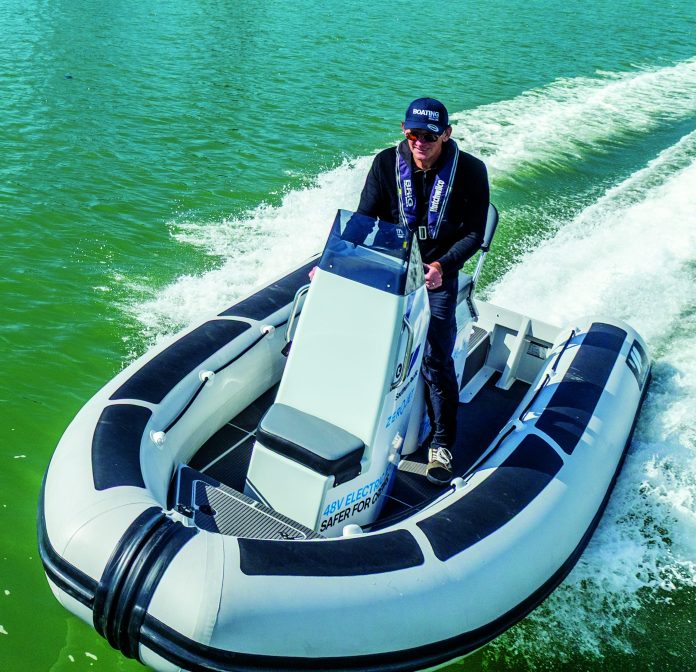
Based on the highly successful Southern Pacific Club 490 coach boat platform, Southern Pacific Boats has teamed up with ZeroJet to develop an electric-powered waterjet version of its popular RIB.
We had been trying to organise this boat test for a few weeks, but she was so in demand at sailing regattas that we have had to wait our turn. But as good things come to those who wait, a day that was convenient for all involved was eventually found. Totally lucking out with the weather, this late-autumn day dawned beautiful, sunny and warm. I was very much looking forward to driving this boat, as someone who very much supports the decarbonisation of transport in general but is sceptical of how useful electric powertrains are in boats; I was intrigued to see how the Club Electric 490 performed.
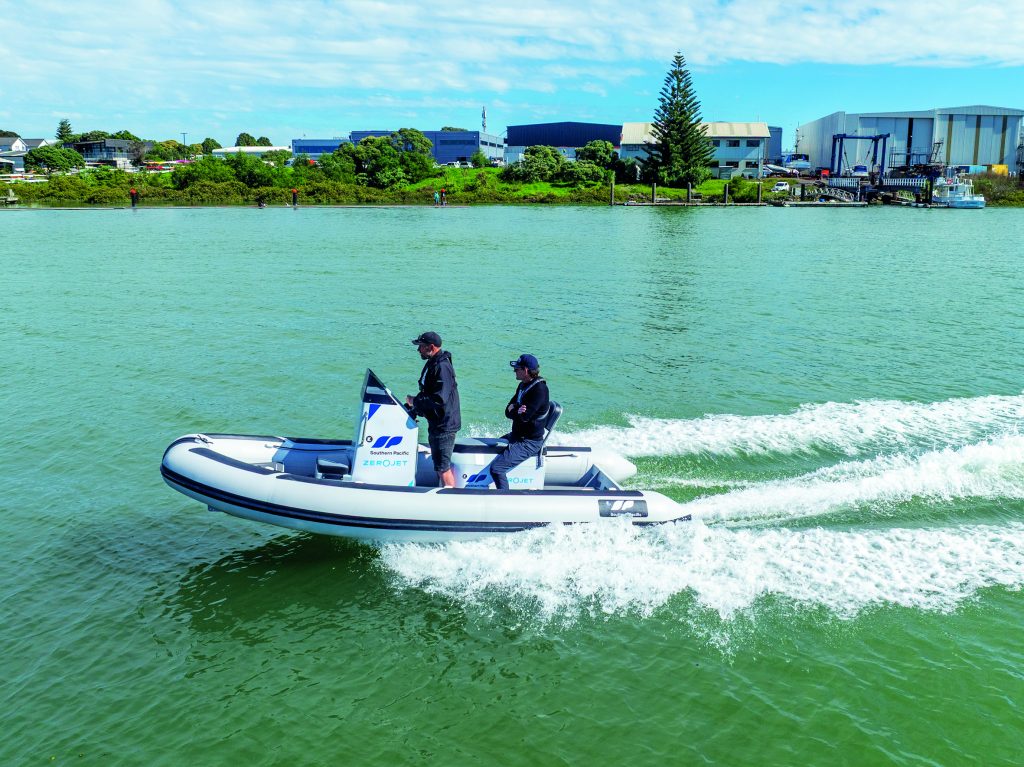
Converting the Club 490 to electric only took the team at ZeroJet about three days. Once completed, the Southern Pacific ZeroJet team’s initial testing gave them a great deal of confidence that they were onto something. But, as can be the case when creating something new, group enthusiasm can sometimes blind you to cold, hard reality. So, prudently, they have undertaken some real-world testing to get genuine feedback from the people who will actually buy this boat.
This took the form of loaning the Club Electric 490 out to some serious sailing regattas: the Murrays Bay Sailing Club’s club regatta in February, Kohimarama Yacht Club’s 2026 Girls Championships in March, Opti Nationals in New Plymouth in April and the Open Skiff Nationals in Paihia, also in April, putting the boat in the hands of the people who will actually use them. So, if you attended any of these regattas, you have already seen this boat in action.
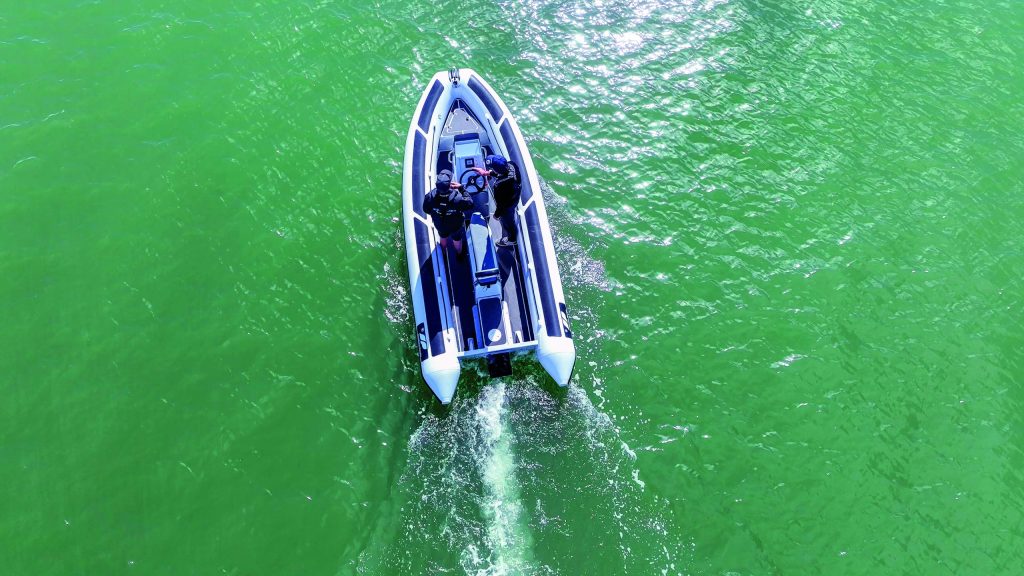
By attending these regattas, in only four short months they have clocked up 120 hours of testing – this is 120 hours of the boat actually being driven, not just sitting idling (FYI: electric motors don’t idle, they are either on or off. If the motor is not in gear, then the motor is not working, and, you are not using any electricity – apologies if I am stating the obvious). The feedback Southern Pacific and Zerojet have received has been invaluable, with much of what they have learned being incorporated into future builds. For example, the top speed of 23 knots has been identified as not quite fast enough. Development work is underway to see if a higher top speed of around 30 knots can be achieved, possibly by adding a second motor.
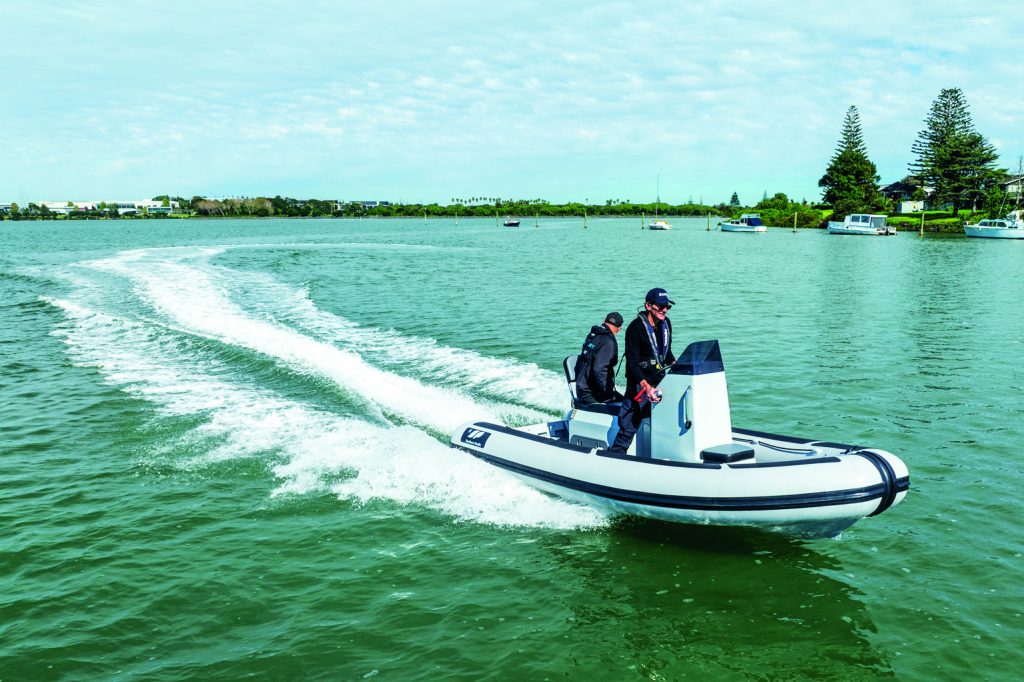
So, what is the Club Electric 490 like to drive?
Quiet – is my first impression. Norm Petersen, the Technical Sales Manager at ZeroJet, was my host, and even with wide open throttle, conversation was possible; yes, you did have to raise your voice, but nowhere near shouting to make yourself heard. At lower speeds, especially in the three- to five-knot range where this boat spends most of its time, there was barely any noise at all and speaking at normal levels was all that was required. Obviously, when in neutral, there is no noise at all.
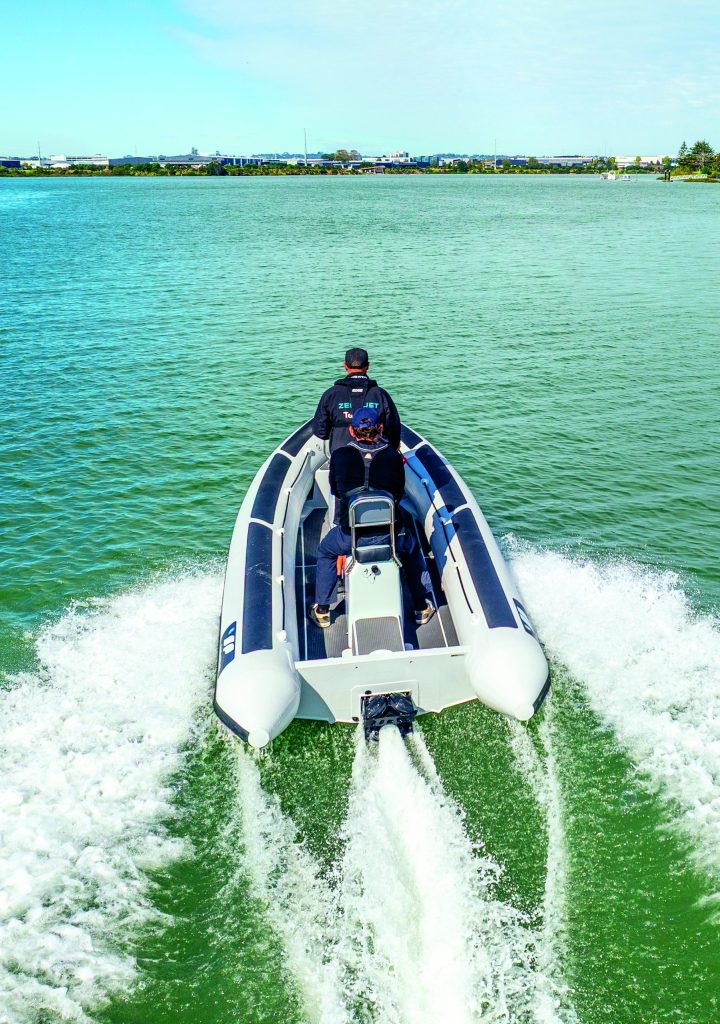
This low-to-no noise is a huge advantage in the world of coach boating and on-water regatta management. Being able to sit alongside your coachee and carry on a conversation at a normal level (or perhaps in hushed tones if there is information you are wanting to convey and don’t want other interested parties to hear!) makes the experience for all involved very easy.
And no, range anxiety is not an issue, as at five knots, this boat will travel 70 nautical miles. Yes, if you want to go everywhere at full throttle, you’ll drain the batteries quite quickly, but that is not what this boat is about.
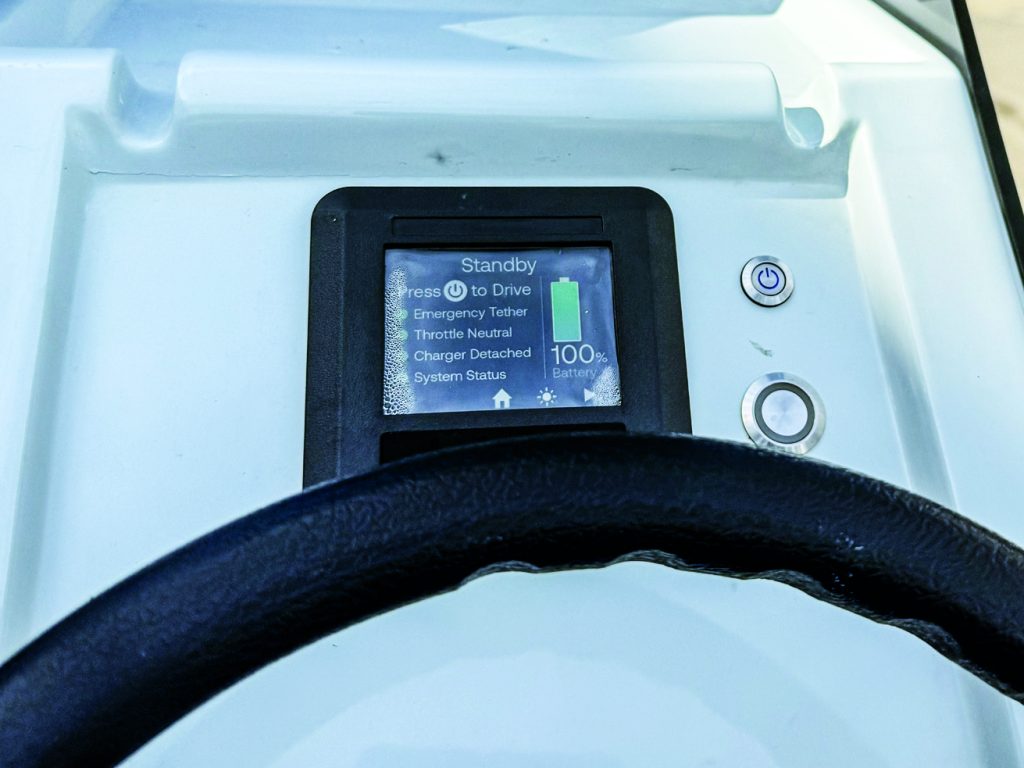 The throttle is a fly-by-wire setup electronically connected to the motor controller. Transitioning from neutral to forward or neutral to reverse is quick and smooth. No loud clunks and no concern about stripping the gearbox gears because you have accidentally gone from forward straight into reverse, as the throttle has a built-in delay giving the motor time to adjust.
Manoeuvrability: the steering was precise and smooth. You do have to adjust your steering technique with jet-powered boats, as you don’t have the outboard motor propeller gearbox and skeg working as a rudder for you. I noticed, for example, that at low speed in a crosswind or current, you need to be a bit more assertive on the helm to compensate and maintain your proper course. Also, be aware that whatever direction you were heading when you shut the power off, that’s the direction you are going. No power, no steering. This is especially relevant when coming in to dock or during low speed maneouvres around other boats. I found that if I did everything a little bit earlier than I would with an outboard and kept a tiny amount of throttle on, everything was fine.
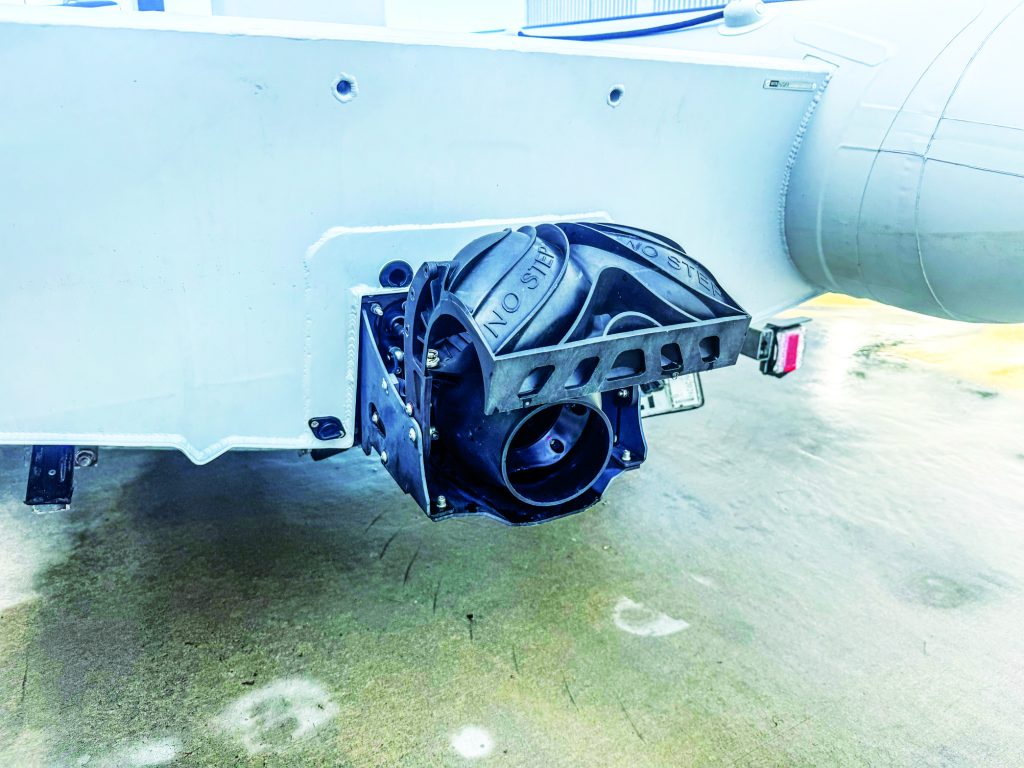
Backing up is a slightly different technique as well. The jet nozzle points in the opposite direction to the direction you steer, so in reverse, if you turn to starboard, your stern is pulled to port. This is easily solved by turning yourself around and facing the stern, when it all becomes quite natural. Thank you for that tip, Norm. None of this is a major and you adjust to it very quickly. Norm, very kindly, let me drive the boat by myself, so I did a touch-and-go to drop Norm off at a nearby jetty. I managed to pull the manoeuvre off relatively professionally and without embarrassing myself (well, Norm made no comment, anyway), and that was after only having driven the boat for about 10 minutes.
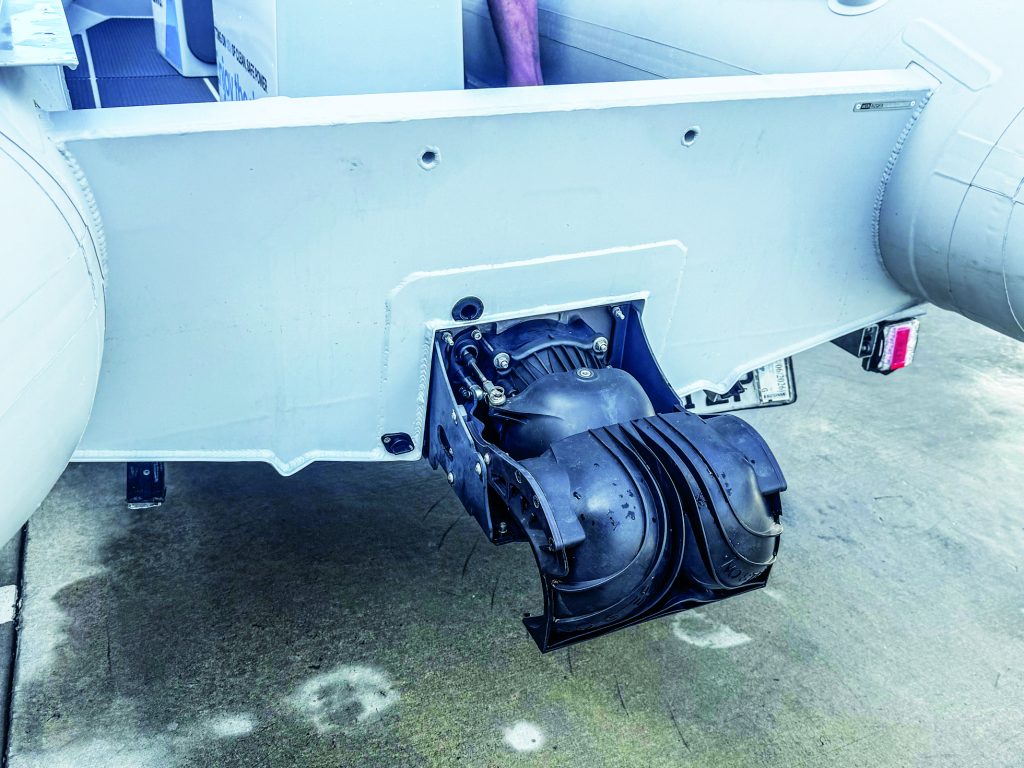
I would agree with the top speed feedback. A couple of extra knots at the top end would be useful, but again, speed is not what this boat is about; spending all day on the water on a quiet, clean and odourless boat is this boat’s strong suit.
The other major advantages of the Club Electric 490 include:
Safety: There’s no propeller, so not having to worry about a propeller must be a weight off a coach’s mind. Being able to manoeuvre up to a capsized Opti or P-Class with a child flailing about in the water, possibly in a panic, and not having to think about the boat’s propeller is just a huge advantage.
Low maintenance: Essentially no maintenance is required. The boat comes with a three-year warranty on the jet and battery as standard. And there is no need to check oil levels or continually run off to the nearest petrol station for more fuel – just plug it in to charge overnight every couple of days (depending on your usage, of course). Any standard wall outlet will do.
Shallow water access: With the Club Electric 490’s robust aluminium hull, you can essentially drive the boat right up the beach and step out onto the sand, barely getting your feet wet. It also means that navigating shallow bays and crossing reefs can be done without any fear.
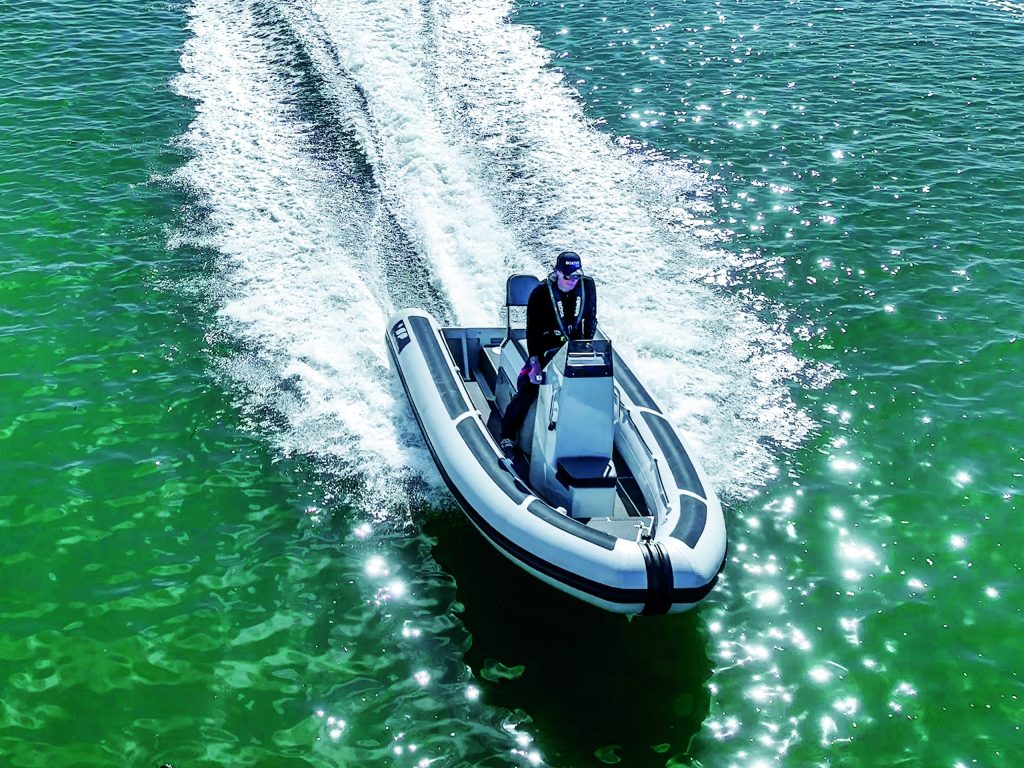
I really enjoyed testing the Club Electric 490. The advantages this boat offers in the world of coaching and small-boat regattas are clearly obvious. Be it sailing or rowing, this boat has many real advantages over its outboard motor-powered brethren. In the very near future, the Club Electric 490 will be sent overseas to gauge international interest; I am very curious to hear the reaction.
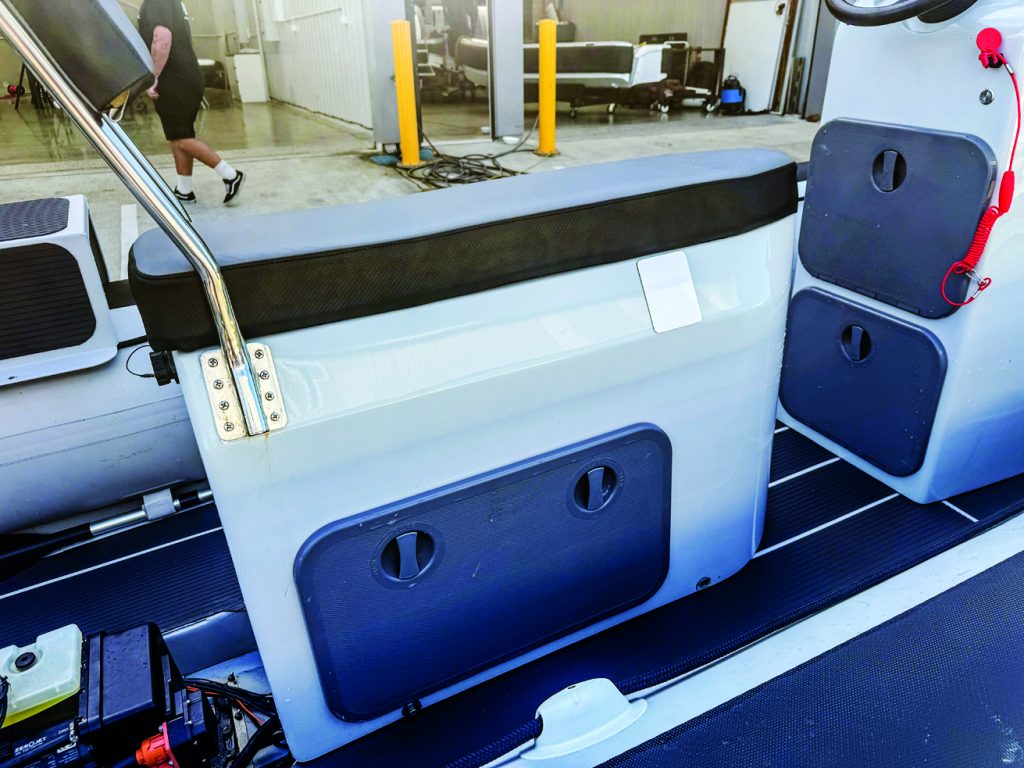
The Club Electric would also make a useful tender. With its centre console and double jockey seat, there is plenty of room fore and aft for transporting gear and space for people to sit on the inflatable tubes. Electric power also means you wouldn’t have to carry petrol on board the mothership. Plus, there’s that shallow water access advantage.
With the confidence of the well-proven Club 490 hull as the foundation, the Club Electric 490, I think, is going to be very popular.
The ZeroJet System Deep Dive
For those of you who don’t know much about ZeroJet propulsion systems, this deep dive will fill that knowledge gap.
ZeroJet is a genuine New Zealand success story, quickly becoming a world leader in the small boat electric jet propulsion market. The quality of the systems it manufactures has been recognised not only by Southern Pacific boats but also by other world-leading tender manufacturers such as AB Inflatables, OC Tenders, Highfield, Spark and Agilis.
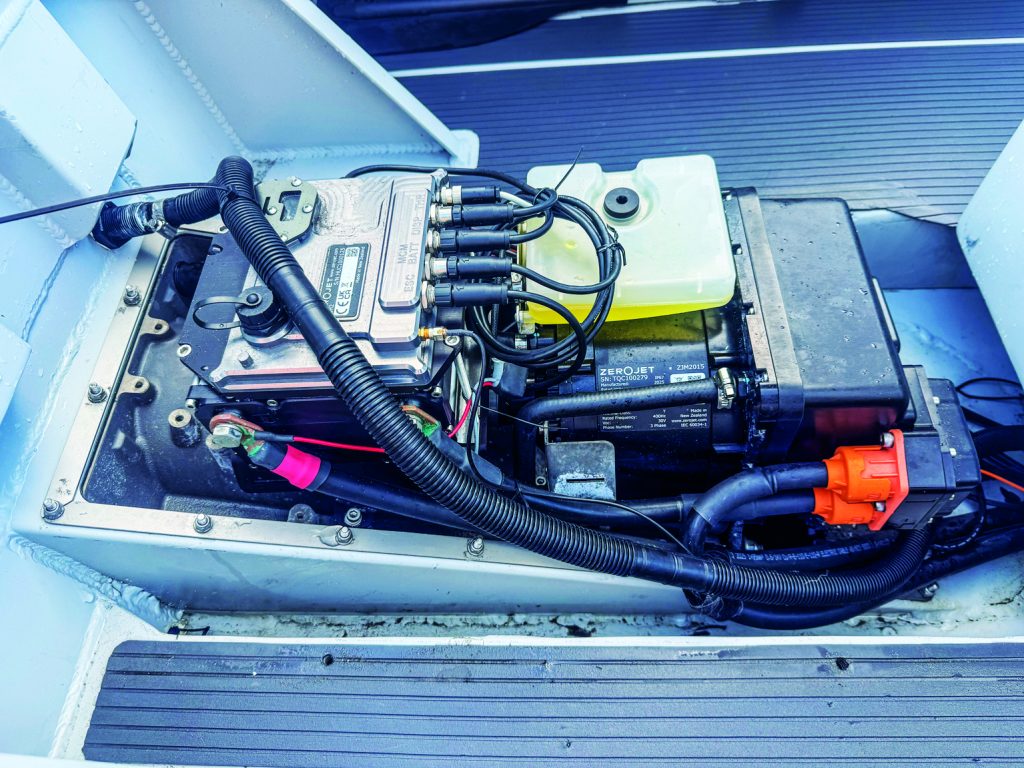
ZeroJet has engineered a complete, integrated, drop-in, plug-and-play solution that can be installed into any small boat. An experienced boat builder can complete the installation in as little as only two hours.
There are three Zerojet systems currently available: a 15 kW (20hp equivalent) for boats 2.8-4m, a 22 kW (30hp equivalent) for boats 3.2-4.2m and a 30 kW (40hp equivalent) for boats 3.6-4.6m.
The key problem ZeroJet solved was designing a low voltage, 48V (comparatively speaking), high-powered and compact system.
The advantage of a 48V system is safety. Apparently, it not only simplifies electrical integration and minimises compliance complexities, but it also significantly reduces electrical risks.
However, traditionally, the problem with a 48V system is that it lacks speed and power, and heat management is an issue, which in turn impacts the efficient conversion of electricity into motive power.
It is these issues ZeroJet has overcome. It has managed to pack a 48V motor that generates 22kW of continuous power and an integrated, highly efficient cooling system into a package that is 61% lighter and 33% smaller per kW than the competition. Effectively setting a new standard in small boat, marine waterjet propulsion.
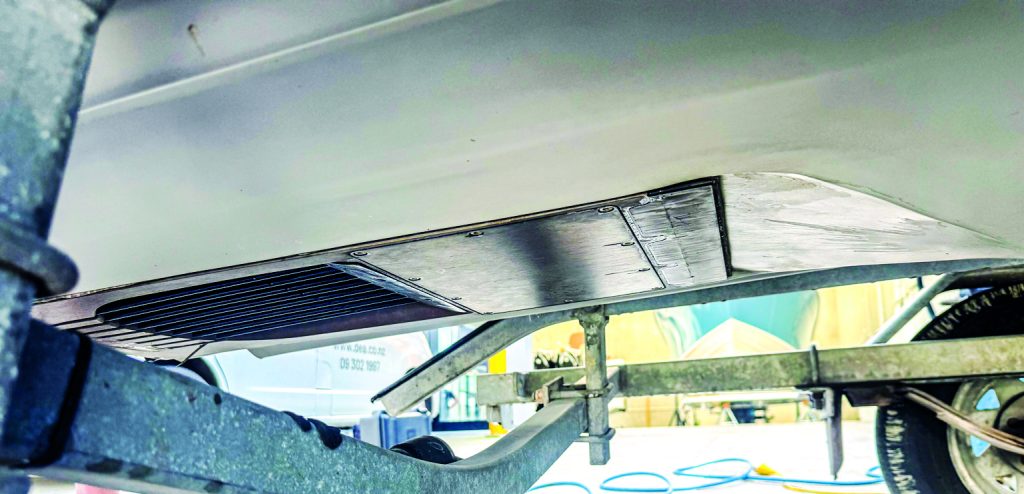
For pointing the boat in the right direction, you have the option of a tiller or wheel. A fly-by-wire helm/console throttle that gives full electronic control of speed and reverse is available, as is a 3.5-inch waterproof display that gives you all the info you need regarding speed, battery levels, range and so forth.
As mentioned, the whole system is plug-and-play. The fully integrated electric waterjet system is straightforward to install and is ready to perform, right out of the box.
Contact the distributor directly for pricing and availability.
