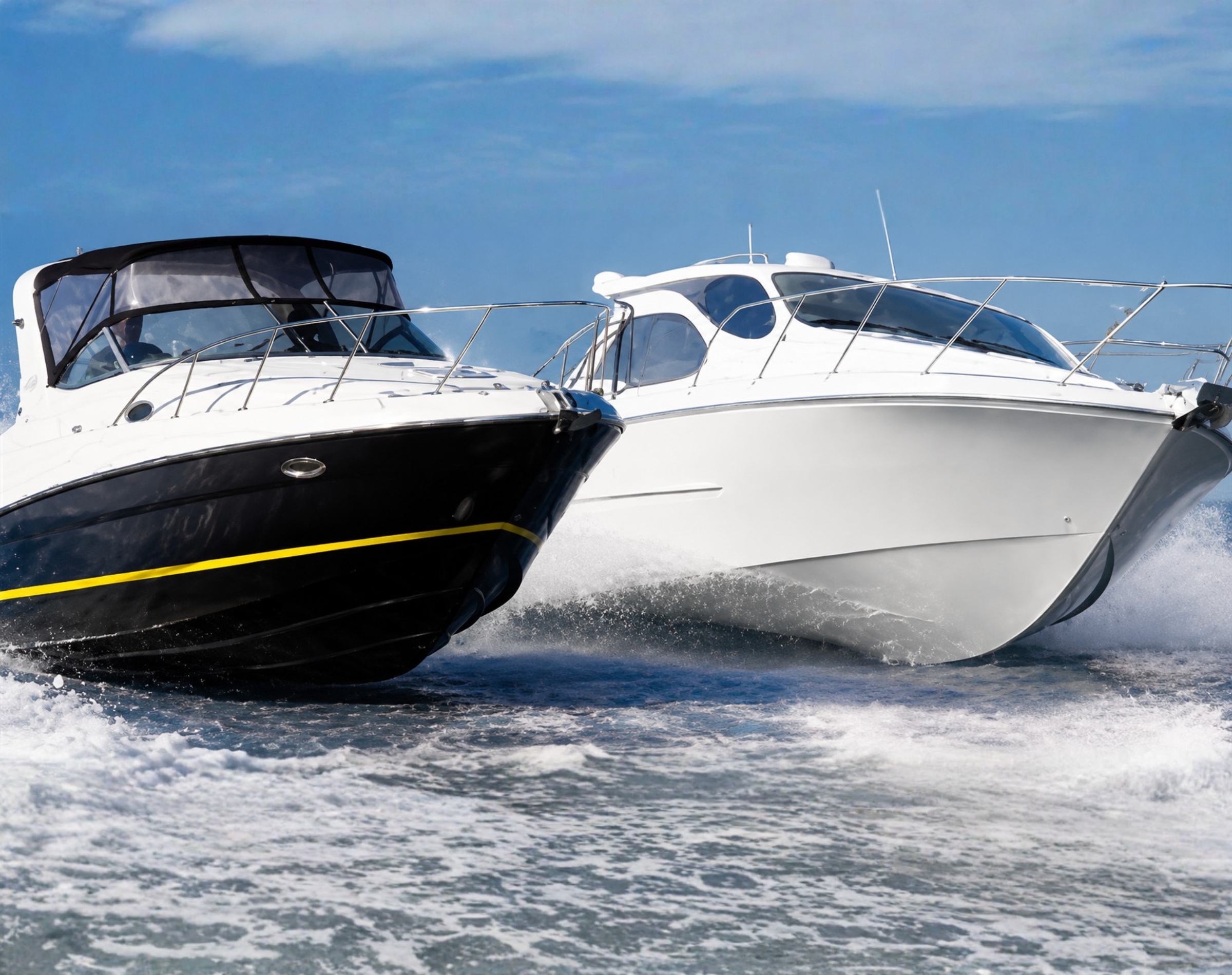
Comparing boats is something that we rarely do. No two boats are the same and where one excels in one department another might reign superior in another. Here we dabble our toes to compare boats two modern classics, which fit squarely in the used-boat market. Our discussion below refers to both boats in their original new-boat market configuration.
Two boats that are difficult to find on today’s used-boat market are the Australian-built Mariner 290 and Christchurch-manufactured Cresta 900 — the sort of boats owners tend to hold onto tightly once they have them. Each sits within a couple of feet of the other in size; when first released in the early 2000s they arrived at a similar price point, separated by only around $10,000, and they continue to represent comparable propositions for buyers seeking family-friendly cabin cruisers capable of extended weekend cruising. Two decades on, both remain highly desirable, and their differences are just as relevant now as they were then.
Both boats, however, are turn-key, self-contained live-aboard packages with similar on-the-water performance and characteristics, while being distinctly different in look, feel and design.
Design
In early 2002, Australia’s Riviera Marine Group (now Riviera Australia) began manufacturing the Mariner 290. The hull is derived from the Wellcraft 2800 Martinique. In a trans-Pacific deal, the Mariner line-up was exported to the US and rebadged as Wellcraft.
For Riviera, its convertible flybridge cruisers account for most export sales. The Mariner boats borrow the fine build quality and styling that is associated with Riviera. Thus the 290 is very much a Riviera down below.

On the surface, meanwhile, you will find fair mouldings and an interior that has the gloss and craftsmanship that is often the domain of much bigger boats. Headliners, joinery, custom-cut bedspreads, decks and hatches all fit like a glove. Yet for all its production values the Mariner 290 does not feel like a mass-produced boat.
There is a degree of individualism thanks to designer decorator packs. Light beech timber joinery down below adds a sense of warmth.
The Cresta 900 was first built by then Christchurch-based Cresta Composites Ltd. The 900 was designed by managing director Graeme McCaw as a project boat in the 1980s, though it was not until October 2000 that the first boat hit the water. The company behind it, Cresta Craft (now evolved and merged to become part of The Composite Group in Christchurch), was a household name for more than 30 years. It was formed by the late Don Kilner in the 1960s and produced plywood trailer boats up to 26 feet before moving into fibreglass construction in the 1970s.
Kilner’s original hulls, the V22 and the V26, were renowned sea boats. The V22 was historically the first trailer boat to circumnavigate New Zealand, under the command of Southland farmer Brian Pearce. Pearce went one better in the V26 and crossed the Tasman with his wife Louise in 1978.
Graeme McCaw purchased the Cresta Craft business in 1987, and by the mid-90s the company had stepped up boat production, turning out cuddy cabin boats from 4.9 to 7.3 metres.
The Cresta 900 was built with 12 interior moulds and five exterior moulds, resulting in a superior factory finish. The design has a distinctly European feel with a large curved windscreen and rounded windows set off by a shapely cabin top and gull-wing hull. The interior is beautifully appointed with soft suede furnishings, inner-sprung mattresses, moulded head linings and polished macrocarpa joinery. The ergonomic helm station remains state of the art for a boat of just 30 feet.
Engineering
On the water, the Mariner 290 feels remarkably stiff. Construction is a hand-laid glass hull is bonded and through-bolted to a foam-cored deck with a series of transverse and longitudinal fibreglass bearers for rigidity.
Boating New Zealand Insert
2002 Riviera M290 Sports Cruiser
Launched in 2002, the Riviera M290 Sports Cruiser brought big-boat comfort into a compact and highly capable package. As the smallest of Riviera’s early-2000s sports cruisers, the M290 still delivered impressive accommodation, including sleeping space for up to six, a private bathroom, practical galley and a comfortable saloon dinette.
On deck, the layout was designed around entertaining, with a twin helm seat, wrap-around cockpit lounge and wet bar creating an easy social flow. Powered by twin MerCruiser petrol sterndrives, the M290 combined sporty performance with genuine weekend-cruising versatility.
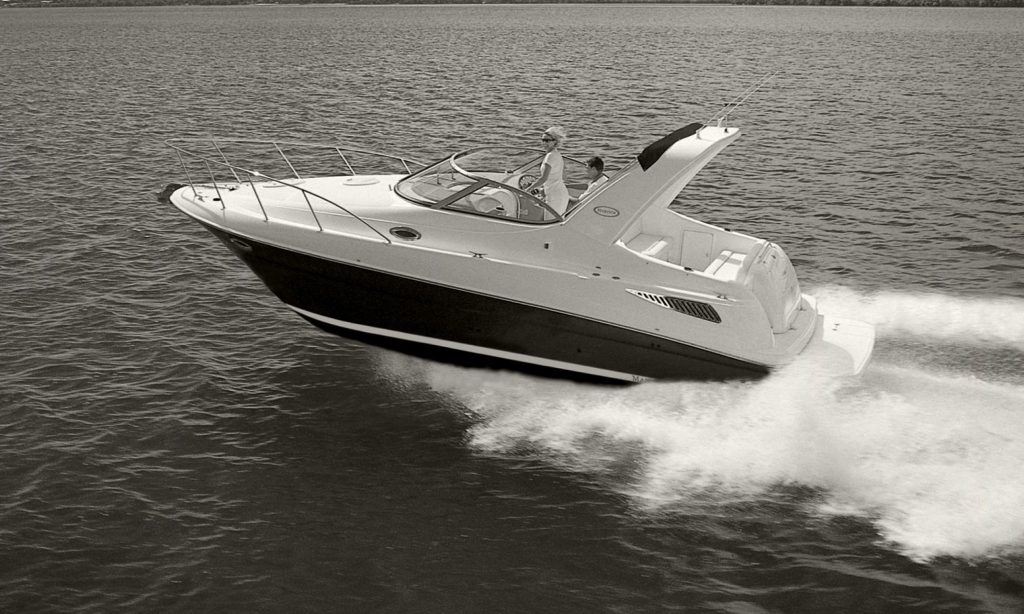
The model was warmly received on both sides of the Tasman. Australian and New Zealand boating media praised its balance of practicality, comfort and lifestyle appeal, helping the M290 achieve strong sales throughout its five-year production run.




Original Specifications
| Length overall | 9.57m |
| Draft | 0.96m |
| Beam | 3.16m |
| Dry weight | 4,000kg |
| Fuel capacity | 418L |
| Water capacity | 208L |
| Standard power | Twin Mercruiser 300hp |
| Sleeping capacity | 4-6 persons |
Learn more about the Riviera M290 Sports Cruiser at Riviera Australia
Looking for a used Riviera 290, then check out boats for sale on Boating New Zealand and on Boating New Zealand‘s sister website, Tradeaboat.
The interior flaunts the pretty curves peculiar to fully-moulded liners and a moulded floor is glued and screwed to the hull. There is a watertight bulkhead forward of the engineroom and a collision bulkhead in the bow.
The Mariner 290 has ball valves and double hose clamps on through-hull fittings below the waterline. An auto bilge pump is fitted in the engine room and forward sub-floor compartment. A carbon monoxide detector and a coded wiring loom and electrical panel including circuit-breakers are fitted for the boat’s 12V and 240V systems.
A shorepower connection and lead is built in. Hot water comes via a heat exchanger off the MerCruiser motors. There is an inverter for the microwave, 200lt of fresh water and 400lt of fuel linked to a cockpit shut-off. A 20-amp battery charger with separate engine starter rounds out a spec sheet that, even by today’s standards, covers more bases than many sportscruisers of the era.
Standard equipment also includes anchoring hardware, docking lines, fenders and a boat hook. The deck gear is solid and stylish and includes a one-piece stainless bowrail, Euro-style circular hatches, electric anchor winch, swim platform and ladder, transom lockers, fender storage, a hot and cold transom shower and an opening windscreen.
The Cresta 900 laminate is engineered by Diab, specialists in foam sandwich construction. The hull has an internal layer of triaxial glass over chopped strand mat with a foam core, topped with a second layer of triaxial glass. The cabin sides and deck are of a similar but lighter construction. The hull is stiffened with internal bearers, two running the full length of the hull, a solid glass keelson, and integral bearers every 1.2 metres.
Boating New Zealand Insert
Cresta 900
The Cresta 900 developed a strong reputation as one of New Zealand’s more capable offshore trailerable cruisers, combining rugged construction with practical liveaboard comfort. Built using a Diab-engineered foam sandwich fibreglass laminate, the hull delivered impressive rigidity and offshore confidence while keeping overall weight manageable.
Its reinforced internal structure featured triaxial glass laminates, a structural foam core, solid glass keelson and full-length internal bearers, helping create the predictable and balanced ride the model became known for. Early boats also stood out for their aggressive wrap-around windscreen styling, giving the Cresta 900 a distinctive Kiwi presence on the water.
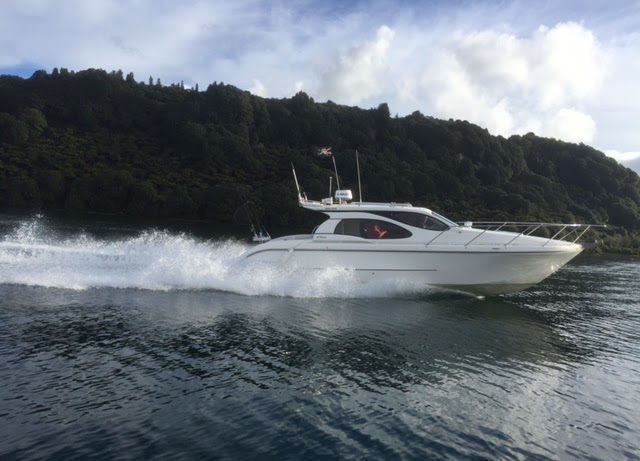
Inside, the layout comfortably accommodated up to six people with a forward V-berth and additional midship berths. Light beech timber joinery modernised the cabin, while an enclosed head, galley and hot-and-cold shower system made extended cruising practical. The model also became well known as the test platform used by Propeller Magazine during its early-2000s petrol-versus-diesel sterndrive comparison testing.
Original Specifications
| Hull length | 8.8m |
| Overall length | 9.4m |
| Beam | 2.8m |
| Deadrise | 21° |
| Fuel capacity | 475L |
| Water capacity | 250L |
| Berths | 5–6 persons |
| Headroom | 1.95m |
| Propulsion | Sterndrive, jet or outboard to 400hp |
Last we heard, Cresta Craft announced plans to revive the platform, describing it as the “ultimate offshore trailerable performance cruiser”, with production expected to recommence from mid-2024. Learn more at
Cresta Craft
Looking for a used Cresta, then check out boats for sale on Boating New Zealand and on Boating New Zealand‘s sister website, Tradeaboat.
The Cresta 900 carries 250lt of water and 475 litres of fuel in built-in fibreglass tanks. The hot water system is gas fired with gas bottles housed in an airtight cockpit locker vented directly outside. Gas and carbon monoxide alarms are fitted as standard.
The electrical wiring looms were designed and built by BEP Marine and, like the Mariner, fitted with circuit breakers. The boat carries twin battery banks and all electrical systems including the anchor windlass are 12 volt. Deck hatches are from Weaver Marine. The boat has dual bilge pumps and a self-draining cockpit. The deck gear is all solid stainless steel and nicely fitted, with one of the most robust stainless steel fairlead systems ever mounted on a small cruiser.
Outdoors
The sunroom of any sports cruiser is, of course, the cockpit. The Mariner 290 has an aft lounge for three people with a second two-person lounge fitted behind the helmseat facing aft. There is a small seat for the co-pilot and a two-person helmseat. All up, the cockpit can comfortably seat six people.
The Cresta 900 cockpit is designed more for fishing, with rod holders mounted in the stern coamings and provision for a drop-in stainless steel bait board. The hinged engine box gobbles up a bit of cockpit space but there is ample room for three or four anglers, and it can be lifted out entirely for full engine access when required. The Cresta’s toilet and shower unit is built into the cockpit on the port side, which adds greatly to the internal volume in the main saloon.
The Mariner 290 cockpit has a moulded amenities centre to port with a wetbar, sink, hot and cold water and an optional fridge. There is no shortage of storage hatches and under-lounge lockers, cockpit lighting, and four speakers courtesy of an audio upgrade.
Access to the Mariner’s twin MerCruiser engines is via a lift-out panel in the cockpit sole, gas-assisted for easy use, with ample room for engine servicing. The Cresta’s cockpit storage suits the angler, with full rod-length lockers on each side. A tackle box is built into the starboard coaming along with sealed lockers for the battery switches and gas bottles. Batteries and bilge pump are housed under the transom, and there is a full-length swim platform with dive ladder built into the portofino stern.
The Mariner 290 has a moulded footrest in front of the captain, along with a moulded beige dash with mock-burl panel. It was originally fitted with engine gauges, compass, depth sounder, stereo remote and VHF radio. Backlit switch panels beneath the timber sportswheel operate everything from the wiper to the anchor winch. On the used market today, it is worth verifying that electronic upgrades have been kept current.
The head is the kind of bathroom you expect in a much bigger boat. The moulded head unit to port comes with a Vacuflush toilet and holding tank, moulded Granicoat vanity and sink and a practical handheld hot-water shower.
The Cresta has an electric flush chemical toilet with a cassette that slides out of the bulkhead for easy management. Below deck, the Mariner has lots of light beech timber and a Granicoat benchtop in the galley with a meths cooktop, microwave oven and 12/240V fridge. There are sufficient cupboards for crockery, cutlery and basic cooking utensils, with pantry space boosted by cupboards opposite the galley.
The Cresta’s galley runs along the starboard side and features a full-size four-burner oven and grill, 70lt 12-volt fridge, large stainless steel sink with hot and cold running water, two large galley cupboards and sliding racks under the sink, a pot cupboard under the stove, two large lockers above, and further stowage opposite.
Waterfront apartment
Both the Mariner 290 and the Cresta 900 offer scaled-down, apartment-like living. Their open-plan interiors provide headroom throughout. The only tight spot on both boats is access to the aft cabin in the Mariner and the mid-cabin in the Cresta.
The aft cabin on the Mariner is accessed by tucking in beside the companionway stairs leading from the cockpit. The cabin is not huge, but once inside there is enough room for a couple to sleep. Access to the mid-cabin on the Cresta is easy, but the berth itself is quite small. It is more likely that the kids will bunk down in these cabins. The doubles on both boats are in their respective bows, though the configurations differ. The double in the Mariner runs crossways and is more round than rectangular. The double in the Cresta is a standard vee berth with an infill squab. Sitting headroom in both boats is ample.
Both the Mariner and the Cresta cater for additional guests via saloon tables that drop down to form doubles, boosting the boat’s sleeping capacity to six.
Ridelines
A big difference between the Mariner and other sportscruisers of its era is the ride. While many sportscruisers were big-volume boats, the Mariner 290 is not too full up front. The reason for a full bow is, of course, to provide space for a double berth. While the Mariner 290 has a good-sized double in the bow, it has not compromised the boat’s entry under the waterline, ensuring both a soft and a dry ride.
The Cresta 900, by virtue of its trailer-boat origins, has a very fine entry and thus an equally dry ride. The Cresta’s dryness is further aided by an aerofoil mounted on the rear of the cabin top which forces air down and out of the cockpit, taking with it any backwash spray. This unique feature works extremely well, allowing the cabin door to remain hinged open at all revs. The gull-wing hull also makes for a stable ride with only minimal lean as the boat is pushed through tight turns.
The Mariner 290 has plenty of get-up-and-go and quite sleek lines. It is a well-proportioned boat that will appeal to everyone from the young at heart to retirees. Originally, powered by twin MerCruiser 4.3L EFI 210hp petrol motors and Bravo 2 legs, the Mariner 290 is a snap to park. Ease of handling, a very full spec sheet, and the sheer joy of twin-engine grunt when you plant the throttles remain compelling arguments on the used market today.
With the leg trimmed in, the Mariner 290 lifts only slightly and was predictable and stable throughout the entire rev range. The steering is light and positive and the twin spray rails were effective in keeping spray at bay. The boat feels much bigger than its 8.7m hull length and would, with a little trim practice, cope with some fairly serious weather.
The Cresta 900 was originally powered by a Volvo 5.7-litre GXI V8 petrol engine producing 315hp through Volvo’s duoprop sternleg. This engine was well suited to the hull and has serious get-up-and-go when pushed through 4000rpm. With the engine mounted in the cockpit, noise insulation is impressive, with little more than the low and discernible growl of the big V8 entering the saloon with the cockpit door closed.
Because the Cresta 900’s beam was pre-determined by road rules, trim is an important element in its handling characteristics, though the boat trims very well with only slight adjustments required to keep her running straight and true. Hydraulic steering makes helming a breeze. The wrap-around windscreen and rounded cabin-side windows give unrestricted 360-degree vision both when at rest and at play.
The beauty of the Cresta lies in its dual-purpose function as a luxury weekend cruiser and a stable fishing platform. Few boats of this size provide adequate facilities to accommodate both demands. The Cresta does, and it does it in style. It also carries the considerable advantage of being trailerable to inland waterways, and at an all-up weight of 3300kg on the trailer it is road legal, requiring serious 4WD towing power. The boat slips on and off its trailer more easily than anticipated.
Both boats are now in the New Zealand used-boat market. Finding a good example of either requires the usual due diligence, with particular attention to engine hours, the condition of through-hull fittings and shaft seals on the Mariner’s twin legs, and the integrity of the foam sandwich laminate on the Cresta. Neither boat was built in huge numbers, which means well-maintained examples hold their appeal among buyers who know what they are looking for.
While both boats are uniquely different in look and feel, they offer similar qualities in terms of accommodation, performance and the kind of on-the-water character that simply does not date.