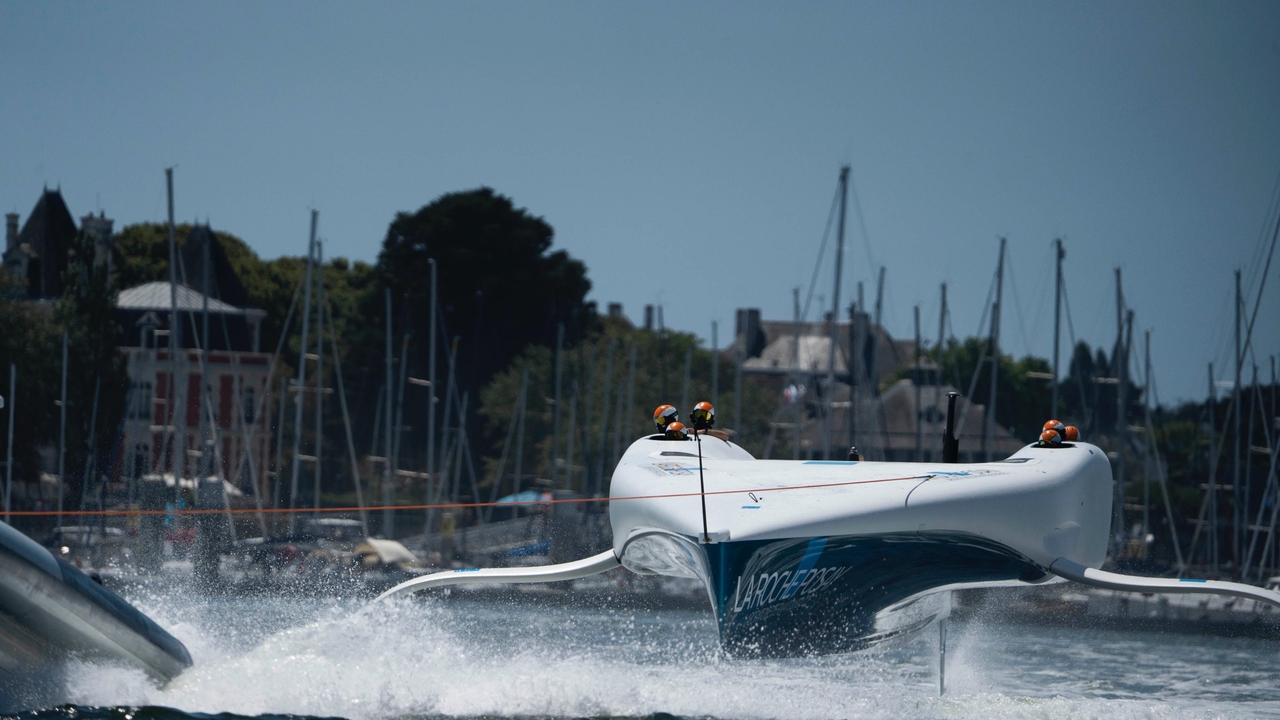
Revealing a stunning new livery, La Roche-Posay Racing Team today splashed their upgraded AC75 for a tow test having spent the end of last week doing stress tests and systems checks ahead of the first full sail planned for Tuesday 30th June.
It has been a busy period for the team, and the result is that they will become the third AC75 in this cycle to sail, joining their sister ship Taihoro of Emirates Team New Zealand and Luna Rossa who are both well into their work-up programmes.
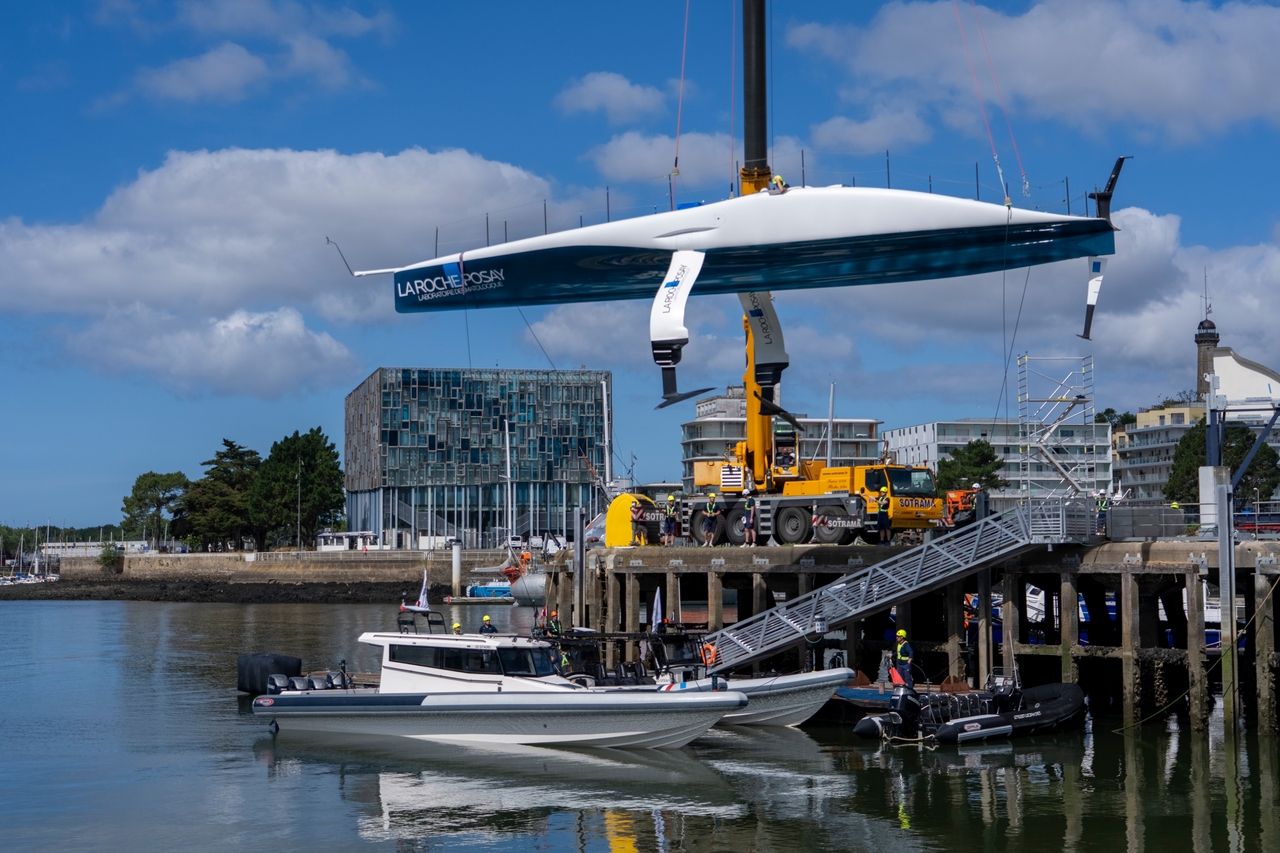
The on-site recon teams have made several observations around the technology with a particular mention on the wings and rudders saying: “The starboard foil wing and flap appear consistent with the Barcelona 2024 configuration, retaining winglet tips with the flap running to the tip end. The port foil differs: the tip carries no winglet but instead a flat grey piece that appears separate or modular from the rest of the wing, with the flap terminating at the junction with this piece rather than continuing to the tip. This arrangement suggests the tip piece may be interchangeable to trial different tip geometries, the port and starboard asymmetry potentially allowing a new tip geometry to be evaluated on starboard tack against the Barcelona 2024 geometry on port tack. The remainder of the foil wing, flap, wing to bulb junction and foil arm fairings show no apparent change. The rudder elevator appears broadly similar to Barcelona 2024. The shaft, however, shows a different profile near the top, with both the leading and trailing edges appearing incurved compared with Barcelona 2024.”
On the tow test today, Quentin Delapierre and Diego Botin were sat in the helm positions with Florian Trittel and Jason Saunders in the trim and flight control positions. The tow test lasted for approximately 90 minutes, broken down into three separate sessions as detailed below.

Speaking afterwards, Antoine Carraz, Technical Director of the La Roche-Posay Racing Team said: ”A launch is always a special moment. For months we’ve been working on plans, simulations, parts and systems. On the day the boat returns to the water, all these elements must work together. It is both the culmination of an initial phase and the start of the real validation work.”
“Externally, the public will recognise the 2024 boat. But technically, this is not simply a refurbishment. We’ve had to rethink its internal architecture and the way the crew interacts with the vessel. The challenge was to radically transform the boat whilst retaining its original platform.”

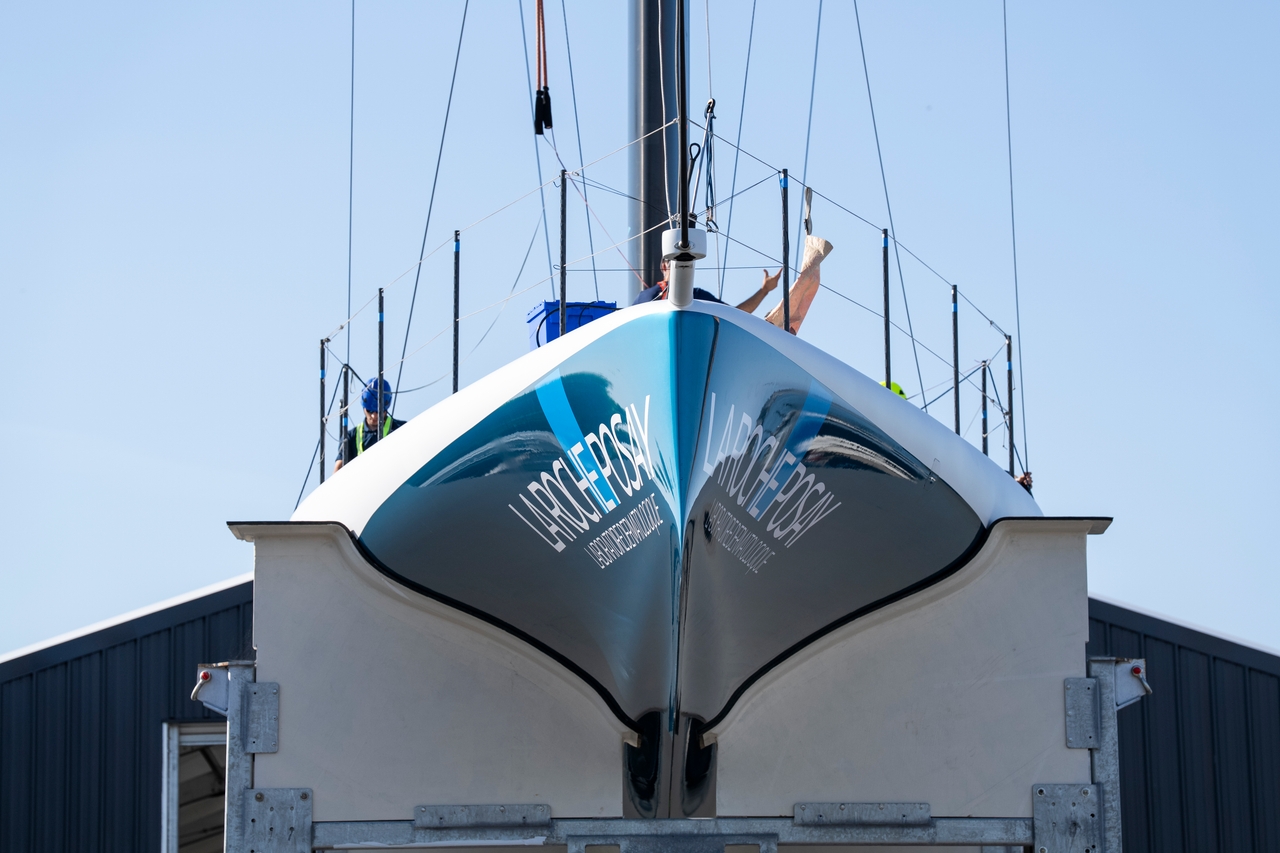
All eyes on Tuesday and a potential first sail. France are back in the America’s Cup and looking sensational.
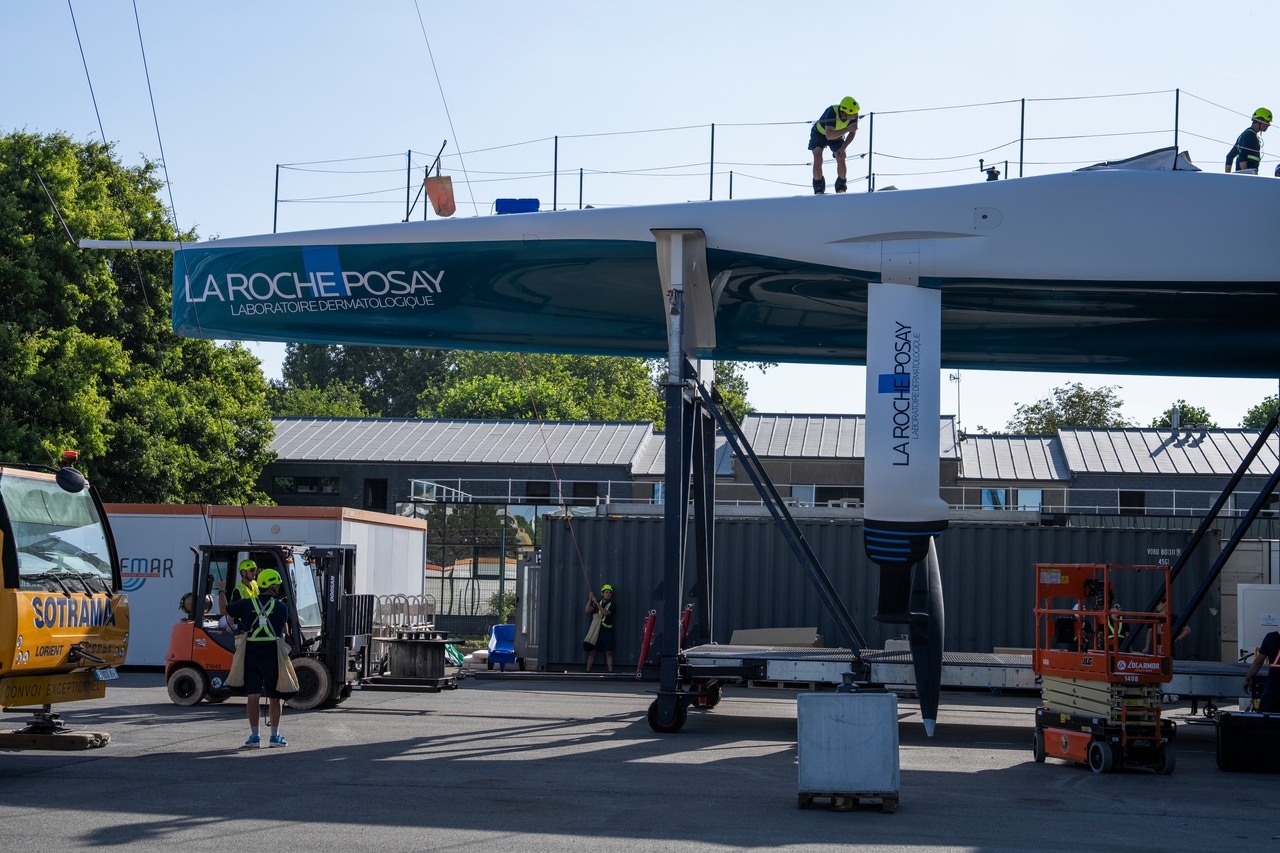
On-Water Recon Report: The plan for the day was a tow test of the boat, its first launch in Lorient for AC38, with dock-out scheduled for around 11:30. As the first time the AC75 had been craned at the Keroman site, much of the morning went on the launching routine itself, the team working out crane and trailer positioning.
The boat rolled out at 10:30, the guardrail stanchions lowered and reset once clear of the shed door. It was fitted with both foils and the rudder, the rudder at full forward rake and touching the hull at roll-out. The anti-ventilation fences on the lower foil arm fairing, taped over on D2, were now exposed, and a white mark was noted at the bottom end of the lower fairing, possibly a visual reference such as a ride-height mark. The rudder shaft appears consistent with the Barcelona 2024 configuration, the leading and trailing edges curving outboard and then inboard at around a quarter of the span from the root. This suggests the rudder fitted today differs from the one seen on D1 and is similar to the AC37 rudder.
The boat was craned in on four slings and lowered into the water, the slings released at 11:22. Four crew were in the pods during the lift, and the foils were cycled through their range while craning, which appeared to be for clearance during handling.
At the dock the deck remained largely covered, the jib track not visible, though the main traveller and the double mainsheet system, sheets rigged, were in view. The former aft pod positions remained visible on the deck. Technicians worked from laptops on deck and below, running a sequence of systems and instrument checks. The foil cant system was cycled repeatedly, the boards raised and lowered, the boat heeling each time a foil was lifted fully clear of the water, on both sides.
A dock briefing preceded dock-out at 12:42. The boat was towed out under a short towline and, before any foiling, carried out two towline-release tests at around 7 knots with both boards down, one to port and one to starboard.
The first foiling run began in the channel and ran out toward the bay, towing from 12:52, the boards canted up until the wings were horizontal at 13:02, foiling by 13:11, and a stop with tow release at 13:17. Through this run ride height and pitch appeared fairly stable, the hull skeg grazing the surface, with some bow-down trim toward the end. The boat then stopped and the foil cant system was cycled again on the water. Two further foiling runs followed in Lorient bay, a short one from around 13:50 and a longer one between 14:08 and 14:22, the last finishing back in the channel close to the dock. On these later runs the pitch appeared irregular early, the boat pitching fore and aft, before settling to a mostly slight bow-down trim, which would be consistent with flight control and flap testing. Antoine Carraz, Technical Director, pointed to this testing in the post-session interview.
The boat docked at around 14:30 and was lifted out at 15:03, returning to the shed at around 16:00.