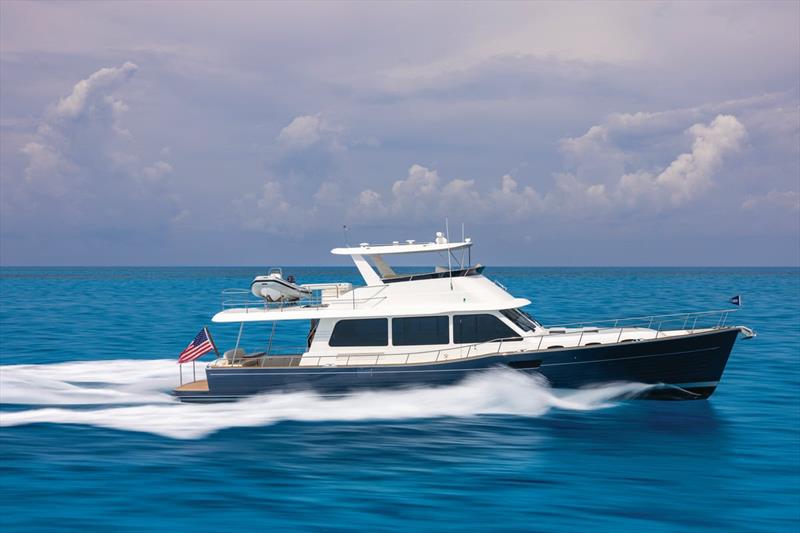
Grand Banks developed V WARP Technology to combine long range with cruising speeds more usually associated with conventional planing motor yachts.
One of the first things you notice driving a Grand Banks 60 is how little happens when the throttles go forward. There is no great climb onto the stern and little bow rise. The boat gathers speed, lifts and settles into a remarkably flat running attitude.
We saw it when Boating New Zealand tested the original Grand Banks 60 in Sydney in 2017. The boat displaced 29 tonnes, yet accelerated cleanly onto the plane. At 21 knots in a 1 to 1.5 metre Tasman swell, there was little movement from the bow and the ride remained soft and dry.
Two years later, our GB60 Skylounge test produced much the same result. There was little discernible bow rise and the boat would remain on the plane at relatively low rpm.

Power & Motoryacht measured it more precisely during its own GB60 testing. At around 11 knots it recorded just 2.5 degrees of bow rise, with little change in running angle as speed increased.
So what is happening underneath?
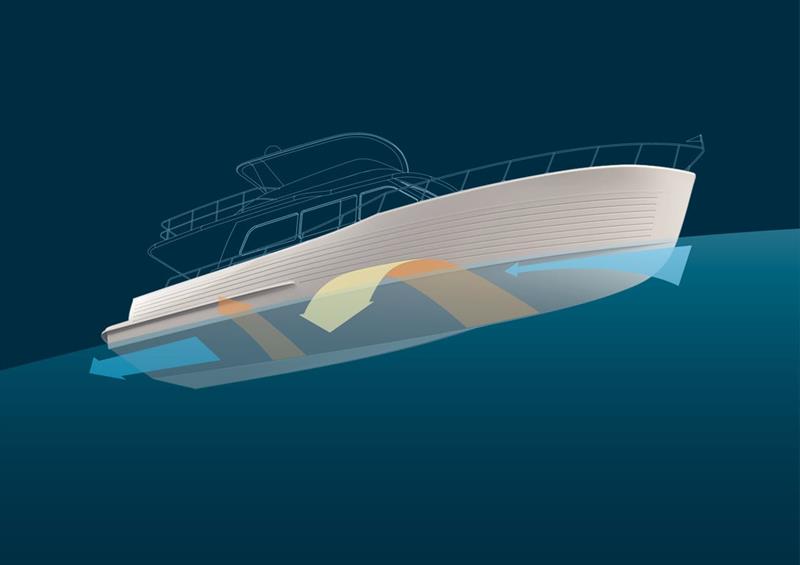
Why does V WARP run so flat?
The bow has a very fine entry, but the hull changes considerably as you move aft. Grand Banks calls it a warped semi displacement hull. The sections progressively flatten until there is just six degrees of deadrise at the transom. That fine entry does the work forward, particularly into a head sea. Further aft, the flatter sections provide lift as speed builds. Our 2017 test also noted the hull’s considerable flare, which helps throw water away from the boat.
There was no obvious hump to climb over as the GB60 reached planing speed. The transition was remarkably smooth. That’s great for efficiency. Energy used lifting the bow, pushing water aside or creating a large wake isn’t moving the boat towards its destination.

Where did the weight go?
The other revealing number from our 2017 test was 29 tonnes. Earlier Grand Banks models of similar length tipped the scales at more than 45 tonnes. The new generation GB60 represented a considerable change in construction.
The hull is E Glass, while Grand Banks uses carbon fibre extensively higher in the boat. Our later Skylounge review recorded a vacuum infused E Glass and vinylester hull, with carbon fibre laminates and Corecell foam higher in the structure.
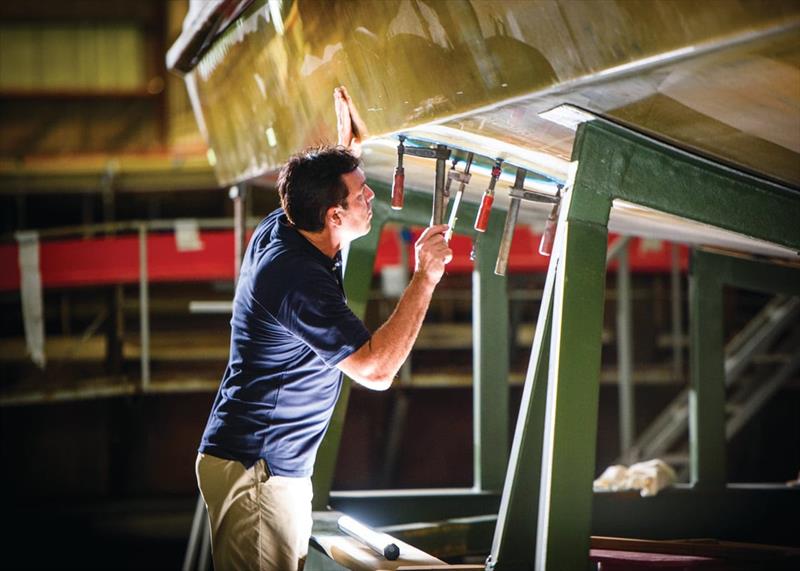
Removing weight from the deck and superstructure also brings the centre of gravity down. Grand Banks uses pre cut, unidirectional carbon fibre, with the fibres orientated to suit the loads they carry. Composite engineering specialist Gurit has also been involved in the programme. Inside, infused composite bulkheads are laminated directly into the hull rather than relying on conventional plywood bulkheads bonded onto flanges. Grand Banks says it takes longer to build this way. The payback is a lighter, stiffer structure.
What does V WARP deliver?
Our Skylounge test showed the benefits weren’t limited to straight line efficiency. With conventional shafts and rudders, the boat could be pushed through tight turns at around 28 knots. Then there is range.
Grand Banks quotes 761 nautical miles at 21 knots for a Grand Banks 60 powered by Volvo D13 shaft drives. That’s a revealing number because there is nothing unusual about the propulsion. These are diesel engines turning conventional shafts. Much of the work has already been done before the engines enter the equation.
Keep the bow fine. Flatten the hull aft. Keep the running angle low. Take unnecessary weight out of the structure. The result is a motor yacht capable of covering serious miles at 21 knots.