


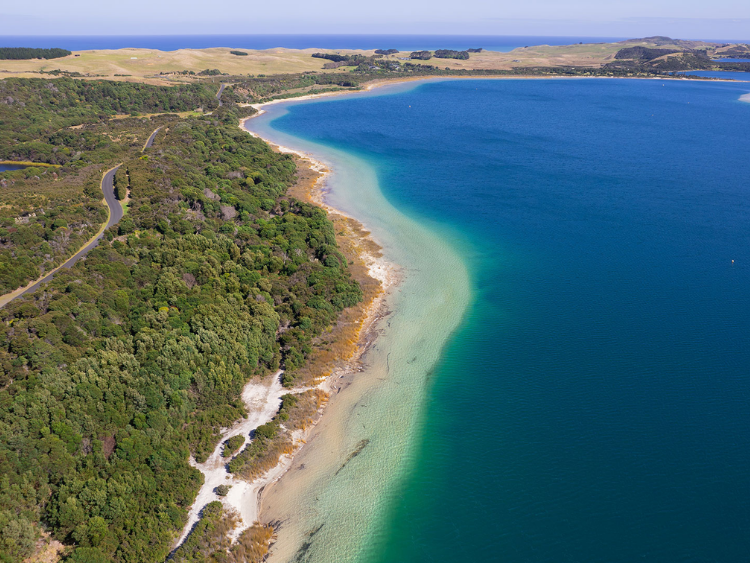
From Friday, boaties launching at Kai Iwi Lakes’ Lake Taharoa will need PIN access from Northland Regional Council’s online self-certification to open a new gate, the outcome of three summers of argument over how to keep the invasive freshwater clam out of Northland.
The target is Corbicula fluminea, a clam most boaties will never see. Juveniles are smaller than a grain of sand, as we explained in our July look at Corbicula. They can survive up to two days out of water, with adults lasting as long as 30. The regional council says the clam spreads on watercraft, trailers and equipment, and its councillors have singled out motors and ballast tanks that still hold water.
Keeping Northland clear
Corbicula fluminea was first found in the Waikato River at Bob’s Landing, near Lake Karāpiro, in May 2023 and is now confirmed between Lake Maraetai and Port Waikato. It has Unwanted Organism status under the Biosecurity Act, which makes knowingly moving the clam, or water that may contain it, an offence. The regional council’s invasive clam page notes that no country has managed to eradicate it.
It has not reached Northland. “We’re particularly worried about the freshwater invasive clam, which has not found its way to Taitokerau yet and we’re keen to keep it that way,” says John Blackwell, the regional council’s Kaipara constituency representative.

Blackwell is a farmer, and he points to a risk that reaches well beyond the lake. “For instance, this clam can affect farm water reticulation, block ballcocks and water lines and potentially threaten the viability of the farm itself.”
How the ramp got a gate
The gate follows a long argument over the ramp. In November 2023 Kaipara District Council, which administers the Taharoa Domain, kept the ramp open and opted for education and monitoring, against a recommendation from its own Taharoa Domain Governance Committee to close it temporarily. The community news site Local Matters reported that the district council agreed in March 2025 to close the ramp from Labour Weekend 2025, then on 25 June voted to keep it open after legal advice cast doubt on its power to close it under the Reserves Act.
Last November Corbicula fluminea turned up in New Plymouth’s Lake Rotomanu, its first find outside the Waikato River, and the lake was closed to motorised craft on 12 November. A different species, Corbicula australis, had been found at Taupō Aqua Park in 2024. In Kaipara, Ric Parore (Te Kuihi) called for Kai Iwi Lakes to be closed to boating before Christmas. “We’ve only got one chance to deal with this risk,” regional council deputy chair Jack Craw told Local Democracy Reporting at the time.
Alongside its push for a temporary closure, the regional council put forward a monitored automated gate, offering $40,000 towards it, with access tied to taking part in biosecurity checks. Its biosecurity manager for incursions and response, Nicky Fitzgibbon, said a gate would strengthen compliance outside the hours the ramp checkpoint was staffed. RNZ reported in December that the district council had unexpectedly approved the gate, on condition the regional council covered installation and upkeep, and that Taharoa is the only one of the three Kai Iwi lakes where power boats are still permitted.
The gate was expected later that summer. In the meantime the ramp checkpoint ran daily from 8.30am to 4.30pm, staffed with ambassadors from Te Roroa and Te Kuihi, and the regional council added eight warranted officers under the Biosecurity Act. The finished gate cost about $53,000, and the regional council is paying for that and its running costs. Kaipara District Council, Te Roroa, Te Kuihi hapū, DOC and the Taharoa Domain Working Group are partners in the work.
Taranaki shows what the other side of the ledger can look like. In February, Taranaki Regional Council councillors heard that trying to eradicate the clam from Lake Rotomanu could cost up to an estimated $1.3 million, with no guarantee of success. They declined to raise rates for it and kept the lake closed to motorised boats while staff looked for funding partners.
“Stopping pests from arriving is far easier and more cost-effective than trying to manage them once they’re established,” Blackwell says.
The regional council records submerged plants growing at 24m in Lake Taharoa, the deepest submerged vegetation growth in the North Island, and the Kai Iwi Lakes are home to the dune lakes galaxias, a native fish found only there.
Before you go
The work starts at the last waterway you used. Drain all lake or river water from the boat, ballast tanks and gear, and remove any visible weed, mud or clams. Wash the boat, trailer and hard gear with tap water onto grass rather than into a stormwater drain. Absorbent gear and the residual water left in ballast tanks or bladders after pumping need one of the approved treatments, such as a soak in hot tap water at 50 to 55°C for at least five minutes. Let gear dry to the touch, inside and out, then leave it another 48 hours, and dry any pooled water inside the boat before leaving the craft to dry for at least 48 hours. Then self-certify, and keep your PIN details handy at the end of the day, because you’ll need the gate open to get the boat back out.
