A little unfairly, society tends to view PWC owners as petrol-heads drowning in testosterone. As Yamaha’s new supercharged GP1800 proves, though, these waterborne missiles can also be fun for families.
Heading out for a family beach picnic – on a PWC?
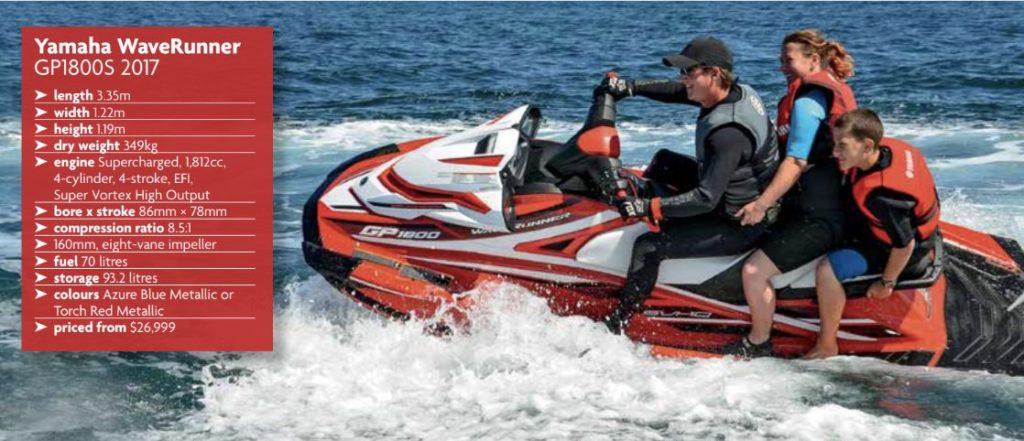
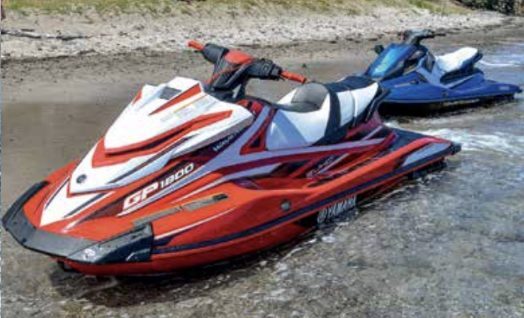
Absolutely. And nothing illustrates the viability of the concept more effectively than Yamaha’s new GP1800. The flagship of the marque’s 2017 WaveRunner range, this three-seater will whisk a trio to a remote beach as fast as the driver dares to go – carving wakes and jumping waves in spray-flung excitement.
Yes, there’s plenty of storage space for carrying the picnic goodies – a massive 93-litre storage locker in the bow, a removable watertight bucket under the seat and a glove box with twin drink holders. More than adequate for stowing a hearty lunch.
And in case you think 1800ccs of supercharged grunt is waaaaaay too powerful for a decent, law-abiding family, note that this PWC comes with a host of rider-friendly features.
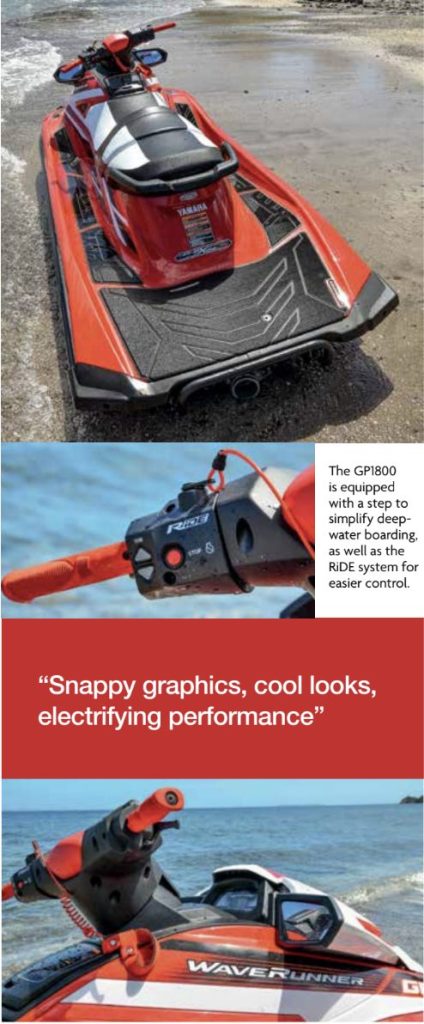
The main one is Yamaha’s new RiDE system (Reverse with Intuitive Deceleration Electronics). It’s described as an intuitive way for controlling the PWC when running, turning, decelerating and reversing. Effectively, it’s a sophisticated bit of technology designed to help riders harness the four-cylinder engine’s enormous torque and acceleration.
Twin triggers provide the control – one on each of the handlebars’ pistol grips – just like bicycle brakes. As with conventional PWCs, you decelerate by releasing the right lever (the throttle). But with RiDE you can also reverse/decelerate by using the left lever.
This is great for maneuvering around confined areas and provides greater stability during rapid deceleration. Pretty cool – and as Yamaha says – it’s intuitive.
There’s also a smart electronic trim system to help you keep things on an even keel, as well as a spring-loaded boarding step at the rear that – in deep water – makes climbing aboard the supercharged PWC super-easy.
All up, it means the GP1800 is flexible and adaptable to every rider’s preferences – you can ride and turn as hard and fast as you like – or perhaps as hard and fast as your backseat driver will allow.
Return of the GP
The GP1800 marks a welcome return of one of Yamaha’s most popular PWC lineages. Fans of the brand may remember the development of enormously-popular GP model range—and its extinction some 14 years ago.
Beginning with the GP1200 in 1997, the lineage evolved with the GP1200R in 2000 and finally, the GP1300 in 2003. All were two-strokes—and all disappeared when Yamaha made its tactical switch to four-stroke engines.
So the GP1800 is a kind of reincarnation—and perhaps appropriately, it draws on some of Yamaha’s pre-existing technology.
Its 1.8-litre Super Vortex High Output (SVHO) engine, for example, debuted in 2014, and quickly stamped its mark on the Aussie professional PWC circuit—19 wins in 21 races in 2014, 17 from 21 in 2015, and since then multiple wins in the Enduro Open Stock class Nationals.
The engine is indeed a glorious piece of engineering. Yamaha’s always been coy about revealing the horsepower of its PWCs, but this beast—I’m told—has at least 265 wild mustangs under the seat, and probably more. Power morphs into propulsion via a 160mm, eight-vane pump.
The hull and deck also carry the same DNA the runs in Yamaha’s earlier VXR model—a model renowned for its raceproven strakes, chines and keel. But it gets better. The GP1800’s hull is constructed from NanoXcel 2—another evolutionary step forward from the previous NanoXcel material. This new stuff is quite a bit lighter. Which means this missile – weighing in at around 349 kg—has a power-to-weight ratio that ventures into uncharted PWC territory.
If this all talk about power and torque sounds like hoon-heaven rather than family-oriented fun, let me stress: the GP1800 is adaptable to riders of any level. You can ride it with as much muscle as you like—though I’d suggest most riders would struggle to tame it.
But you can also ride with ease and grace – and there are excellent features to help you maintain your dignity. In addition to the already mentioned RiDE and electronic trim, you can, with the push of a button, engage the Low RPM mode. It limits performance for novice riders, while improving fuel economy. The 70-litre fuel tank, incidentally, translates into a range (depending on your trigger finger’s enthusiasm) of 143km at 57kmh and 129km at 67kmh.
Irrespective of how you ride, you’ll enjoy the read-at-a-glance multifunction LCD screen, and if you’re worried that your better half might have fallen off during your high-speed donuts, check the snazzy rear view mirrors from time to time.
Yamaha enthusiasts, I’m confident, will welcome the GP1800 like a long-lost sibling, returning to its rightful place at the head of the family. It retails for $26,999.
Value Proposition
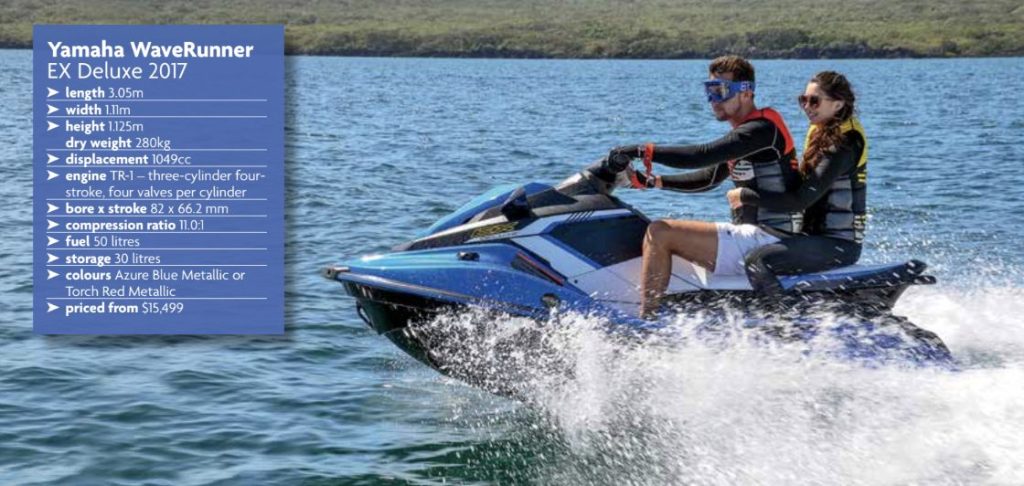
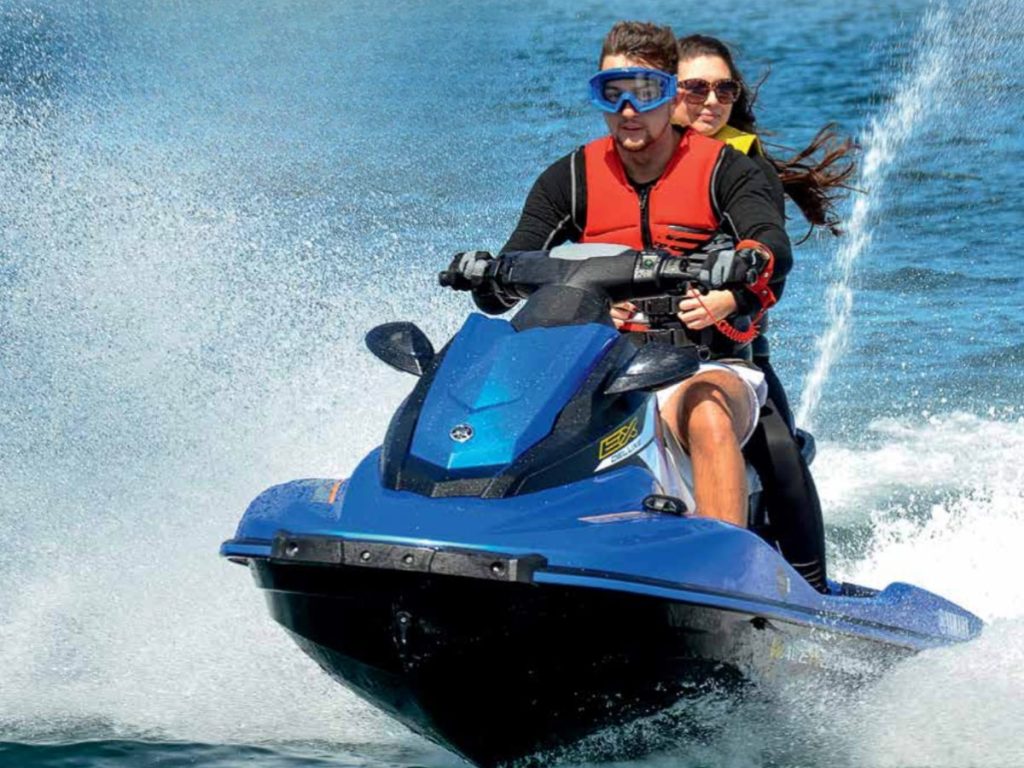
Another newcomer to Yamaha’s 2017 WaveRunner family is the EX Series—comprising three models: the base EX, the EX Sport and EX Deluxe. The model featured in this review is the latter.
I hesitate to call the EX an ‘entry-level’ PWC—it’s a sharp piece of kit. I prefer to says the EX is part of Yahama’s ‘widening-the-PWC-appeal-base’ strategy—it’s cheaper and more accessible than its bigger siblings—more bang for your buck.
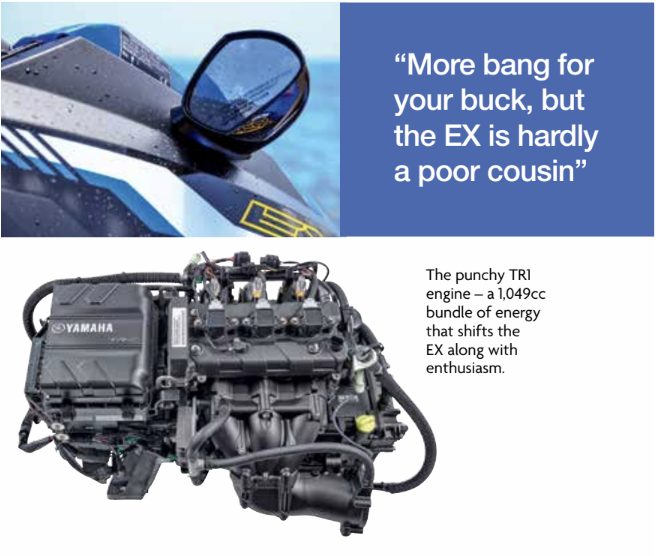
It’s also an easier riding proposition for novices. All three models are powered by the acclaimed TR1 engine – a 1,049cc, three-cylinder bundle of energy that shifts the EX’s 271kgs along with alacrity.
Much of the trimmed approach comes from the way the EX is put together. There are fewer fairings and panels – these contours are instead integrated into the overall body.
The instrument panel is a lot more basic than the bigger PWCs, and there is less storage. Hull and deck are glass fibre-reinforced polyester rather than NanoXcel.
But it’s not all about cutting back: the EX Sport and Deluxe are both equipped with the RiDE dual-trigger controls. You also get the cool pistol grips, and the sporty engine is easily capable of carrying a three-up load. It delivers a high-octane ride.
EX Deluxes are available in two colour options – Azure Blue Metallic and Silver Metallic with Torch Red Metallic. They retail for $15,499.
Yamaha’s 2017 Waverunners
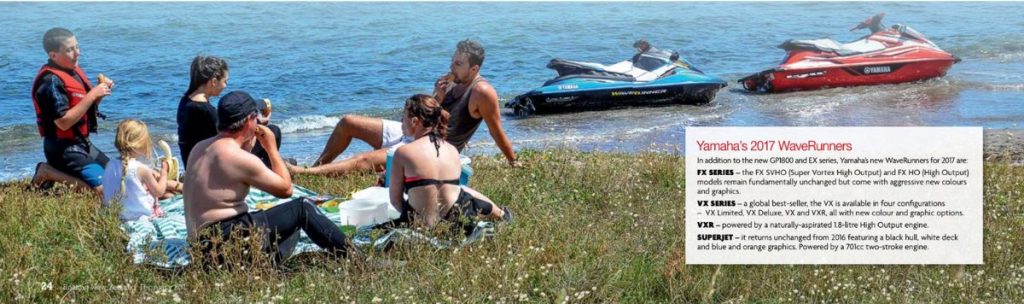
In addition to the new GP1800 and EX series, Yamaha’s new WaveRunners for 2017 are:
- FX SERIES – the FX SVHO (Super Vortex High Output) and FX HO (High Output) models remain fundamentally unchanged but come with aggressive new colours and graphics.
- VX SERIES – a global best-seller, the VX is available in four configurations – VX Limited, VX Deluxe, VX and VXR, all with new colour and graphic options.
- VXR – powered by a naturally-aspirated 1.8-litre High Output engine.
- SUPERJET – it returns unchanged from 2016 featuring a black hull, white deck and blue and orange graphics. Powered by a 701cc two-stroke engine.