An award-winning alloy-hulled adventure boat from Finland is now available in New Zealand. It ticks a lot of boxes for Kiwi boaties too.
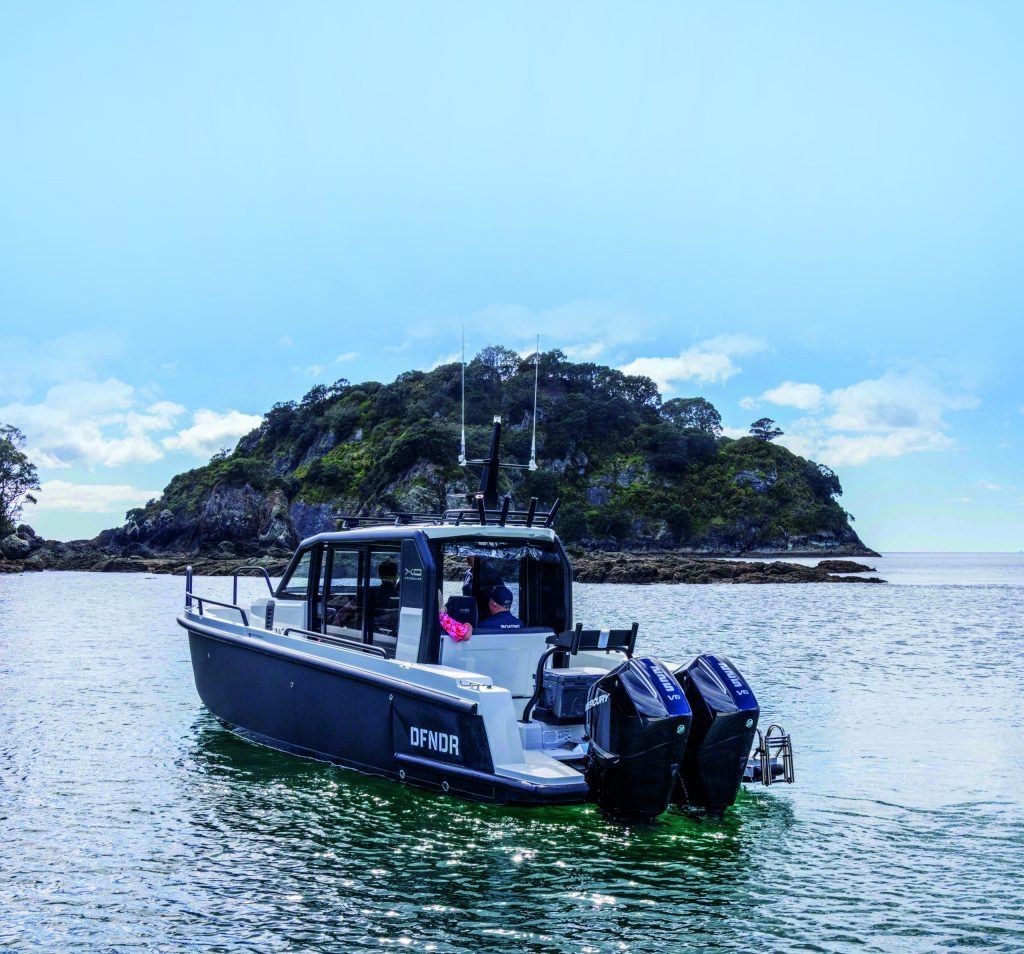
Described as an adventure boat in its home market and also hailed as a commuter vessel, the Finnish-designed, Finnish-Polish-built XO Crossover DFNDR 9 stands out as a compelling blend of rugged practicality and modern design. It won Adventure Boat of the Year, Motor Boats Awards, Dusseldorf Boot 2023. With its military-grade 5083 aluminium hull, carbon-look wrap, and fibreglass topsides and decks, this vessel is completely at home in New Zealand’s often challenging boating environment.
Looks good, works well
The XO range features the increasingly familiar plumb bow, deep vee hull, and long waterline length, becoming more common in motorboats from Europe, as well as from other builders around the globe, including New Zealand. XO’s boats share some stylistic DNA and partial ownership with Axopar, a well-known Scandinavian builder of sporty fibreglass vessels also sold here (XO owns 40% of Axopar), which are notable for their plumb bows.
But while the DFNDR 9 echoes the sharp, purposeful lines familiar to Axopar enthusiasts, it’s a very different boat in most other respects. To start with, it features a strongly built aluminium hull, engineered to handle rough seas, but mated to a fully moulded fibreglass liner and decks above the belting offering refinement and warmth. XO hulls are fabricated in both Finland and Poland with 8mm plate at the keel, 5mm at the waterline, and 4mm on the topsides, reinforced with a honeycomb of aluminium and lined with foam to deaden sound. The fibreglass moulding and final assembly take place in a separate factory in Poland.
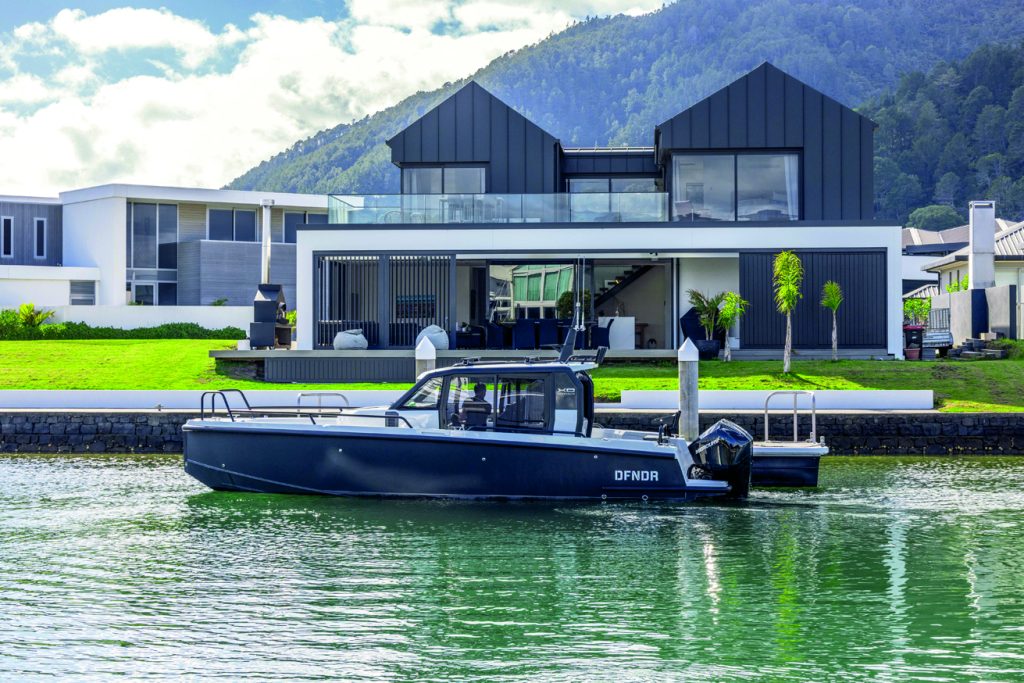
For the DFNDR, its designers were seeking something resembling a nautical equivalent of an aluminium-bodied Land Rover Defender, which is also tough, but with a touch of elegance to match – an SUV for the sea. I think they have succeeded rather well.
On the transom, twin Mercury 3.4-litre 225hp V6 outboards deliver the power, while a sturdy triple-axle Enduro trailer carries the vessel on the road. With the whole rig weighing in at somewhere near four tonnes once loaded with fuel and gear, trailering requires a specialised, heavy-duty tow vehicle – we towed and launched the boat behind a new Dodge RAM 1500 Rebel Hurricane, which has a factory 4.5-tonne tow rating. Unlike some other large trailer boats, which are beamier, the DFNDR 9 has a more manageable 2.6m beam for travelling on our roads.
The electrically braked trailer was custom-built in New Zealand for easy launching and retrieving. A Credo remote braking system, operated via USB or Bluetooth, activates the trailer brakes, which can also be done independently of the vehicle – handy when backing down a steep, slippery boat ramp.
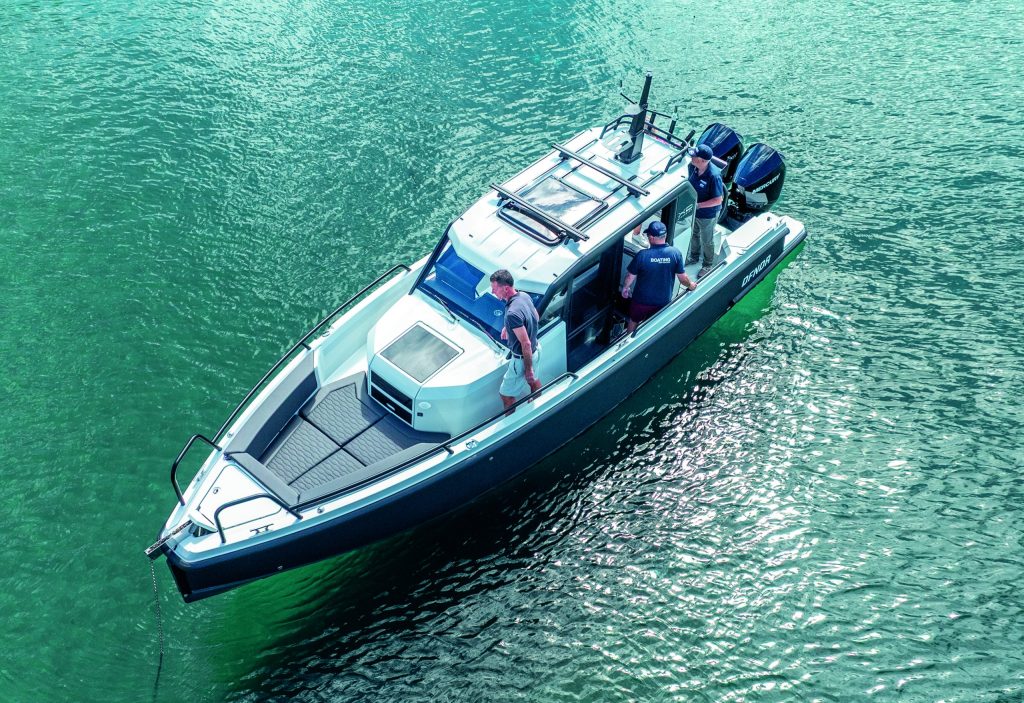
The DFNDR’s adventure-ready spirit is reflected in its layout. Fully walk-around with a large foredeck and a comfortable wheelhouse that opens to the cockpit aft, it projects an aura of competence and practicality. The modest-sized cockpit features a purpose-built bait station, a Yeti chilly bin, and an overhead rocket launcher, all fitted by the importer for New Zealand-style fishing (through-coaming rod holders are yet to be fitted) and gunwale fender locker storage. Spacious swim steps and a robust dive ladder can accommodate scuba divers and swimmers, with room under the cockpit sole for dive bottles.
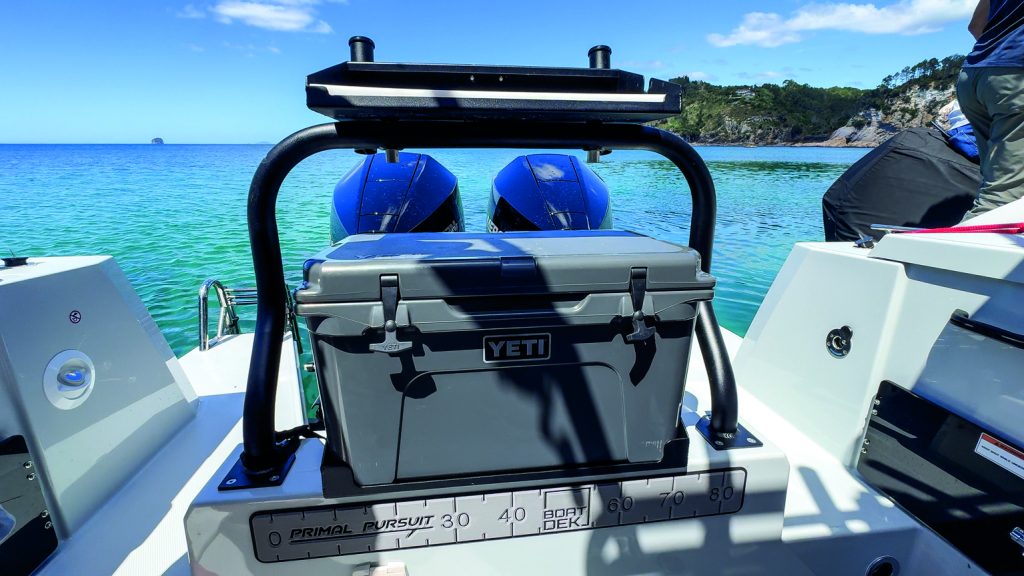
The transom is low to the water, but the swim platforms on either side extend well aft, beyond the motors, offering plenty of buoyancy, so shipping water over the transom is unlikely. The cockpit drains via grates into the sump or through scuppers.
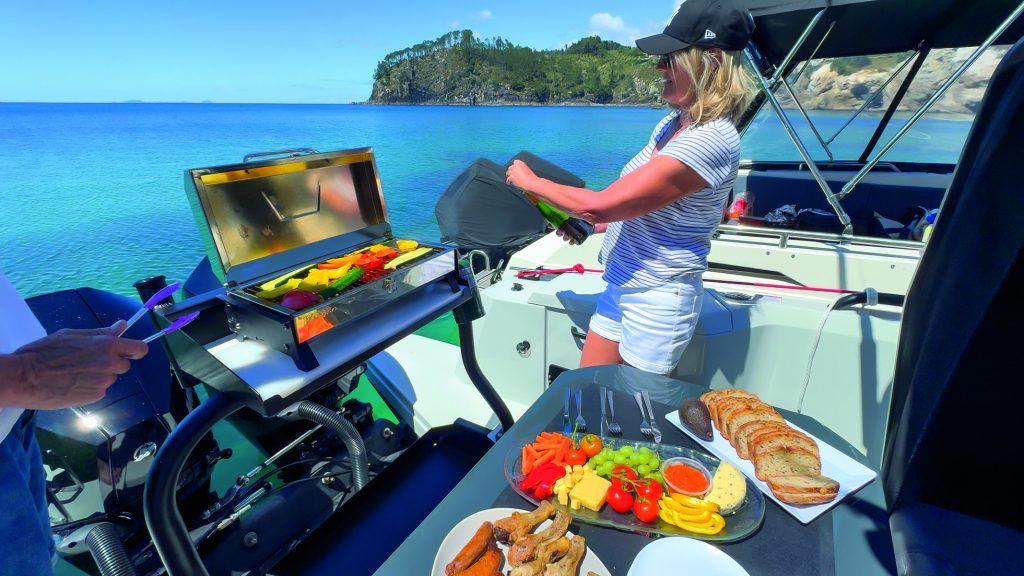
There’s a drop-in cockpit table for entertaining or eating, while the bait station also supports a portable BBQ or a canister gas cooker. Alternatively, remove the bait station and chilly bin altogether and slot in the custom transom seat (a standard factory transom seat is also available). A hot water cylinder feeds the cockpit shower – great for washing off the salt after a swim, warm up after a dive, or freshening up after a day onboard.
Wheelhouse-mounted Yakima roof racks can accommodate paddleboards, kayaks, an inflatable dinghy, or even bicycles, and there’s a full suite of comfy squabs and backrest cushions for the foredeck, which turns it into a sun lounger’s paradise. Too sunny? There’s an easily erected canopy to provide shade.
Tracks and domes prevent squabs and backrests from blowing off, though it’s advisable to stow them when underway. Or you can leave the squabs stowed below and cast lures from the bow for sport fish instead.
Attention to detail is evident in the powder-coated handrails and substantial cleats, a deep anchor locker fitted with 100m of rode and plenty of stainless steel chain, and a clever folding fairlead that is housed inside the anchor locker when not in use, leaving the bow clean. Heavy-duty rubbing strakes and a substantial bow pad offer protection when coming alongside or nudging up against an object, while the bow thruster complements the vessel’s twin outboards to provide precise manoeuvring and control in tight situations.
Function and form
The XO Crossover DFNDR 9 is as functional as it is striking. Its dark black and grey colour scheme is complemented by white gelcoat, tinted sliding glass doors, dark grey headlining inside the wheelhouse. A sliding roof panel complements the doors, admitting light and air.
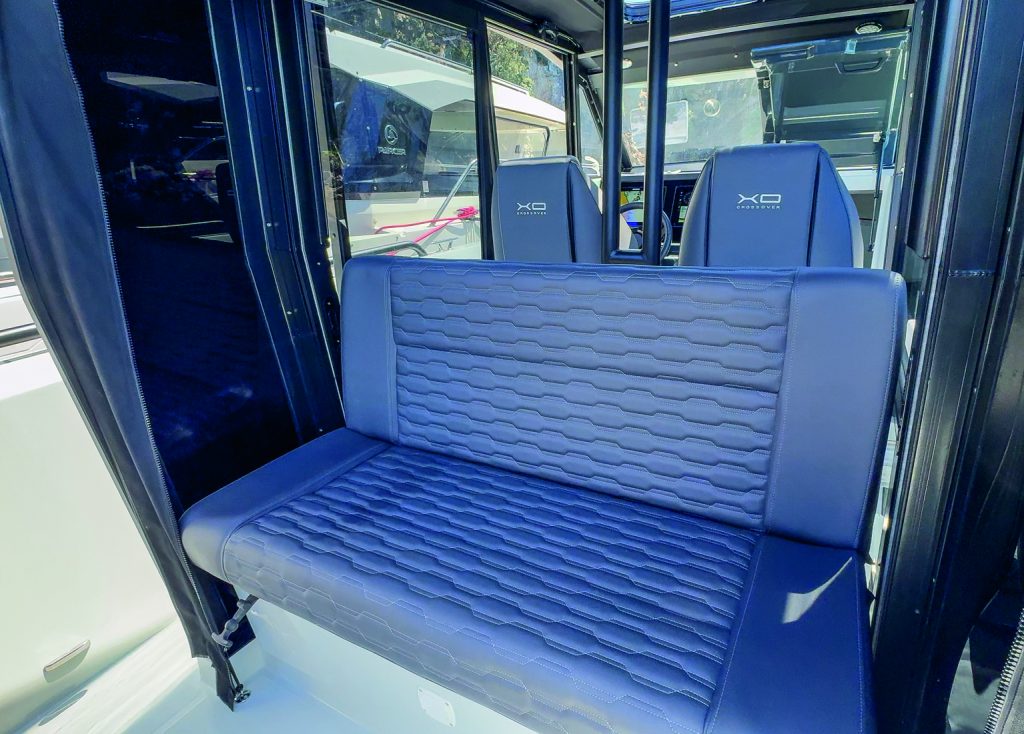
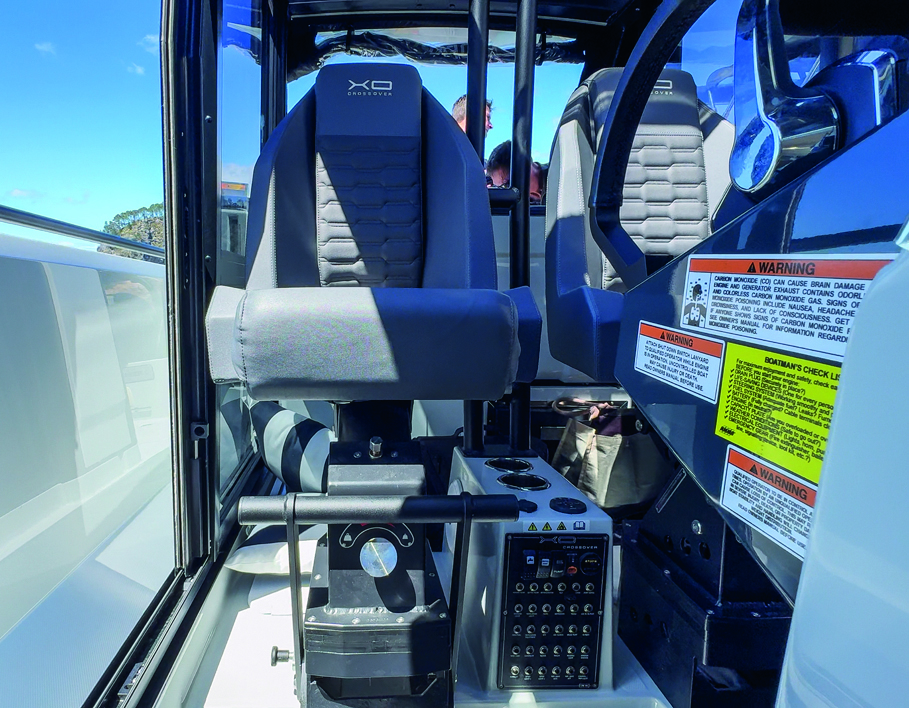
Inside, the DFNDR Crossover impresses with its clever use of space. The wheelhouse on this model is shorter than on the EXPLR 10 (the slightly bigger sister to the DFNDR 9), but still accommodates two high-quality, fully adjustable suspension seats forward and a three-person padded bench seat aft. The latter features a reversible backrest, allowing passengers to face either aft into the cockpit or forward in the direction of travel, and drop-down rear clears fully enclose the wheelhouse for enhanced comfort in bad weather. Stacked sliding doors on each side provide access to the seats, both front and back.
Seated at the helm, there’s excellent support from the footrests (the passenger seat footrest folds out from the seat; the helmsman’s is fixed to the bulkhead), great vision in every direction through the glasshouse, and plenty of well-positioned handholds. The console has ample space for displays – a pair of Simrad MFDs, along with the usual array of ignition switches and breakers; anchor, bow thruster, and Lenco trim tab controls; Mercury throttle and shift; and the locking latch to open the companionway hatch door, which opens upwards on gas struts.
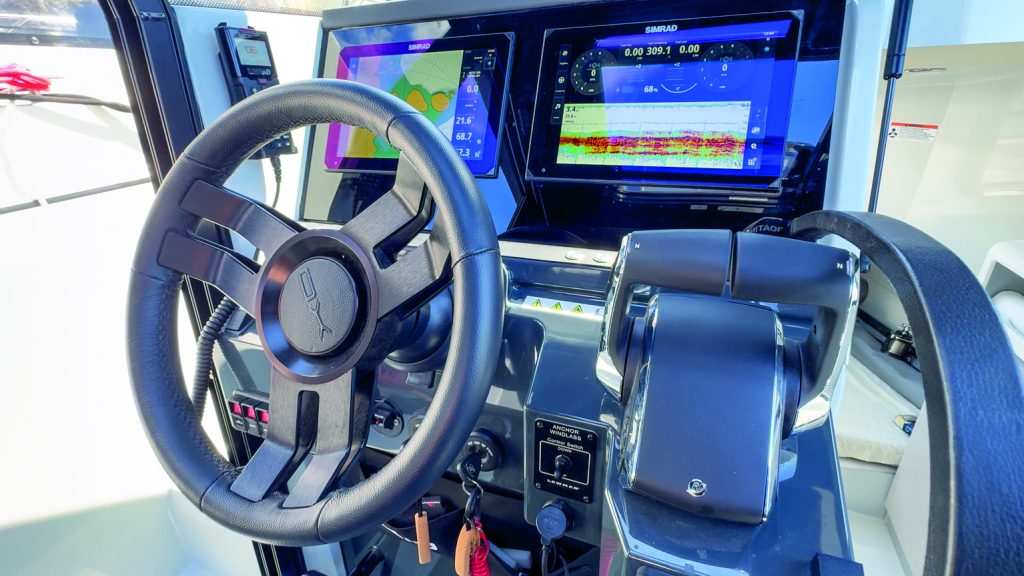
There are no Mercury gauges on this vessel, with all the engine data displayed on the Simrad MFDs. The VHF radio is located to port beside the helm door and height-adjustable wheel, with the main switch panel on the front of the console between the seats at floor level. This console also sports a pair of cup holders.
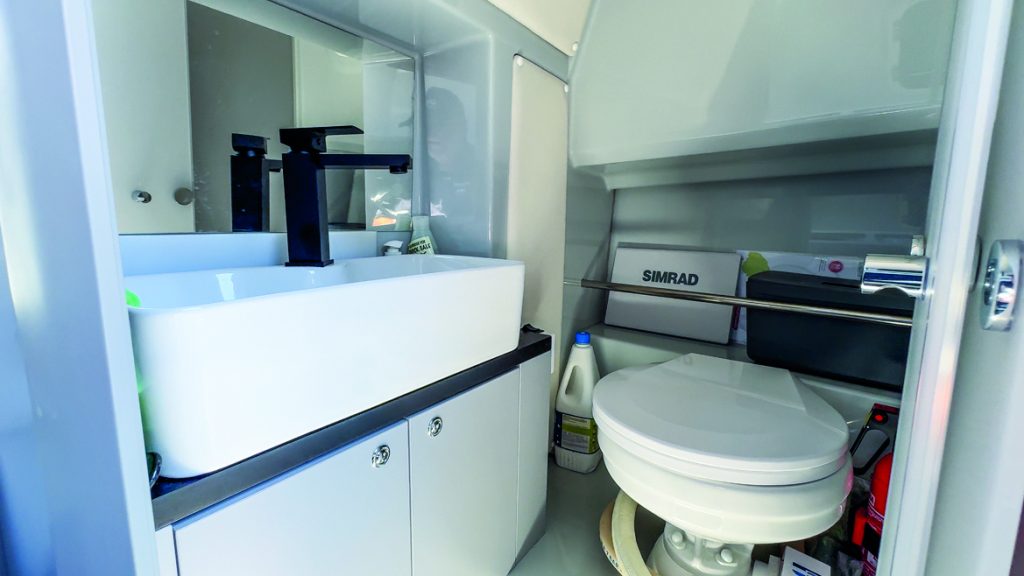
Access to the forward cabin is on the starboard side via steps. Every aspect of the interior speaks to thoughtful, high-quality craftsmanship. The cabin extends under the foredeck, so the ceiling is low over the full-length V-berths, but there’s standing headroom near the entrance where a separate heads compartment with a small vanity and bi-fold doors is situated – no cramped under-bed toilet here. Lifting the berth squabs reveals the stainless steel fuel, water and holding tanks, positioned forward to balance the boat, and speakers for the Fusion sound system also feature inside the cabin.
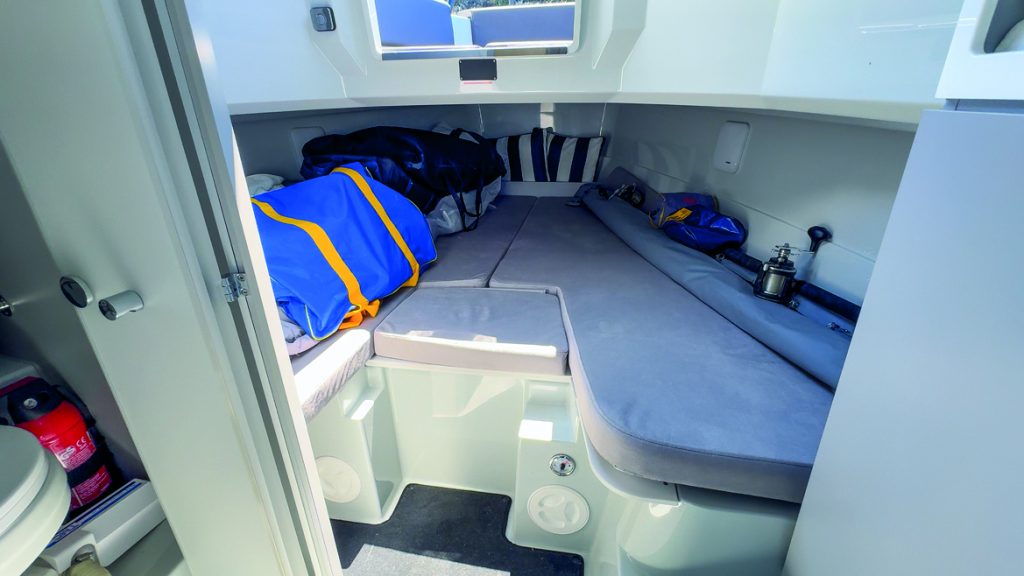
With 450 litres of fuel and 100 litres of water on board, long journeys and overnighters become not only possible but also comfortable. Storage is reasonably generous, there’s concealed LED lighting, and a large ceiling hatch/skylight provides access to the foredeck and cabin ventilation.
Confidence-inspiring
On the water, the XO DFNR 9 is a revelation.
We headed out of Pauanui for a few hours of exploring the coast and enjoying the sights. Conditions were mostly good, but with enough breeze to make the sea conditions a realistic test, especially later in the day.
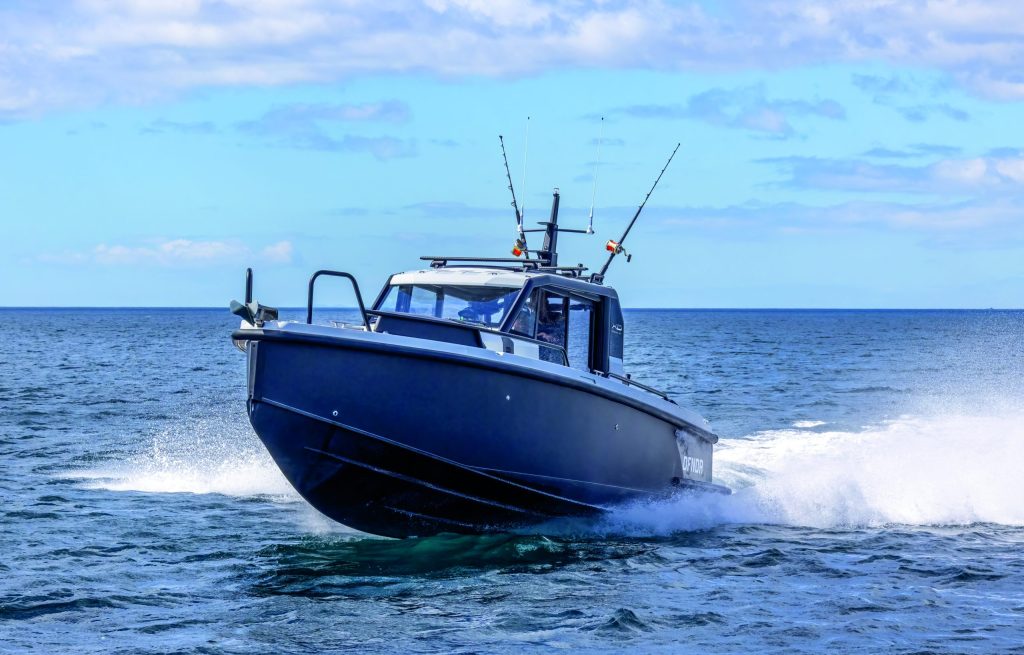
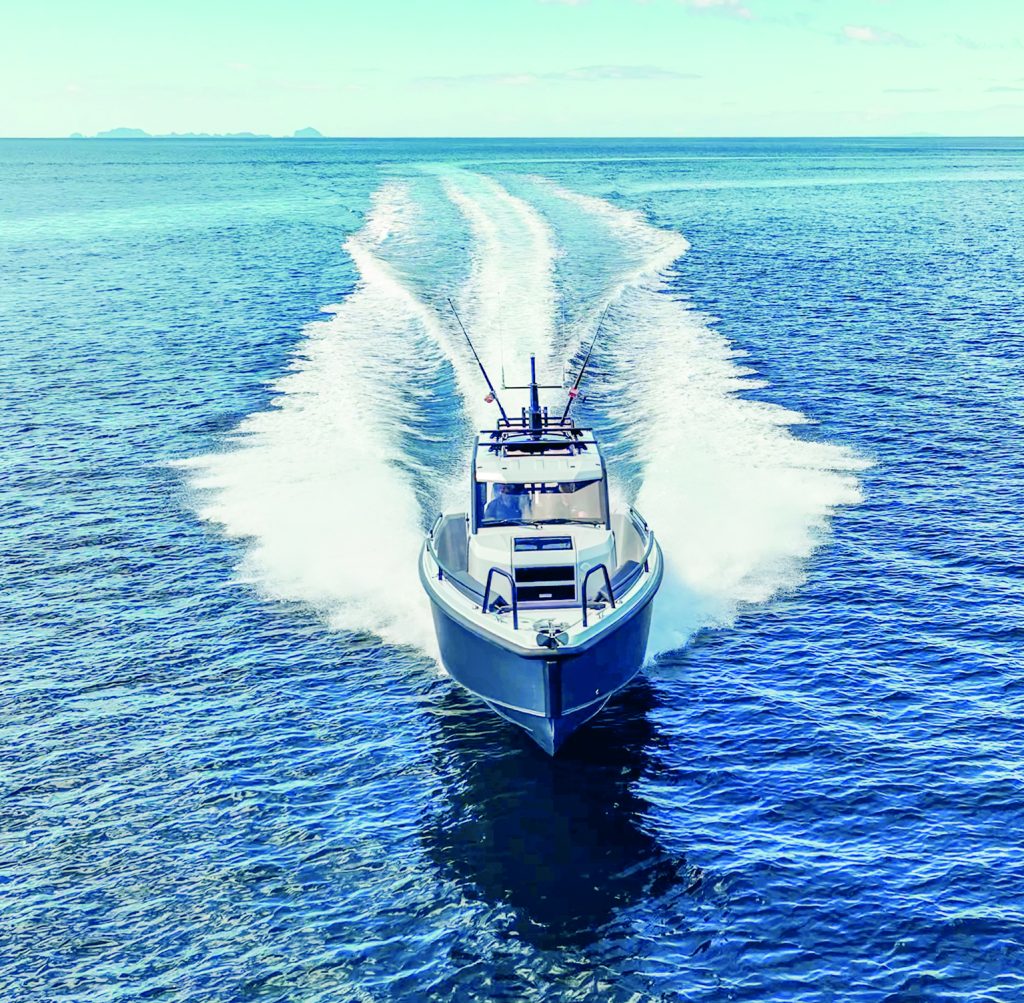
In the flat water of the harbour, we easily achieved 46 knots, which is impressive for a boat with a full load of fuel and water on board, plus four adults. Engine noise is quite acceptable inside the cabin and even less intrusive with the back clears rolled down.
Once we’d crossed the bar, we headed up the coast at a comfortable 28–32 knots, burning about 33 litres per hour per engine at just under 4,000rpm. Throttle response is excellent, there’s minimal bow rise getting onto the plane, and the hull is soft-riding and dry.
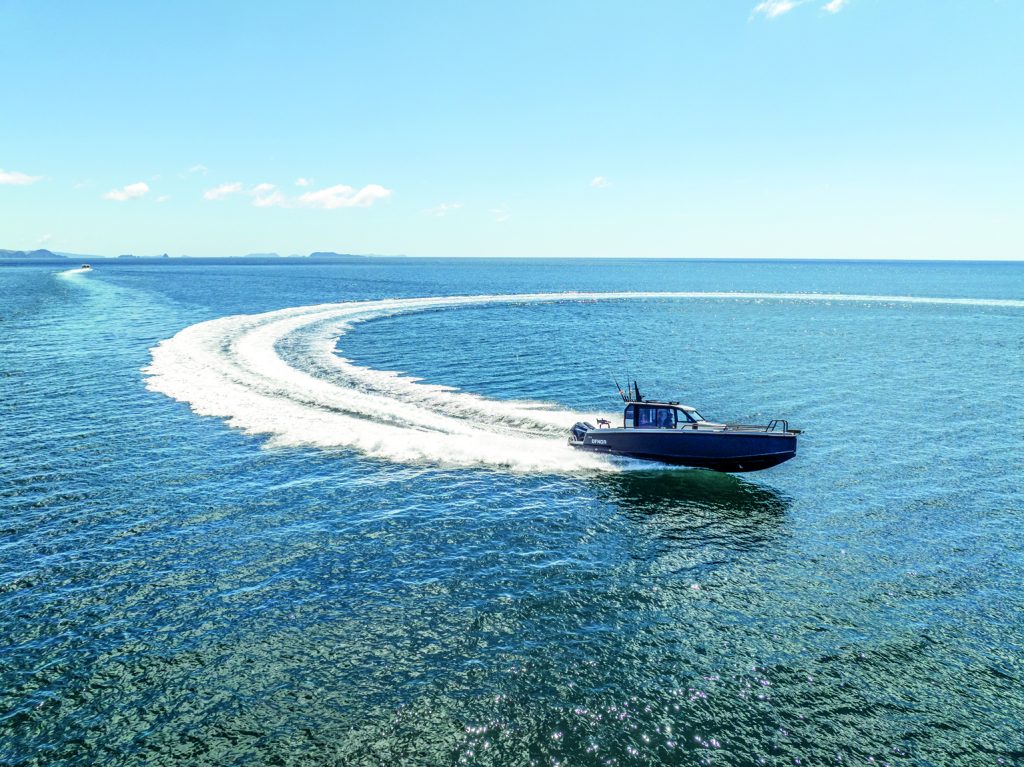
Turning the boat at speed invariably brings a smile to your face, though passengers should be warned to hold tight – the g-forces generated by the deep vee hull are considerable. I was particularly struck by how quiet the XO was, with none of the usual percussive soundtrack one expects from an aluminium-hulled vessel, a testament to its robust construction. Very impressive.
Even in half a metre of chop, plus some swell, the ride remained dry and stable, and there was no call for the dual windscreen wiper-washers, even though we could see our companion vessel regularly taking spray over the bow and onto the windscreen.
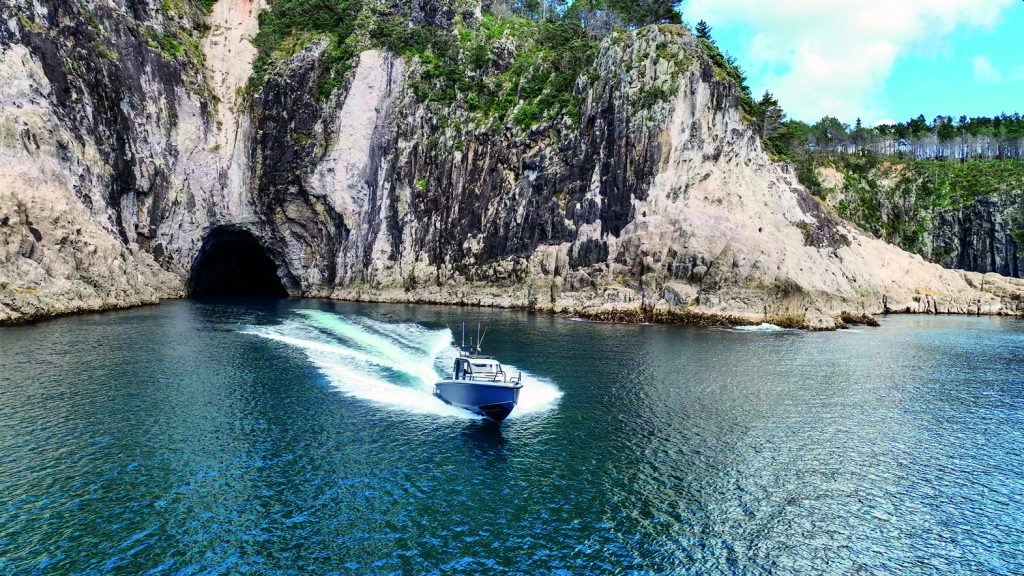
Encouraged by its evident ability, we pushed the XO in bigger seas, giving the Mercurys their head and trimming them well out, once again topping 46 knots. And while it got a little loose at the top end, fully trimmed out, the vessel’s handling at higher speeds is generally stable and confidence-inspiring.
And while twin Mercury V6 225hps are an excellent match, the XO Crossover DFNDR 9 can also be specced with a single Mercury 400hp V10. Lighter than the twins, it should provide additional torque and an even higher top speed with lower running and maintenance costs.
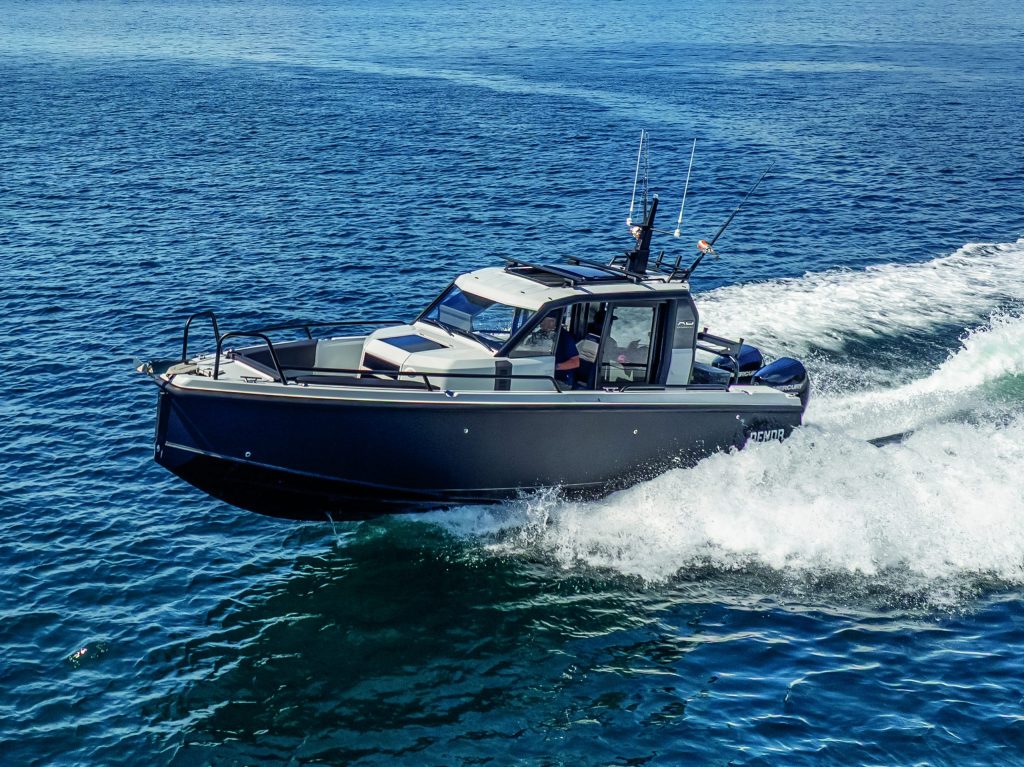
Final thoughts
The XO Crossover DFNDR 9 is a great example of practical design, sound engineering, and XO’s relentless pursuit of versatility. Whether commuting, fishing and diving, or simply exploring new coastlines, this boat is ready for whatever the journey may bring.