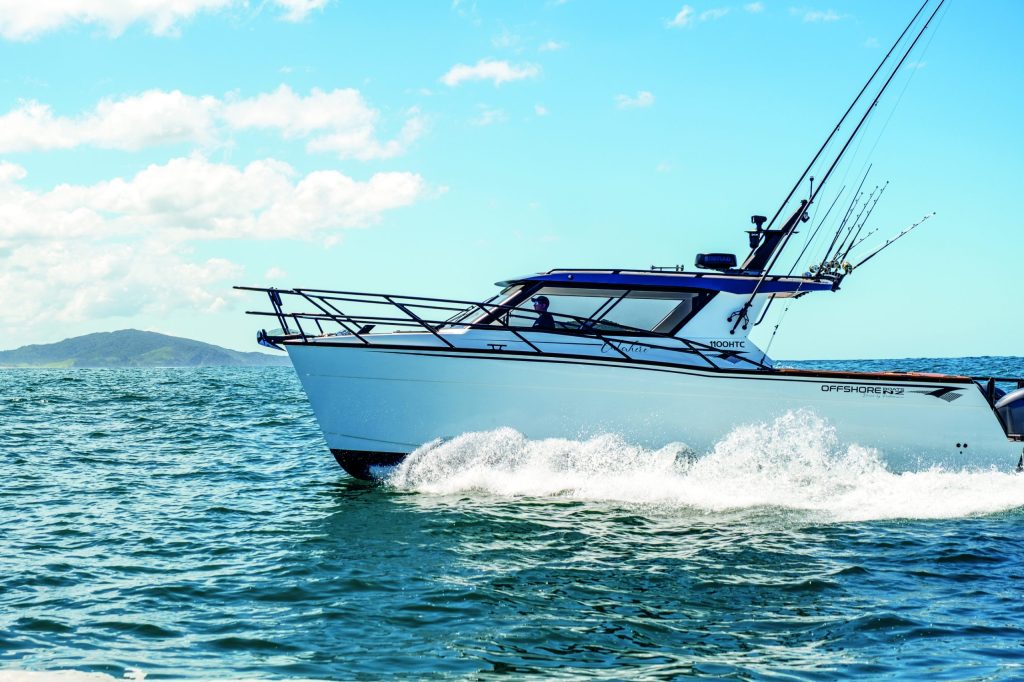
Built from aluminium by Whangarei’s Offshore Boats NZ, this 11m Dan Leech designed foil-assisted power catamaran had its genesis at a SailGP event in Lyttelton a few years ago.
That’s where Outahere’s owner Mike saw a smaller, composite Dan Leech 980 powercat buzzing around the course (Boating NZ reviewed this boat in the April 2023 edition). He was so impressed with the fuss-free way it got about that he decided to approach Leech for
a larger, fully-planing design for Offshore Boats NZ to build.
Offshore Boats is probably better known for its high-quality aluminium monohull trailer boats, largely aimed at sport fishers – Boating NZ has reviewed several over the years. But while this Dan Leech cat is the largest vessel the company has built to date, it’s not the first catamaran – Offshore Boats NZ delivered a 7.35m trailerable powercat to its happy owners mid-2025, has a 9m ready to build, and there’s a 14m on the horizon, all foil-assisted Dan Leech designs.
Mike’s association with Jonathan Barlow and Offshore Boats NZ goes back many years and includes the pair fishing and diving together, as well as Offshore trailer boats owned by family members. Mike’s no stranger to power catamarans either, having owned a 40-foot Wright powercat for many years and later an American built, outboard-powered World Cat GRP centre-console: “It went really well but simply wasn’t a practical boat for New Zealand. No storage, no shelter and certainly no proper overnighting facilities,” said Mike.
So, while he was set on another catamaran, this time in aluminium, with Dan Leech as the designer, his familiarity with Offshore Boats’ workmanship and Jonathan’s enthusiasm for the project work made the Whangarei company his preferred builder.
Outahere took approximately two years from concept to launch, with Mike and Offshore Boats having considerable input into the final configuration and fitout. In the end, it’s a rather more luxurious vessel than was first envisaged, driven mostly by the builder, who wanted the boat to showcase Offshore Boat’s capabilities. There are also changes to the original design, like the wide rear door opening, cavity window, and a stronger roof able to support walking on.
I joined Outahere at Marsden Cove early one Friday morning for a shakedown cruise with the owner Mike, Jonathan and Chris from Offshore Boats, and fishing personality and social media influencer In Joon Park and his camera man Dan. The plan was to leave Whangarei Heads behind and head 70 nautical miles offshore, catch a feed of hapuku and bass, and perhaps troll a bit for yellowfin tuna, which had been reported up and down the coast.
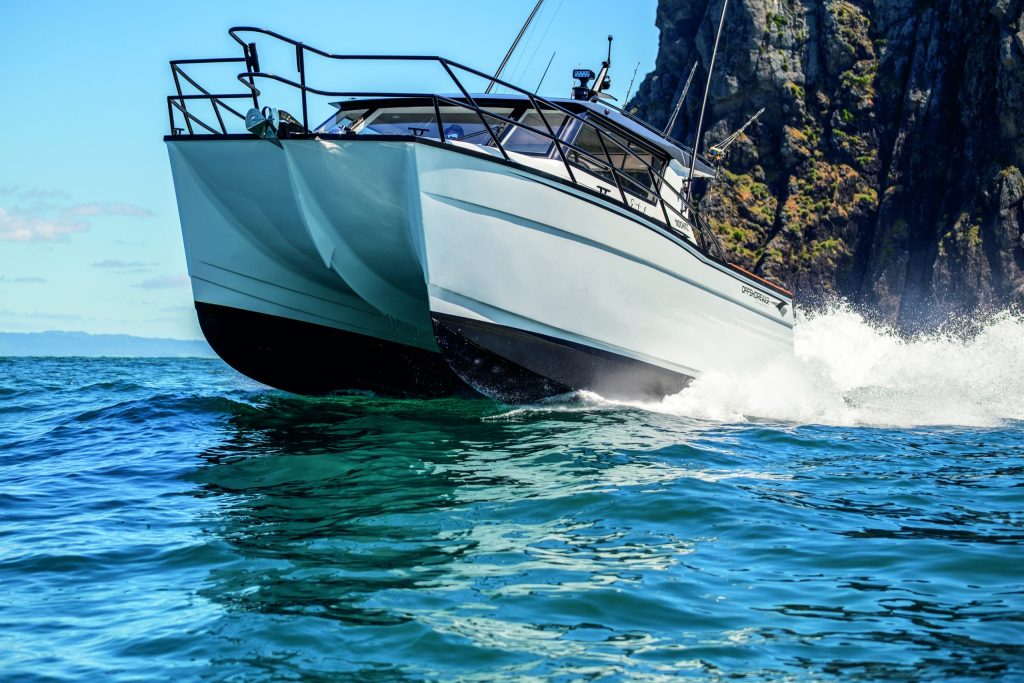
Most of the crew had spent the previous day putting the OffshoreNZ 11m through its paces for the camera and allowing Mike to familiarise himself with his new boat and its many systems. They had found enough rough water in the ‘Mad Mile’ off Whangarei Heads to give it some air, and even a day later as we headed out, there was still a good metre and a half of swell running and quite confused water between the Heads and the Hen and Chickens Islands.
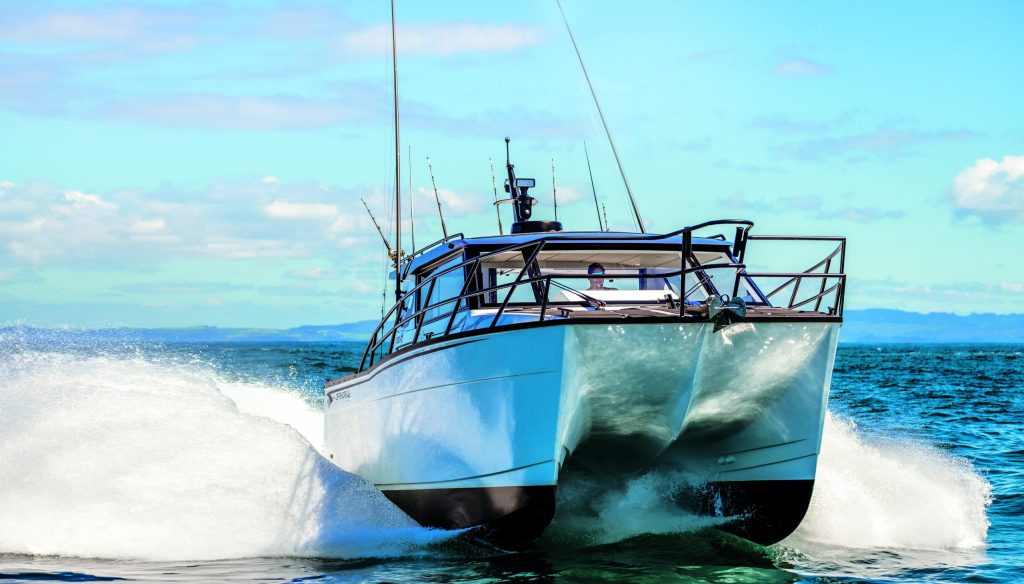
With a long way to go, we pushed through the slop at around 25 knots, experiencing a dry and mostly comfortable ride, even with the seas on the nose – a catamaran’s least favourite angle of attack. Dialling back the speed a little avoided the odd hard landing we experienced coming off the back of a particularly large or steep wave. Fairly soon the islands were behind us, and the sea state became more regular, allowing Outahere to cruise at 25-plus knots again in comfort.
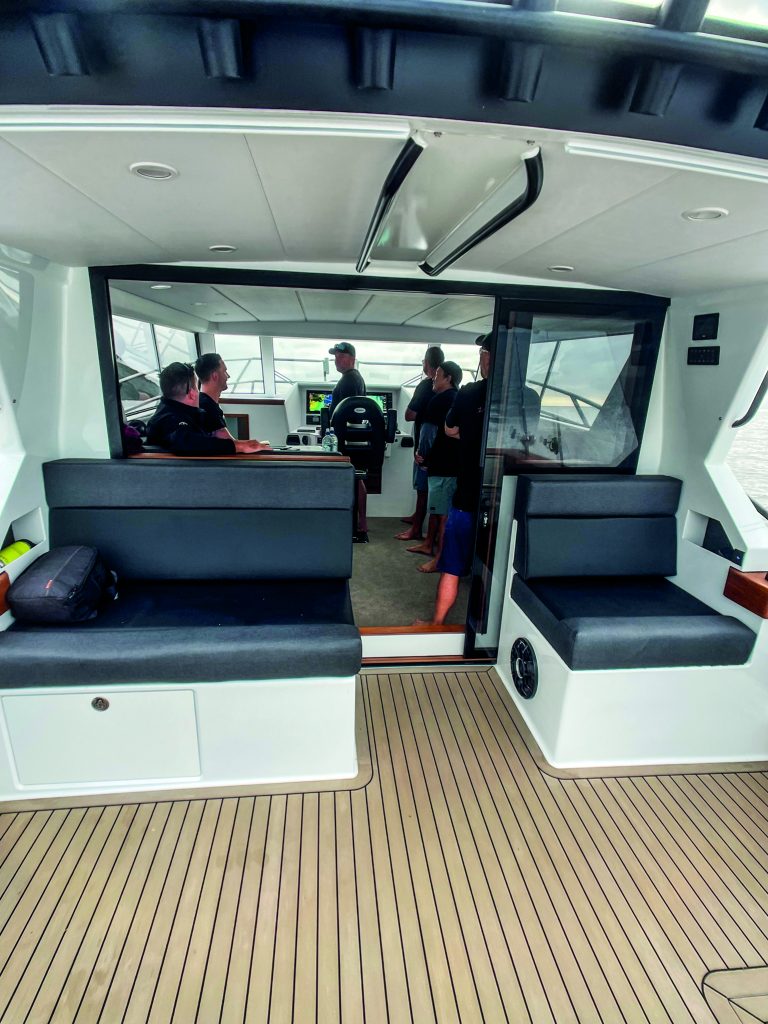
The saloon is a pleasant place to be when the boat’s underway. Closing the rear door and window cuts out most of the engines’ V6 snarl and hull noise is quite acceptable – the foil lifts a good portion of the hull out of the water anyway, so it was only the odd re-entry off the back of a big wave where hull noise intruded.
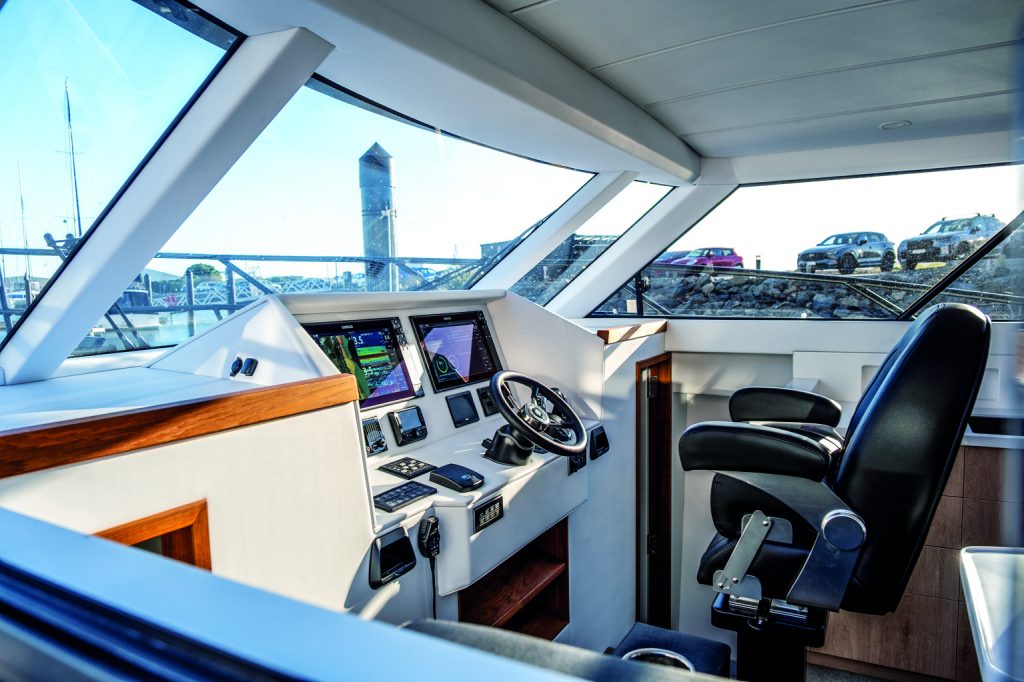
One of the benefits of a catamaran is volume, which this Leech cat amply demonstrates. The saloon is wide and spacious, with room for a fully-equipped galley along its starboard side and a decent-sized raised dinette and L-shaped settee to port. This can serve as an extra berth if required. The helm console is positioned on the boat’s centreline with a single luxury helm seat for the driver.
Vision from the helm is good, though the vessel does ride a little bow up when it’s foiling, which somewhat restricts close by visibility directly ahead. Sliding side windows open wide for excellent ventilation, especially with the rear door and window open as well. The interior is air-conditioned for comfort, and the boat also features CZone digital switching, with vessel systems controlled from a panel on the dash, in the cockpit and in the starboard cabin.
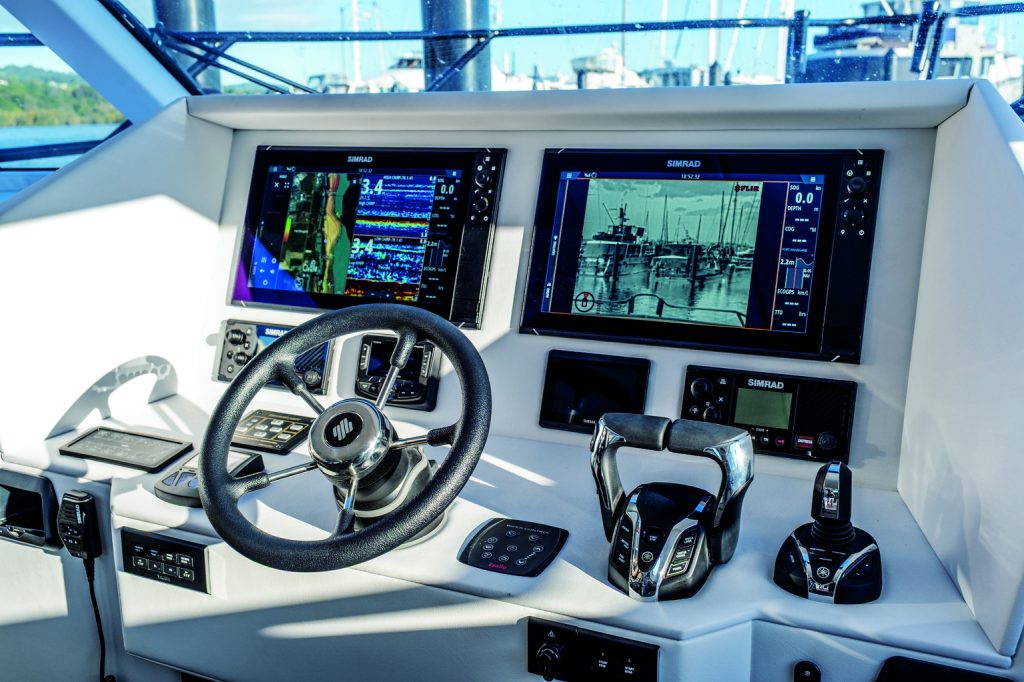
Helm Master EX means the latest Yamaha throttle and shift controls, with switchable single lever operation, and joystick control at low speed – there’s a second joystick helm in the cockpit on the starboard side positioned below another Simrad display. The boat enjoys the full Helm Maste EX suite with Setpoint, which includes Staypoint, Fishpoint, Driftpoint and Driftpoint Track functions, along with a versatile integrated autopilot.
Access into the hulls is via stairs either side of the helm; to starboard is a double berth cabin forward with a modest hanging locker and some drawer storage, plus a utility room aft containing the hot water system among other utilities and with space for storing bulky items. In the port hull, there’s another berth extending aft under the dinette and a good-sized head compartment forward. It’s not super luxurious, but very functional and impeccably finished, as is true of the whole vessel.
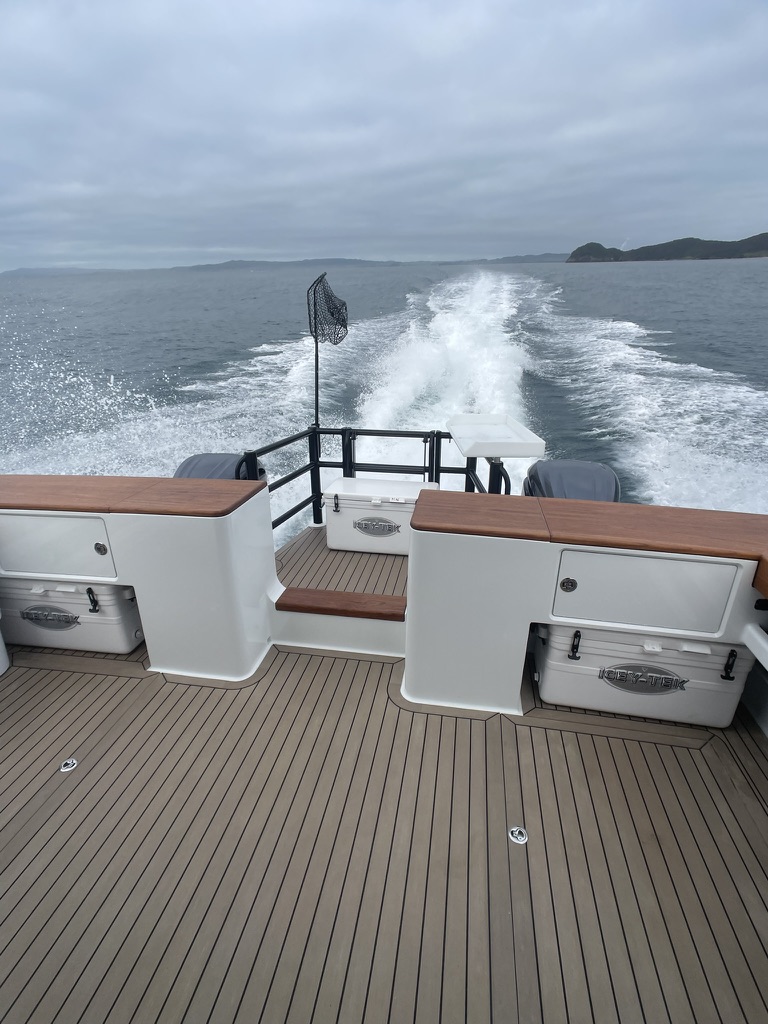
Volume is a property the cockpit also displays in spades. The design is nearly as wide as it is deep, featuring Flexiteek flooring for comfort and grip. Each hull has sizable underfloor storage for equipment, with one side fitted for dive bottles, and there are long shelves beneath the teak-capped gunwales. There’s a freshwater washdown on the port side and a high-pressure saltwater deck wash in the starboard corner, which we put to good use during the day.
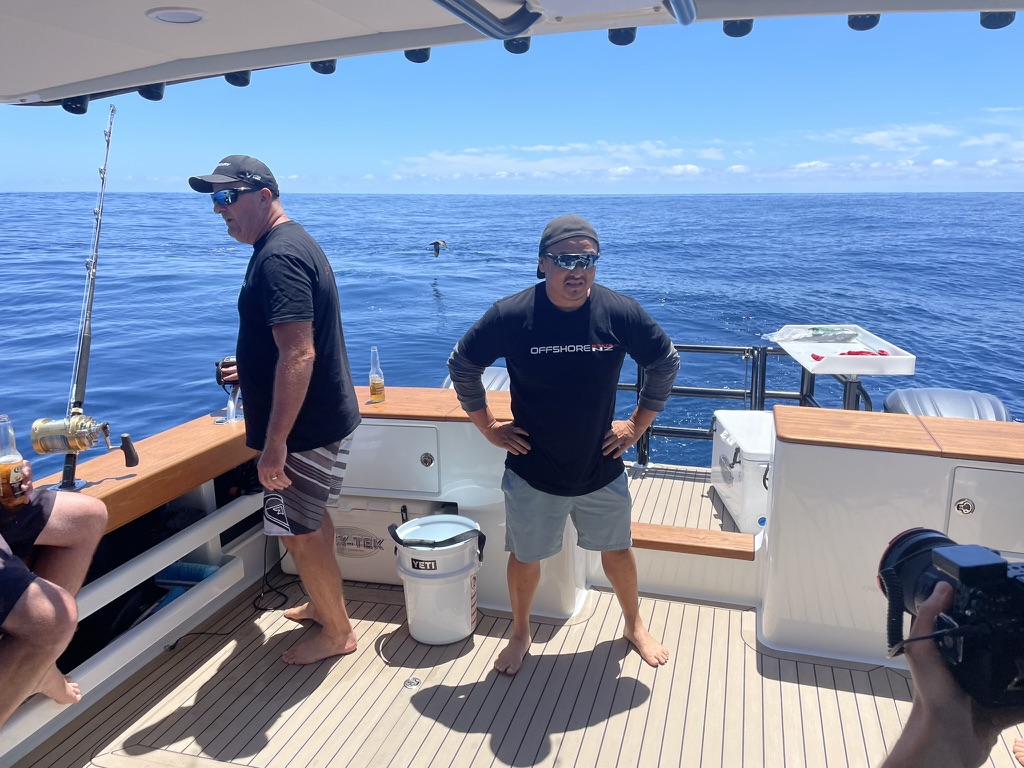
There’s more storage under the bulkhead seats both sides of the saloon door, upholstered in grey waterproof fabric. It’s a comfortable place to sit out of the weather under the protection of the cabin roof overhang which extends well back over the cockpit. Drawers under the seat on the port side are dedicated fishing tackle lockers, while the starboard seat has ample space under for gear bags and bulky items, as well as the sub-woofer for the Fusion sound system – speakers are strategically located inside the saloon and in the cockpit tucked under the gunwales forward.
You’ll find additional locker space across the transom, some of it dedicated to tackle box/tray storage, a live well and tuna tubes capped with teak either side of the open transom step-through amidships and custom Icey-Tek chilly bins either side. The large, caged platform between the outboards features a heavy-duty drop-down boarding ladder, provision for a bait table both sides, and a couple of rod holders. Like the rest of the boat’s railings, the aluminium cage is powder-coated in matte black.
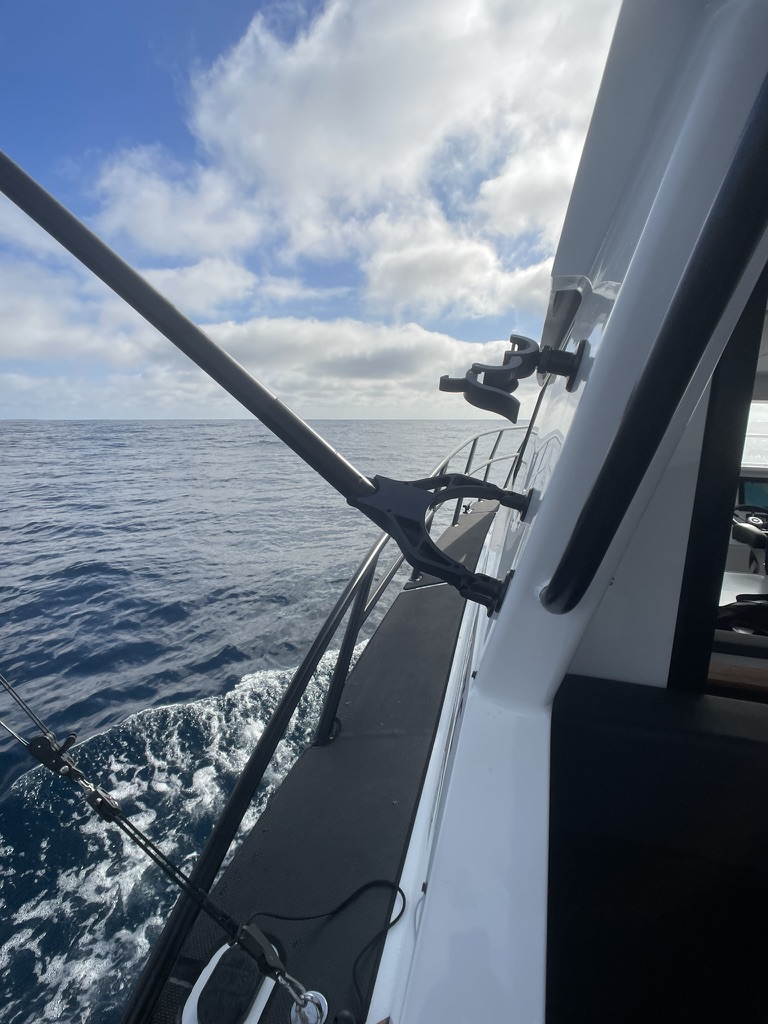
Speaking of rod holders, Exploding Fish adjustables are set into the wide teak coamings, six of them, and the vessel is game-rigged with top-of-the-line Kraken outrigger bases and Kilwell carbon poles. There are outlets for electric fishing reels, one in each corner, which we put to good use later in the day, and the heavy-duty, matte-black rocket launcher can accommodate 13 rods.
Access to the foredeck is pretty good, even with the poles deployed, thanks to wide side decks, handholds along the roof, and solid thigh-high railings wrapping around the sides and bow. U-Dek on the foredeck and side decks offers good grip while the rails provide security and support when casting lures from the bow – Mike loves his topwater fishing, so the foredeck will be a popular spot. The foredeck also provides access to the Maxwell capstan and Maxset anchor.
Our trolling efforts delivered just a single very large skipjack tuna but proved that the boat’s set up is perfect for towing lures. At one stage we were running seven lures in the boat’s wide, flat wake, which is fine with plenty of crew available to clear the gear in the event of a strike, but four or five lures would be easier to manage.
The big Simrad MFDs on the dash showed us a clear picture of the bottom some 500m below us, repeated in the cockpit, along with our track, and the Setpoint function on the Helm Master EX system stopped us right on cue above the mark we’d set on the GPS chart. A little bit of slow speed graphing located some promising sign and baits were sent to the bottom, using the joystick control to hold the boat in place against the current. Bites were almost immediate, and electric reels took the hard work out of bringing a string of bass and bluenose to the surface.
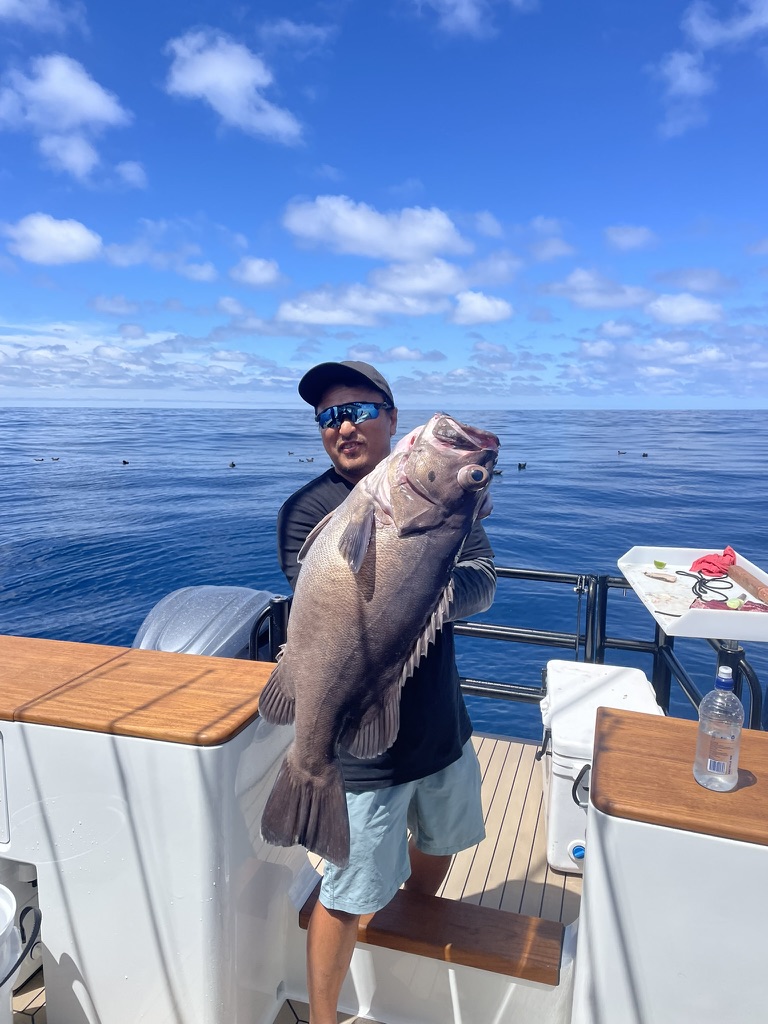
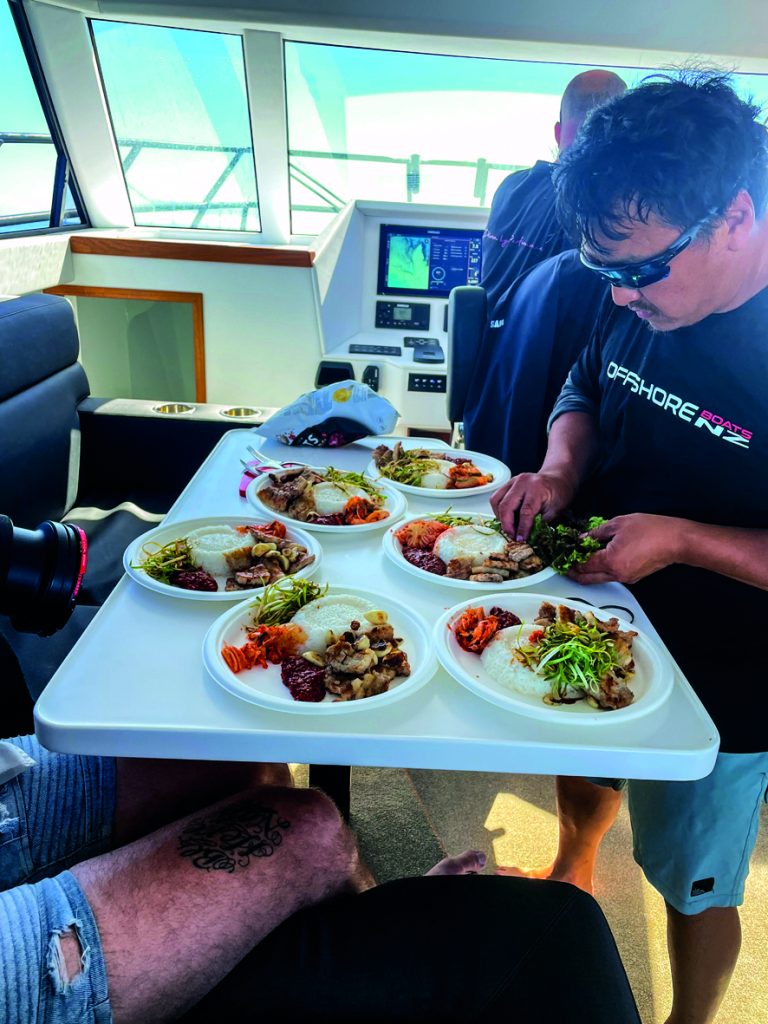
We enjoyed three or four successful drops with some of the crew even opting to fish using conventional tackle from the bow – lots of winding. When we called it quits, and after giving the catch time to chill in ice bags on deck, we enjoyed a delicious Korean BBQ, cooked by In Joon on deck. After that, a concerted effort processing and bagging the fish while we began trolling our way back resulted in plenty of chilled fillets for everyone, with the promise of smoked wings to come.
The cockpit and galley both played their parts in food preparation and fish processing, with the saltwater deck wash working overtime in the cockpit. With four or five people processing fish at once, the wide cockpit was appreciated, as was the swim platform, where the worst of the inevitable mess was confined.
With everything shipshape and our big day drawing to a close, we opened the throttles and began the long run back to shore, sea conditions allowing Outahere to travel at its most fuel-efficient speed of 32 knots. We were able to maintain this cruising speed most of the way back, slowing only a little as we closed on Whangarei Heads.
As we entered the harbour, Chris wound the vessel up to an indicated 44 knots, which is impressive for an 11m vessel; even in rougher conditions the day before, the boat had managed 39 knots.
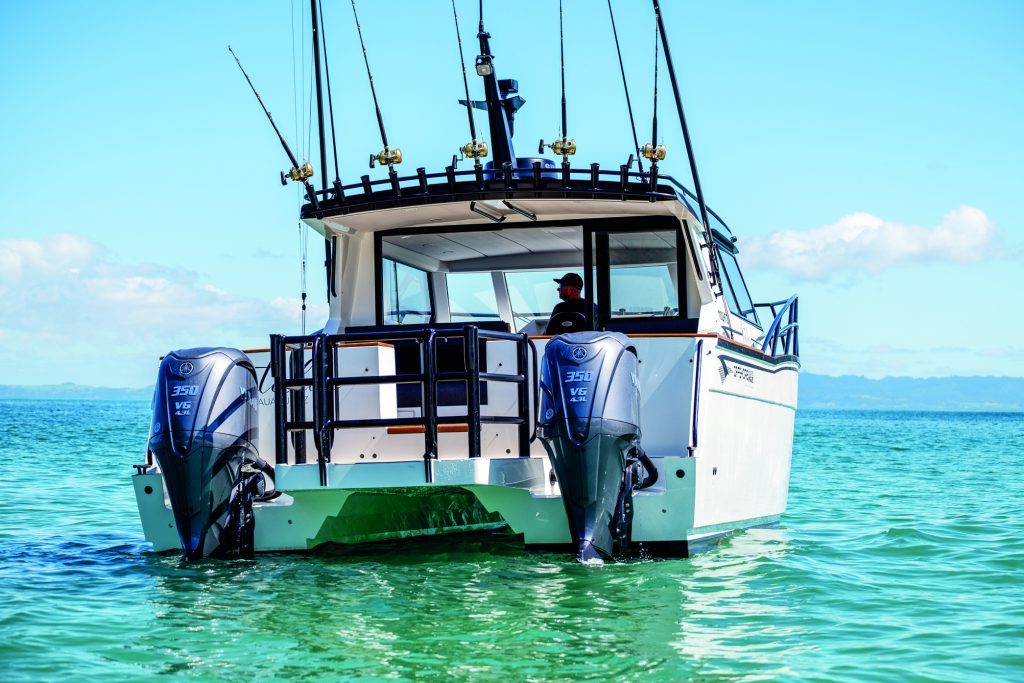
Between them Dan Leech, Offshore Boats and Outahere’s owner Mike have produced an impeccably built, bluewater-capable fishing, diving and cruising powercat suitable for navigating the tricky shoal waters of Pauanui Bar on any tide and with the range to go pretty much wherever Mike wishes to dive or drop a line. From Pauanui, that could be as far afield as White Island.
Built to survey, Outahere is Offshore Boat’s largest project to date, but with the evident success of this collaboration, there will almost certainly be similar projects coming up. Watch this space.