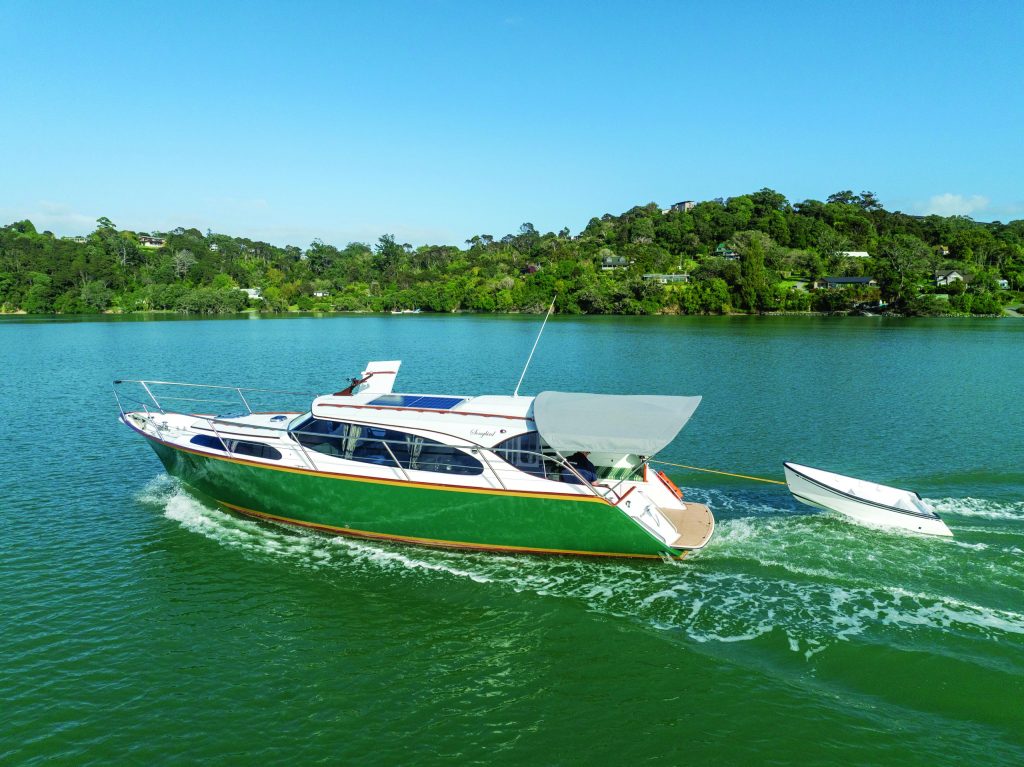
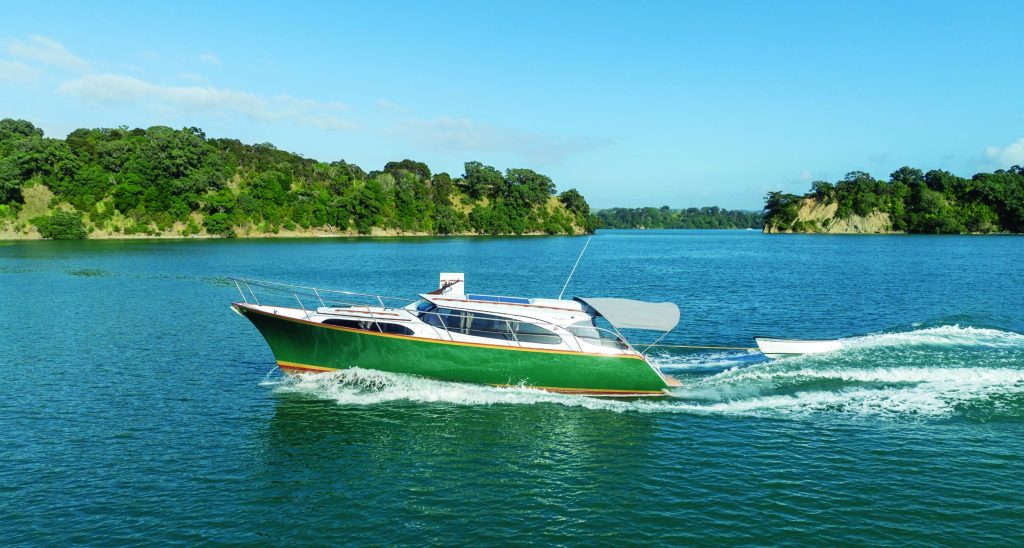
Songbird slips easily through the Mahurangi Harbour into a gentle south-west. The four-cylinder Yanmar is murmuring away at 2,000rpm, pushing the launch to an easy eight knots. Looking aft, a flat wake uncoils from the stern, with barely a wave to disturb the moored boats on either side. This is picture-postcard stuff.
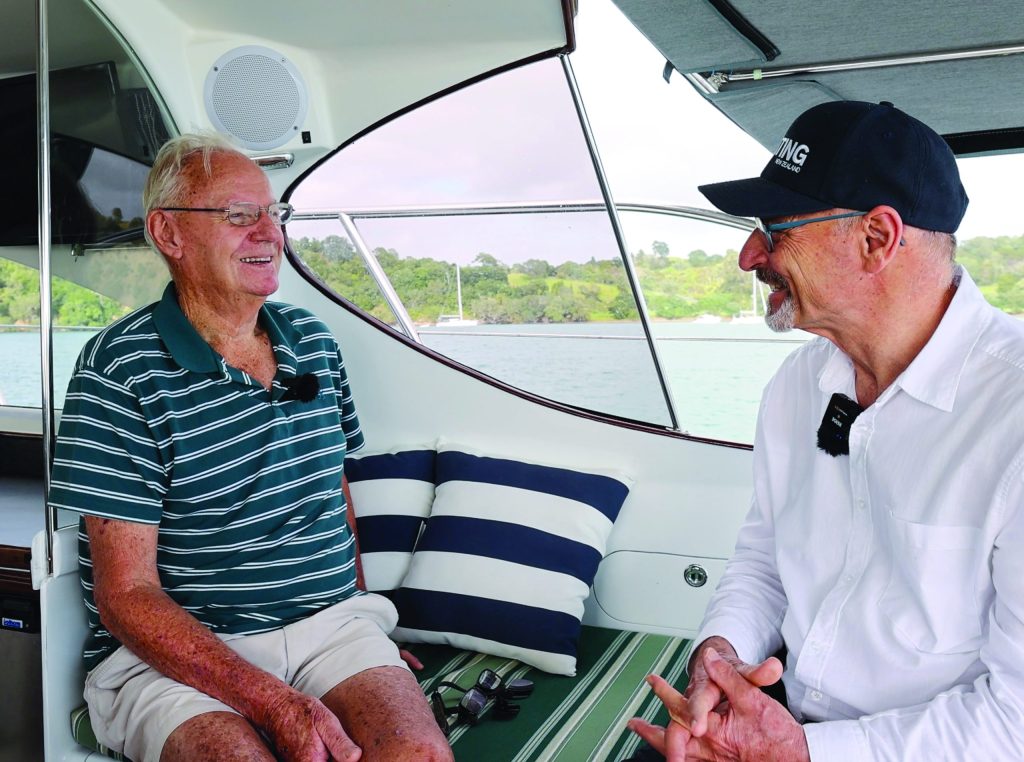
At the helm, all smiles, is Bill Townson. No stranger to building boats and, more recently, designing them, Bill’s first real taste of boatbuilding was back in 1964 when he built Mercia, the first of what became the Pied Piper design from his late brother Des’s drafting board.
Bill has built several of Des’s yachts since then, including the 11.3m Thyme, two Twilights, Petrouchka and Shangrila, and the 12.2m Cezanne, which he and his wife Mona used for a five-year circumnavigation.
The first yacht Bill designed and built under his own name was the 14m Monet, which was followed by the 13.1m pilothouse Leonardo. After selling Leonardo a few years later, Bill and Mona decided to buy a launch. Looking over what was available in the secondhand launch market, it didn’t take Bill long to become disillusioned.
“The first thing we realised was how much diesel they [launches] used – more fuel in a weekend than we used in a year.”
The couple quickly realised they had no interest in planing speeds, large, fuel-hungry horsepower engines, or flybridges. Additionally, anything remotely interesting was often found to have neglected maintenance, tired engines, dodgy electronics, or peeling paintwork.
“I soon realised nearly all secondhand launches had problems of some sort, which wasn’t what we wanted.”
The idea of designing and building his own launch was beginning to germinate when, midway through March 2020, the central government announced a nationwide lockdown.
Like most of us, Bill thought, “What am I going to do at home for the next few weeks?” and, after discarding the idea of house renovations, decided, “I’ll build another boat.”
Putting pen to paper, Bill clarified his must-haves: a helm door, walk-around side decks, sedan styling, low fuel consumption, and, naturally, an easily-handled hull.
“It’s actually more like a yacht hull than your typical launch. The PC [prismatic coefficient] is quite a bit higher than a typical yacht.”
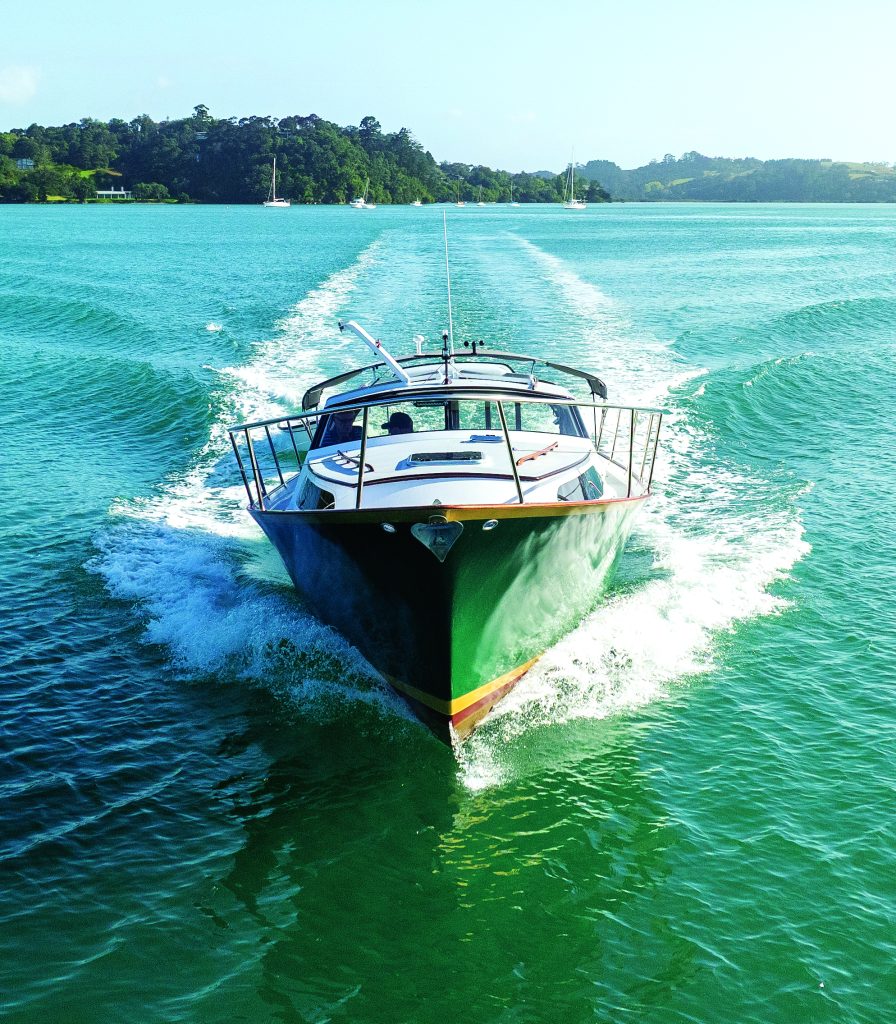
Wanting to avoid any chine slap at the bow, Bill drew a very fine clipper bow, which, combined with a flat run aft and a tight turn to the bilges aft of centre, made for an easily-driven hull. In time-honoured fashion, Bill started by carving a half model, which he developed into a line drawing and ultimately full-sized patterns.
Looking through his timber stack, Bill quickly realised he didn’t have enough kauri to build another boat. However, a friend introduced him to yellow Alaskan cedar (Callitropsis nootkatensis), which shares most of kauri’s characteristics, but without the latter’s high price tag. Yellow Alaskan cedar has a long, straight grain, steams and glues easily, is durable, rot-resistant and easily-worked.
“It’s more like a cypress than cedar,” says Bill.
Because of its excellent structural strength, Bill’s preferred method of boat construction is triple-diagonal glued timber. For the same overall thickness, three layers are significantly stronger than two. Songbird was built with an inner layer of Alaskan Yellow cedar laid at 45o to the keel, a second layer of kauri at 90o, and a third, outer layer of cedar on the opposite diagonal to the first. All skins were 8mm thick.
The end result behaves much like a giant plywood skin, made even stronger because Songbird’s glassed inside and out with 300g woven glass/epoxy. This provides a better base for the paint. The centre part of the interior, which contains the engine bearers and built-in tanks, is glassed with 400g unidirectional athwartships, laid waterline to waterline, providing massive stiffening throughout the middle of the boat. The bulkheads are all 12mm plywood, glass-tabbed into the hull after its internal glassing.
The engine beds are 150 x 50mm kauri, glassed into the hull between stations four and seven, then fully-glassed, making them essentially a permanent part of the structure. The decks are 12mm ply, with 18mm ply coamings rebated to take the armoured glass windows, which were glued in with an expansion joint.
The cabintop – from inside out – is a sandwich of 4mm ply, unidirectional glass, 20mm foam, and an external layer of triaxial glass. This was built over a former on top of the coamings. Once finished, it was lifted off, flipped upside down, and the ceiling was spray-painted working downwards. The completed cabin top was then flipped back over and glued into its final position. All gluing and glassing were done using WEST epoxy.
The hull colour has an interesting backstory that many readers might recall. Bill had been trying for some time to find a specific shade of British Racing Green for the hull without success. One night, he saw Hillary Barry on TV One’s Seven Sharp wearing a dress the colour he had envisaged. Bill sent Barry an email, and to his surprise, she provided a swatch sample of her dress. This was then run through Altex Paint’s colour spectrometry equipment. Voila! Not only did Bill get his colour spot on, but he also got to appear on Seven Sharp – twice. This could only happen in New Zealand, right?
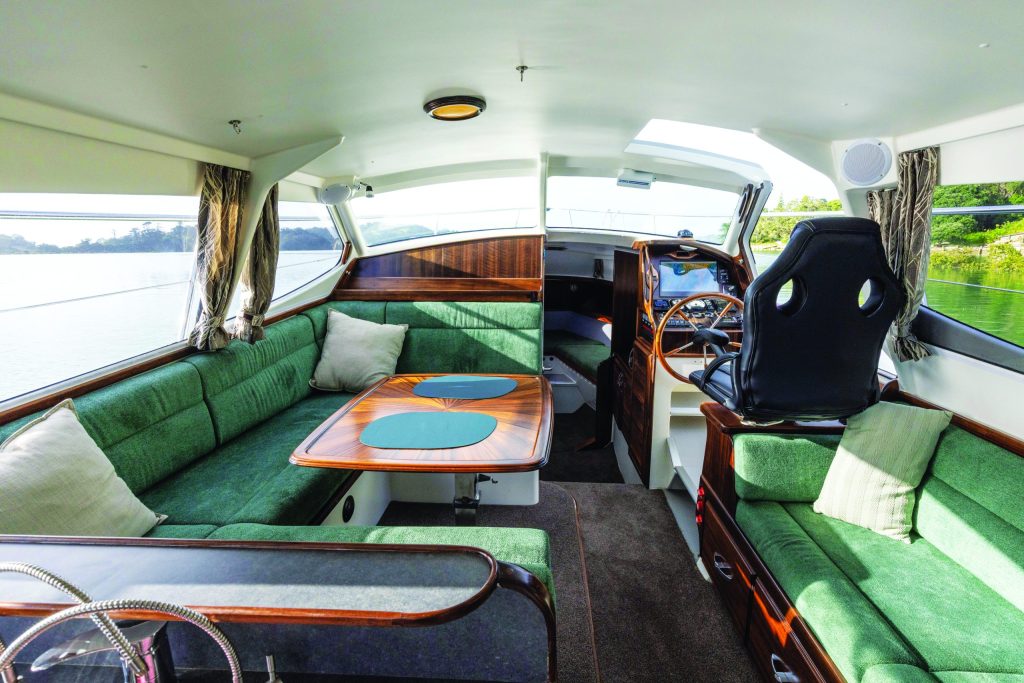
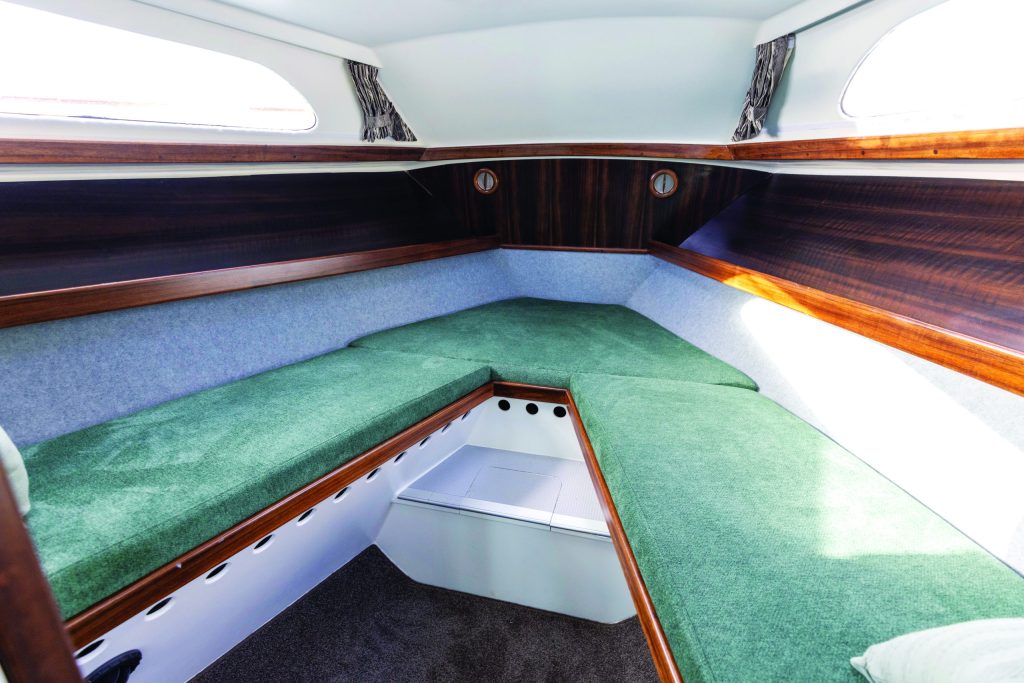
Going aboard, Songbird is as far from your average 11.4m European launch as it’s possible to be. Unashamedly, she’s a yachtie’s launch – slim, low, comfortable, and sitting with the sea rather than bulldozing through it. She has the classic minimalist layout: sleeps two, eats four, and drinks six. Actually, she can sleep four and could probably comfortably seat ten.
The boarding platform and cockpit are at the same level, and there is full headroom, even for our photographer, who stands well over two metres tall. Down a step is the cabin sole, which again offers generous headroom right through to the forecabin.
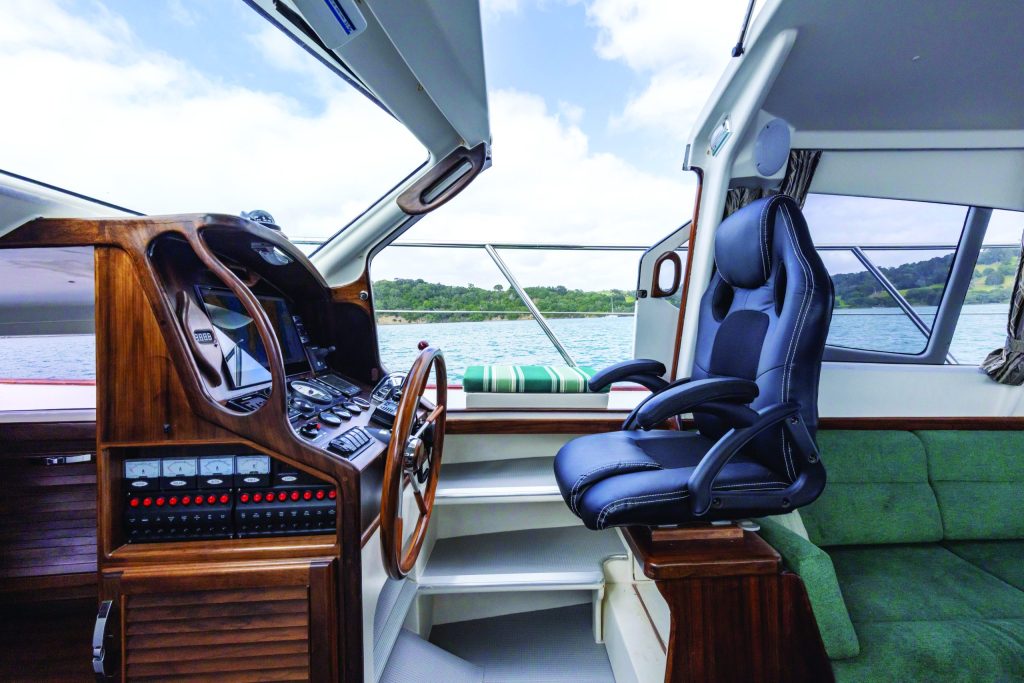
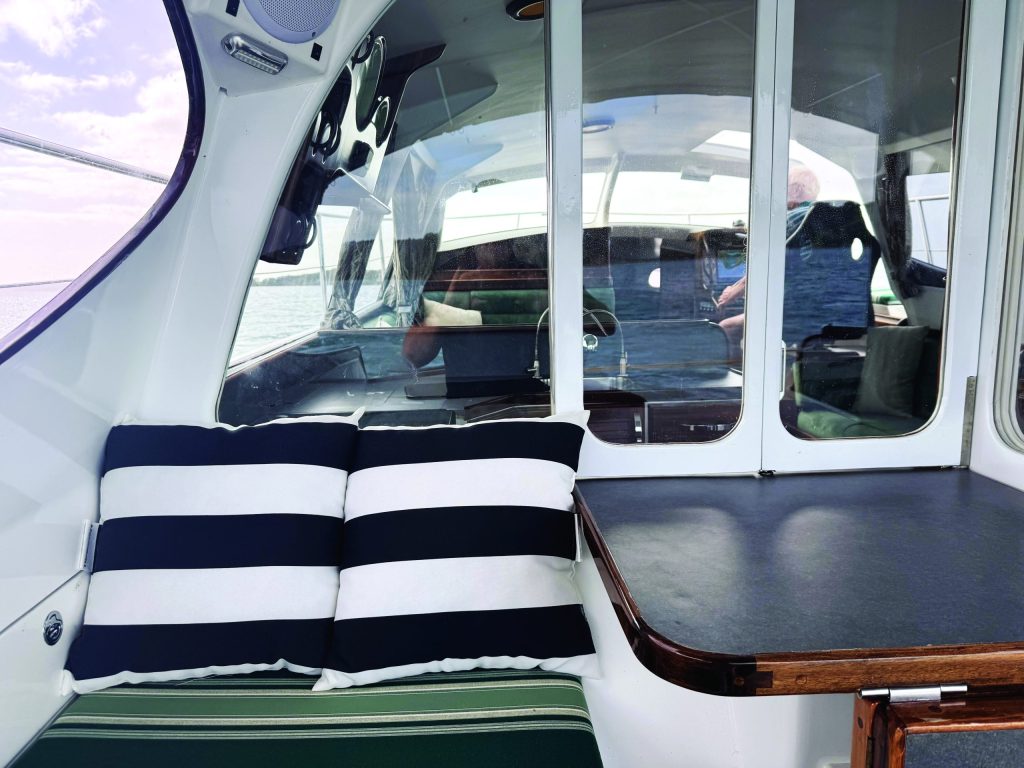
The U-shaped galley has all the usual accoutrements, the main feature being the stunning dark walnut trim. The ceiling paint and varnished trim were all done with Miratone paint, which is tricky to apply because it dries so quickly. All other paints were supplied by Altex. The photos show the impeccable standard of joinery throughout, and it’s even more impressive in person. Every joint is flawless.
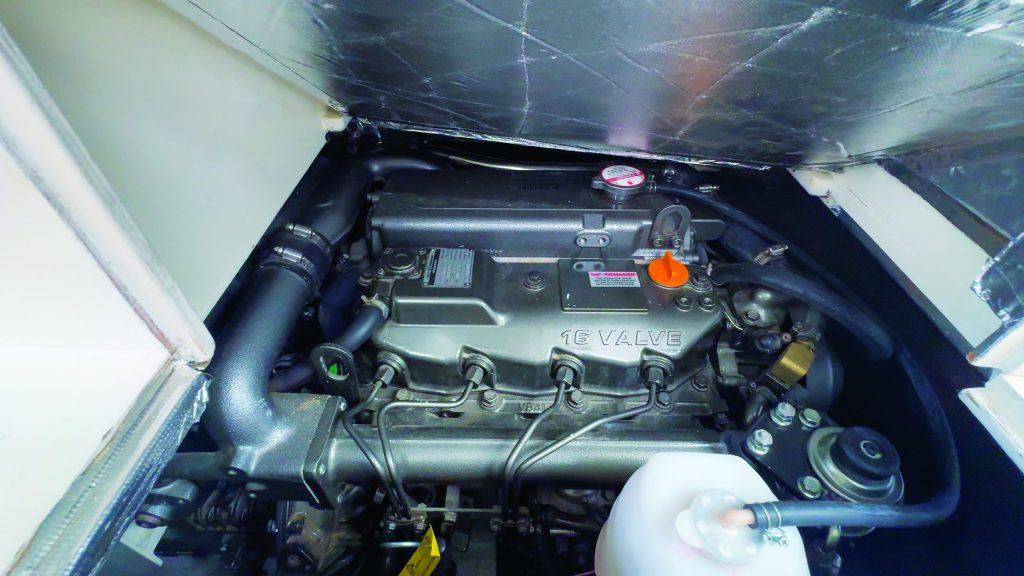
The 4JH4-HTE Yanmar engine is hidden away beneath the aft part of the dinette. Two strategically located panels lift out for daily checks and to access the water and diesel strainers. Another section of the dinette can be unscrewed for more engine access, changing belts and the like, while if the full Monty is required, the dinette itself can be relatively easily removed.
This sort of logical thinking is typical of Bill, who is always thinking, “One day I’ll have to get in there, so let’s make it easy.”
This is so different from your average production boat, where designers often don’t consider access, and routine tasks can require the agility of a teenage gymnast, with ultra-long arms and gorilla-like fingers.
Countless smart ideas from Bill’s innovative mind are everywhere. For example:
• The engine can be flushed with fresh water prior to shutdown by opening one valve and closing another in the same locker.
• The saloon table is raised and lowered with a modified 12V electric drill motor.
• The access door between the cockpit and the interior is easily unshipped and slid away into a dedicated storage locker.
• The lifeline’s midwire is an 8mm rod bent to match the toprail’s curve, rather than a wire that would result in a series of straight lines between stanchions.
• There is a two-person seat that can be slung from the cabin ceiling, so that two passengers can view out the main front windows.
• A detachable seat can be mounted adjacent to the helm, so the helmsperson can sit comfortably on the side decks to steer the boat.
• And much, much more.
Underway, Songbird has a light, gentle motion, easily nodding to the light headwinds. She felt very Townson-like to this writer, almost ready to dance through the seas like Twilights and Talents. While designed for an 8-knot cruise speed, she can be pushed to 13 knots at full revs.
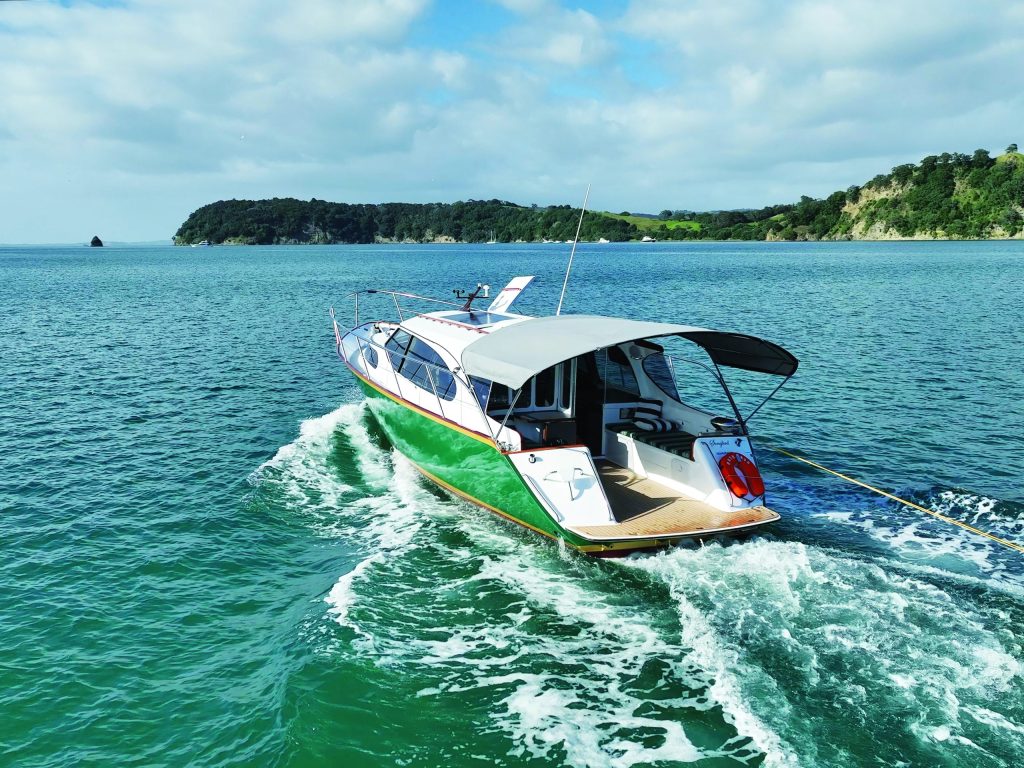
As tested, Songbird is sitting 50mm above her marks, which Bill has calculated means she’s a good 1,000kg under her designed displacement.
Much of the lower displacement was due to the half-empty fuel and water tanks. Likewise, most of the lockers are empty, so filling the tanks and bringing all the usual cruising gear aboard should bring her down to her marks.
Bill was initially concerned that the hull would roll at anchor; however, that hasn’t proved to be the case, unquestionably due to the flat sections aft and the generous beam.
The clipper bow is unusual, but it’s an excellent way to work flare into the bow whilst keeping the hull shape easy to build. Bill reports that it’s rare for spray to come over the gunwale; 90% of it is dragged aft by the breeze around the bow. The clipper bow also creates a spacious foredeck for anchor work.
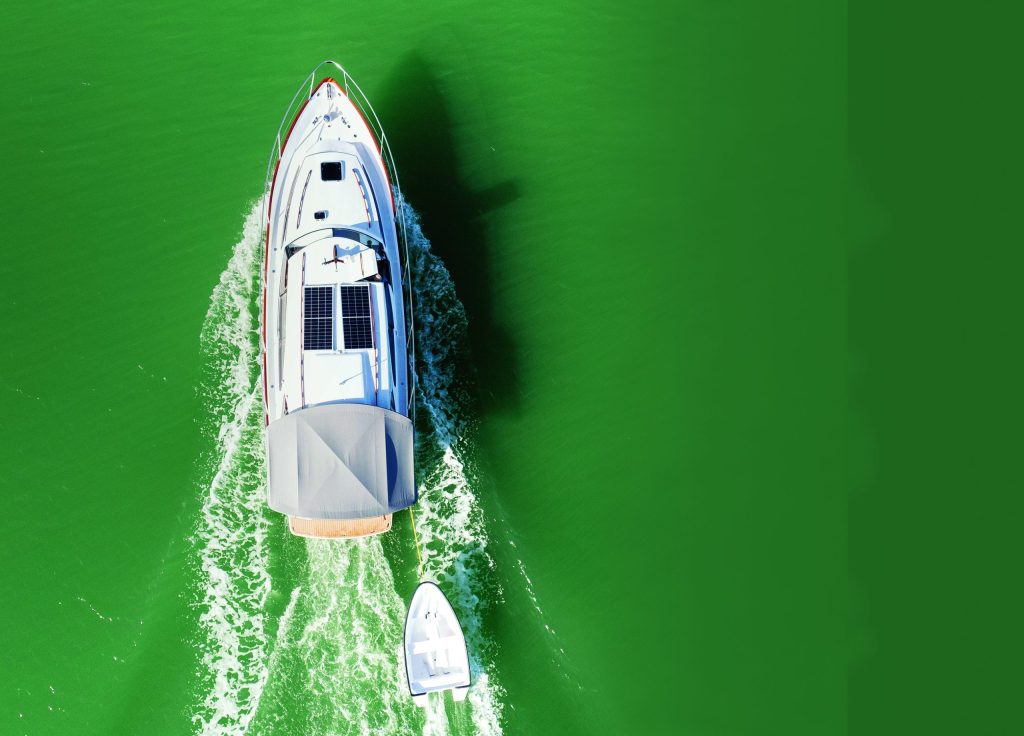
Speaking of which, Songbird’s side decks are brilliant for accessing the foredeck, wide, safe and secure. Combined with the two-part hatch at the helm and the higher-than-average solid handrail, one can go from the helm to the anchor in any conditions with perfect ease and safety. Many modern launches ignore this aspect, and accessing their foredecks is often a white-knuckle exercise.
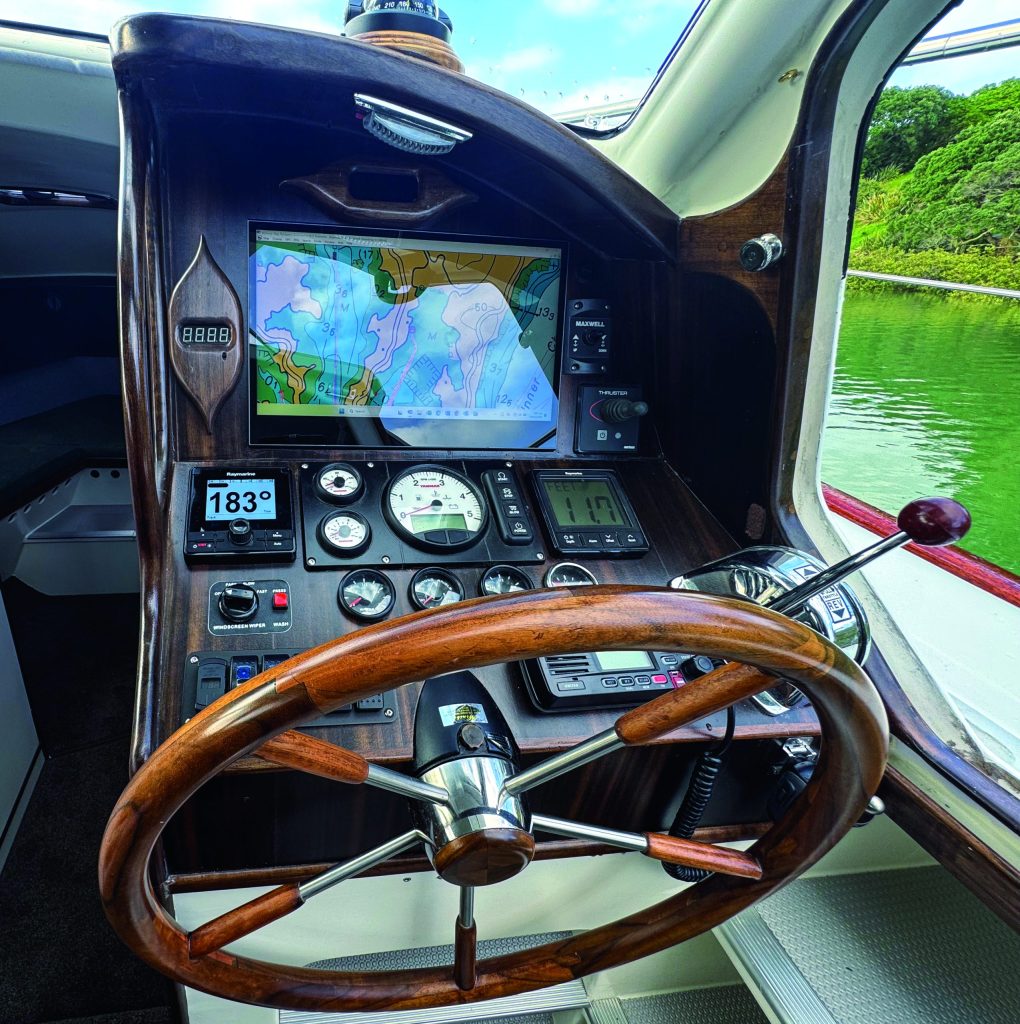
The hydraulic steering was beautifully balanced, firm, and positive, providing just the right amount of feedback. With his extensive yachting background, Bill had agonised over the size of the rudder, but settled on the traditional 5% of the lateral underwater area.
In this writer’s opinion, the rudder size is spot on. Turning Songbird 360o without the bow thruster showed a turning circle a gnat’s whisker over a boat length. The only time we used the bow thruster was to guide Songbird back onto Bill’s tricky four-rope mooring; her shallow hull struggles to grip the water in a cross breeze.
Songbird was launched in November 2025, with Bill and Mona’s many friends and helpers present. While excited, Bill was actually exhausted. While the first three years of the project had gone easily enough, the last two had been physically challenging.
“I just didn’t have the energy anymore.”
Given he’s now aged 83, this is perfectly understandable.
It all caught up with Bill after Songbird was launched. While the boat has been everything he wished for and more, the couple has found that age has caught up with them, and they are struggling to get the boat on and off their mooring. Given recent health issues, they have made the difficult decision to sell Songbird.
“I wanted to do it while we have choices, I don’t want to wait until it’s forced on us,” explained Bill with a tear in his eye. Having gone through selling a deeply-loved yacht a few years ago for similar reasons, this writer could only empathise.
It’s a wise man who acts strategically to avoid having events dictated to them later. And Bill is a wise man.
Whoever buys Songbird will become the custodian of one of the finest timber launches ever to grace the sparkling waters of the Hauraki Gulf.
And she will always be the boat that Bill Townson designed and built.