The biggest boat in the Smartwave lineup, the Smartwave 4800 has a softer, more rounded hull that has less of the gullwing shape and is more like a conventional vee hull.
|
Originally published in August 2014. Specifications and model details reflect that period. Smartwave’s polyethylene boats were already well established in New Zealand waters when we conducted this review more than a decade ago. Known for their toughness, buoyancy and low-maintenance appeal, the brand carved out a niche among families, clubs and coastal users looking for something practical and durable. While the range has evolved and pricing has shifted since 2014, this review offers a useful snapshot of Smartwave’s 3500, 4200 and 4800 models as they stood at the time. We have retained the original text below as an archival reference for readers researching the development of polyethylene boats in New Zealand. |
Smartwave makes great little poly boats (boats made from polyethylene plastic). We got to test three variants of this innovative plastic design.
We spent a lot of time trying to organise a boat review of the Smartwave 4200 centre console. After several false starts, we finally got around to testing this new poly boat. On the day we also grabbed two of its sibling boats: the bigger Smartwave 4800 and the smaller Smartwave 3500. It turned out to be a very interesting exercise in comparing three very similarly configured boats but of different sizes.
Smartwave Poly Boats
Smartwave makes poly boats, plastic boats moulded out of linear medium density polyethylene (LMDPE). This makes all Smartwave boats UV-stabilised, exceptionally strong and durable.
LMDPE itself floats, and the double-skinned hull is foam-filled—so, even if the boat were to be cut in half, both parts would continue to float. All models of Smartwave have undergone CE certifications, so these are phenomenally safe boats.
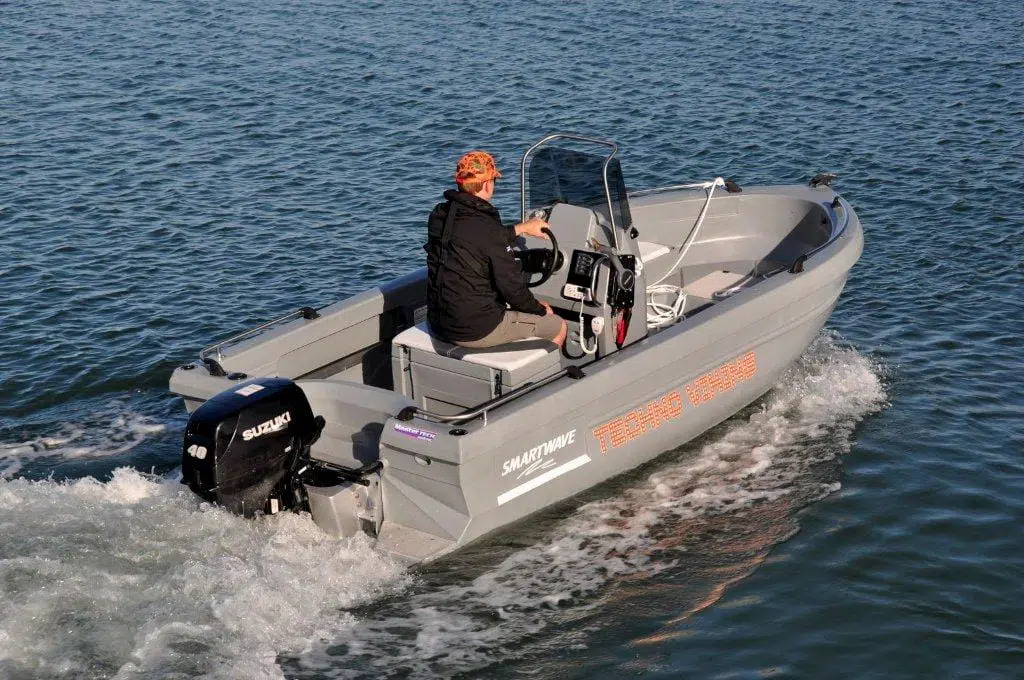
The Smartwave 4800 Boat
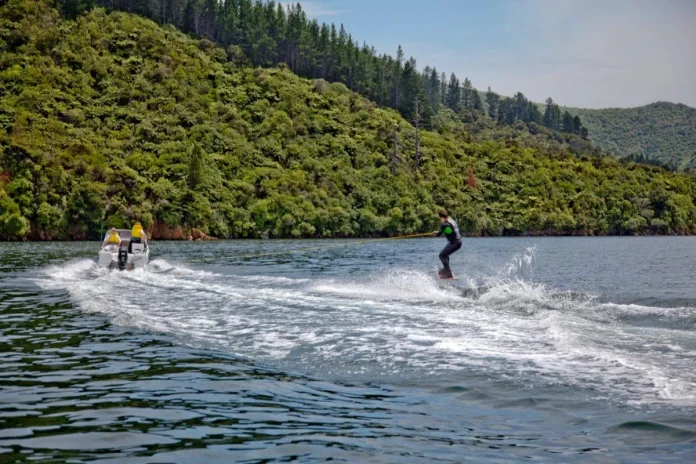
The biggest boat in the Smartwave lineup, the Smartwave 4800 has a softer, more rounded hull that has less of the gullwing shape and is more like a conventional vee hull.
We again had the centre console layout to have a play with, although this model also comes in a cuddy cabin “offshore runabout” version. This boat was moulded in a pleasant white colour with a slight marble fleck, and this time came with the 50hp Tohatsu motor.
Measuring 4.80m in length, and with a beam of 1.96m, it is the most spacious of the three and can accommodate six passengers with ease. This is the only model that has a built in fuel tank, an 80lt underfloor unit. Due to the lack of tote tanks there is more space under the transom for storage. There is additional underfloor stowage for keeping gear out of the way, while pockets moulded into the sides provide a shelf with integrated rod storage options.
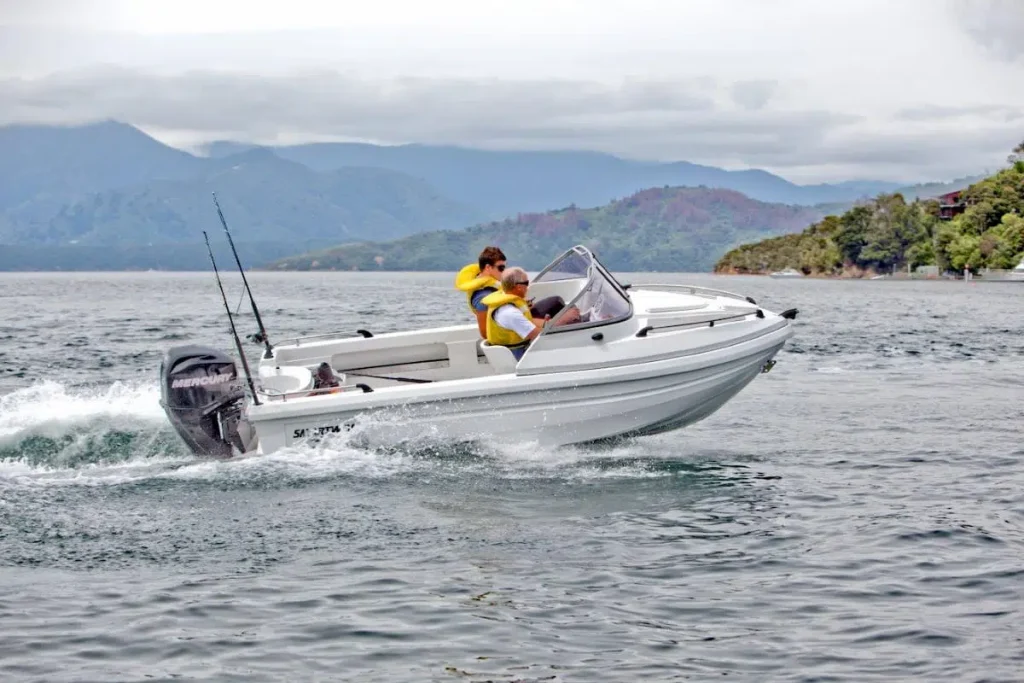
Rodholders are moulded into the boat, and stainless grab handles are again fitted to the gunwales. Up front however, there is no separate anchor well, and the anchor would need to be stored in the under-seat pocket when not in use.
A conventional stainless bowsprit holds the anchor and rode when required, with a cleat fitted out of the way inside the gunwale for tying off.
The same centre console unit as used in the other two boats is fitted, but with more space to move around the sides of this one. The helm seating is again on a padded chilly bin, big enough for two to sit on comfortably, with further seating in the stern and bow areas.
The centre console is mounted well forward on this boat, reducing the foredeck area but opening up the rear cockpit space. This makes for more usable space in the boat and also improves the ride when there is a single occupant, but it does mean the console position is more liable to cop spray in a rough sea.
The 50hp Tohatsu is again in the middle of the recommended range, which for this model is between 40 and 60hp. Unless heavily laden it is likely, once again, to be completely adequate. The boat tracked flat and held a line easily when at speed. We did not measure top speed, but we easily reached speeds well over 20kts.
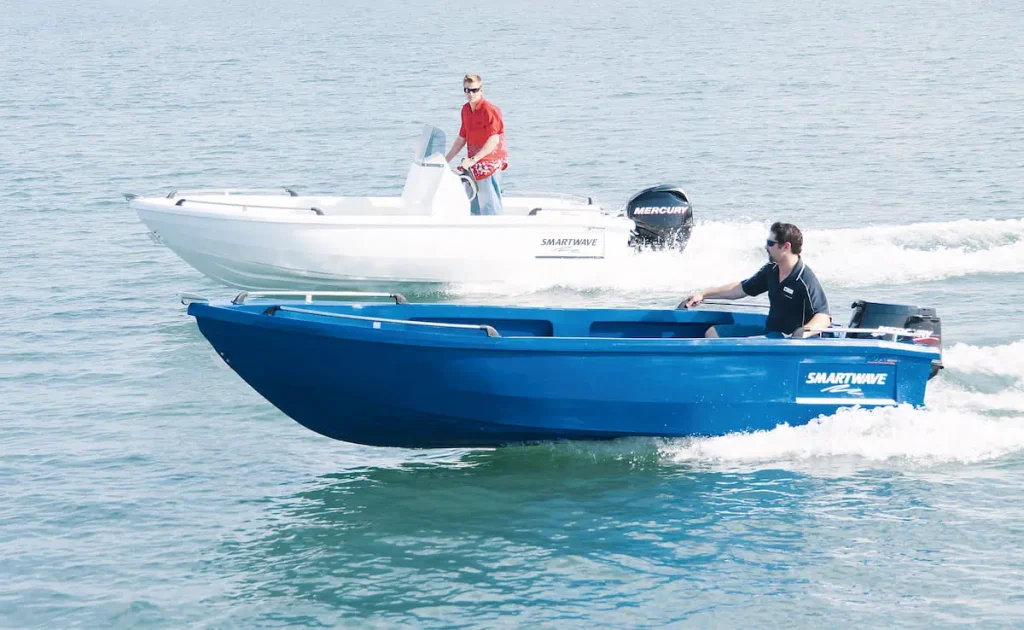
The greater weight of this boat means that the boat punches through the chop better than the smaller models which tend to lift over it, and hence there’s a smoother ride over a short disturbed sea. However, due to the more conventional hull design, the boat is not quite as good at turning away the spray as the gullwing shaped 4200 and could be a slightly wetter ride in poorer conditions.
Being a more “conventional” shape, the 4800 is likely to have broad appeal, and the availability of the cuddy cabin also means there are more options for a family boat. The 4800 is still a very modest towing proposition, so, for those with a slightly larger budget, may be a good option.
The Verdict
All the Smartwave boats have their strong points, with very few vices. They are extremely well priced, arguably the safest boats you will ever buy and virtually indestructible.
The new design 4200 with its gullwing hull is the most radical design and has managed to pull that off well, delivering a dry and smooth-running boat. We rated the ride quality of the 4200 as being better than the 4800 although there is, of course, less space. The 3500 is definitely best-suited to sheltered waters rather than open sea, although on a good day could certainly be taken out wider.
All three have the same ultra-safe reliability due to the construction material, and choosing one to suit your budget and preferred style of boating should be an easy decision.
Highs
- Toughness of the hull.
- Great sound absorption of the hull.
Lows
- Open boats get wet in a chop.
Specifications
| Model | 3500 | 4200 | 4800 |
|---|---|---|---|
| Material | Linear medium density polyethylene with foam-filled voids | ||
| Length | 3.5m | 4.2m | 4.8m |
| Beam | 1.7m | 1.93m | 1.96m |
| Weight | 100kg | 220kg | 325kg |
| Engine hp | 30 | 40 | 50 |
| Fuel | Tote tanks | Tote tanks | 80lt underfloor |