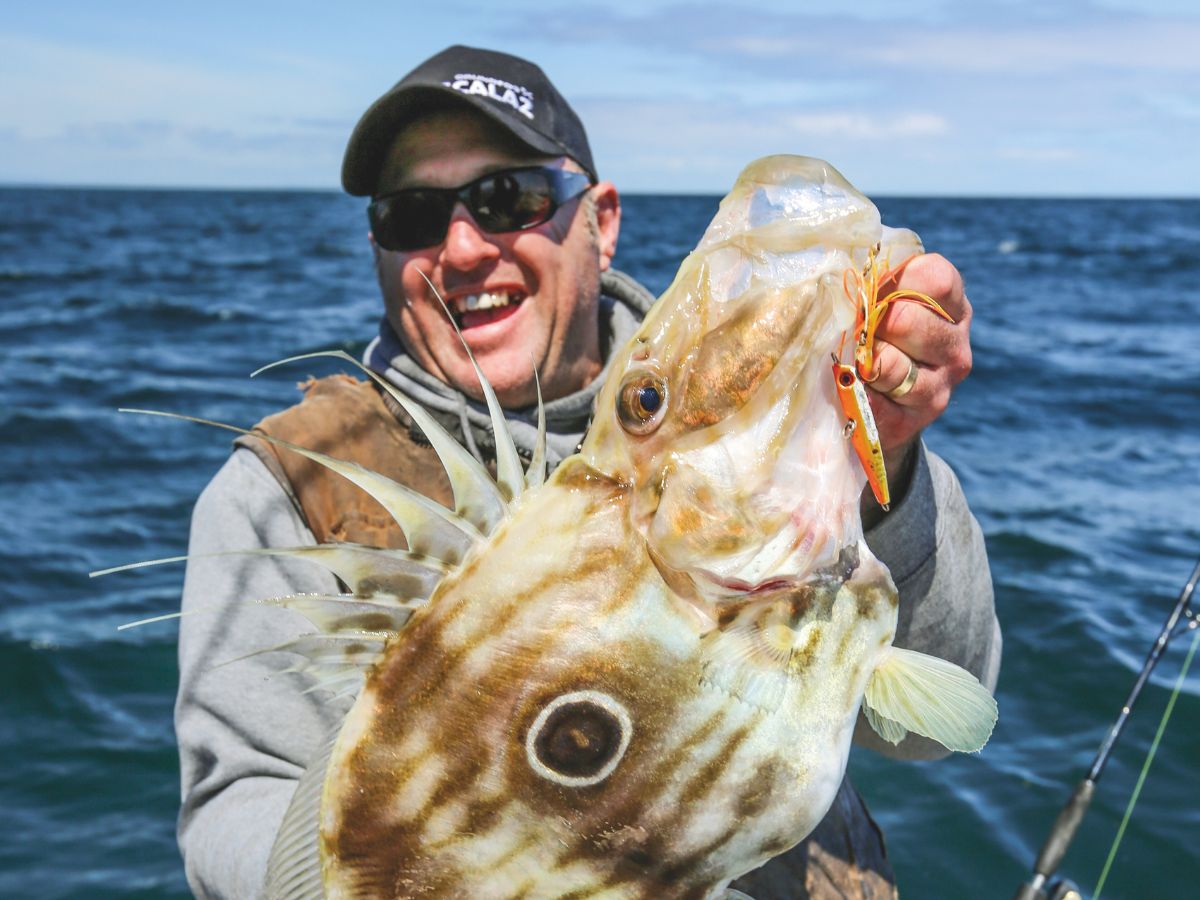
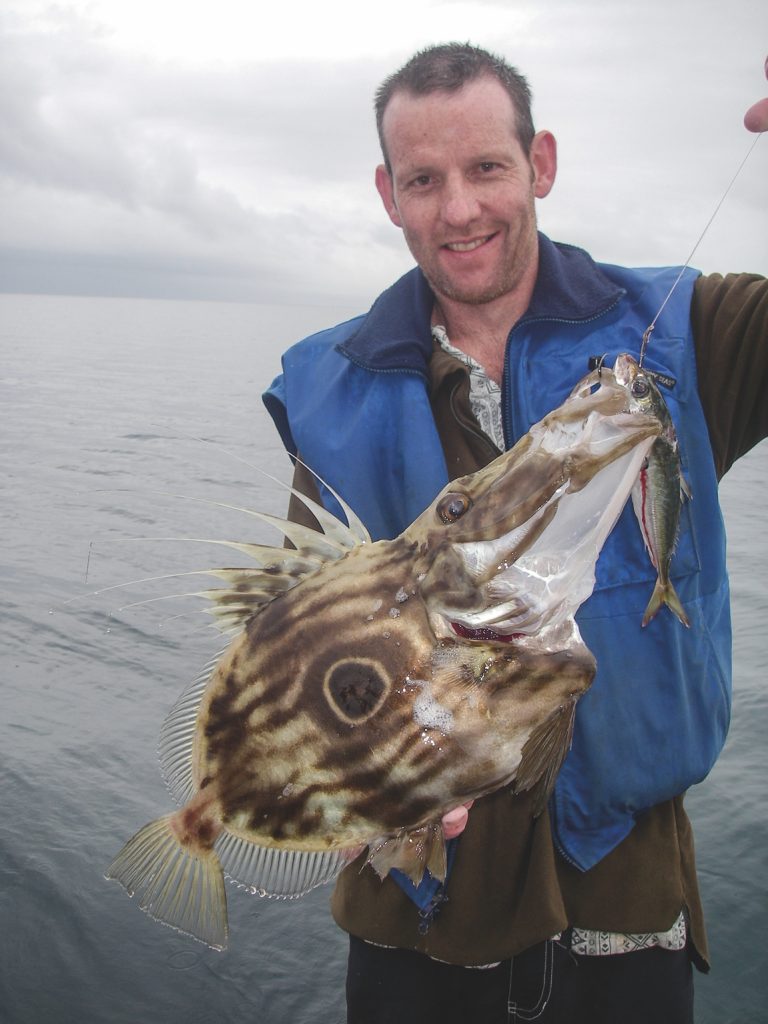
No, it won’t be Jack Nicholson’s grinning, demented face popping through the smashed door when this cry goes up. Rather, it will be one of happiness knowing that a john dory, one of the most delicious fish in the ocean, is about to come on board!
The fact that john dory are still reasonably abundant, especially in more northern waters, is something of an enigma. As relatively poor swimmers that almost seem to drift around in the current, you’d think they would be too slow to catch the speedy baitfish they shadow and that they’d be sitting ducks to predators such as sharks. Yet they manage to survive very successfully using several tactics.
First up is a brownish green creamy coloration, which blends in beautifully with weedy environments, helping them to ambush prey and making them less visible to bigger fish.

Secondly, they also have an incredibly slim profile when viewed end on, again making them harder to see. It is this aspect that allows them to ‘ghost’ up to potential prey, close enough for their huge, distensible mouth to shoot out and engulf surprisingly big baitfish.
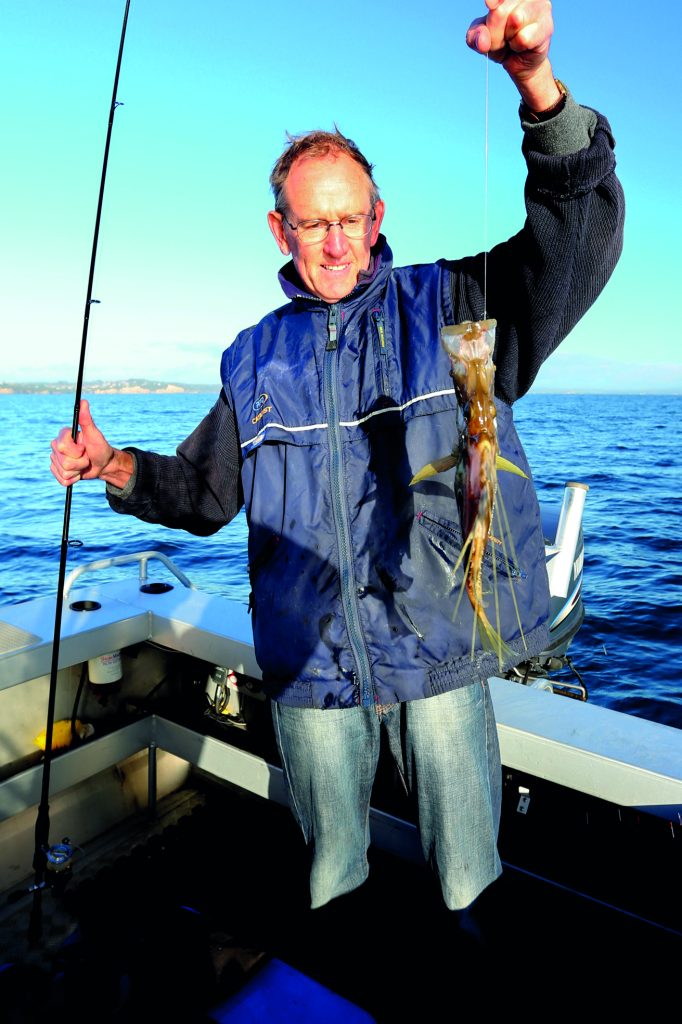
Thirdly, the large blotchy dot like a big eye on their sides seems to disorient other fish, making it hard for predators and prey alike to determine which way the john dory might be heading. The bony lines of spines along their bellies must act as a deterrent to predators, too.
But none of these tactics work on anglers. Instead, we have worked out that as they almost exclusively eat live prey and that the best way to catch them is to drop down a live bait or a slow moving lure near schools of baitfish.
Suitable John Dory tackle
Although our target species is a reasonably small, weak fighting fish, the gear used to catch them needs to be sturdy, as kingfish are a common bycatch. Consequently, 15 to 24kg tackle is practical, ideally fitted with a reel that holds at least 200m of suitable line, on a powerful seven to 10 foot rod, the length determined by where you are fishing.
The mainline can be braid or nylon; each has its pros and cons. Braid is around one third the thickness of nylon, so a much smaller reel can be used, and it cuts through the current very effectively, too. Nylon, on the other hand, is much cheaper to buy, and its extra diameter means it’s better at withstanding damage from contact with wharf and bridge piles or other structures. Or simply go strong and practical with a 37kg nylon handline.

First, find a likely location. I generally target johnnies from wharves in northern parts, or out of boats along the sides of channels, or in front of weedy structures showing baitfish schools.
While john dory are not strong swimmers, they are nonetheless often found around wharves where there is some current present. More understandably though, they frequently hold around the wharf piles, as these break up the tidal flow so johnnies can hold position with less effort. The baitfish are there for similar reasons, with the wharf’s structure sheltering small fish from the current and providing cover from predators.
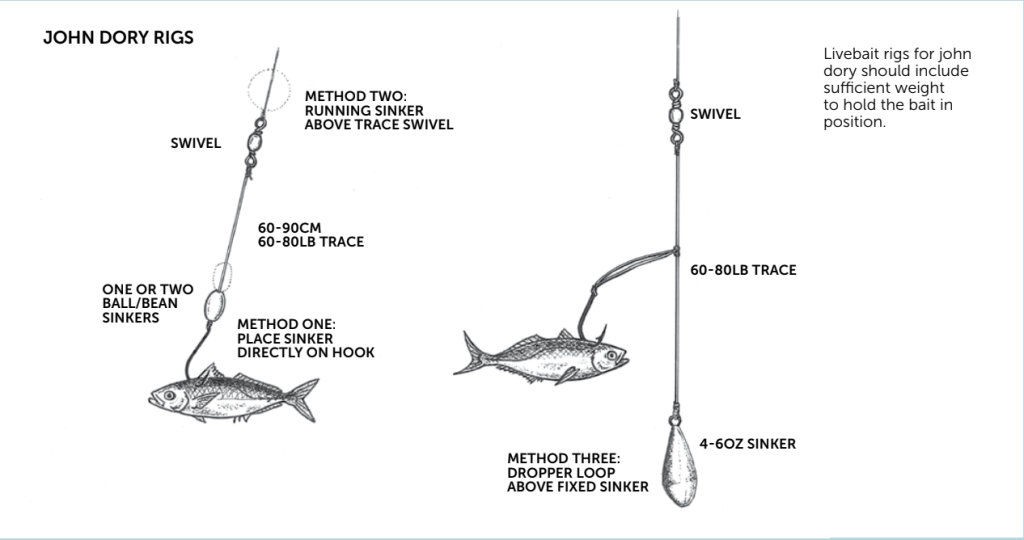
So it makes sense to present a back hooked livebait as close as possible to any piles that have baitfish nearby. You’ll need to account for tidal direction and strength; the livebait needs to be positioned quite near the pylon on the bottom, but not so close that it can swim around it. In short, a rig with a decent sinker and a leader measuring no more than 60cm is required. Just a gentle lob is all that’s required when dropping the live bait down.
Next, set your reel so the outfit can be laid down on the wharf, with the tip section protruding over the side, just a small amount of drag pressure set and the ratchet deployed, and leave it to look after itself. Done correctly, the rod will not get pulled in. You can adapt this technique when your boat is tied up alongside a wharf.

Sometimes the bait will become agitated, making the rod tip bounce around, before it steadily bends downwards, signalling that the bait’s been eaten. You may hear the sound of a slowly clicking ratchet as the johnny swims off. But not always.
Occasionally the rod tip just bends a bit more, and the line moves around a bit in the current. The john dory has eaten the bait but is content to stay in its ambush position behind the pylon until you set the hook.
Alternatively, if baitfish are hard to catch or lure fishing techniques are preferred, john dory can also be caught on softbaits or fluttery jigs. Again, it pays to target the area just down current of wharf pylons.
Softbaits may need quite a heavy jig head to maintain a position close to the pilings if the current is quite strong, especially if paddle tail soft baits are used. Speaking of which, paddle tails really do look enticing when slowly lifted and dropped in the current, their tail thrashing invitingly. Small wonder that johnnies can’t resist them.
As for jigs, 40 to 120g examples offering some flutter and flash get the most johnny strikes. Again, a slow lift and drop action just off the sea floor works best.
It’s a similar story around reefy, weedy areas. Look for schools of baitfish, ideally over relatively clear ground just in front of a reefy structure, or attract your own baitfish school with a steady berley trail and fish around it.
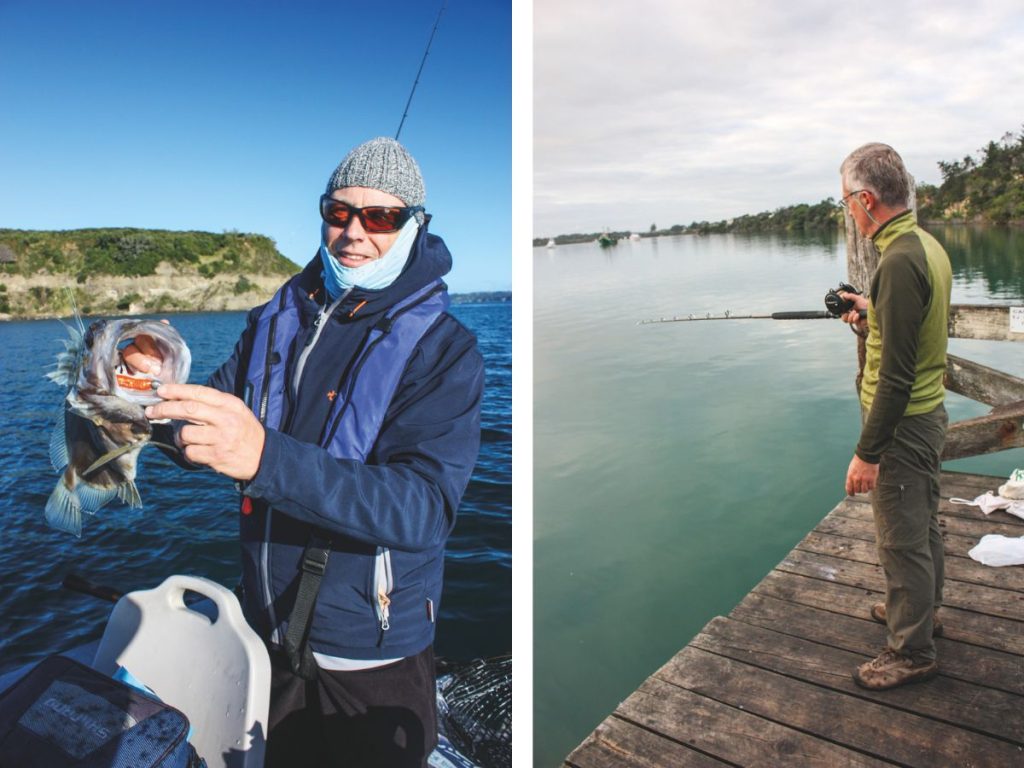
regular kingfish bycatches!
Live baits, softbaits, and jigs can do the damage in this situation as well. If using live bait, keep the leader length to the sinker or dropper length quite short, as it acts as a tether that makes the live bait easier to catch and eat. In fact, it’s perfectly acceptable to place the sinker directly on top of the hook.
Whether fishing live bait or lures, in whatever situation, use your fishfinder to identify where baitfish are holding and present your offering at the same depth.
Avoid setting live baits too close to the bottom where they can be snagged. One to two metres off the bottom is recommended.
Wriggling live baits securely tethered to a suitable sinker can be left to work their own magic, the reel set with just enough drag pressure to hold the bait in position with the ratchet on. Softbaits and jigs, on the other hand, need to be actively worked, slowly and repeatedly lifted and dropped.
Finally, john dory should always be brought on board using a net. In addition to having very soft mouths from which hooks easily tear free, they are often not hooked at all. Instead they have the bait jammed in their mouths, ready to slip free at any moment.
Here comes Johnny!