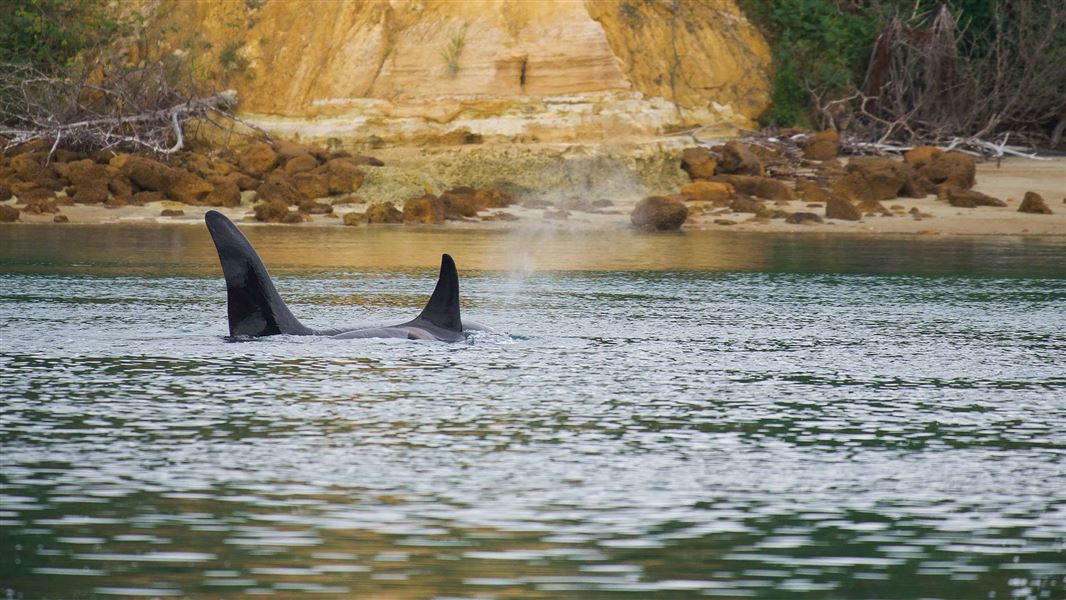
On 23 March, a pod of orca feeding in Raglan Harbour was approached by several recreational boats. A witness reported the incident to the Department of Conservation, identifying at least one small runabout among the vessels. DOC has confirmed there was also an earlier incident in the same harbour a few weeks before that.
DOC’s Waikato Operations Manager Niwha Jones says anyone who witnessed the 23 March incident and can identify the boats or their skippers should call 0800 DOC HOT and quote case number CLE-11562. Information can be given anonymously. They are after eyewitness accounts, video or photos.
“Orca are amazing animals to encounter if you’re out on the water,” Jones says, “but they’re a powerful apex predator and deliberately getting close to them is very risky. We urge all boaties to let the orca interact with humans and vessels on their terms, not ours.”
Orca move through Raglan Harbour periodically to feed. Seeing them from a distance, whether from shore or the water, is one of those encounters that stays with you. Get too close, and you are breaking the law.
What the law says
Every orca in New Zealand waters is protected under the Marine Mammals Protection Act 1978. The rules are specific, and they apply regardless of what you are on, from a 60-footer to a kayak.

Vessels must stay at least 50 metres away from orca. Fifty metres is the legal floor, not the ideal position. If a pod is actively feeding or has calves in tow, the sensible thing is to back off further and watch from a distance.
No vessel should place itself directly in front of the animals. Orca move as a group and cutting across their path counts as a disturbance, even if the distance looks adequate.
No more than three vessels are allowed within 300 metres of orca at any one time. Kayaks can raft together and count as one, but individual kayaks each count separately.
Do not try to swim with orca. If orca approach while you are already in the water, leave quietly. No splashing, no sudden movement.
The penalties
Harassing, disturbing, injuring or killing a marine mammal is a criminal offence under the Marine Mammals Protection Act. The maximum penalty is two years in prison or a fine of up to $250,000.

DOC can issue infringement notices for less serious breaches, but prosecutions happen too. Getting too close to a pod of orca is not the sort of thing that ends with a conversation on the dock. People have faced court over it.
Most New Zealand boaters would not deliberately push a pod of orca around. But crowding them out of excitement, or not knowing where the 50-metre line is, carries the same legal weight as deliberate harassment. Worth knowing before the next time a fin shows up off the bow.
If you were near Raglan Harbour on 23 March and saw what happened, call 0800 DOC HOT and quote case number CLE-11562.
For More information on ORCA, go to this website.