A major industrial transition has reshaped the American recreational boating landscape. Groupe Beneteau recently finalised a decisive restructuring program, electing to halt assembly lines at its long-standing Cadillac, Michigan facility. Marking a major pivot toward European consolidation, this move divests Groupe Beneteau of three iconic domestic watercraft labels: Four Winns, Glastron, and Scarab Jet.
A century of shared American heritage
Historically, Four Winns, Glastron, and Scarab Jet each carry immense cultural weight, bridging decades of cinematic fame, racing milestones, and family recreation:
Scarab: Originating from engineer Larry Smith’s high-performance 1974 deep-V design, the brand honorably resurrected the racing name of sportsman Lance Reventlow. Utilising Kevlar laminates, the brand achieved legendary racing status when Betty Cook drove Kaama to secure the 1977 UIM World Offshore Championship, shattering ocean glass ceilings as the first female world titleholder. Pop-culture immortality followed in 1985 when the Scarab 38KV became Sonny Crockett’s neon-hued icon on Miami Vice, prompting actor Don Johnson to later join the circuit and pilot a 46-foot variant to an APBA world championship in 1988.
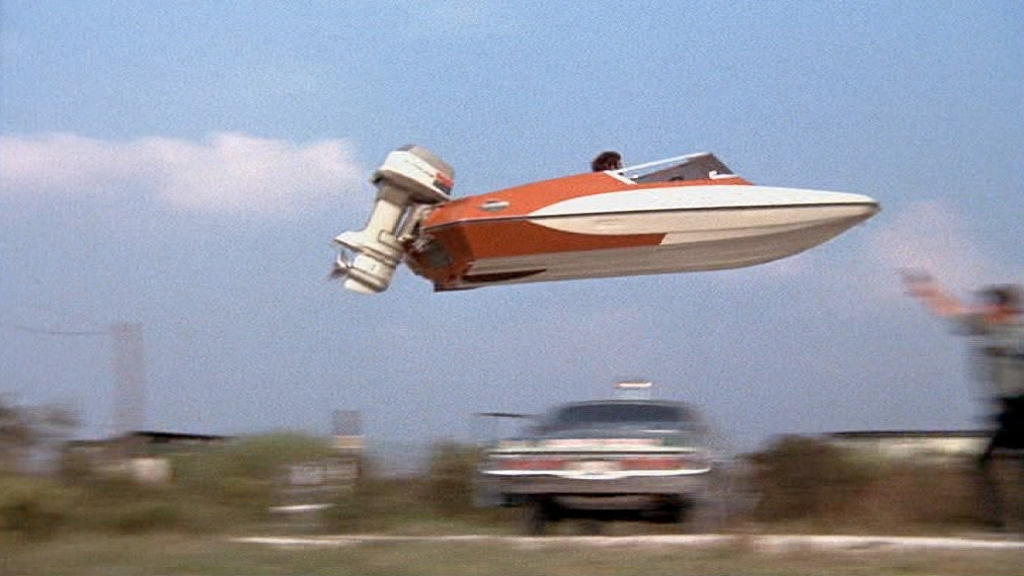
Glastron: Renowned for blending performance with cinematic showmanship, Glastron earned worldwide fascination during the 1973 James Bond film Live and Let Die. In a breathtaking pursuit sequence, a Glastron GT-150 leaped an astonishing 110 feet across a Louisiana highway and police car, securing an enduring Hollywood legacy.
Bond 26 and the boats of 007: Will the new film keep the nautical tradition afloat?
Four Winns: Founded in Cadillac in 1975 by Bill Winn Sr. and his three sons, the builder became the reliable backbone of domestic family day boating. Over 50 years, they pioneered recreational bowrider comfort, culminating in the modern Four Winns H2e—the first mass-production fully electric runabout.
Reabsorbing factory capacity into European centres
Rather than relocating, Beneteau is leveraging its modern infrastructure across Europe to absorb future production capacity. Small-to-midsize dayboating demands are being rerouted into Poland, which specialise in efficient outboard designs. Meanwhile, premium dayboat production will be absorbed by Beneteau’s historical facilities in Vendée, France, and its facility in Portugal.
Driving Wellcraft into global channels
While its former Cadillac stablemates are being sold off, the iconic Wellcraft brand has been chosen as one of Beneteau’s seven strategic pillars. However, its distribution mechanics are changing fundamentally. Wellcraft’s specialised offshore commuter and centre-console lines will transition to premier Polish and French shipyards.

This manufacturing relocation strategically unlocks massive distribution channels. Wellcraft can now tap directly into Beneteau’s network of over 1,200 global sales locations, positioning the rugged explorer platform seamlessly into expanding Mediterranean, Baltic, and Asia-Pacific markets. Free from the financial drain of sluggish runabout lines, Wellcraft will focus exclusively on high-margin offshore multi-use designs.
An export-driven future
This strategic retreat does not signal a total withdrawal from American waters. Instead, Beneteau is abandoning the localised factory model in favor of an aggressive, highly profitable export strategy. Moving forward, American boat dealers will be supplied by shipping premium vessels directly across the ocean, sustained by international order books that have climbed nearly 10%. To support this influx of larger vessels, Beneteau has funneled capital into expanding domestic infrastructure, including a new €3.3 million vessel commissioning center in Les Sables-d’Olonne, France, boosting annual launch capacities dramatically.