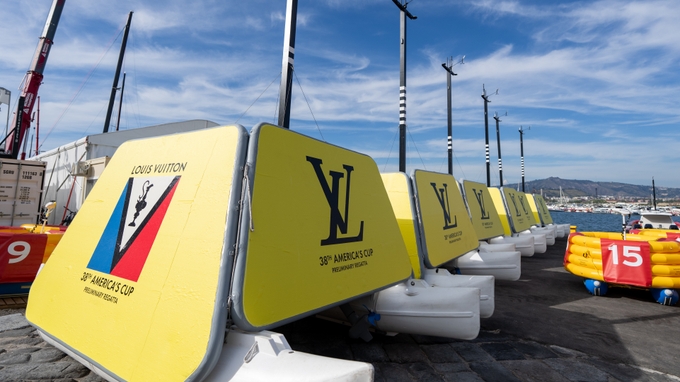
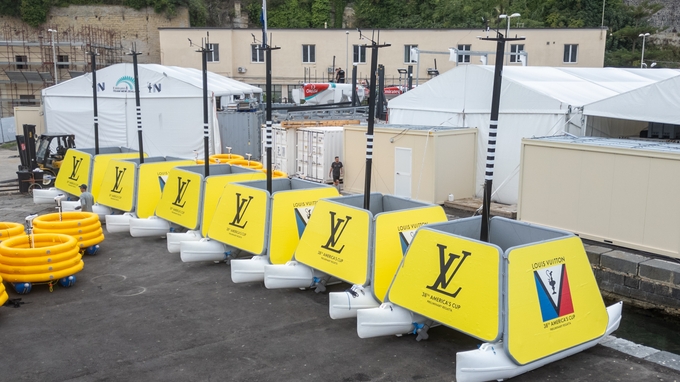
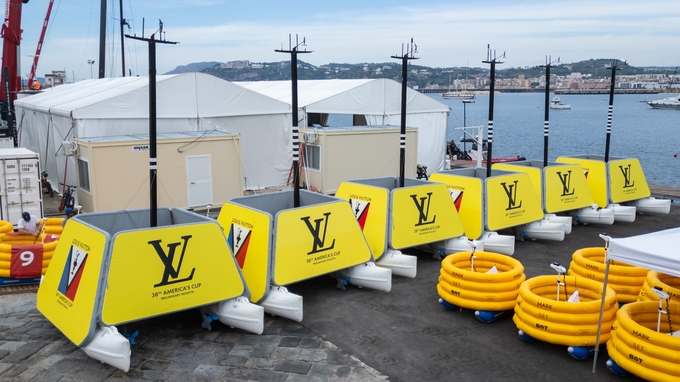
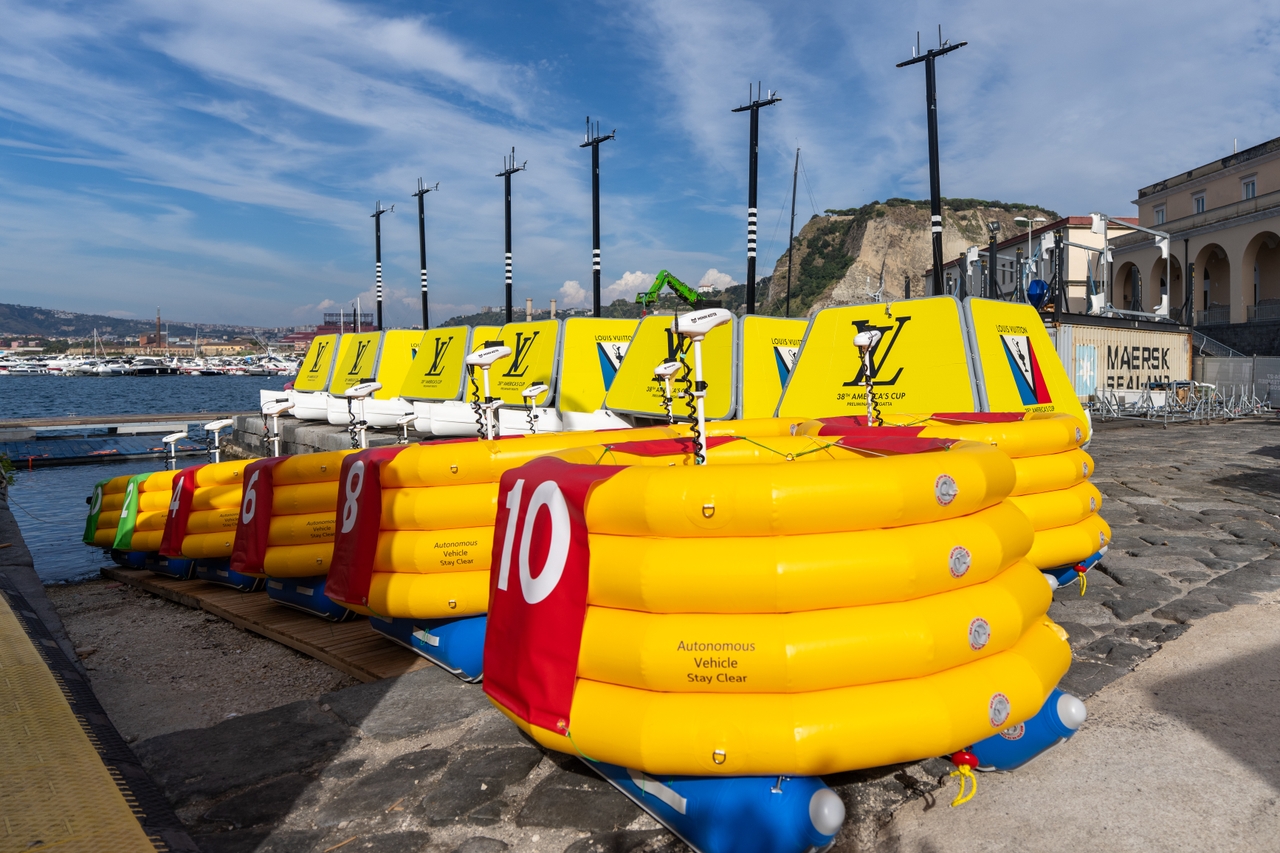
With frontier technology being the very essence of the Louis Vuitton 38th America’s Cup, the event will once again be using autonomous buoys to mark the racecourse of the Preliminary Regatta. Autonomous buoys have become ubiquitous at premier yachting events, largely due to their reduced environmental impact (no anchors on the sea bed) and to allow for Race Officials to quickly alter the axis of the course depending on variance in wind direction.
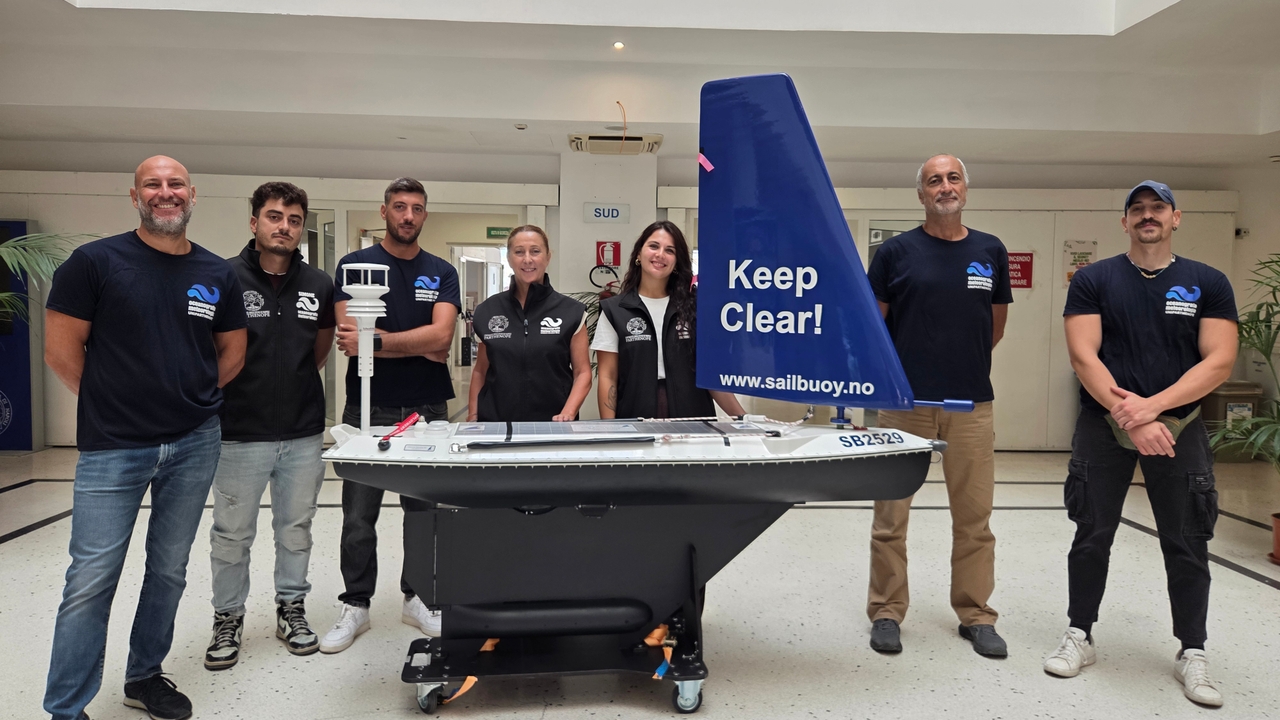
The Sailbuoy runs entirely on wind power for the movement and is solar powered for the scientific payload, it has no engine, no propeller, wind and sun are enough to realise long monitoring missions at sea. It collects oceanographic, biological and meteorological data in coastal and open ocean areas with no environmental impact and no human presence. University Parthenope Naples
For PR2 Naples, Iain Murray the Regatta Director and his professional race team will have full GPS control of the marker buoys which can both vary the axis and also the length of the legs of the course to hit the target race time (per race) of between 20-25 minutes.
The Sailbuoy runs entirely on wind power for the movement and is solar powered for the scientific payload, it has no engine, no propeller, wind and sun are enough to realise long monitoring missions at sea. It collects oceanographic, biological and meteorological data in coastal and open ocean areas with no environmental impact and no human presence. University Parthenope Naples
Autonomous buoys have been a revelation in yacht racing, allowing for the most consistent and fair racing possible. Gone are the days of lengthy delays between races as Race Officials instruct marker buoy chains to be reeled in and then anchors dropped to the seabed to secure the marks. Today it is all at a push of a button and aligned with complex software to deliver the most outstanding, and fair, racing.
The Sailbuoy runs entirely on wind power for the movement and is solar powered for the scientific payload, it has no engine, no propeller, wind and sun are enough to realise long monitoring missions at sea. It collects oceanographic, biological and meteorological data in coastal and open ocean areas with no environmental impact and no human presence. University Parthenope Naples
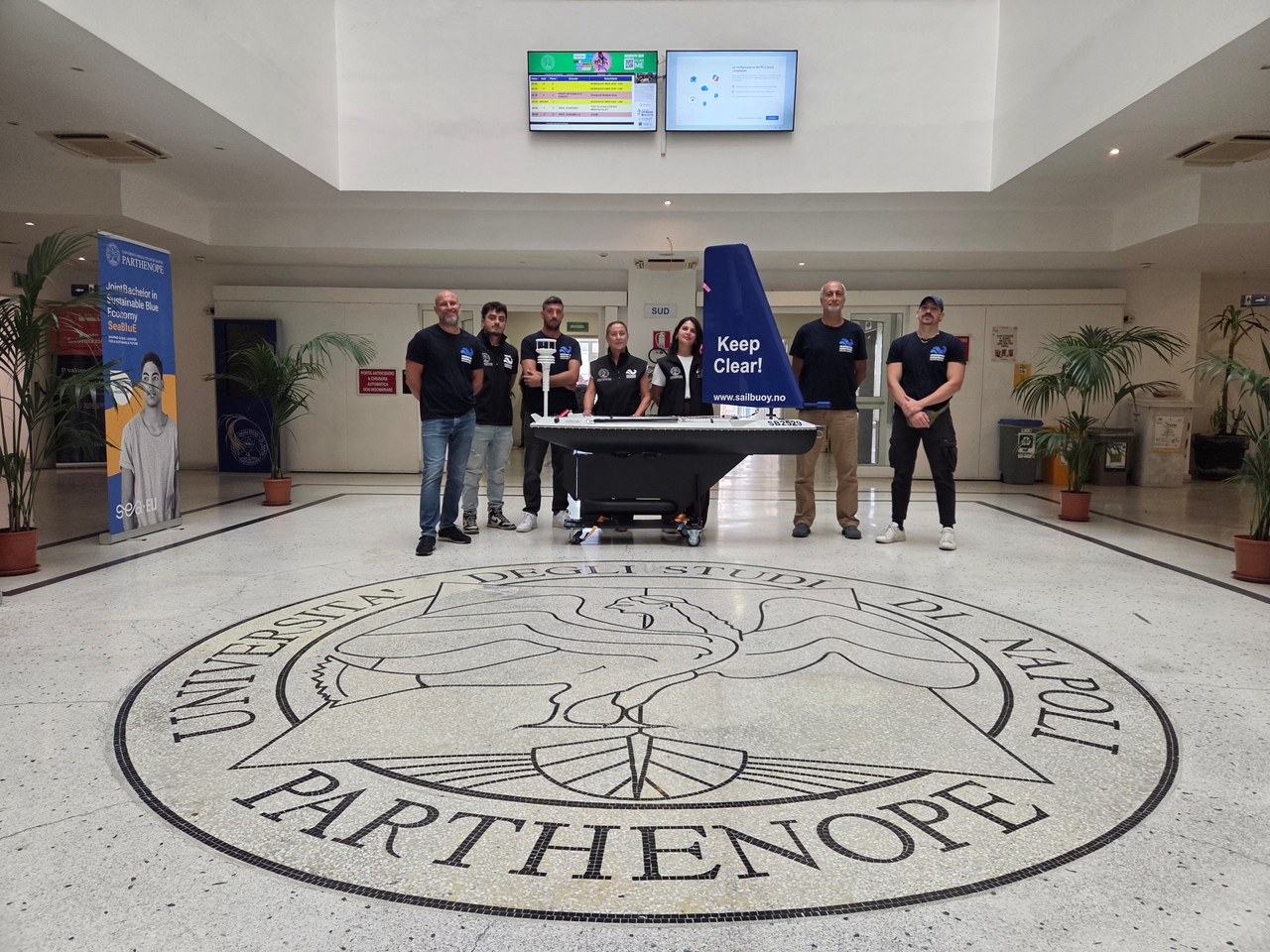
Taking this technology to the next level though is the Universita’ Degli Studi di Napoli Pathenope who will be showcasing their remarkable autonomous surface vehicle that will be gathering vital data from the world’s oceans in the coming years.

The Sailbuoy runs entirely on wind power for the movement and is solar powered for the scientific payload, it has no engine, no propeller, wind and sun are enough to realise long monitoring missions at sea. It collects oceanographic, biological and meteorological data in coastal and open ocean areas with no environmental impact and no human presence. University Parthenope Naples
Named ‘Azzurra’ – one of the most famous names in Italian America’s Cup history after the yacht that first challenged for Italy in 1983 under the burgee of the Yacht Club Costa Smeralda – it’s an exciting project that visitors to the Official Race Village in Naples for PR2 can view in the Commune di Napoli & University stand on Friday 25th September where ‘Azzurra’ will be unveiled for the first time. The autonomous surface vehicle is operated by the Department of Science and Technology at Parthenope University of Naples.
The Sailbuoy runs entirely on wind power for the movement and is solar powered for the scientific payload, it has no engine, no propeller, wind and sun are enough to realise long monitoring missions at sea. It collects oceanographic, biological and meteorological data in coastal and open ocean areas with no environmental impact and no human presence. University Parthenope Naples
Azzurra is Italy’s first sailbuoy: an autonomous marine surface drone measuring approximately two metres in length and powered entirely by wind and sail. It can navigate along pre-programmed routes, while a real-time connection allows its missions to be modified remotely while under way.
The Sailbuoy runs entirely on wind power for the movement and is solar powered for the scientific payload, it has no engine, no propeller, wind and sun are enough to realise long monitoring missions at sea. It collects oceanographic, biological and meteorological data in coastal and open ocean areas with no environmental impact and no human presence. University Parthenope Naples
Azzurra’s entire suite of instruments are powered by solar panels and designed to collect valuable meteorological and oceanographic data. The combination of wind propulsion and solar energy enables Azzurra to operate silently and with no environmental impact. Together with the vessel’s distinctive hull design, this power system gives the drone virtually unlimited endurance.

During its missions, Azzurra measures and transmits key atmospheric parameters including temperature, pressure, humidity and wind conditions at the sea surface, both in coastal waters and in the open ocean, where such data is more difficult to obtain and therefore especially valuable. Its oceanographic instruments transmit data on wave height and direction, water temperature, salinity, chlorophyll and oxygen concentrations, turbidity, and the speed and direction of currents from the surface to up to 50 metres depth.
The Azzurra sailbuoy is manufactured by the Norwegian company Offshore Sensing, which collaborates with universities and research centres around the world. Its autonomous vessels now operate across all the world’s oceans. Following its initial trials and missions in the warm waters of the Gulf of Naples and the Mediterranean Sea, Azzurra will take part in several research projects in the cold waters of the Southern Ocean around Antarctica, where Parthenope University has been conducting research for approximately 35 years. Its distinctive features make the drone particularly well suited to operating in remote areas and extreme environments.
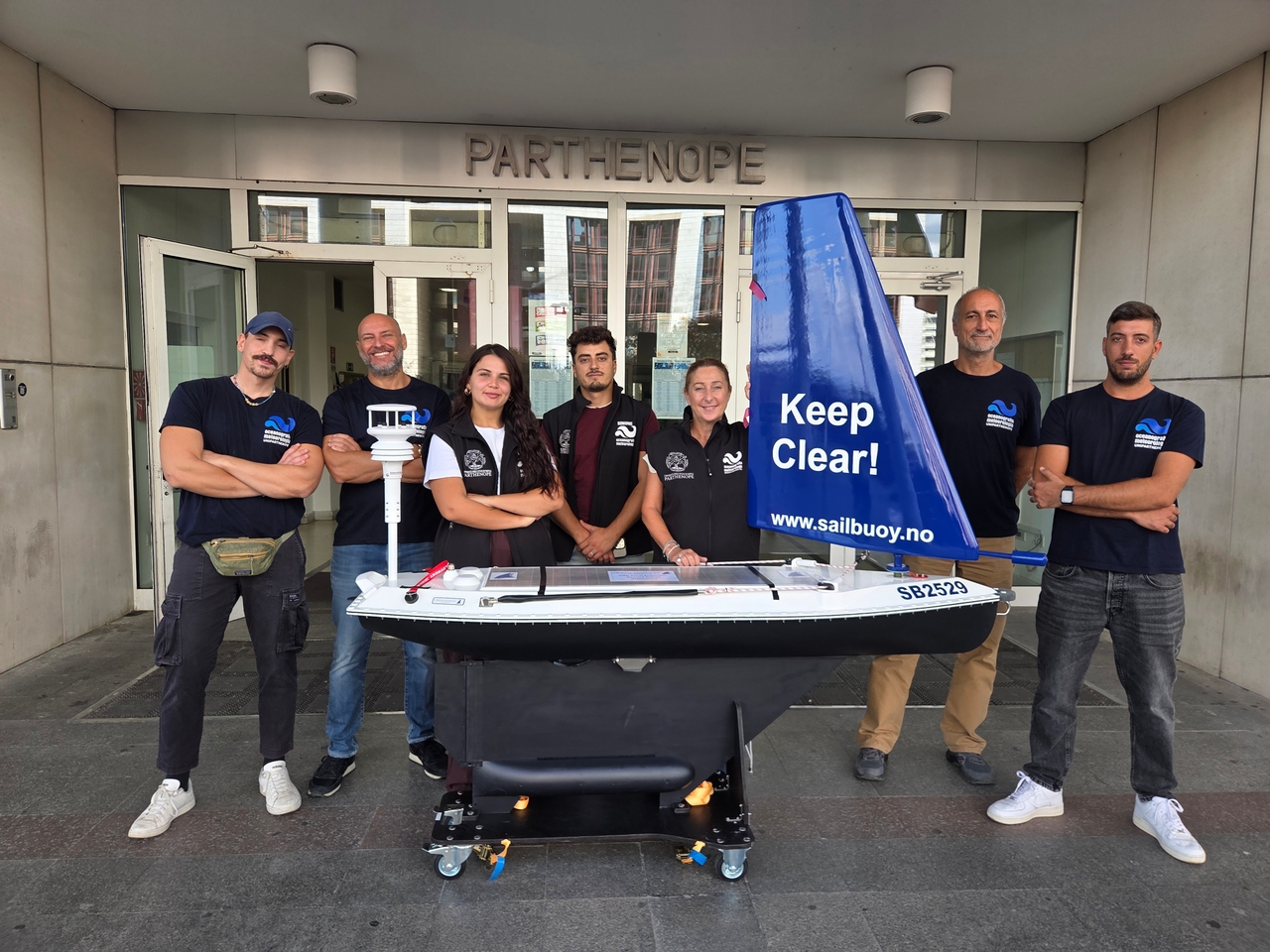
The Sailbuoy runs entirely on wind power for the movement and is solar powered for the scientific payload, it has no engine, no propeller, wind and sun are enough to realise long monitoring missions at sea. It collects oceanographic, biological and meteorological data in coastal and open ocean areas with no environmental impact and no human presence. University Parthenope Naples
Surface marine drones such as Azzurra, together with the underwater vehicles operated by Parthenope University, make it possible to expand oceanographic data collection without requiring scientific personnel or research vessels at sea. These technologies enable data to be gathered 365 days a year, even in sea and weather conditions that would prevent the use of traditional observation methods.