[cmsmasters_row][cmsmasters_column data_width=”1/1″][cmsmasters_text]
Steam spawned the Industrial Revolution and with it, powered vessels. Some 230 years on, only the relics remain – a few surviving ships maintained and operated by dedicated enthusiasts. But the magic also lives on in small, working replicas crafted by perfectionists.

Now enjoying his retirement, Christchurch’s David Pringle began building balsa wood ships at about 12 years old – and after years of fine-tuning turned his delicate skills to steam models. Intricate, detailed creations powered by miniature, fully-operational steam engines.

I caught up with him at the Lake Rotoiti Classic Boat Show in March, where his exhibit presented a fascinating cross-section of his handiwork. The vessels are all about a metre LOA and built from plans accessed from the UK or the USA – replicas of recreational boats built in the 1900s era.

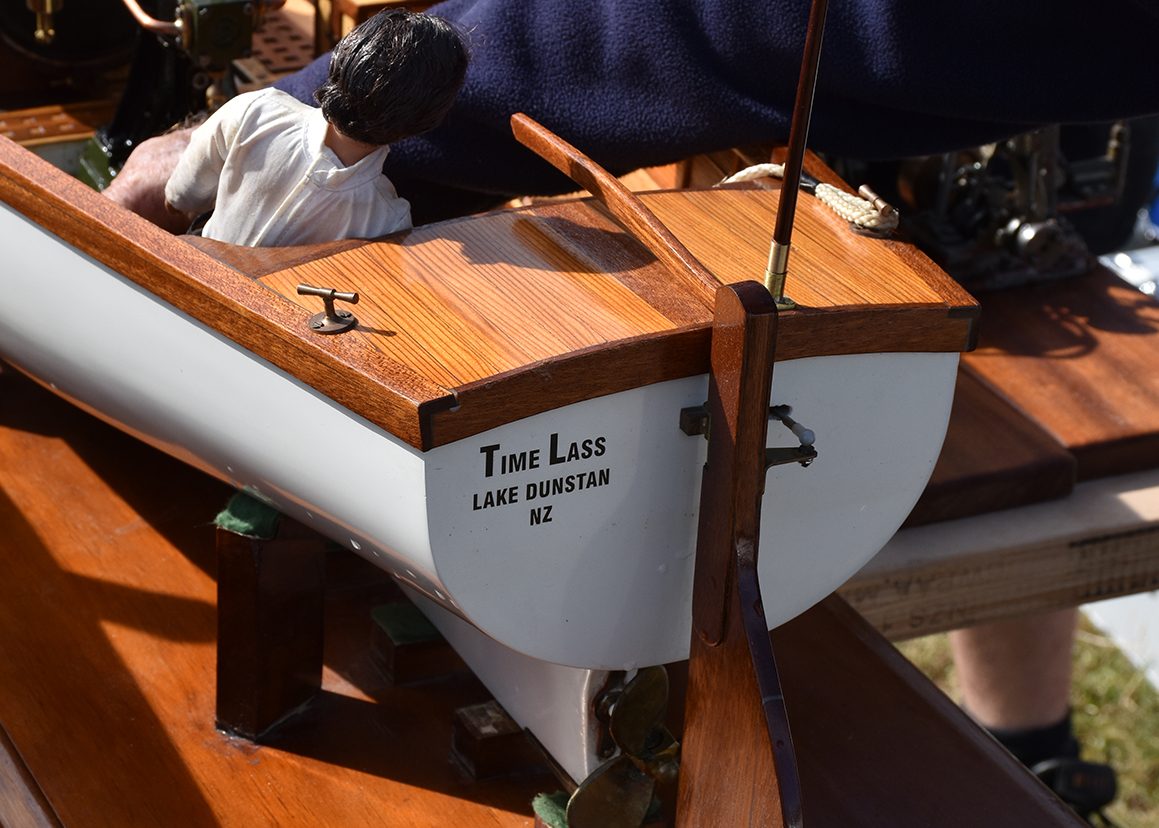
Vessels that were used on the Thames and places like Lake Windermere in UK, owned by the upper classes. The names of Pringle’s boats, though, have a more local flavour – among them Time Lass, Kathryn and Just Ticking Over. The latter’s name is a reference to her unusual engine – more on that in a moment.
Balsa wood has long since been supplanted as the timber of choice. Today Pringle uses a variety of species, but mostly hemp wood and Oregon, with mahogany for the trims. Working with mahogany demands a special technique: it’s cut into very thin sections which are soaked in hot water before being moulded around the hull form. Epoxy glue holds it all together.
Each model has a build time of around two years.
Engines
As with the plans for the models, the miniature steam engines are also sourced from the UK and/or the USA. Most are single-cylinder Stuart Turner engines – which again are models of real working powerplants from the golden age of steam. One of Pringle’s model engines was a gift that had never run.
“It was completely rusted – so I disassembled and cleaned it – and because some of the parts were beyond repair I had to make new ones. I have a small metalwork lathe for this – most of the parts are fabricated from bronze, brass or mild steel.” He has also built an engine from freshly-cast components – “finicky, drudge work – I spent hours removing all the burrs.”
But Just Ticking Over – a fantail launch – is powered by a more exotic beast. A V-twin unit known by steam cognoscenti as an ‘oscillating’ engine, it’s manufactured in the USA. Twin-cylinder engines, Pringle explains, are more reliable for stopping and starting.

“When you stop a single-cylinder engine the piston sometimes ends up in an awkward position – a bit like bottom-dead-centre in an internal combustion engine – where the steam can’t get the piston moving. You don’t have that problem with a twin-cylinder engine. One piston will always be in the right position.”
Oscillating engines are also faster-revving and because steam engines are typically direct-drive, Just Ticking Over is the fastest of Pringle’s boats – it doesn’t need much more than ‘ticking over’ to move along at a decent clip.
And because the drive-train ends in a variable-pitch propeller it’s also easier to switch between forward and reverse. He manufactured the prop himself – using heat to bend the blades to the right pitch.
The steam for the engines is created in boilers running at 30-40 PSI. New Zealand regulations require the boilers to be certified (they operate in public places) with a healthy, built-in safety margin: they are actually certified to 100 PSI. Pressure is displayed on the boiler’s tiny gauge.
Boilers are fired by butane or propane gas – typically the small canisters used by campers – though Pringle builds the burners from scratch. “They’re ceramic and mounted on the cylinder. The burner’s equipped with a little valve and is lit with a match.”
Water is hand-pumped to the boiler before the boat is launched – just enough for a single run. “You have to keep an eye on the sight-glass and top up the boiler if the water level falls a bit, but I typically get about a 20–25 minute run from a single ‘charge’ of water.”
Control
As scale-models, says Pringle, the boats achieve their design speed (3–4 knots) as per their waterline length. Rudder and throttle are operated via radio control – and in the case of Just Ticking Over – it also adjusts the variable-pitch prop.
And the mannequins piloting the vessels?
“They’re Ken and Barbie dolls – which I sheepishly confess I acquired by raiding my daughter’s collection over the years. She wasn’t very pleased at the time, but I think she’s eventually accepted that it was all for a good cause.”
[/cmsmasters_text][/cmsmasters_column][/cmsmasters_row][cmsmasters_row data_shortcode_id=”jvwtpaa6ew” data_padding_bottom_mobile_v=”0″ data_padding_top_mobile_v=”0″ data_padding_bottom_mobile_h=”0″ data_padding_top_mobile_h=”0″ data_padding_bottom_tablet=”0″ data_padding_top_tablet=”0″ data_padding_bottom_laptop=”0″ data_padding_top_laptop=”0″ data_padding_bottom_large=”0″ data_padding_top_large=”0″ data_padding_bottom=”50″ data_padding_top=”0″ data_bg_parallax_ratio=”0.5″ data_bg_size=”cover” data_bg_attachment=”scroll” data_bg_repeat=”no-repeat” data_bg_position=”top center” data_color=”default” data_bot_style=”default” data_top_style=”default” data_padding_right=”3″ data_padding_left=”3″ data_width=”boxed”][cmsmasters_column data_width=”1/1″ data_shortcode_id=”knfste099″ data_animation_delay=”0″ data_border_style=”default” data_bg_size=”cover” data_bg_attachment=”scroll” data_bg_repeat=”no-repeat” data_bg_position=”top center”][cmsmasters_embed shortcode_id=”7aucj8czbd” link=”https://youtu.be/dW8oSdhyAC8″ animation_delay=”0″][/cmsmasters_column][/cmsmasters_row]