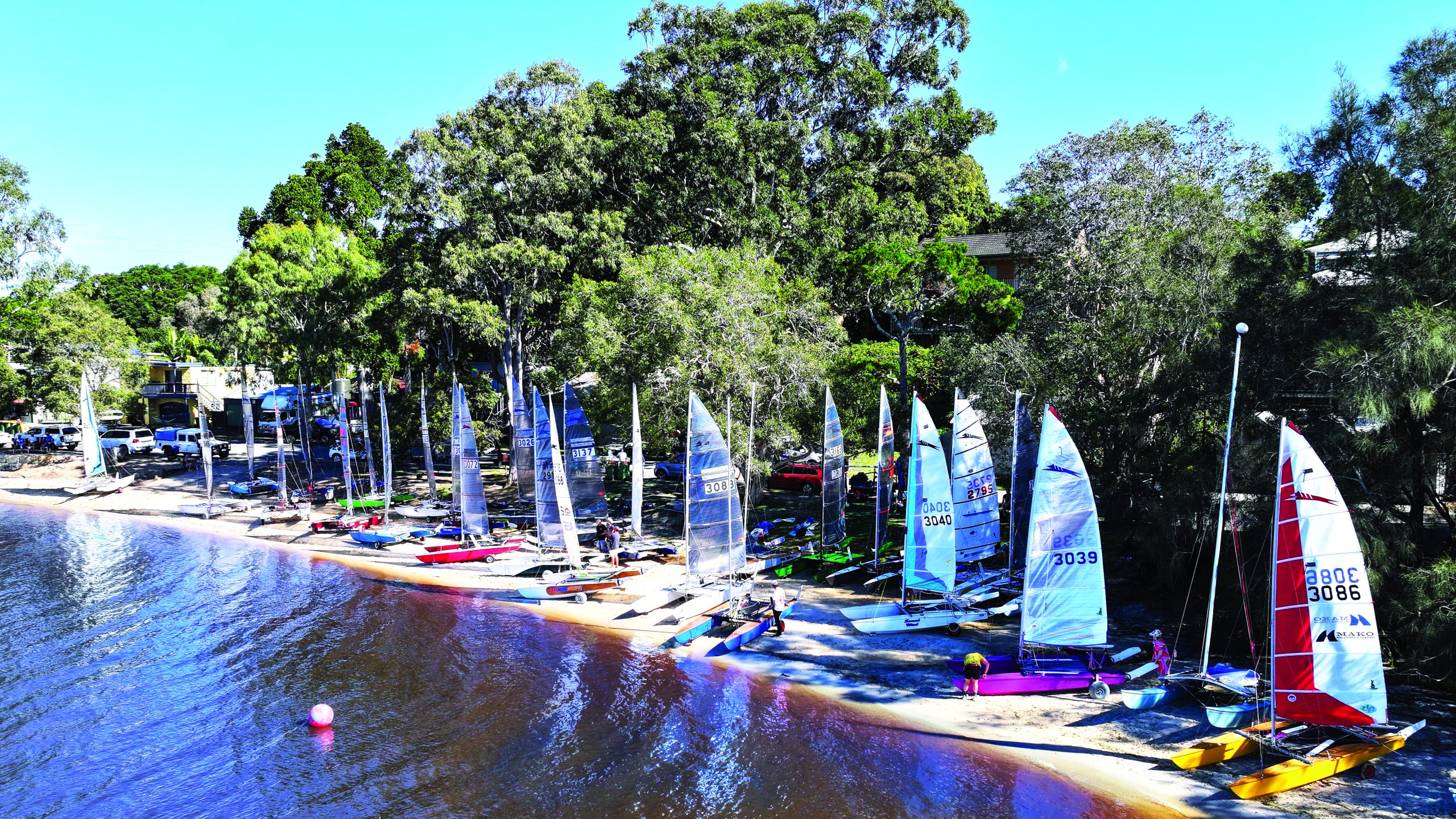
Initially held yearly, then biannually, Australia made the early running, but in recent years New Zealand has had the edge. Typically the challenging team crams 20 boats into a shipping container; the host nation fields up to 30, and the fleet is divided: 10 Kiwis vs 10 Kangaroos; 10 Wallabies vs 10 Tuis, and sometimes some local invitees.
Reinstating the rivalry
It was felt – on both sides of the Tasman – that the break had gone on long enough. Teams, based on performance in their most recent Nationals, were invited for a 2025 event. Winter selected itself calendar-wise (nobody wants a boat missing-in-transit during the on-season), and the Australians chose a Queensland lake as the battleground. The New Zealand Association (NZPTOA) started the – largely voluntary and unsponsored – process of collating and delivering boats and sailors…
Specifications
length 14 ft (4.3m)
width 7ft (2.2m)
minimum weight 110 lbs (50kg)
sail area 100 sq ft (9.2 m2)
Partial development class
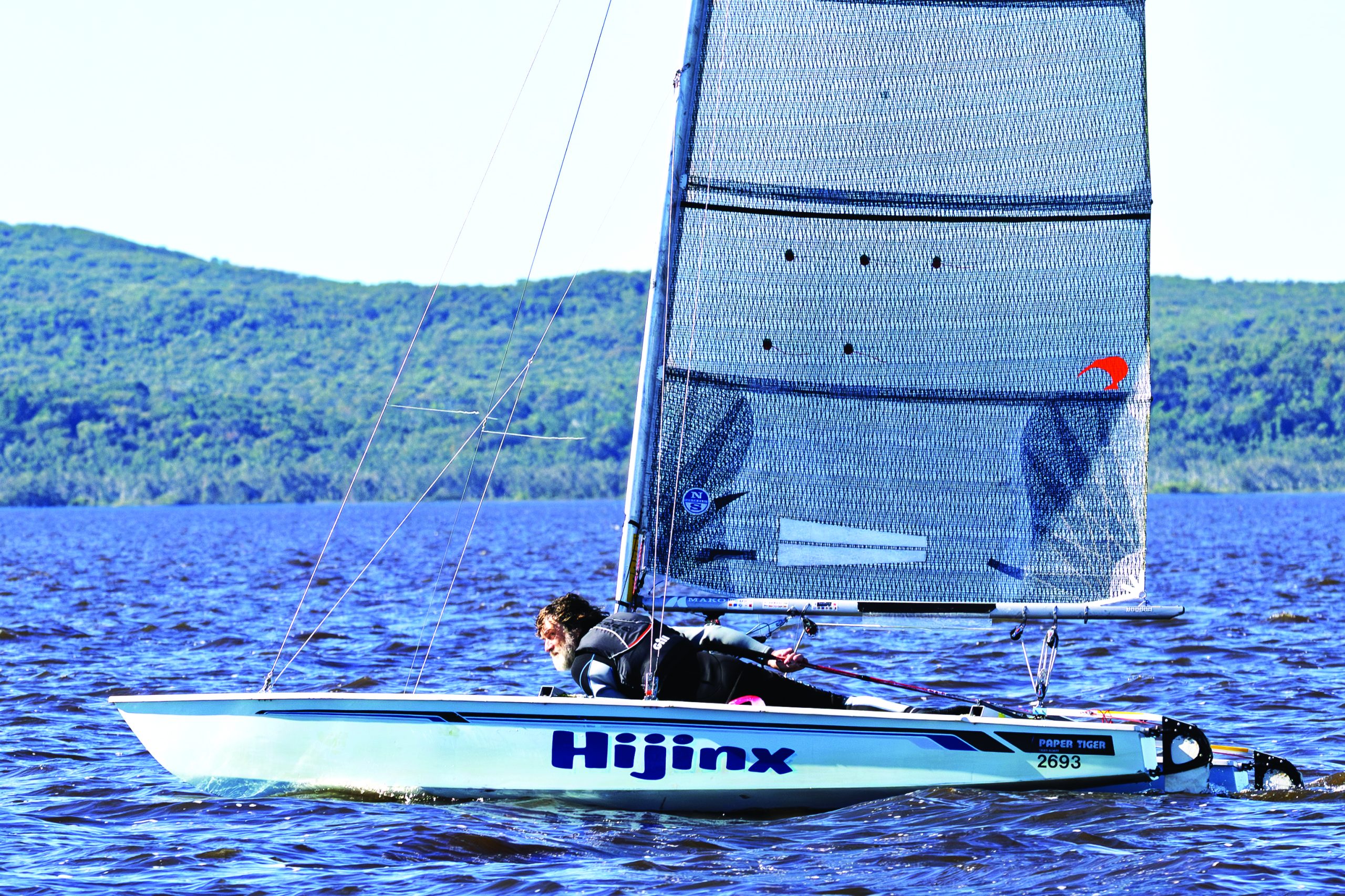
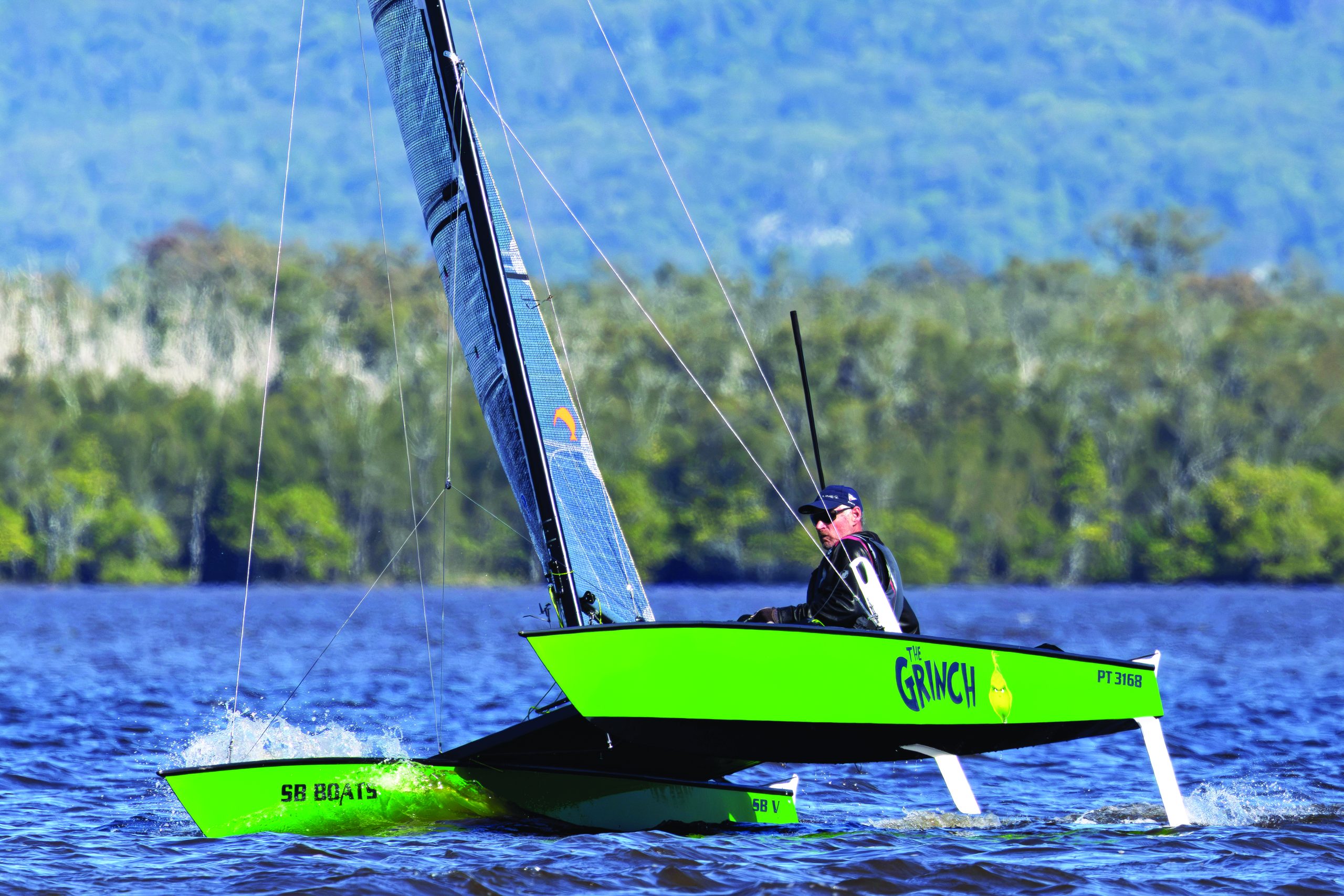
The Paper Tiger was designed in 1968 by Ron Given, initially aimed at home construction in plywood. More than 3,200 sail numbers have since been issued, and for many years PTs were factory-built on both sides of the Tasman, mainly in foam sandwich. Recently, boats have been built using CAD-defined carbon-foam panels, but the Class Rules stipulate a minimum weight (50kg for the bare raft; no rig, no appendages), enabling older boats to stay competitive.
Variables include centreboards, rudders, mast rake/bend and much of the control layout – more than enough scope for the DIY-inclined tinkerer. There are many ways to assemble the jigsaw and endless debates to be had as a result. Over the years boards and rudders have become higher-aspect; hulls and connecting structures stiffer; rigs raked further aft; masts stiffer; sails flatter; and carbon componentry more common.

Team-building begins
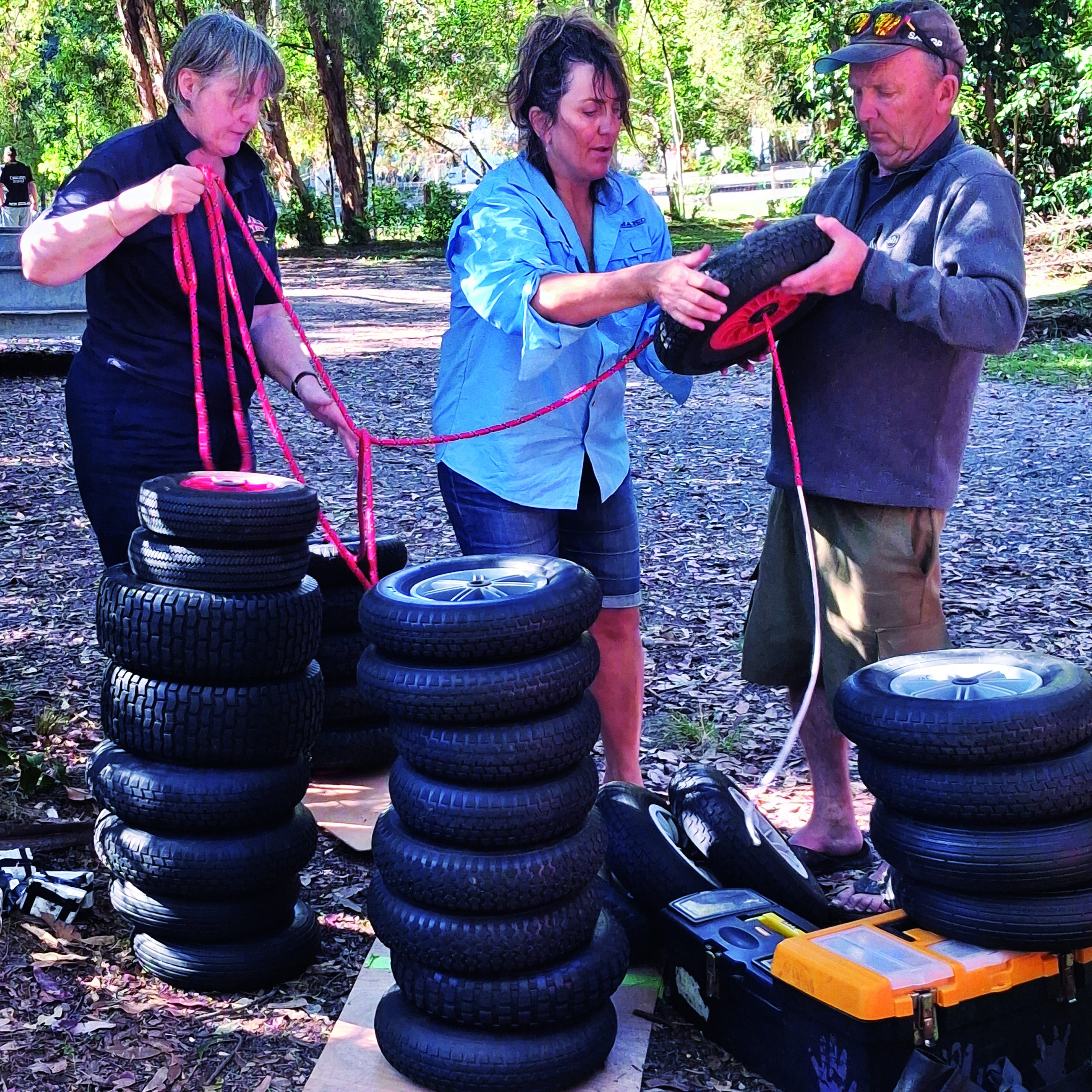
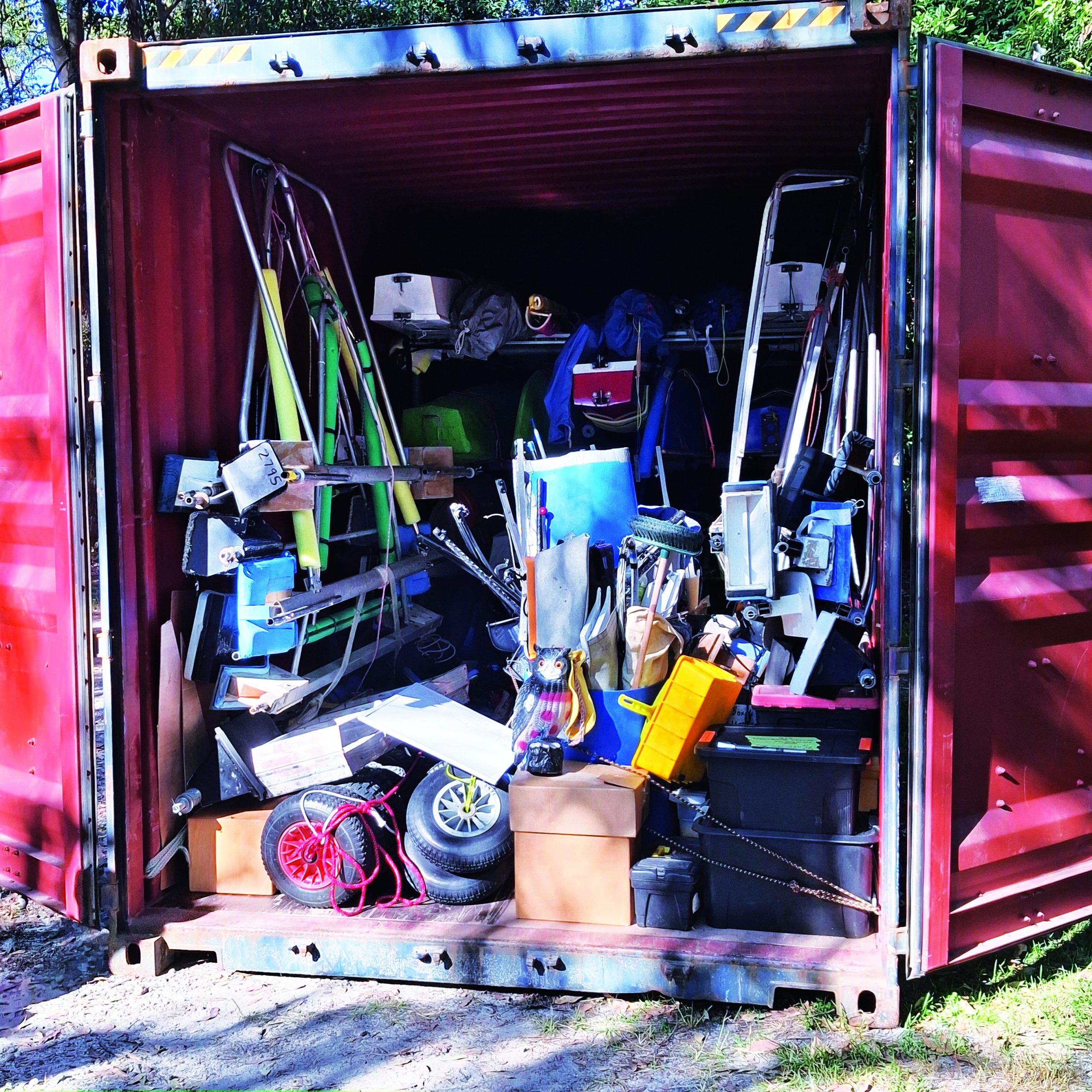
One weekend in May, boats and their owners from as far apart as Auckland and Dunedin converged on Mainfreight’s Wellington depot, with Team South Island arriving with six boats in a one-vehicle haul. Hulls were strapped into two scaffold-pole frames, which were sequentially rolled into the shipping container. Sails were stacked between hulls; masts placed underneath, and an impossible-looking amount of gear – beams and booms, trolleys and tools – arrayed in the remaining space. With doors closed, the team went out for tea, bonding well underway.
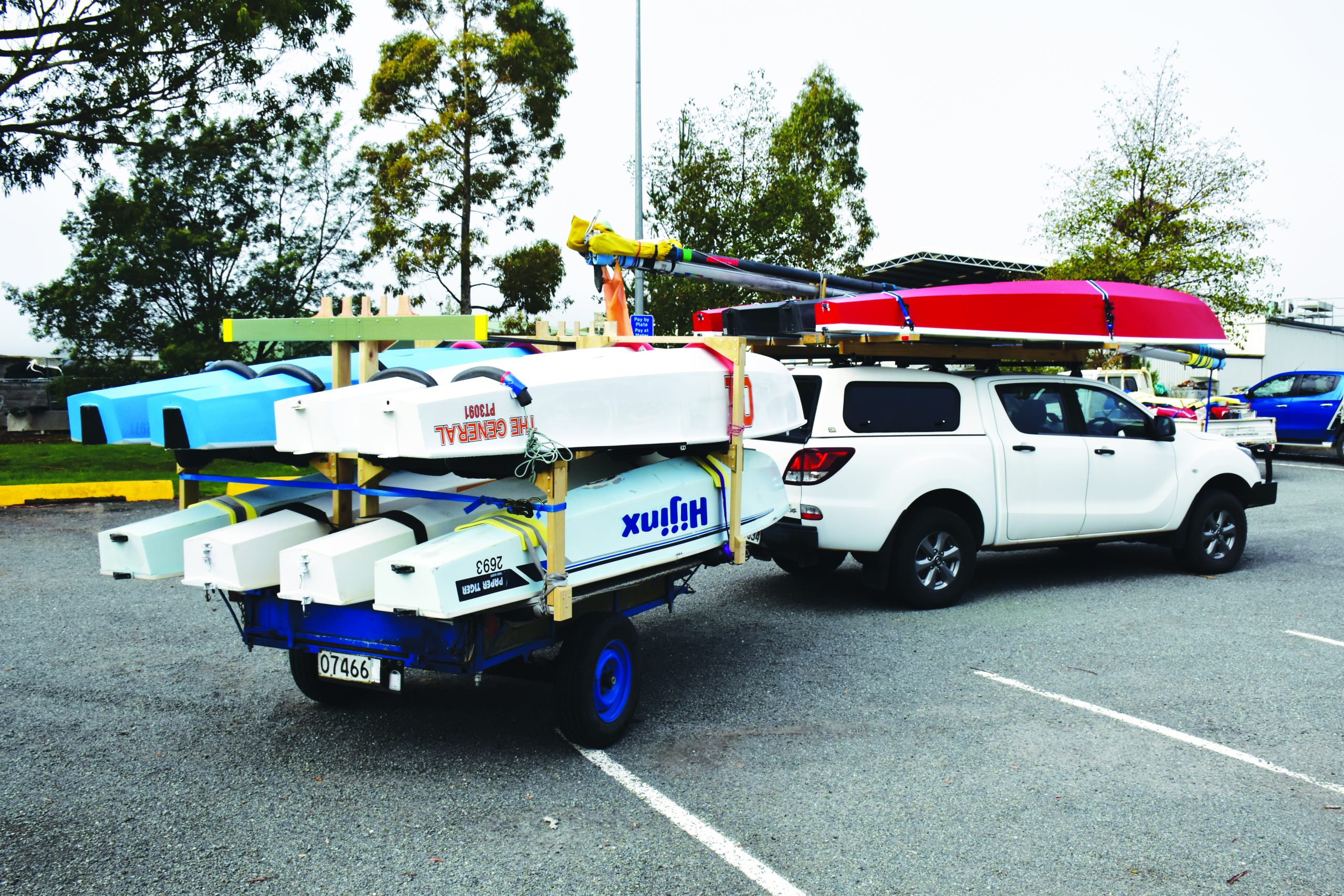
Stress intruded when the scheduled container ship failed to dock in Wellington, but great work (largely by Mainfreight’s Levi Kroot) got the container to Brisbane via Tauranga with days to spare. From there it got trucked to the Apollonian Hotel, which the New Zealand team had booked out. This proved a delightful spot for unloading, living and reloading – albeit several hundred suburban metres from the beach.
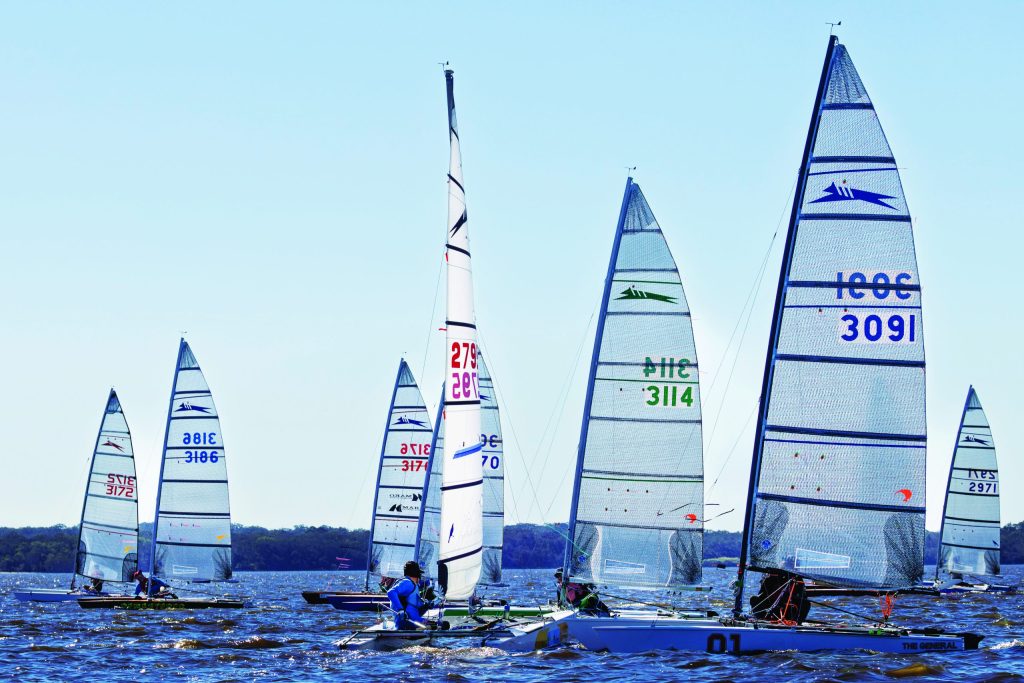
Converging on Lake Cootharaba from various flights and via a chartered bus, the team commenced boat assembly on July 4, some even getting in a quick sail the same day. Practice went on during all of the 5th, and practice and measurement on the 6th. It quickly became apparent that the Kiwi boats no longer held a technological edge and that the Aussie boats were moded a little differently, more vertical centreboards being a feature. Campfire scuttlebutt traversed the possibility that they were optimised for light/lake conditions, but the test would be on the water.
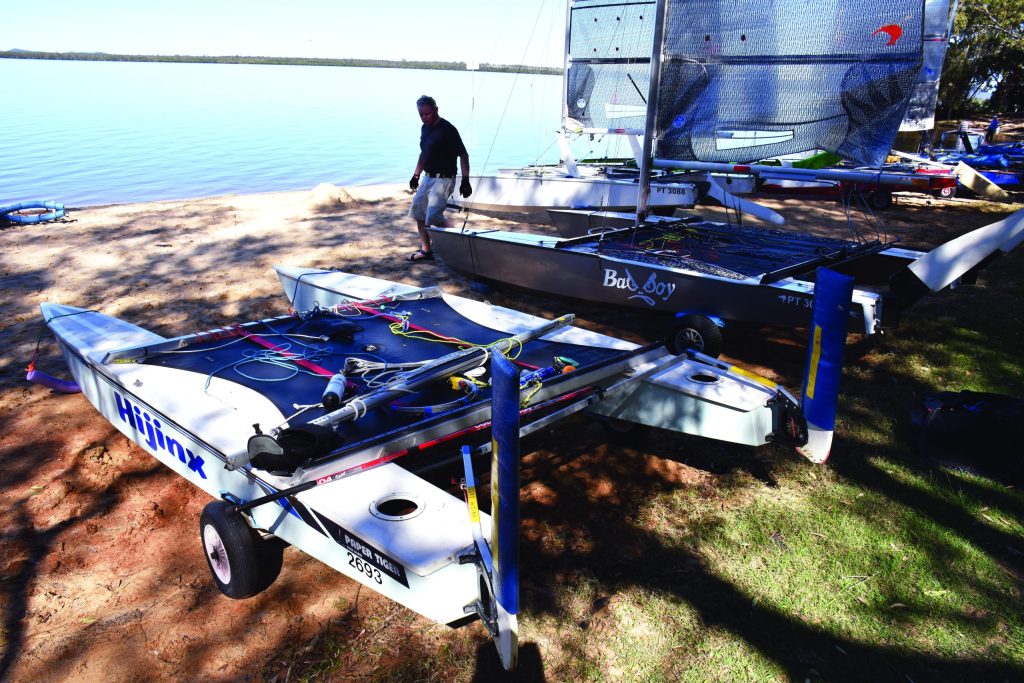
The Kiwi team boasted an average age of 58, a combined sailing experience of 341 years, and PT-specific experience of 138 years. The Kangaroos averaged 53 years old, with 387 and 258 years of experience, respectively. The Australian fleet boasted the oldest (78) and youngest (26) sailors in the regatta. The fact that there were two female competitors from each nation and three parent/offspring combinations on the water denoted both a growing trend and the nature of the class.
Talk about light, Trev.
Day One
Produced light winds, and the two scheduled races established Rohan Nicol (3145 CUT/COPY) as the sailor to beat, although current NZ Champion (and two-time International Champion) Hayden Percy won the second. The lightweight Kiwis Scott Barker (3168 The Grinch) and Owen Jenkins (2925 Wind Torque) showed promise too, but on average the Aussies seemed to have the edge. A ‘welcome dinner’ finished the day nicely, with the teams being introduced jointly, severally, and more often than not, humorously.
Day Two
Again saw light winds, and the race committee (R/C) did well to get three races away. With the fifth race completed, everyone got a discard, but Rohan still had a handy lead with Scott running second and Hayden and Luke Stout (3131 Go’n Wild) third equal. Hayden, though, was still carrying an 11th from Race 1, which would later become his second discard – and part of the major debate of the regatta.
Day Three
The race committee pushed for the scheduled three races, but only got two away. During the starting sequence for the last race, they were informed by other officials up the course that the wind had shifted enough for boats starting at the committee boat end to lay through (sail to the top mark on one tack). Given that the whole fleet couldn’t start there, the correct call would have been to abandon. Perhaps wary of running out of time window for a rerun, the R/C chose to continue.

The bunch that laid straight through was largely Australian, while Hayden led the bigger group, which had to put in two extra tacks. The NZ management lodged a protest, requesting redress (essentially, requesting that the race be discounted). Given that every sailor was going to be either pleased or disgruntled, depending on whether the race would or would not be retained, a can of worms had been well and truly opened. Not to mention endless mathematical possibilities…
On the final day, with the protest still unresolved, the race committee blew up an already-underway race because of a major wind shift. Perhaps they were spooked by the protest, but once a race is under way, well, there’s not a sailor alive who hasn’t benefited from a wind-shift – or not! As it happened this time, an Australian had hooked into it and looked likely to blitz the fleet; he wore the abandonment very well indeed. Hayden won both races, with Rohan second and third. If the protest removed Race 7, they would be on equal points, but Hayden would get it on countback. It didn’t, and he didn’t.
Aftermath
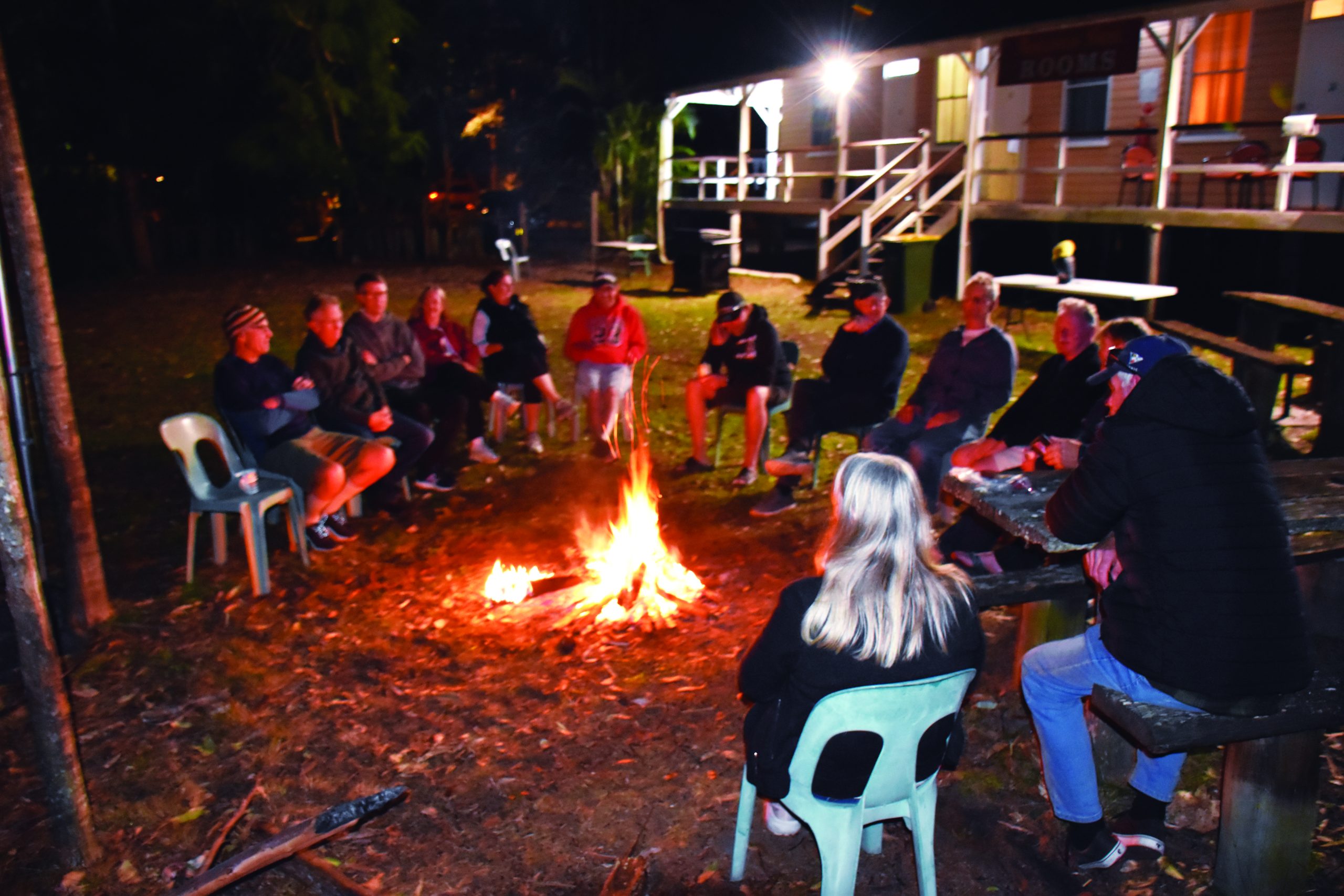
Rohan and Hayden had had a ding-dong stoush up front, Rohan coming out the winner. The Kiwis couldn’t quite match the Kangaroos; the Tuis trounced the Wombats and Brenda Brownlee from Nelson Y/C (3072 Hairy Maclary), with one year in Paper Tigers, won the Women’s trophy. Following an entirely satisfactory prizegiving at the Apollonian, our now-close band circled the fire in debrief mood, with talk turning to possible venues for a rematch – Nelson? Picton? Welly?
The next day the Kiwi team loaded its boats for the return trip, applying itself to its task with bonhomie to spare. That last night around the campfire, nobody wanted to head for bed, a mood which showed up later in the trail of post-parting WhatsApp comments – everyone valued how we had gelled and what we had achieved as a team. We were reluctant to let it go.
Thanks to those who did the heavy lifting organisation-wise; thanks to those partners who pitched in and those who supported on the water and in the kitchen. Thanks too to the late Ron Given for our iconic little piece of Kiwiana. Roll on the next challenge!
Writers Comment
I went to my first Nationals in 2005. Woefully off the pace in the pre-regatta invitation race, I’d also learned that my boat did not (quite) measure and was a tad too heavy… I was derigging (and seriously contemplating leaving) when two sailors came over and asked if I wanted a hand setting up my boat? They were Mark Hatch – still campaigning PTs – and Jamie Sutherland, nowadays an international racing judge. Two hours later they left and I stayed – and stay still (interestingly, six of those competing in 2005 were in this New Zealand team).
Later, during the 2009 Nationals, an older class legend asked me how I’d gone in the last race. My response – that I was
a bit off the pace on the reaches – elicited the reply: “Well, we’d better go back to the start via the wing-mark then; let’s see what you’re doing wrong.” None of them needed to bother, but they did and that is both the nature of the class and a major factor in its longevity.
On the last night of this regatta, looking around the firelit faces of folk I now regarded as family, and reflecting on a lifetime of cruising and racing (at 70 I was the oldest of the Kiwis and at 40, my boat the oldest of both fleets), all I can think of is doing it again. And again. I wouldn’t have missed it for the world.