Wanderer
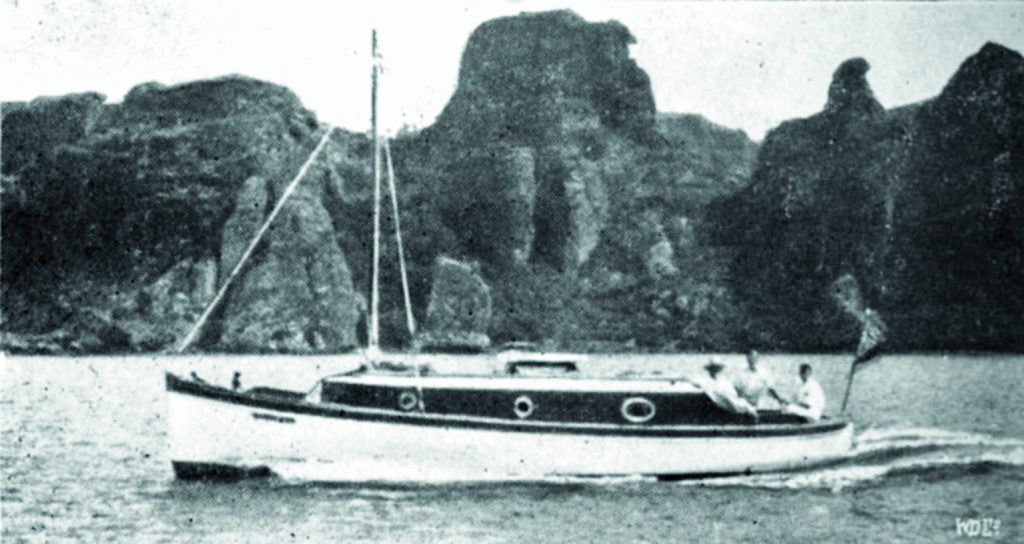
WANDERER was almost new. Logan Bros completed her in early October 1908 for Hubert Henry Dacre, an Auckland dentist who had recently opened a practice in Mangonui. She was a typical Logan canoe-sterned double-ender of the period, built ruggedly with a three-skin diagonal kauri hull without frames. Wanderer was designed to enable Dacre to visit patients around the Far North, then virtually roadless and with no rail link to Auckland north of Te Hana. Wanderer was the only entrant from outside Auckland. Dacre brought her down from Mangonui for the Rudder Cup race in the teeth of a SW gale, which she handled well.
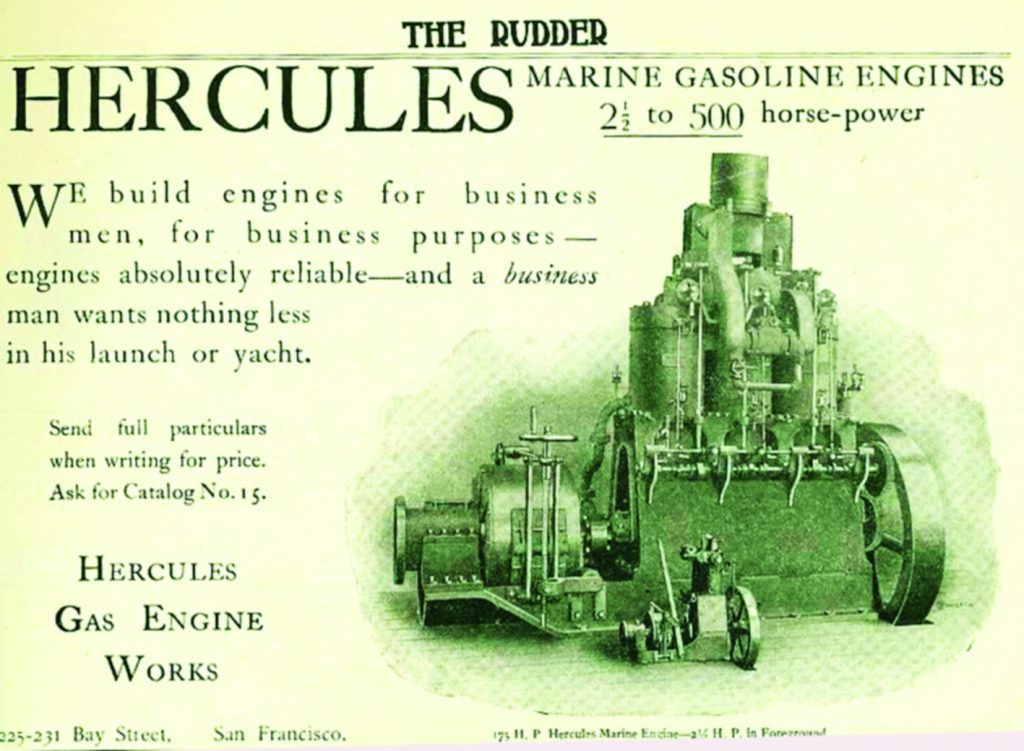
At 33 feet overall with a 7ft 9in beam Wanderer was a slightly smaller double-ender than the much-admired Logan Bros Kotiro, built for Alf Gifford in November 1906. She was fitted with a twin-cylinder four-stroke 12-16hp Standard engine, built by the Standard Motor Construction Company of Jersey City, New Jersey, known informally as a ‘Jersey Standard’ to distinguish it from the ’Frisco Standard’ built by the Standard Gas Engine Company of San Francisco as fitted to the entrant Petrel that I described at length in the last issue. The New Zealand agent was William T.J. Bell, who had recently left the employment of W. A. Ryan & Co., of the Railway Wharf, the well-established agents for the San Francisco-built Union engine, probably the biggest selling marine engine in the country at the time.
The Jersey Standard was a well-built engine which had received many important government contracts in the USA. In 1905 the company built some engines for Russian naval submarines. In 1917 Standard received a huge order for 1,100 220hp @ 400rpm engines to power the Elco-built Motor Launches (MLs) for the Royal Navy and the U.S. Navy. Like the Frisco Standard in Petrel, the Jersey Standard engine in Wanderer featured an open crankcase design, but it had automatic inlet and camshaft-operated exhaust side-valves instead of an F-head with positively operated valves by a vertical camshaft. It was reversible by sliding the camshaft so it could be directly attached to the propeller shaft without reversing gear. It had an air compressor and a reservoir to run a whistle. Apart from the fact it did not need a boiler certificate and a man with a steam ticket, it was run just like a contemporary small steam plant.
Matareka II
MATAREKA II was a Logan Bros double-ender, built in September 1907 for Auckland merchant W.S. Whitley, then Commodore of the New Zealand Power Boat Association, to replace his first Logan Bros Matareka of 1903. She was another strong, diagonal-built, sea-going Logan launch but bigger all round than Wanderer at 40ft loa and 8ft 9in beam. Her engine was a four-stroke 25hp Union, at that time Logan Bros’ preferred make. The Union agents were W. A. Ryan & Co whose premises were adjacent to Logan Bros’ yard on the Railway Wharf in the Waitematā Harbour. They were also the agents for the Oldsmobile ‘curved dash’ car, very popular at the time.

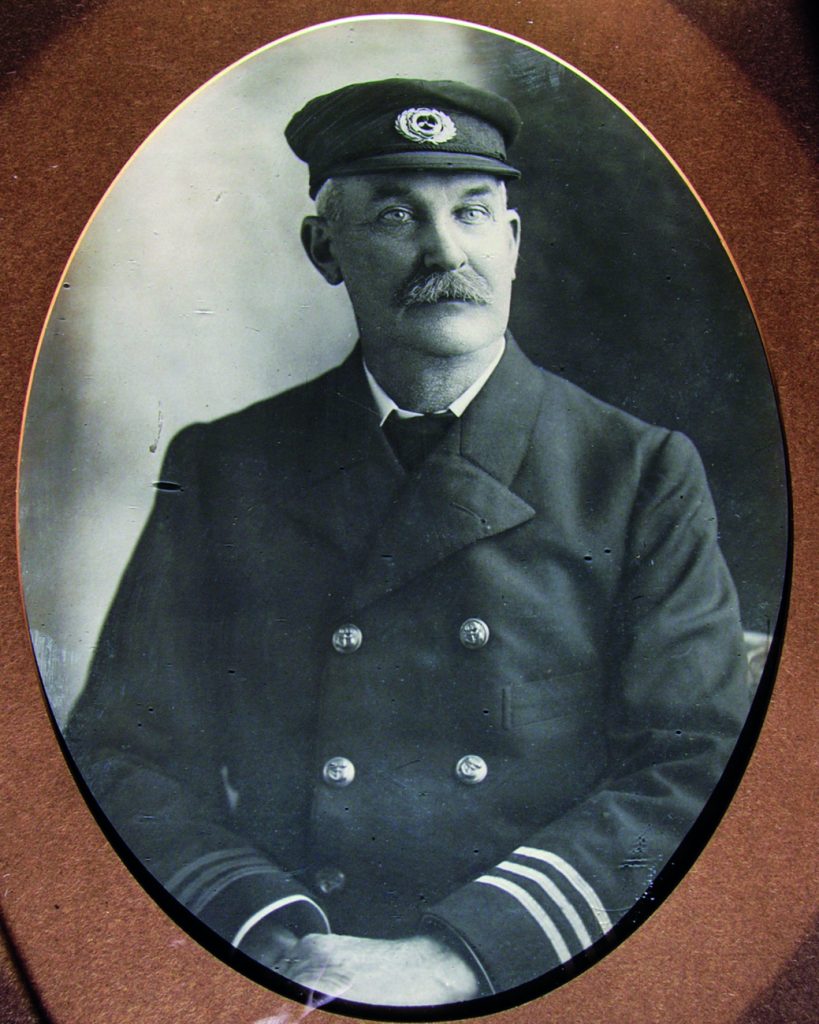
The Union Gas Engine Company of San Francisco had been in operation since 1892 and claimed to have pioneered the gasoline marine engine and make-and-break electric ignition. Their works had been destroyed in the San Francisco earthquake of April 18, 1906, but the company swiftly re-established itself at Oakland, across the Bay.
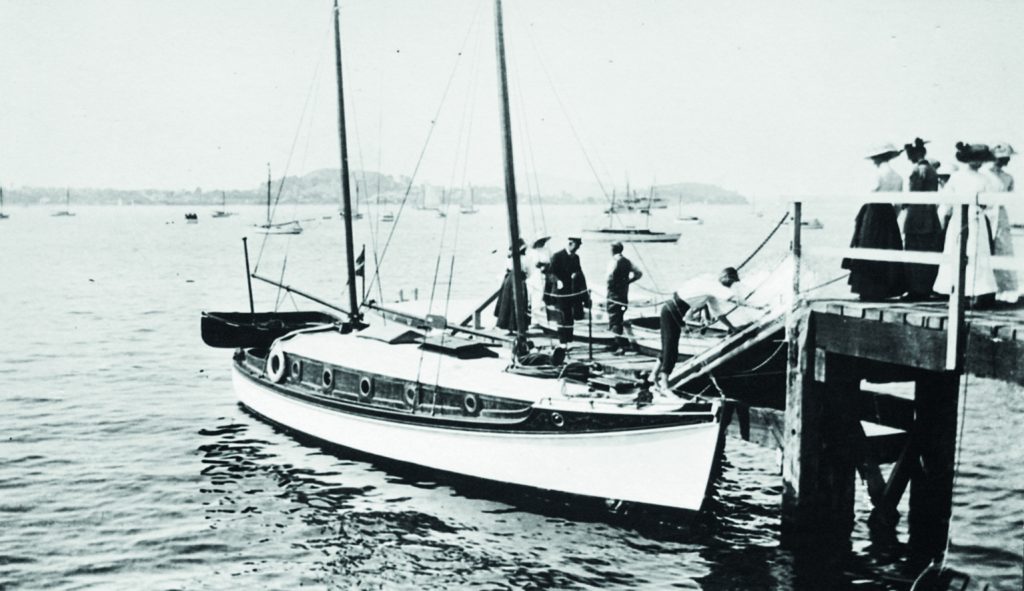
Matareka’s 25hp engine was especially ordered by Whitley and was one of a new line of models produced at Oakland. It was a three-cylinder T-head unit designed to run a 30-inch propeller at 500rpm. Again, it had an open crankcase but with substantial splash plates. The crankshaft was machined from a solid steel billet, certified by Lloyds.

It weighed 1925lbs (873kg) dry. Lubrication was by mechanical pump rather than drip, as was more common at the time. I cannot find bore, stroke, or capacity details but estimate a capacity of around 20 litres, with bags of torque.
Winsome
WINSOME was one of the smaller entrants at 34ft loa by 7ft 2in beam, built by Bailey & Lowe for Fred Cooper in late 1907 to replace his one-month-old Bailey & Lowe 28-footer Tawhiri which had been destroyed when a scow launched from Bailey & Lowe’s slip ran right over her in January 1907. She had what is loosely called a ‘cruiser stern’ or ‘compromise stern,’ a modified whaleboat/canoe stern with a reverse slope reminiscent of the more extreme ‘torpedo (boat) stern’ much favoured a few years before.

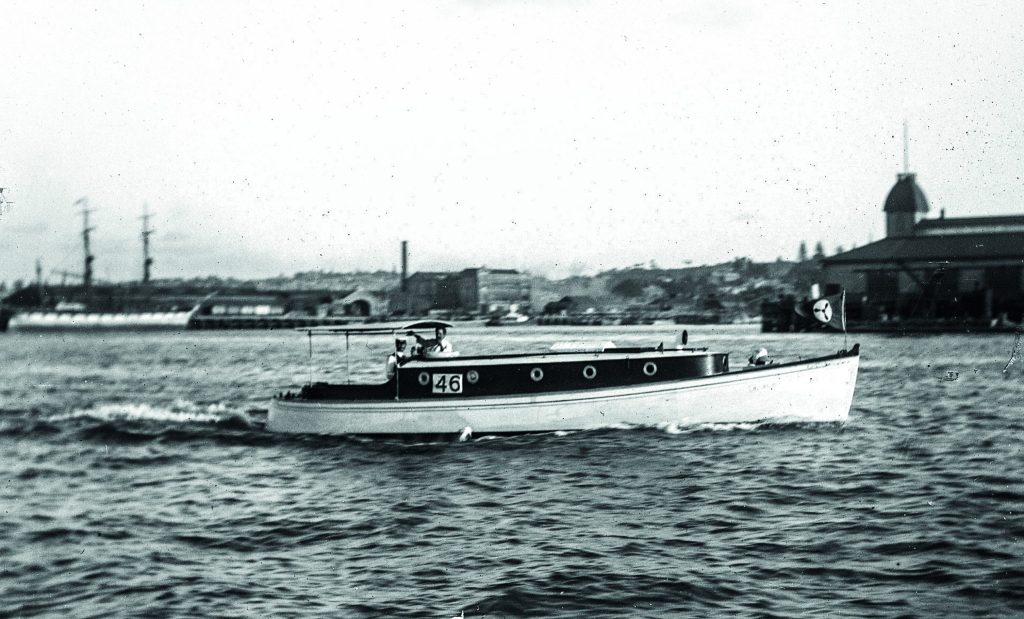
Winsome was equipped with a 12hp Hercules engine, the same as Tawhiri and very likely the same unit rescued. One of the earliest California-built marine engines, with a wide range, the Hercules was built by the Hercules Gas Engine Works of Alameda. The company’s factory survived the 1906 San Francisco earthquake, but Hercules had disappeared by 1909. Many of the key personnel had left in 1904 to found the Atlas company. It had no connection with the major Hercules Engine company founded in 1915 in Canton Ohio to build engines for trucks and cars and whose cylinder blocks were later found in many proprietary marine engines, like Gray. Bailey & Lowe favoured the make and may have been the local agents. Bailey & Tyer, an offshoot firm, used them too. Bailey & Lowe later took on the agency for the Buffalo NY-built Sterling, to great mutual benefit.
Floral
FLORAL was built by Walter Bailey and Bill Lowe for their own use in late 1907 as the prototype and flagship for Bailey & Lowe’s long line of highly successful tuck stern, single-skin 35-footers that extended well into the postwar years. Although their hulls were round-bilge, their good design and reasonably high power-to-weight ratio ensured that in later years they planed readily with the application of sufficient power.
The major advance in hull-design that Floral introduced to launches was her tuck, or transom stern, which carried the hull buoyancy right to the stern. This arrangement emulated the well-established Auckland mullet boat, which had developed its transom stern for hauling in nets over the stern in shallow waters but which had proved to be fast and able to carry sail in all weathers to get the catch back to the Auckland wharves. It had the supreme advantage, too, of not squatting under power like the counter stern and, to a lesser extent, the canoe stern and its derivatives. It was not as stylish as either, but its ability to handle much more power to the point of the plane soon became evident.
Many years ago I owned a Chas. Bailey counter-stern Milkmaid type of c1905 which was designed to be driven bya 5hp (rated) engine at 7.5 knots. When I bought her, she was fitted with a grunty six-cylinder 85bhp Universal engine driving through a Joe’s gearbox, clearly for towing duties. At anything over a fast idle, the bow would rise and the counter would start sinking below the stern wave. Later I owned a tuck-stern 1919 Bailey & Lowe 35-footer with a Hino 180hp (originally a 150hp Sterling, designed for a comfortable 17 knots) which could show 20 knots on the GPS in calm water, planing under (almost) complete control. QED.
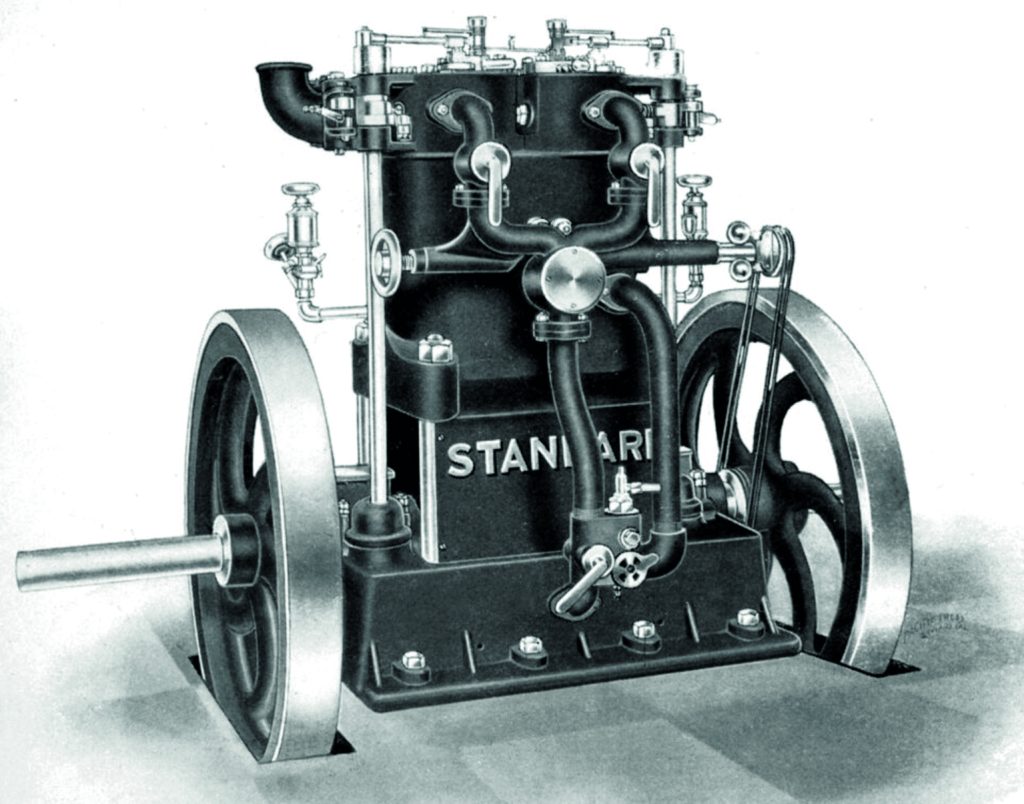
Floral was a tad narrower than the later Bailey & Lowe 35-footers at 7ft 10in beam and was somewhat underpowered with a 10hp Frisco Standard. Her owners raced her as often as they could to promote the marque. Naturally one of her rivals was Fred Cooper’s Winsome with a close handicap. I have described the Frisco Standard engine as fitted to Petrel in the last issue. Floral’s was a slightly later twin cylinder but in the same archaic style.
Vanora
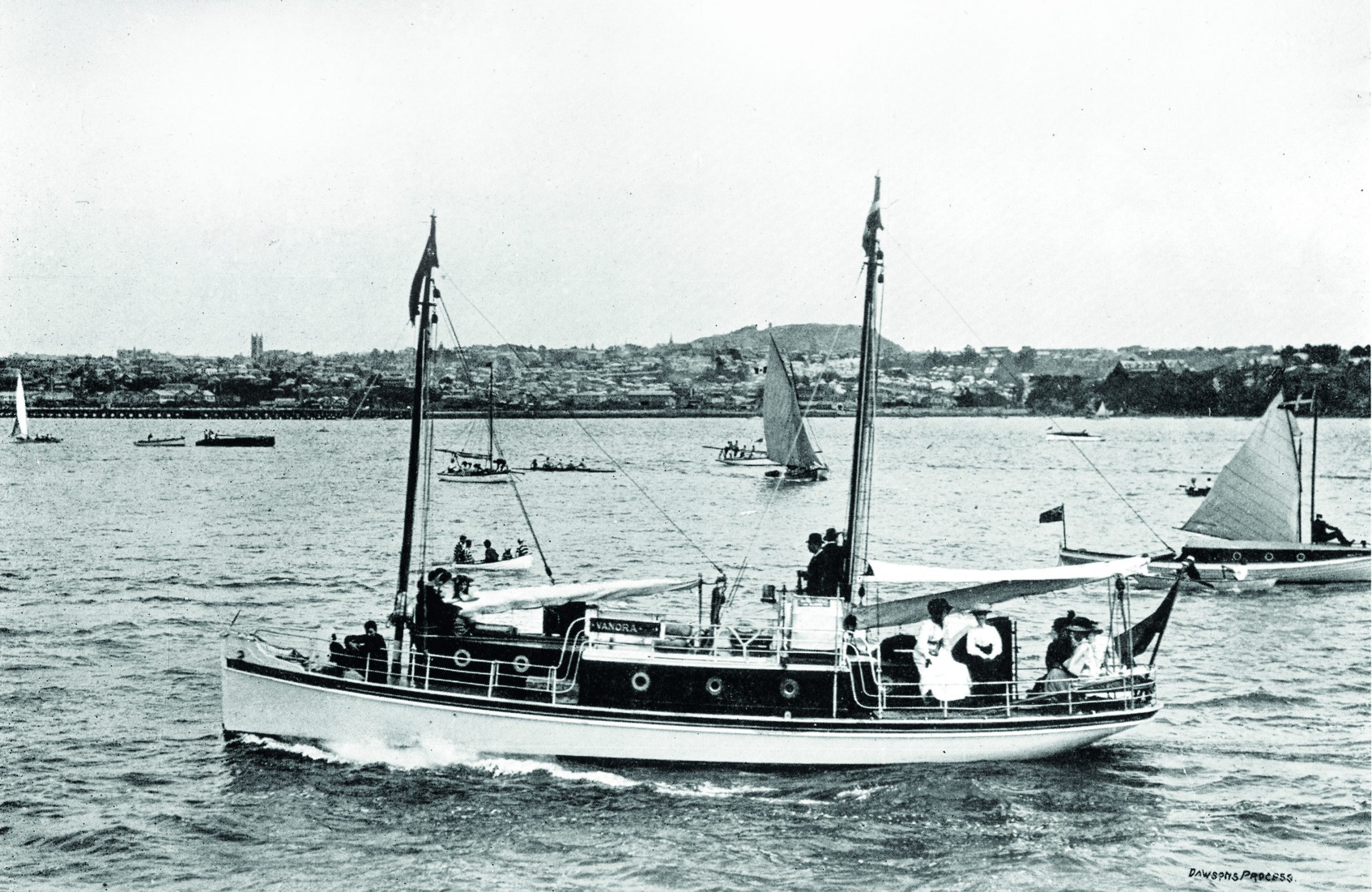
VANORA was a big handsome vessel, built by Logan Bros for Capt. George Mercer of Nelson in January 1899 as the motor vessel Huria for the Marlborough Sounds trade. She was named after the Maori heroine Huria Matenga, who, with her husband, had rescued all but one of the crew from the wreck of the Delaware in 1863. Huria had a three-skin diagonal-built counter stern hull, 45ft 6in loa, with a beam of 11ft and draught of 4ft 6in. She was launched with a two-cylinder Coventry-built Daimler petrol engine running at 450rpm.
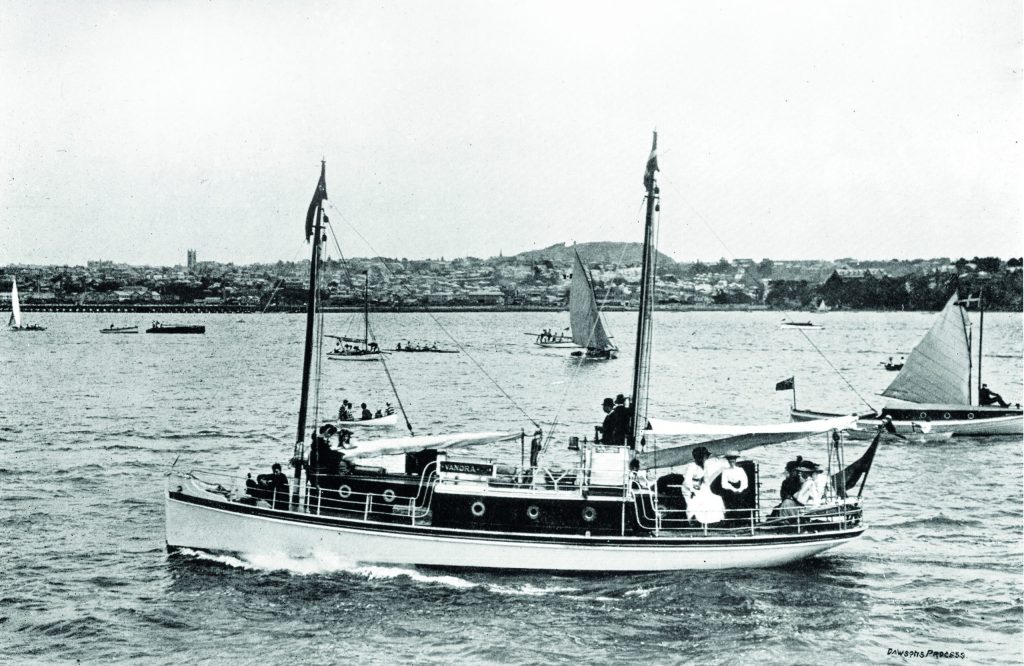
In between three launches called Naomi that Chas, Bailey Jr built for him between 1902 and 1907, Austrian M.A. Jenny, a controversial figure in New Zealand yachting, bought Huria, changed her name to Vanora and had her converted into a luxury motor yacht in Wellington in 1905. She was beautifully fitted out, regardless of expense, and had a three-cylinder 30hp Gardner kerosene engine installed. Lindsay Cooke, the licensee of the Metropolitan Hotel in Queen Street, bought her in 1907 from Jenny and brought her to Auckland.

Gardner engines had been built in their works at Barton Hall, Manchester since 1899. Even though they were very much more expensive than the American-sourced engines, they enjoyed tariff protection in New Zealand as ‘Empire Preference.’ Of course, New Zealand was still a British colony until September 1907, with most people of European descent regarding Britain as ‘Home’. The original Gardner local agents were F.S. Greenshields & Co. of Wellington, but later the Auckland agents were Hoiland & Gillett, builders of the Zealandia marine engine, and later again John Chambers & Son Ltd.
Vanora’s 30hp Gardner had three separate inline vertical cylinders and was a two-stroke ‘semi-diesel’ with individual blowtorches to heat the ‘hot bulbs’ to vaporise the kerosene fuel for starting. Scan the QR code or follow the link below for a stirring video of a four-cylinder Gardner of this type starting up.
In the next issue I will describe the remaining entries in the Rudder Cup race of December 1908, their builders, engines and owners.