Modern cruising boats carry more solar, more battery capacity, and higher expectations of independence than ever before. What has not always kept pace is how onboard systems are designed to use that power.
Watermakers are a good example. All watermakers work on the same basic process. Seawater is filtered, pressurised, and pushed through a reverse osmosis membrane. Salt and impurities are rejected. Fresh water is collected.
The difference is how much effort it takes to get there.
Most conventional systems rely on two pumps. A small 12 volt pump feeds seawater to the unit. A second high pressure pump, often running on 220 volts, does the desalination work. The system functions well, but it draws heavily on onboard power.


In practice, this usually means running a generator or the main engine. Water is made, but at the cost of fuel, noise, heat, and wear. Over time, watermaking becomes something that is scheduled around power production rather than daily needs.
That is the problem that Oceanflo, the Kiwi company that designs and builds watermakers entirely in-house, set out to address. Built by people who understand boats and how they are actually used, their goal in creating Oceanflo watermakers is to make fresh water without turning it into an engine-running exercise.
A closer look at Oceanflow watermakers
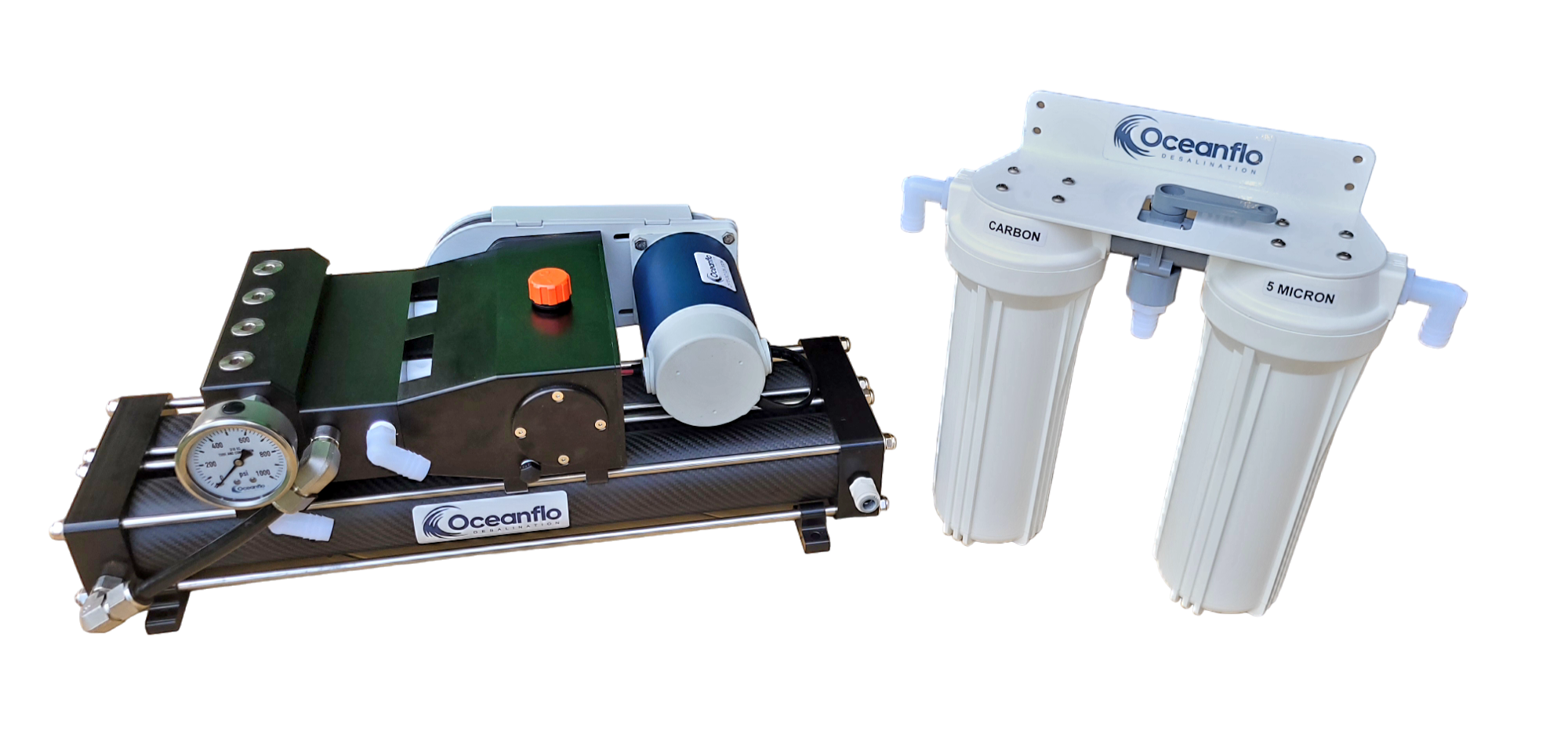
Oceanflo watermakers tackle the high-pressure requirements with a highly efficient proprietary DC-powered pump. Its innovative energy recovery system allows this to be done without the need for AC power.
The systems are available in both 12V and 24V versions. The electrical demand is low enough that watermaking can be done sensibly from solar on many boats—generating 300w of solar means the power overhead is met.

Fewer components also mean fewer things to maintain. The system is simpler, quieter, and easier to live with.
Oceanflo offers three models built around two output levels.
OF70M manual
The OF70M produces 70 litres of fresh water per hour. It is the simplest system in the range.
Whilst the high-pressure pump design is inherently automatically pressure regulated, water is initially sent overboard until the quality is correct, then directed to the tanks. A weekly freshwater flush is also carried out manually.
This model suits owners who are comfortable operating systems directly and want a straightforward, well-built solution without additional electronics.
OF70A automated
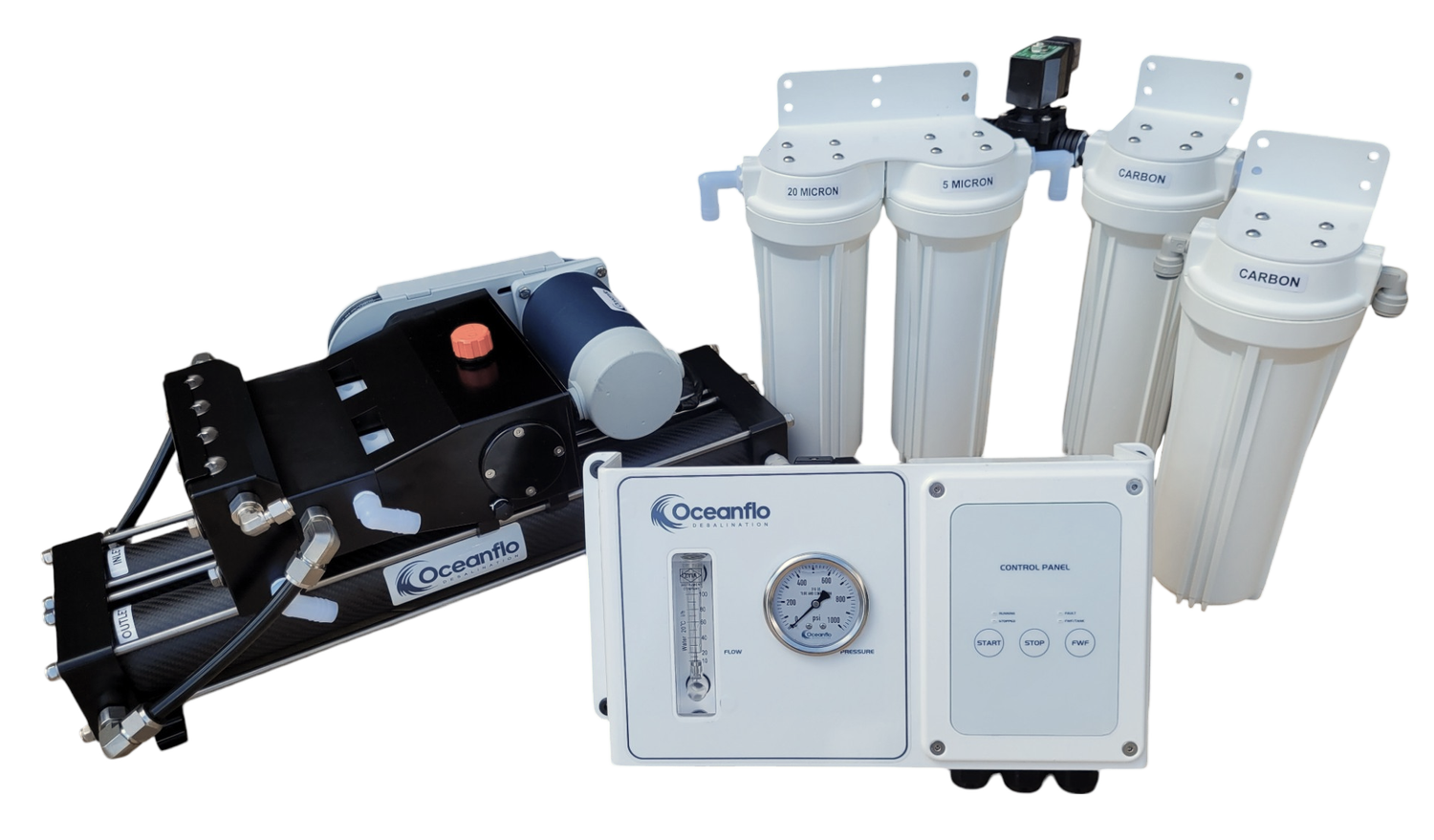
The OF70A uses the same desalination hardware as the manual model but adds automated control.
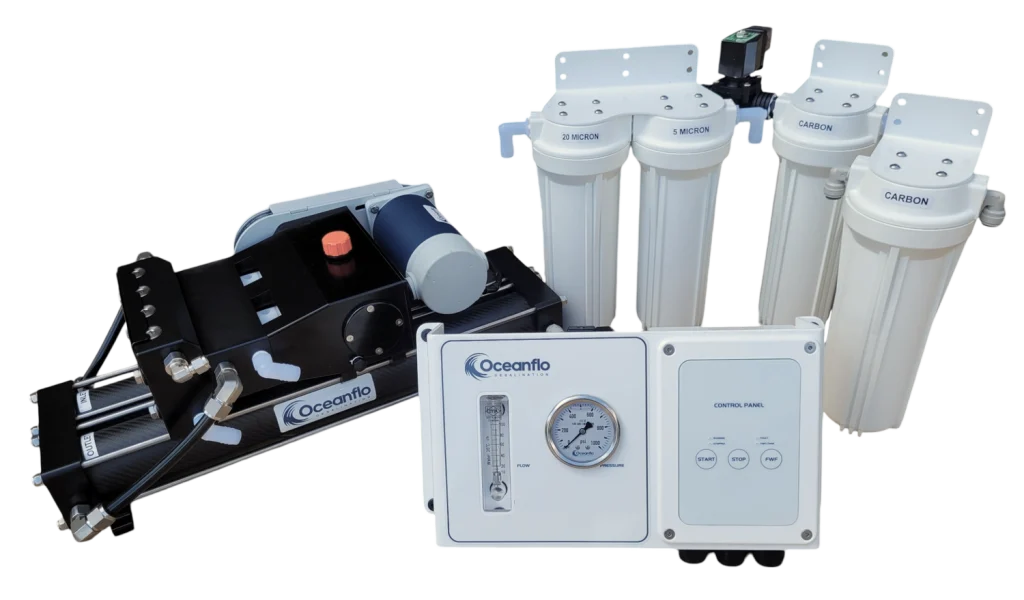
A local control panel shows flow and pressure. The system manages start and stop functions and automatically diverts water overboard until salinity is within limits. Once quality is reached, water is sent to the tanks without intervention.

A freshwater flush is handled automatically. A second control panel in the saloon allows the unit to be started or stopped without accessing the machinery space.
For short-handed crews, this removes most of the day-to-day involvement.
OF150A high-volume automated
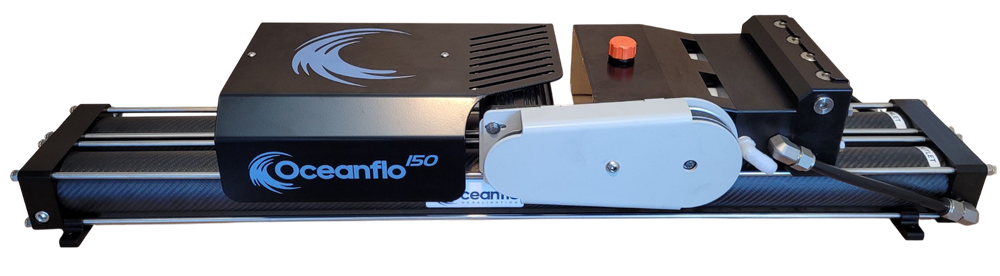
The OF150A increases output to 150 litres per hour.
It retains the same innovative high-pressure pump design and automated control features, paired with a larger, brushless DC motor. The higher output suits boats with larger crews or higher daily water use, without pushing owners back toward generator dependence.
Oceanflo—designed to fit real boats
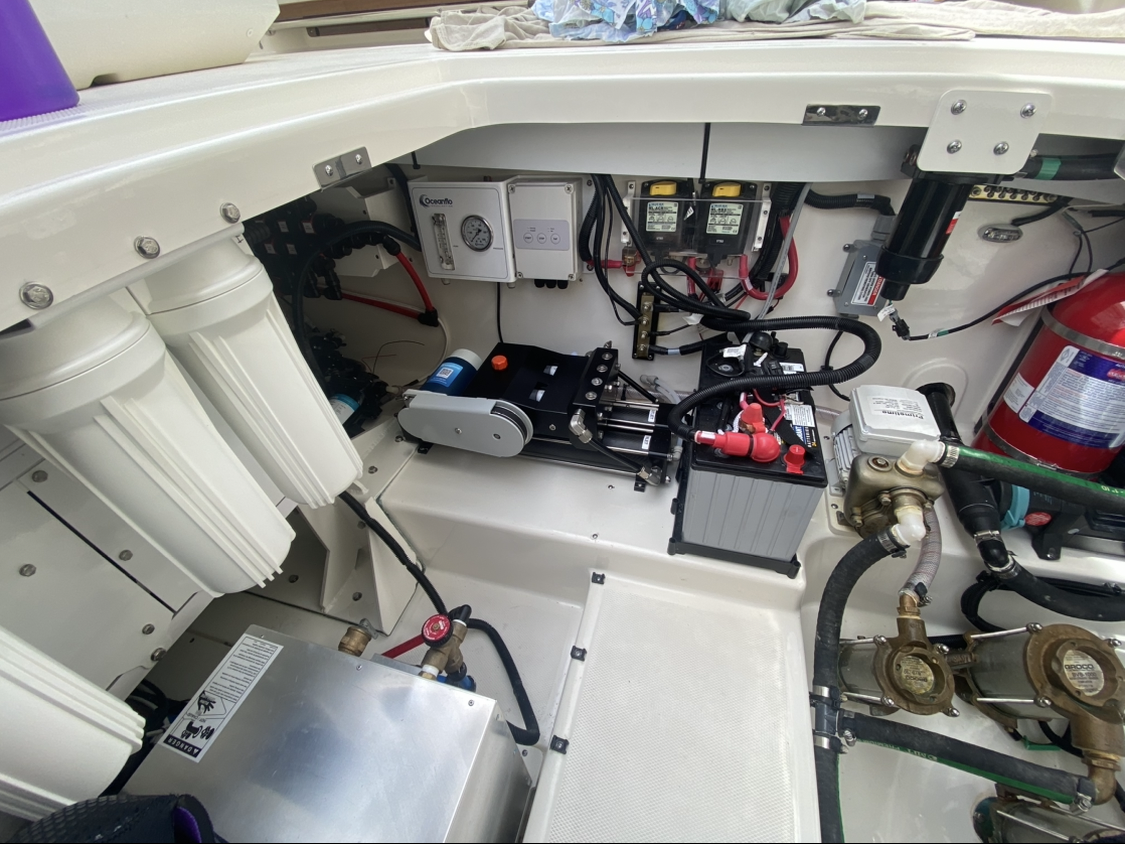
Space is often the limiting factor when installing a watermaker. Oceanflo has cleverly been designed with this in mind.
The system supports shorter reverse osmosis membranes, typically around 50 cm in length. These are far easier to place in engine compartments, lockers, or under floors where older one-meter-long membranes were a standard years ago.
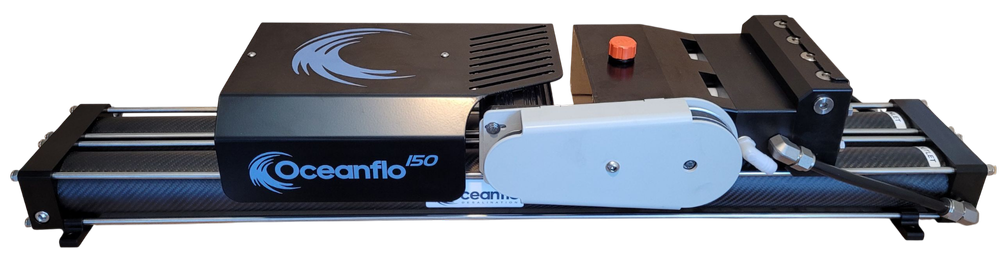
The main unit is compact and logically laid out. Installation does not require major compromises: it fits neatly under the floor, in the engine room, or under a built-in seat in the saloon.
Noise, vibration, and finish
The system uses quality DC motors and runs at relatively low RPM, keeping noise and vibration to the minimum.
Component quality is high throughout. Fittings, housings, and layout reflect equipment designed to be used regularly, not just installed and forgotten.
This is consistent with in-house manufacturing, where feedback from use feeds directly back into design. In the tech world, this is a fine example of ‘plug and play.’
Cost, value, and practicality
At around the $10,000 entry point, Oceanflo watermakers are financially accessible.
There are few watermakers available for less than this. From my own personal experience, I can tell you that cheaper systems are often highly manual kit-style builds. Those systems can be useful for learning how watermakers work, but they tend to be complex to install and demanding to operate.
Oceanflo takes a different path. Even the manual OF70M arrives as a complete, cohesive system. It is easy to install and clear to operate. The automated models go further, offering features usually found on far more expensive systems.
Automatic salinity control, automated flushing, and remote operation are typically associated with much higher price points. Here, they are delivered without turning the system into something fragile or complicated.
The result is a watermaker that feels finished and affordable, without feeling stripped back.
Making water without the engine running
Oceanflo is not trying to change how desalination works. It is focusing on how much it costs to do it—both upfront costs (your hard-earned cash) and operational costs (or what I call “power cost per litre”.)
By lowering the power required per litre of water produced, these systems make fresh water a background task rather than a scheduled event. Water can be made when the sun is out, without starting engines or generators.
For owners who want simpler systems, fewer engine hours, and better use of onboard power, Oceanflo watermakers offers a solution that fits how boats are actually used.
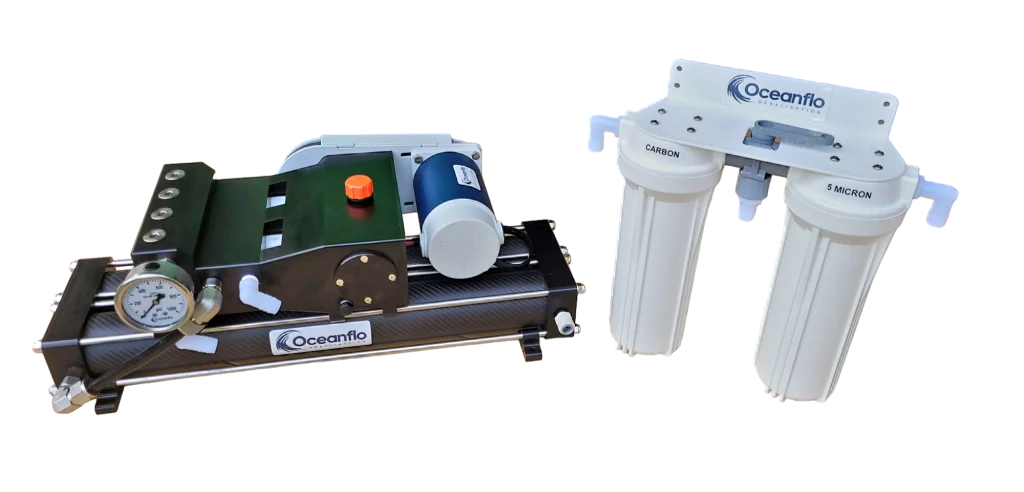
It is a New Zealand-built answer to a problem most cruisers live with every day. Making fresh water at sea, without making a meal of it.