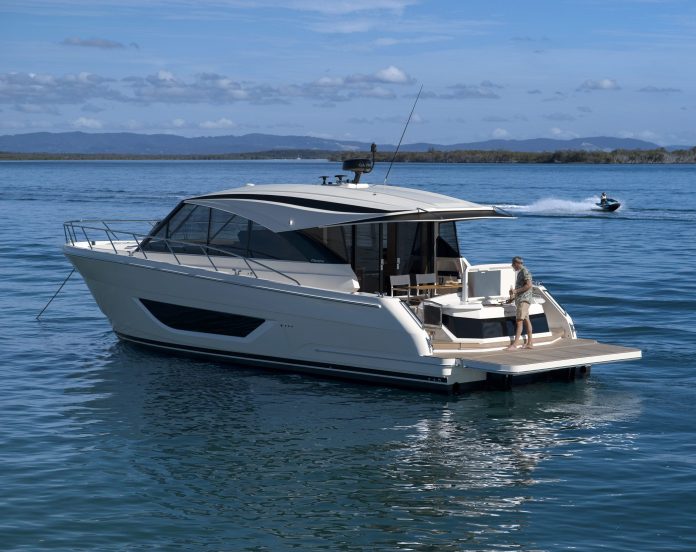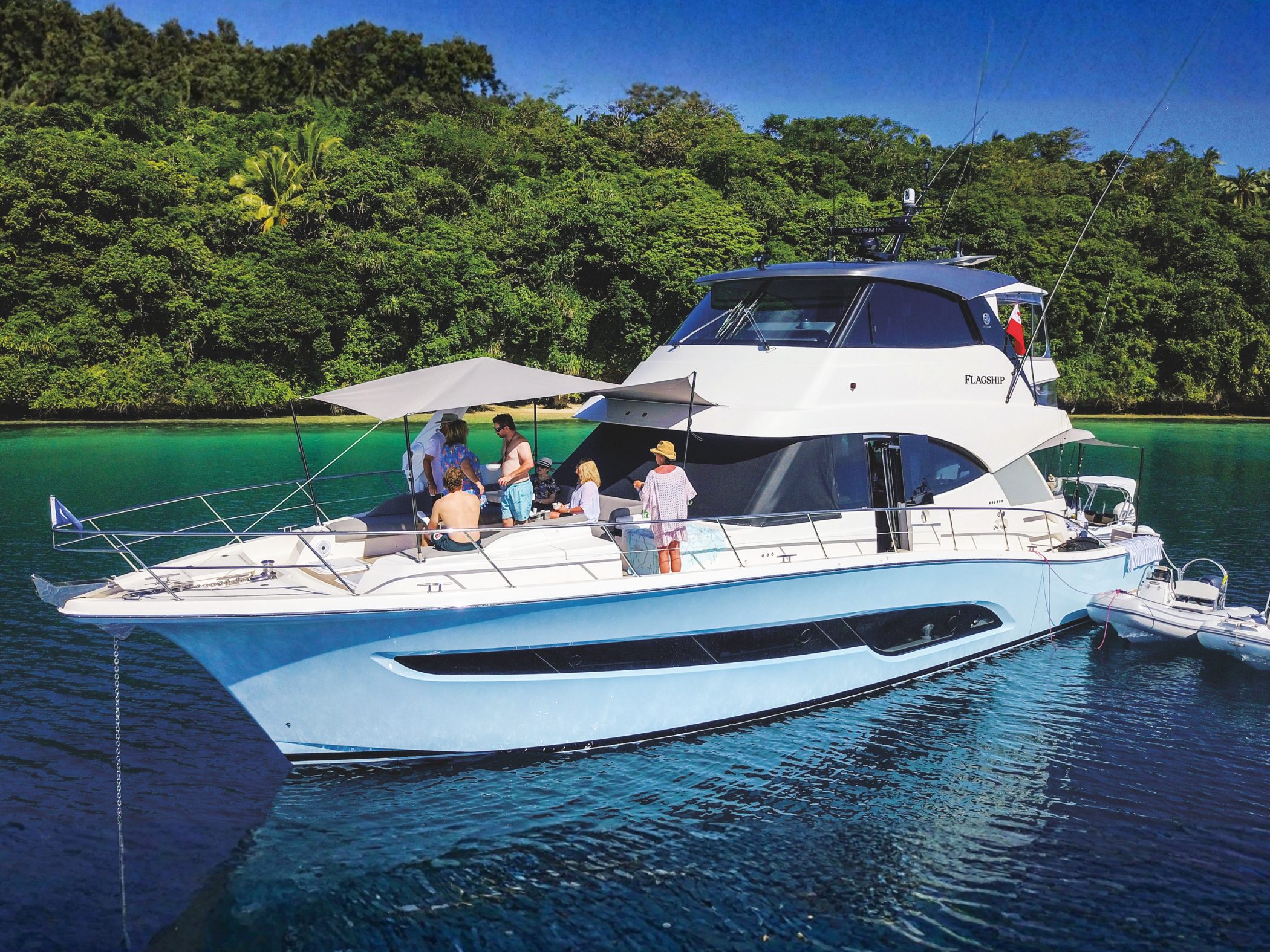
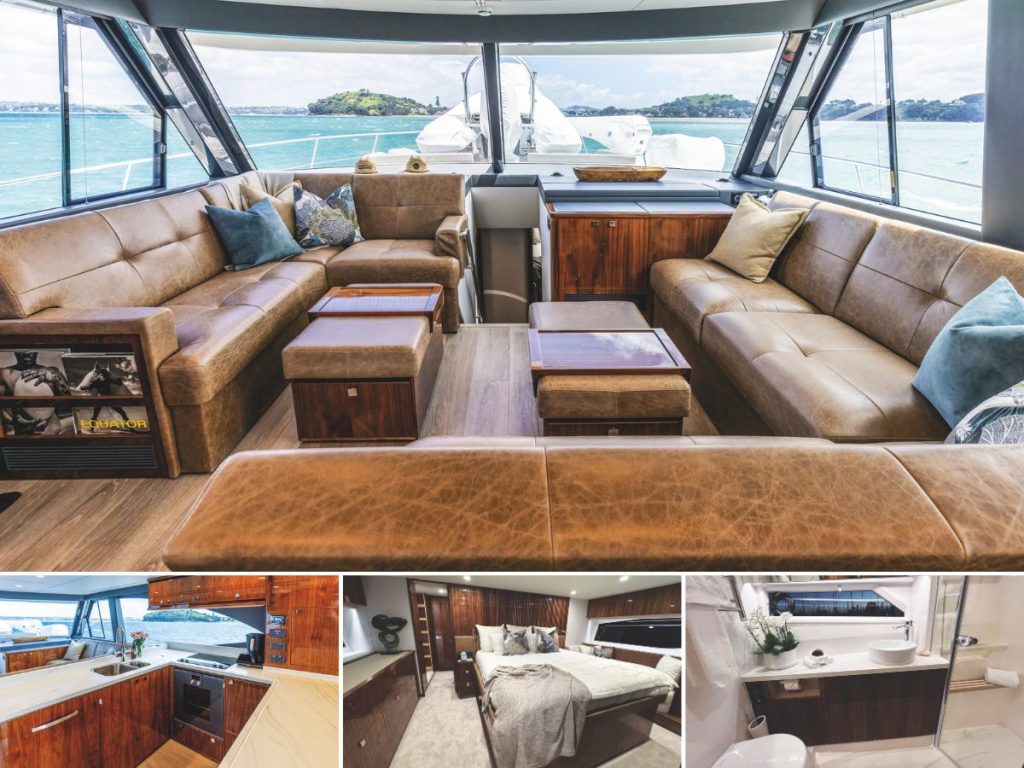
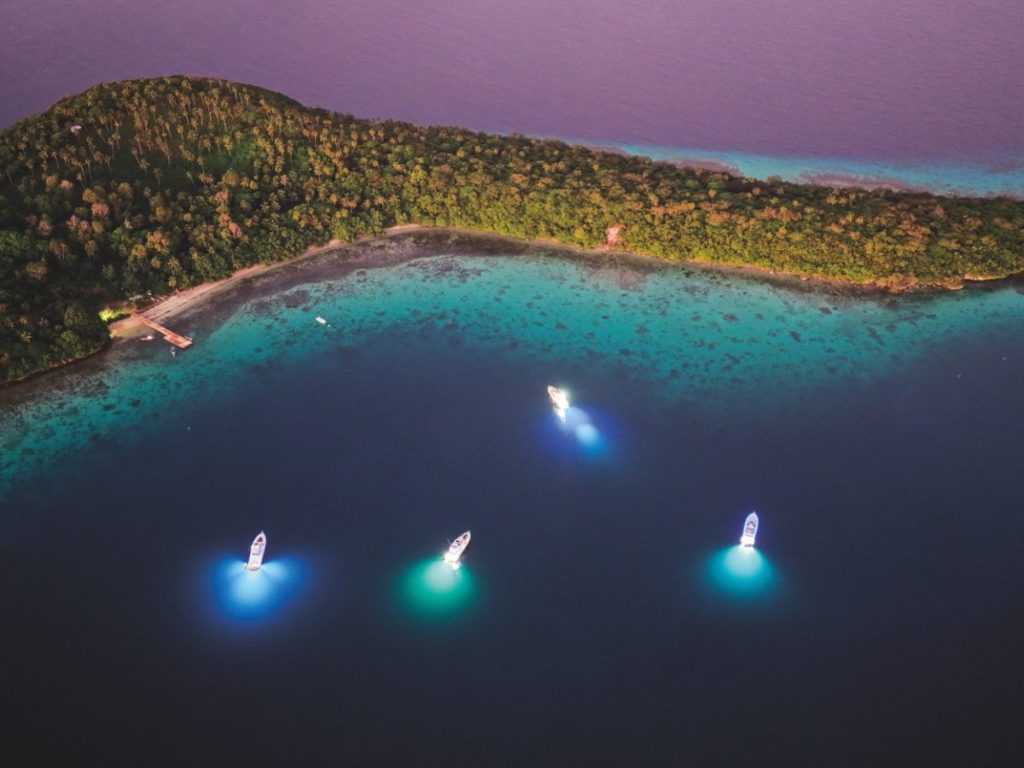
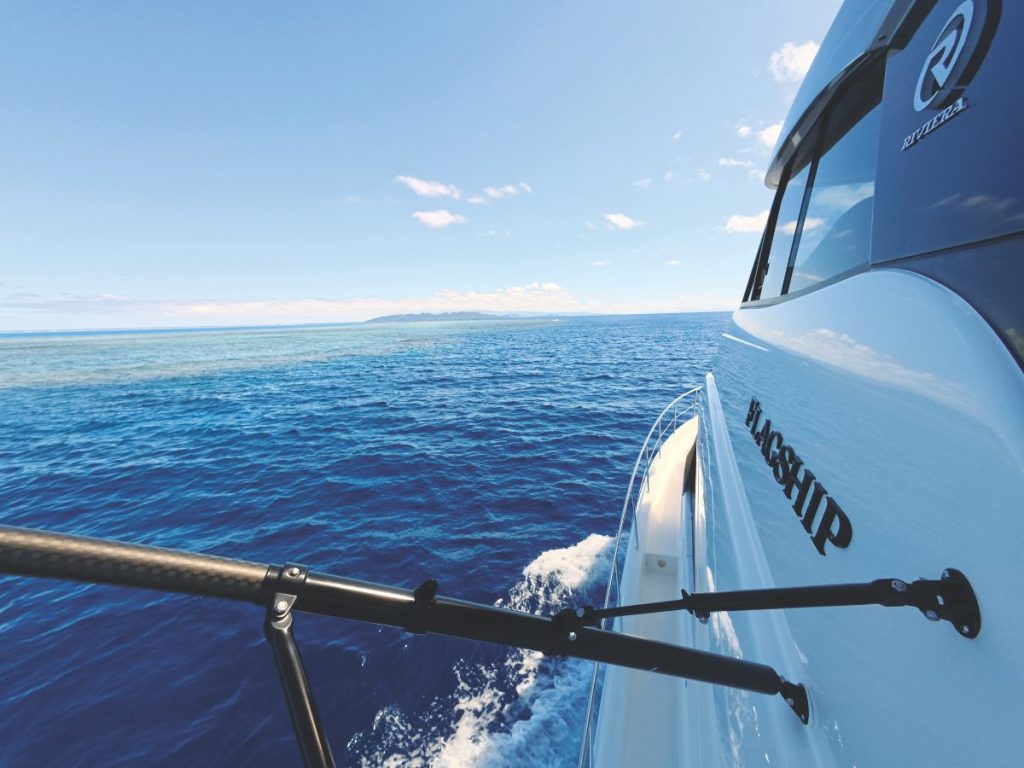
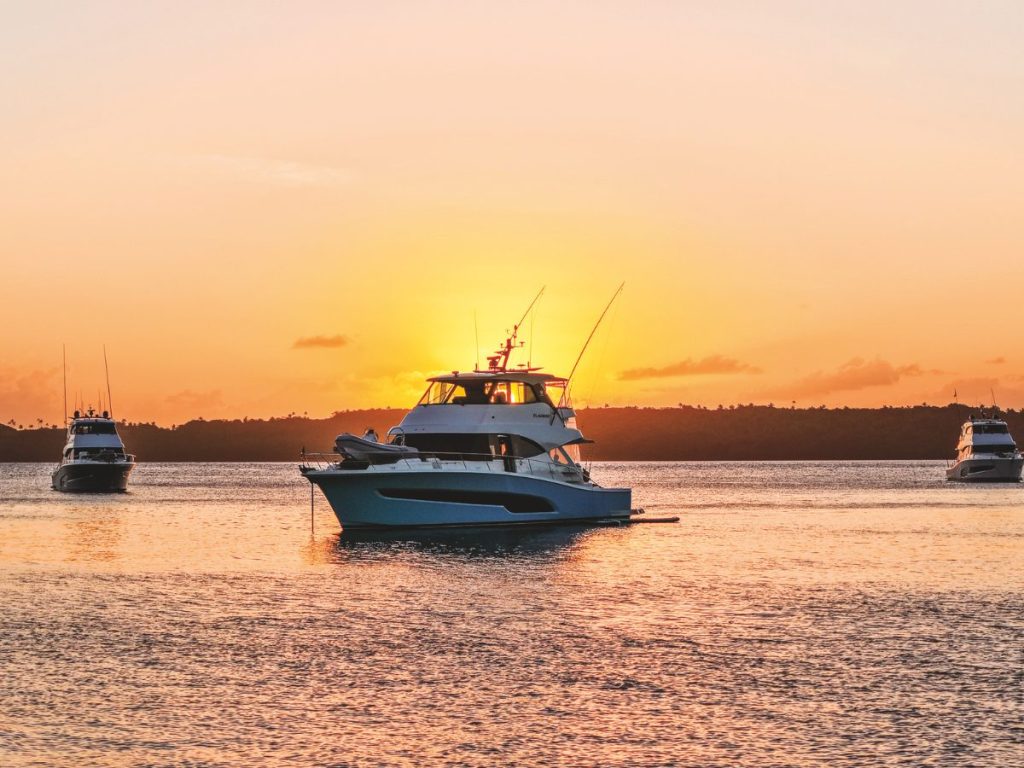
Launched in 2025, the 19.8m Flagship is the first of Riviera’s new 58 Sports Motor Yacht (SMY) into New Zealand. She is classic Riviera-handsome and gleaming-but she also illustrates the options and possibilities available to buyers wanting to refine a new Riviera to their usage/cruising preferences.
It’s this optimisation ‘that makes Flagship unique. Lying at R Marine Flagship – the New Zealand Riviera dealership base in Westhaven – the vessel was conceived to showcase how luxury motor yachts can be ‘tuned’ for cruising finesse and adapted to a buyer’s preferences.
Flagship’s improvements are particularly interesting because they weren’t chosen from a brochure – they’re based on experience. Specifically, the experience of Dean Horgan (Dealer Principal), and his wife Suzie. Dean’s bluewater cruising experience extends to thousands of miles and many decades. His association with Riviera is almost as long.
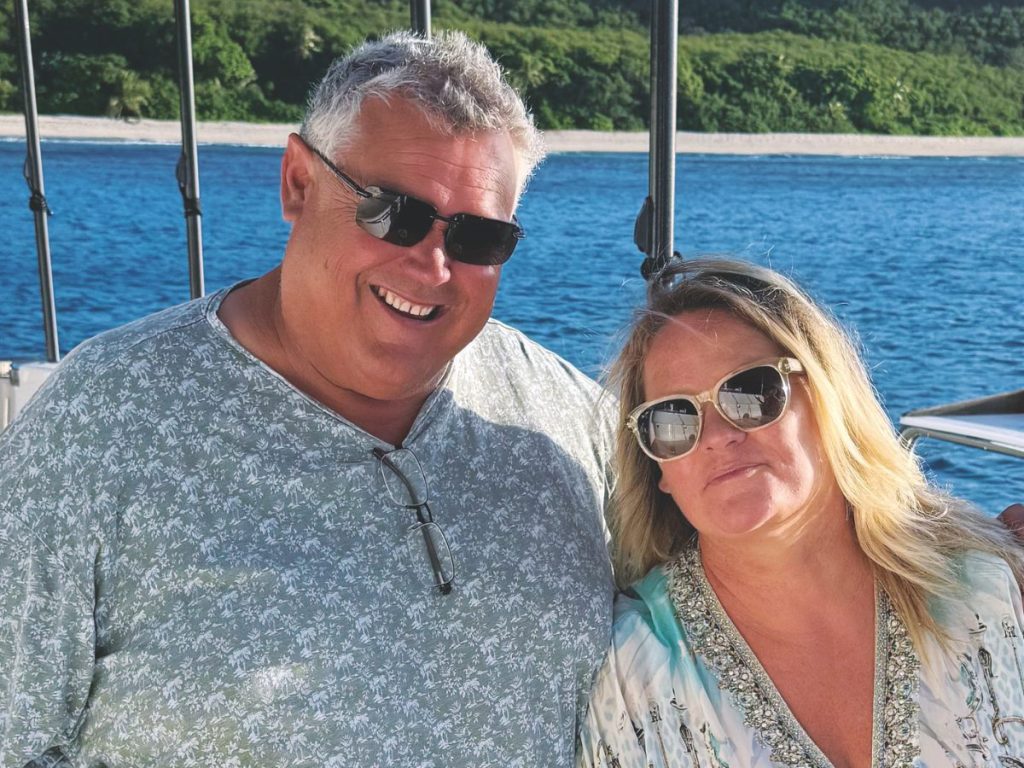
Together with Suzie’s lifetime of practical on-water experience they shaped Flagship into the ultimate spec for long-range cruising, fishing and an effortless lifestyle on the water. Refinements that saw the installation of additional/different equipment for easy use, cruising in comfort, and manageable running costs.

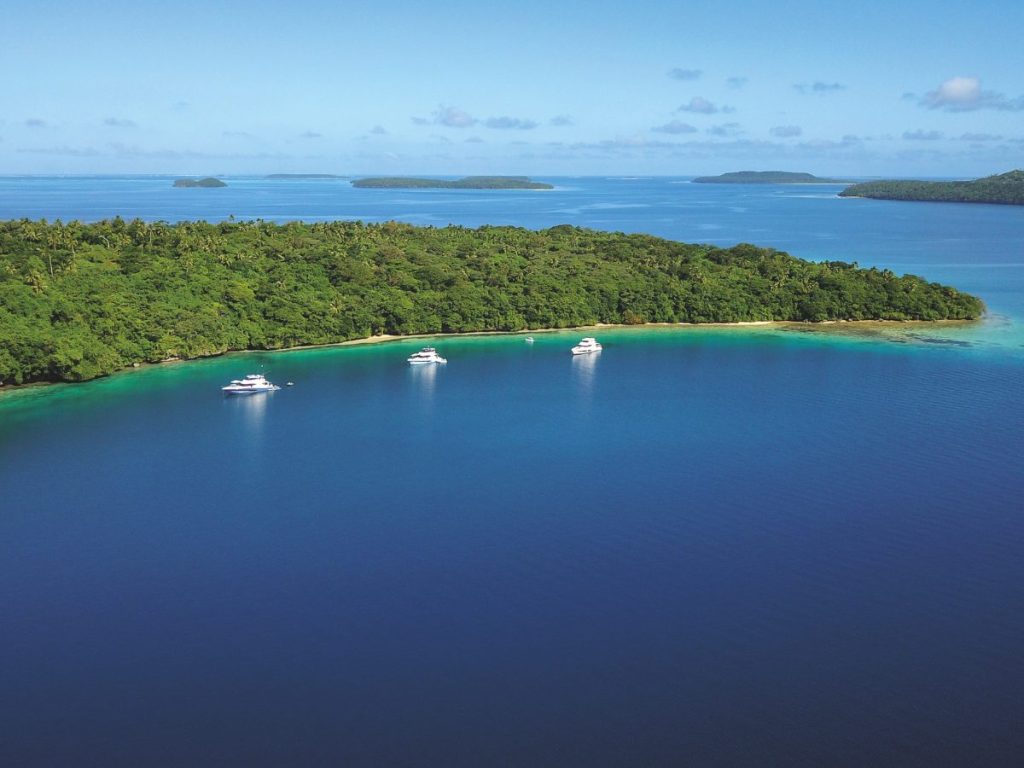
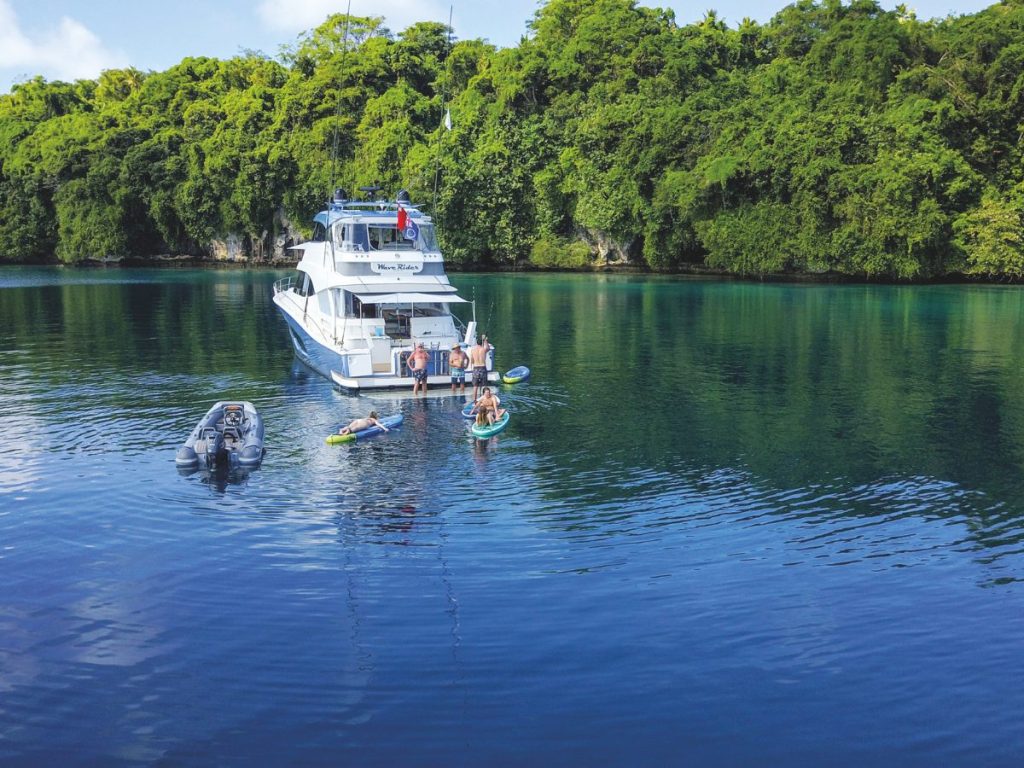
For them, the best way to illustrate these features was an extended cruise from Auckland to Tonga and Fiji. “Our key objective,” says Dean, “was to showcase how factory-new Rivieras can be adapted to individual choices. How boats can/should be configured, how technology can boost energy efficiency – how overall operation can be simplified.”
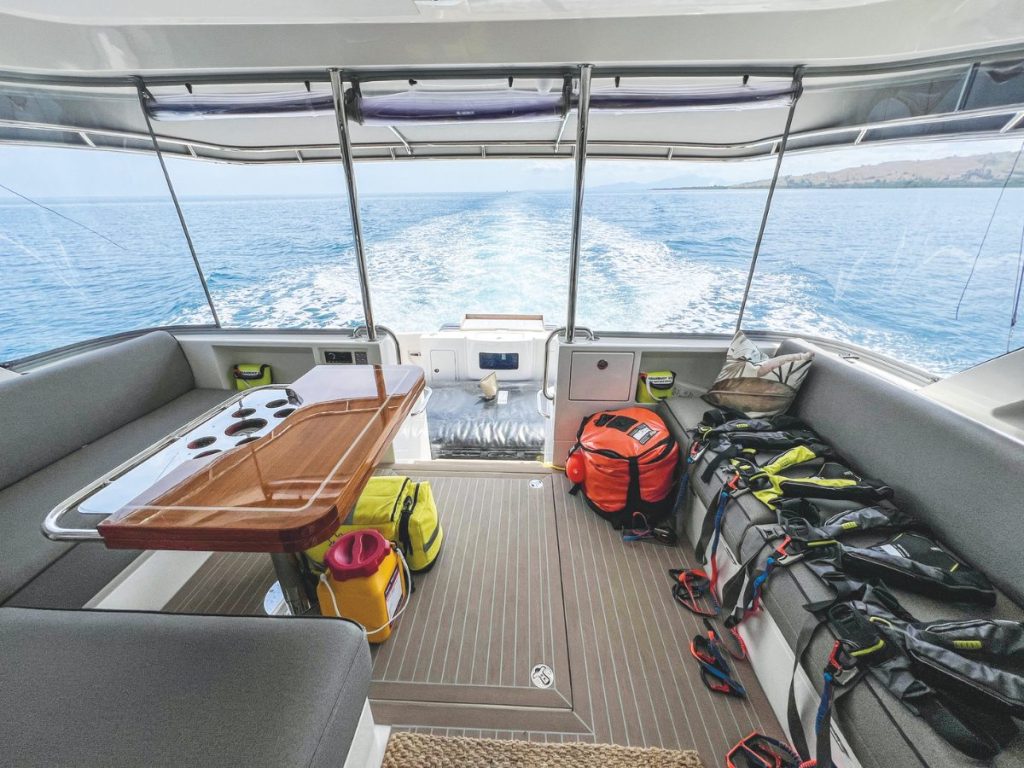
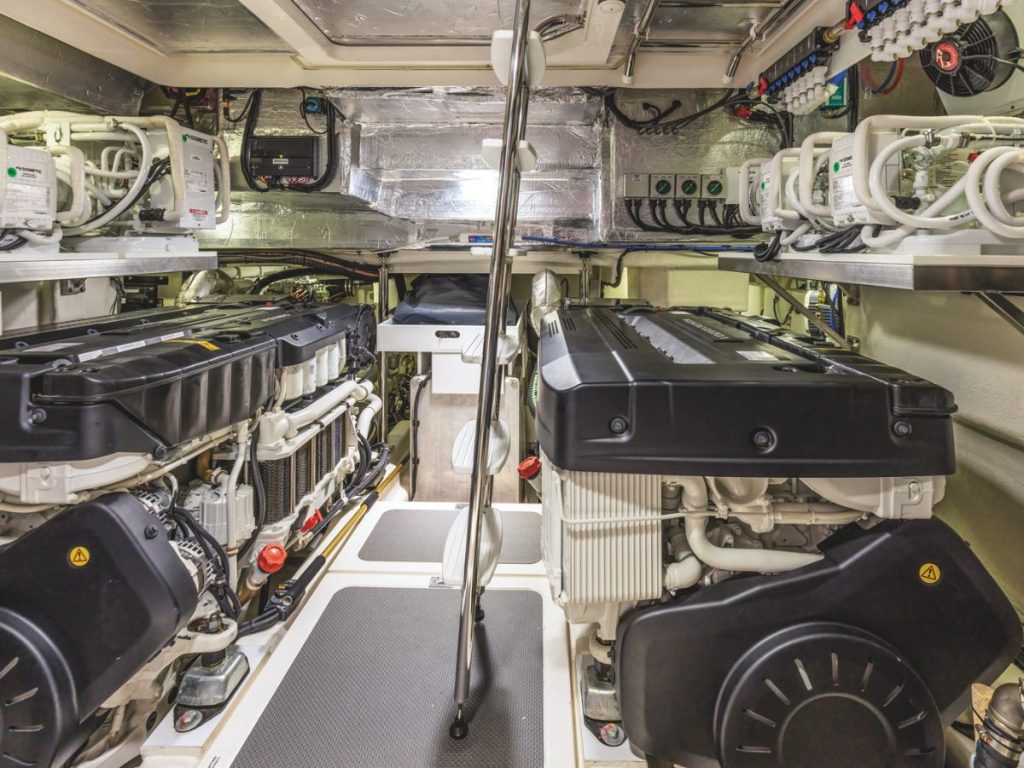
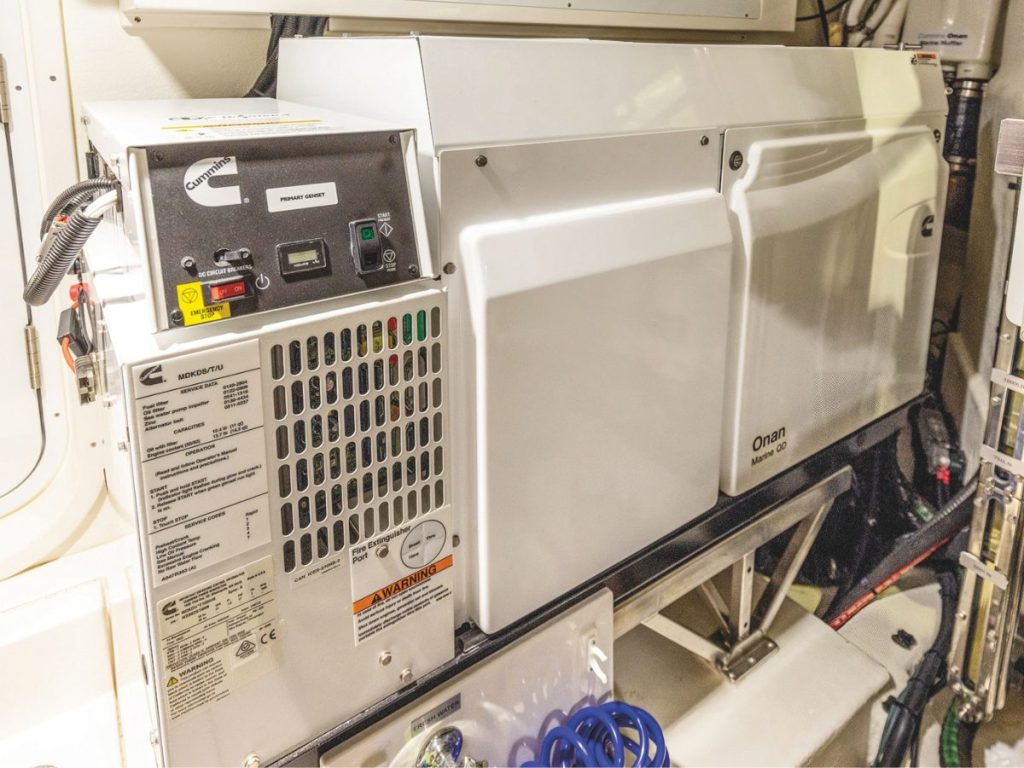
Getting to the islands with plenty of fuel in reserve – was the first adjustment for Flagship. The 58 SMY is powered by twin 1,000hp D13 Volvos mated to IPS 1350 (twin-screw) propulsion units – enough to power her to around 32 knots. The standard vessel carries 4,500 litres of diesel – Flagship is fitted at the factory with long-range tanks (6,500 litres). She’s also equipped with a 27kVA Onan generator (more about this in a moment).
Longer legs, says Dean, “opens up a different cruising mindset: less port-to-port hopping, more freedom and flexibility to use weather windows as they arise, stopping wherever you like, the confidence to take on lengthy open ocean cruises and arrive at your destination with plenty of reserve fuel.”
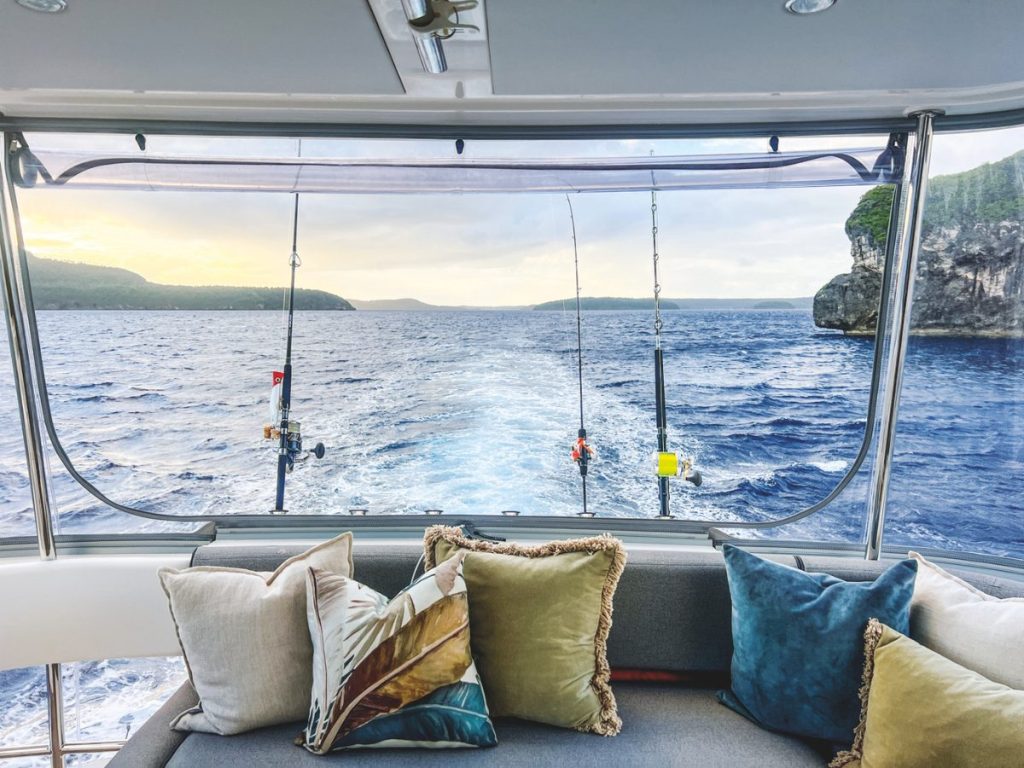
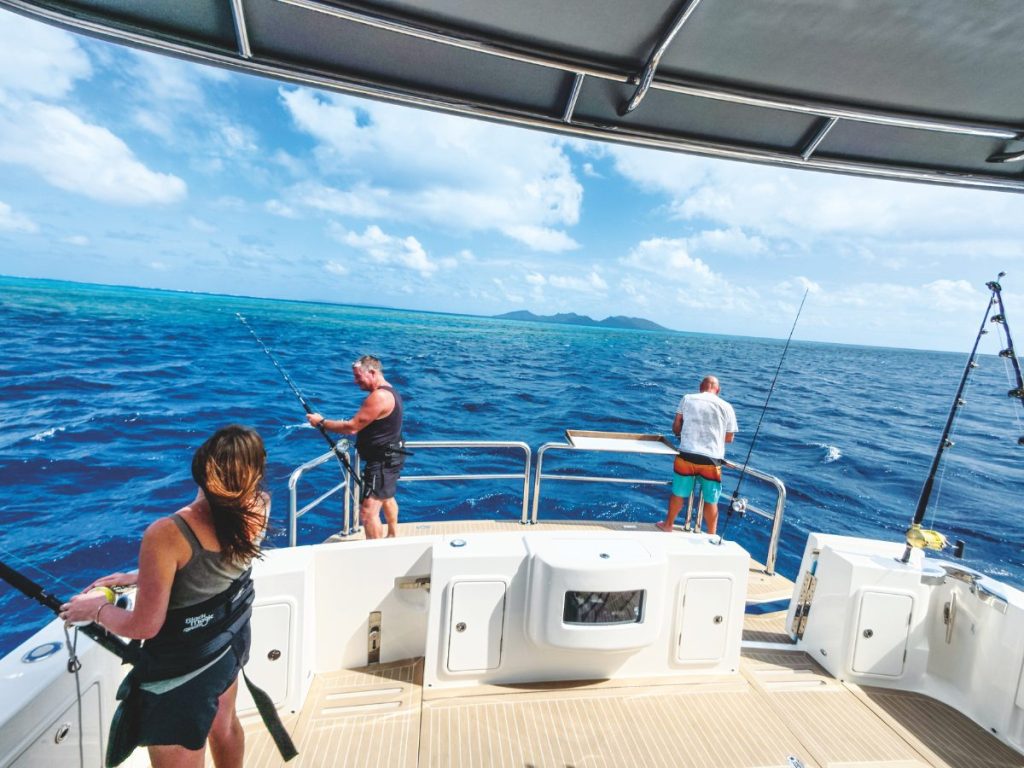
Minerva Reef, adds Suzie, was very special. “After days of open ocean, arriving felt like discovering a hidden world. The water was alive – bait schools pulsing beneath the surface, rods loading up fast, and the kind of strikes that stop you, mid-sentence. Yellowfin and wahoo came aboard, marlin lit up the wake, and sailfish worked the blue just outside the reef. It wasn’t just good fishing, it was abundant, wild and constant. Minerva was one of those rare, unforgettable moments that remind you why you go to sea.”

“Cruising at around 8.5 knots,” says Dean, “proved to be the optimum setting. We arrived at Tonga’s Nuku’alofa [after a fishing stop at Minerva Reef] with 2,500 litres in the tanks. Over the entire four-and-a-half-month cruise we used an average of 27 litres an hour between the engines and the generator.”
Crucial to that relatively modest fuel equation was the minimal use of the generator (about an hour a day). And to appreciate how that worked, we need to explore the vessel’s overall electrical/energy configuration.
Efficiency
Like many high-end motor yachts, the 58 SMY’s electrical load is substantial but, like most boaties, Horgan didn’t want his cruising dominated by an ‘always-on’ generator with its corresponding fuel consumption.
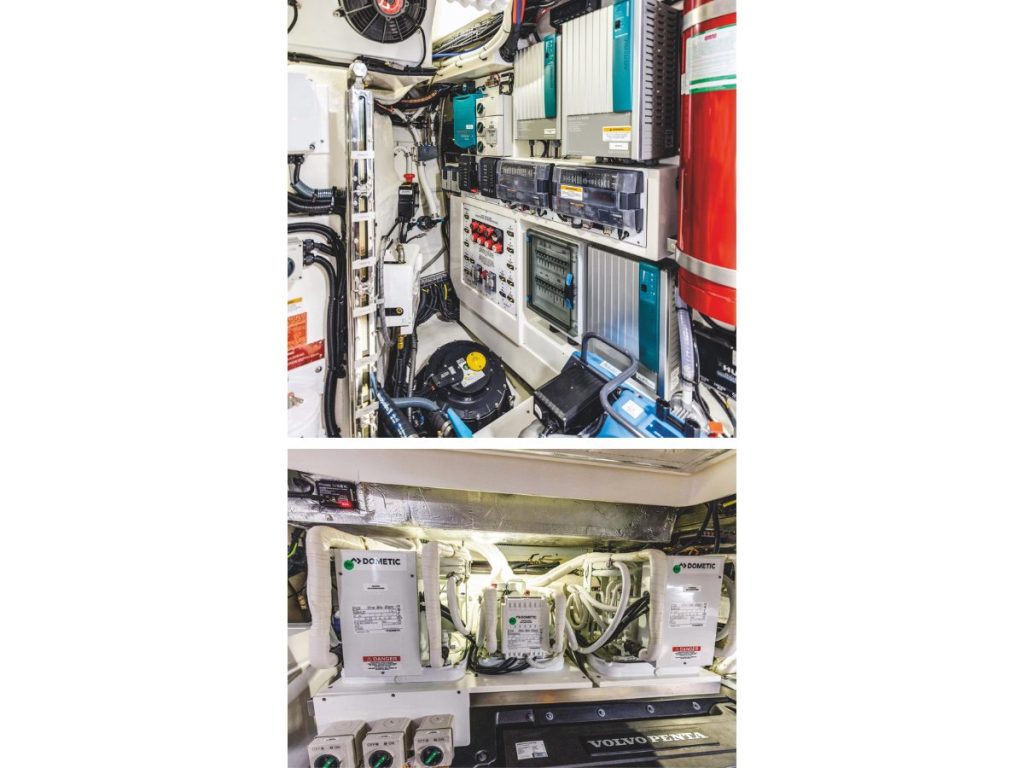
The solution? Lots of integrated technology, but the major components include some Mastervolt magic, lithium-ion battery banks, high-tech solar power and an anti-UV laminate on the vessel’s expansive windows to reduce the air-conditioning load. All up, a combination that reduced generator time to an hour or so every day.
Three 100-amp Mastervolt chargers are hooked up to the generator. Their 300-amp output feeds lithium battery banks (about 600 amp-hours equivalent). In turn, the batteries power a 5kW Mastervolt inverter for 240 volts AC. In this configuration, all AC outlets are alive 24/7 (typically, AC outlets are only alive when the generator’s running).
The lithium batteries are separated into a house bank and an auxiliary bank. The latter powers high-load items such as the anchor winch, foredeck davit and stern hydraulic platform. While each engine has a high-output alternator charging its AGM start batteries, each is also fitted with secondary alternators charging the auxiliary and house bank exclusively. This arrangement avoids having to use the start batteries for the anchor, davit and hydraulic platform.
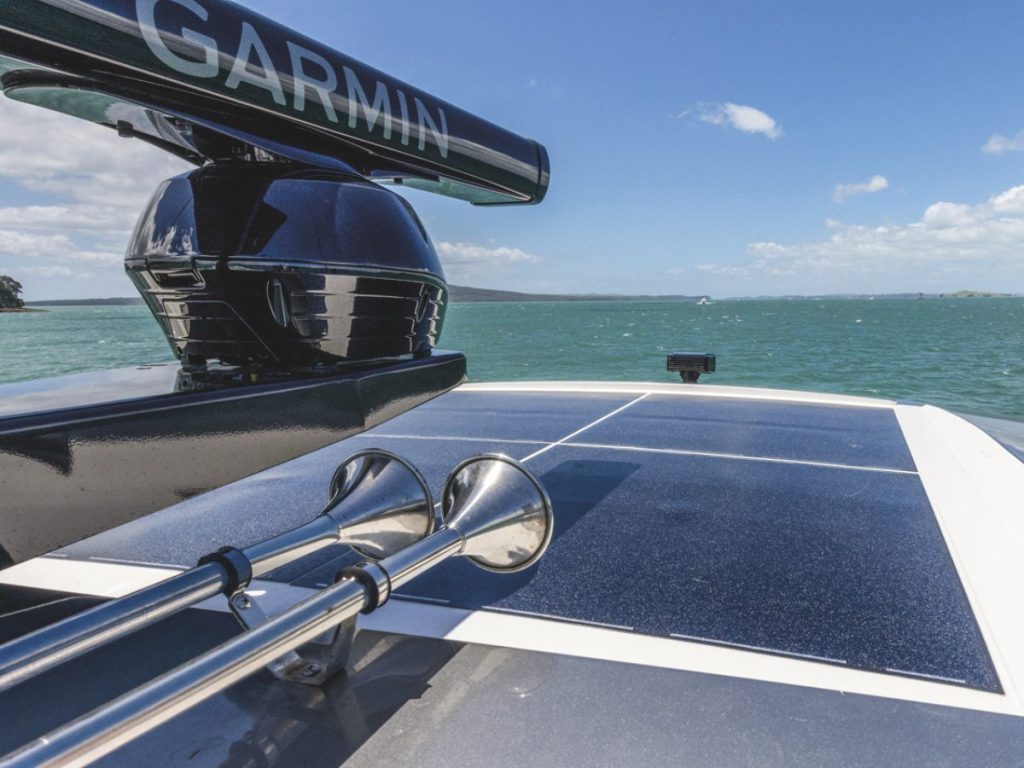
But a major player in the charging system is the solar power on the flybridge roof. There are eight panels (700mm² each) together delivering 1,650 watts. Horgan says the panels (around 2.5mm thick) include a nonslip walkable surface and are easily moulded into the roof’s curvature. Very streamlined and unobtrusive.

“These are military-grade panels using sophisticated cell technology,” says Dean. “Together they produce about 50 amps at 24-volts – and they are a significant component in the overall charging system, helping to minimise generator run-time.”
The panels integrate seamlessly with the Mastervolt infrastructure, and while Horgan concedes the technology is expensive, he is adamant the outlay is quickly recovered by the reduced generator fuel/servicing costs – and the ease of operation.
Generator efficiency is also enhanced because it drives other items during its one-hour cycle time. Among them the high-capacity Blue Water Legend 1850GPD modular watermaker, all the fridges/freezers (there are 12), the Zip hot water system, the ice-maker and ice-chipper. The generator consumes around eight litres per hour.
In practice, this all equated to an easy, simple start to the day. A fuss-free routine of systems ‘waking up’, water being made, batteries charged, coffee. By the time anchor was up and a new bay chosen, the generator had done its work.
Water quality
The 58 SMY carries 800 litres of water – plenty for coastal cruising but not nearly enough if your guests like to shower and dress up for dinners on extended, bluewater voyages. To that end Dean elected to make Flagship completely independent for fresh water. It’s all processed from the ocean with a Blue Water Legend 1850GPD modular watermaker (300 litres per hour).
In the islands, independence is everything. Fresh water isn’t a ‘nice-to-have’ when you’re anchored off a palm-lined beach for a week. It’s the difference between rationing and relaxing.
To boost water purity and decrease maintenance the watermaker’s coupled to a sand filter trap that removes any plankton prior to desalination. After desalination the water passes through an activated carbon filter, followed by UV sterilisation. Uprated water pumps (higher pressure and volume) distribute the water around the vessel.
The water also feeds the ice-maker and ice-chipper. The latter produces around 400kg per day, and to improve thermal efficiency/reduce electrical load, the bin boasts triple-insulated 100mm walls. The ice-chipper is designed to hold a sizeable wahoo/tuna – “I’ve discovered the catch lasts better if it’s chilled whole, without gutting or gilling,” says Dean. In practice, that means fresh sashimi, grilled fillets, and the easy generosity of feeding friends on nearby boats.
THE MAJOR WEAPONS IN THE TECH ARMOURY ARE THREE GARMIN TRANSDUCERS
Another thermal/energy saving feature is the 3M laminate fitted to all windows (there are quite a few…). The laminate cuts UV radiation by about 95%, keeping things cooler and reducing the air-conditioning load. A particularly welcome feature in the tropics.
Garmin/navigation
Not all boat owners are passionate anglers but for those who are the technology fitted to Flagship demonstrates the possibilities. It’s inspiring stuff – all geared to streamlining the hunt and a more satisfying catch-ratio.
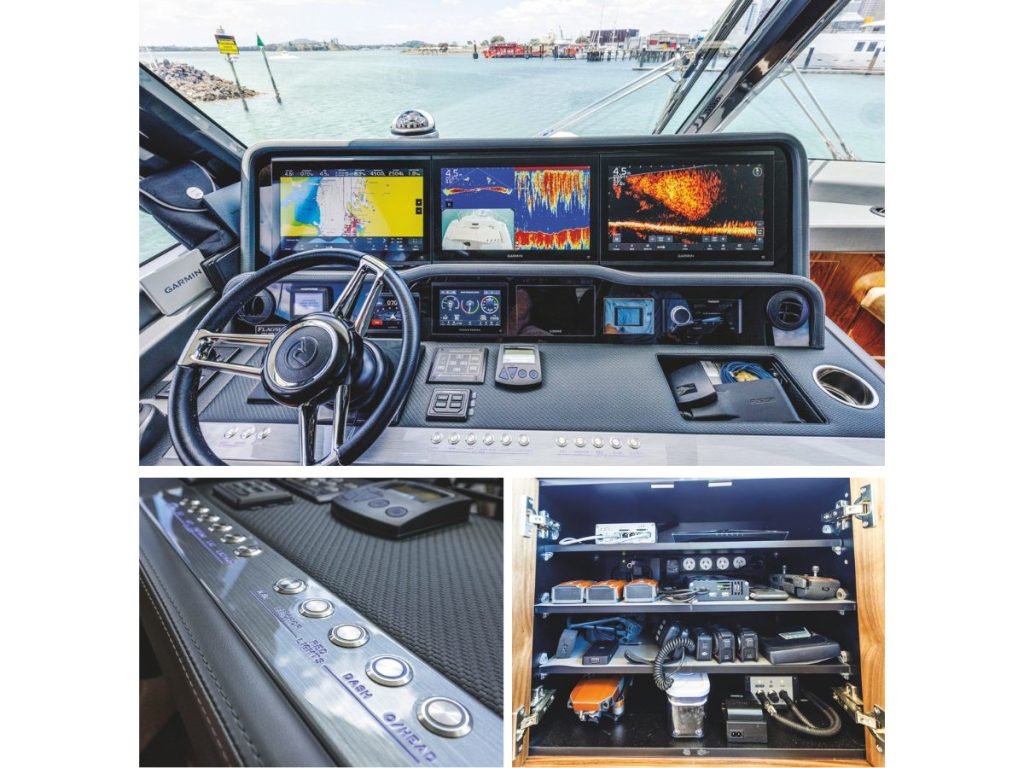
Fishing around the islands is a different game, with deep water, steep drop-offs, current lines that flicker like highways, and baitballs suddenly appearing where the chart says there should be nothing. The right electronics don’t replace skill, but they sharpen it. The major weapons in the tech armoury are three Garmin transducers – spearheaded by a 3kW LHW 509 unit. Designed for seeking prey in deep water, it reads to a depth of 4,000m. It’s complemented by Garmin’s relatively new PS70. This provides a ‘slice’ of underwater activity in real time – reflecting a ‘straight-down’ and a ‘sideways’ view. The side view is up to five times the depth of the water. In effect, in 100m of water the PS70 ‘displays’ a 500m wide ‘swath’ as the vessel moves forward.
The third transducer is a PanOptix forward-scanning unit, displaying a view about 30m ahead of the vessel. “It delivers a very clear, accurate representation of the bottom,” says Horgan. “It’s particularly useful when venturing into unfamiliar anchorages, and great for avoiding any coral bombies in island anchorages.”
All views are displayed on three 19-inch” Garmin MFDs on the flybridge – plenty of space to explore the data from the three transducers concurrently (and a lot more). And because the MFDs have HDMI ports, transducer views can also be displayed on the vessel’s 55-inch saloon TV, or on the 32-inch cockpit unit, or on the 32-inch mezzanine unit (or all three). Ideal for keeping an eye on proceedings while having lunch.
Riviera, Dean points out, will, of course, accommodate every buyer’s MFD preferences. “I like the Garmin technology because the interface is very similar to that of an iPhone. It’s intuitive and simple to use and it integrates seamlessly with diverse boat systems.
“I also like Garmin’s SmartMode feature. This allows users to create a variety of MFD ‘presets’ around the type of activity – fishing, cruising or docking, for example – and with the push of a button you select the optimum views for the mode of operation.”
Additional ‘one-button’ advantages come with Garmin’s acquisition of Fusion about a decade ago. “I can control the stereo from anywhere on the boat and even from my phone.”
Flagship’s tender lives on the foredeck and transferring it between sea and its chocks is a simple operation with the four-axis hydraulic davit: left, right, up and down – and ‘reach’. “It’s an easy, one-person job.” For short hops between bays, the tender is loaded onto the hydraulic stern platform.
Communication
Maintaining contact with family and friends (and the office…) while offshore is a nice-to-have for many cruisers, and technology like Starlink’s satellite constellation makes it simpler (and more affordable) than ever before.
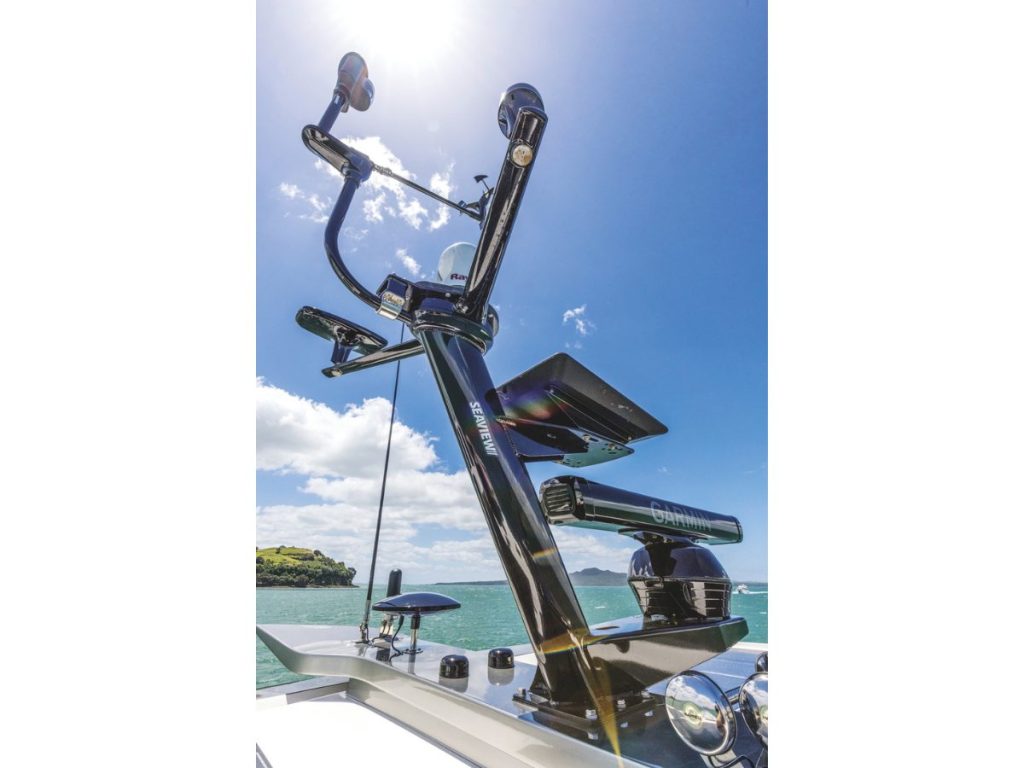
A custom-built Seaview tower on the flybridge is Flagship’s communication central. In addition to the Starlink receiver it carries modules such as radar, a satellite compass, FLIR (thermal infrared imaging), GPS units and a flurry of antennae.
“The tower is a custom-designed,” says Dean, “because the various bits of equipment need an appropriate degree of separation – to ensure the electromagnetic radiation from each module doesn’t compromise the performance of its neighbours.
Starlink, he adds, is a game-changer. “It worked superbly in the islands – we used it for calls, emails, video links, Zoom calls, watching movies, rugby, motor racing. It effectively allows you to work remotely – no one needs to know you’re on the open seas, 1,000km from the office.
“It’s particularly impressive given how offshore communication technology has evolved over the decades – from the early days of SSB radio through to Meridian and Satcom. These were all expensive and usually came with a large (and heavy) footprint. Starlink is very discreet and affordable. We discovered a lot of cruisers in the islands were using it for home-schooling.”
“Easy communication,” says Suzie, “is about freedom – the ability to check in when you want to, share the best moments as they happen, and still keep everything running back home, without the trip feeling like an escape from reality.”
Another smart piece of comms technology is the Teltonika modem that lives in a saloon cabinet. It features dual SIM slots. “One slot is reserved for a New Zealand SIM card – the other’s for a local card depending on the country being visited. In Fiji, for example, we fitted a Digicel card. You can switch between networks instantly.”
Remote operation is enabled with CZone. It runs the vessel’s digital switching and can be configured in multiple ways (presets) to suit owner preferences. As an example, it can be programmed to auto-start the generator (if you are away from the boat) or switch on the air-conditioning to prepare the boat for your arrival.
Long-range cruising means rolling seas and to keep the G&Ts in one place Flagship has been fitted with carbon fibre Humphree stabilisers. Each fin measures 0.8m² and the system is fully-automatic, adjusting its action to the sea state. Horgan particularly likes the ‘coordinated turn’ feature. In hard turns where the vessel might ‘lean out’ the stabilisers compensate instantly.
Stabilisers don’t just keep glasses upright – they keep people relaxed, make meals possible, and enable undisturbed sleep. They make difference between ‘enduring’ a passage and enjoying it.
Dean estimates the technology upgrades/additions have added about a tonne of weight – taking her displacement (fully loaded) to 44 tonnes. A lot of the extra weight, of course, has been offset by the lithium-ion batteries (and their smaller footprint).
Choices galore
How does a prospective owner make informed choices around this technology?
“Rather than showing someone everything over an hour or two, we like to sit down with buyers to get a sense of what they want – how they plan to use the boat, their typical cruising/usage profile – and then tailor the vessel accordingly. We offer advice, recommendations and suggestions – personalising the vessel to the individual.
“It takes a lot of planning, but it all makes perfect sense if you can use technology to help the boat look after itself with minimal owner input. A cruising lifestyle should be enjoyable – not a chore.”
And that’s what Flagship demonstrates so well. Any Riviera can be shaped into something that not only looks exceptional but also performs in a class of its own. BNZ