The FC 430 Tiller is one of Fin Chaser’s longest running and most popular models. First introduced in 2011, it is an entry level model that remains a top seller for Fin Chaser. While this seaworthy little boat goes well with a 30hp outboard, it is commonly bundled with a tiller steer 40hp.

Fin Chaser principals Ross and Max Christensen and their team are happy to fit whatever outboard a customer desires. However, since Fin Chaser holds agencies for Suzuki and Mercury, they stuck with two stroke and four stroke models from those two manufacturers when they decided to compare 40hp outboards for the benefit of their customers.
The setup
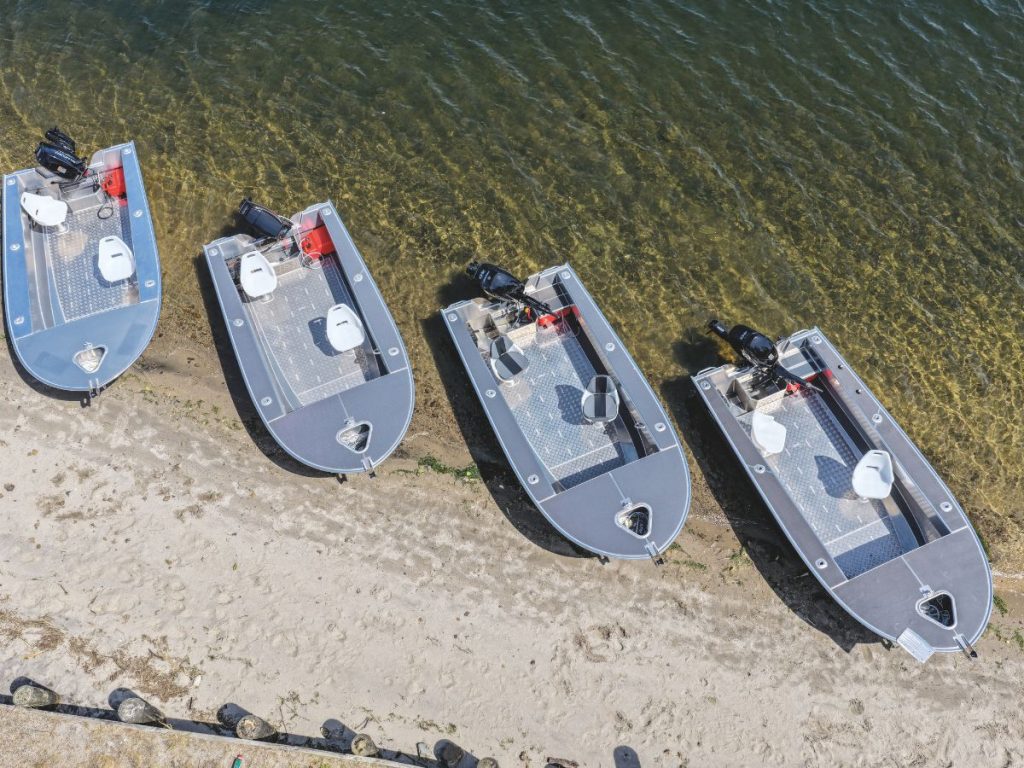
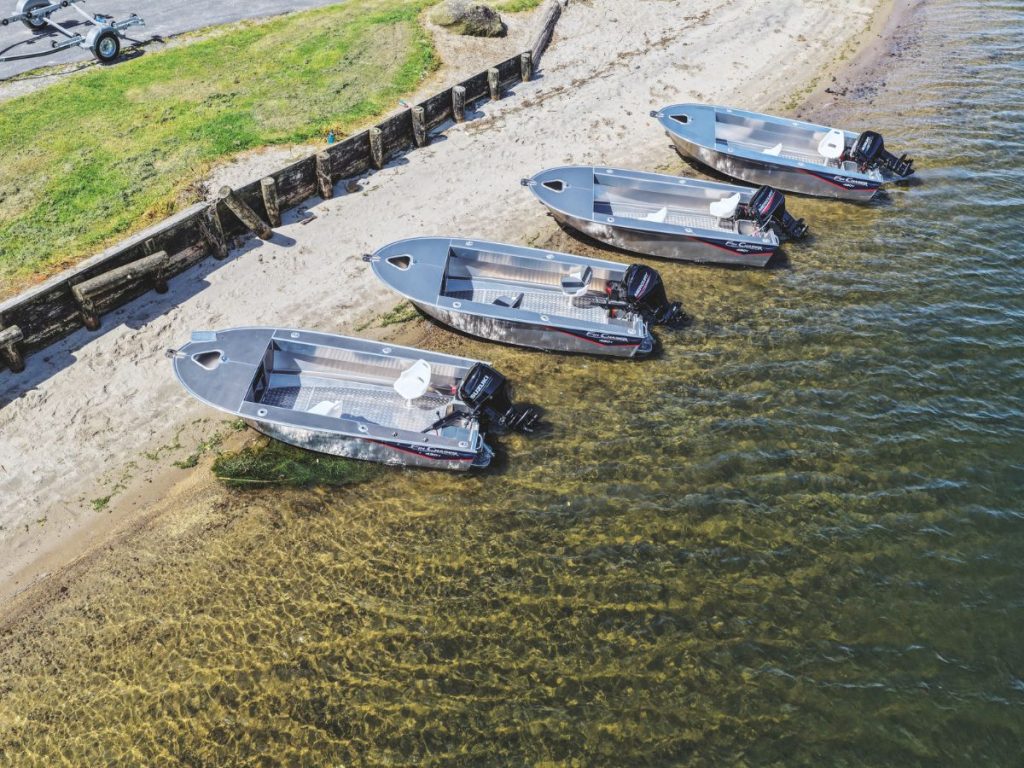
The team at Fin Chaser rigged four identical FC430s with tiller steer Mercury and Suzuki 40hp outboards, a two stroke and a four stroke outboard from Suzuki, and a two stroke and a four stroke model from Mercury. Fin Chaser offers all four of these engines to customers at different price points.

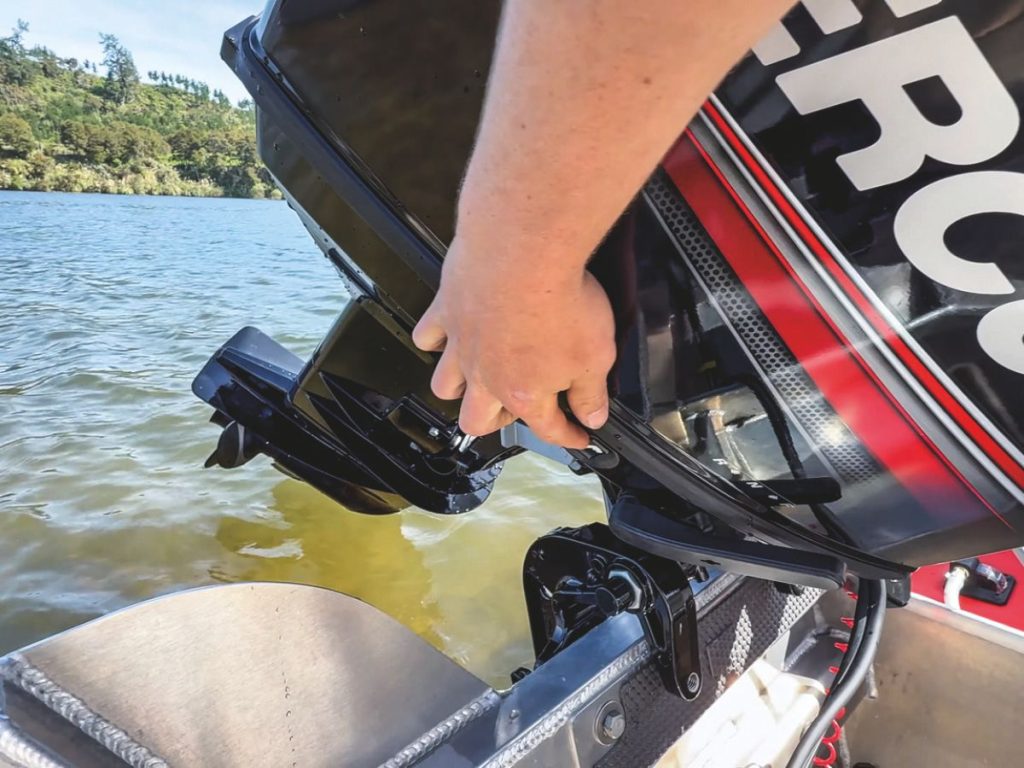
Both four strokes offer electric power trim and electric start. The Mercury two stroke has power trim, though on the side of the motor rather than on the tiller, electric start, and oil injection. The Suzuki is the most basic of the motors, lacking power trim and using premix fuel. The two strokes are run out models and, once existing stock is exhausted, will no longer be available in New Zealand.

The FC 430s each had a single pedestal seat for the helmsman on the right hand side aft and another seat forward. Two also featured a step shelf seat over the tote tank in the left hand corner of the transom, which proved useful during the speed tests. The boats fitted with two stroke motors missed out on this feature, along with the swim step and boarding ladder.
The trial
The premise was to run the boats on Lake Karapiro and compare them for performance and fuel economy. Each boat was loaded with two adults, 20 litres of fuel, and a start battery. Acceleration, throttle response, and top speed were compared against the others in flat water.


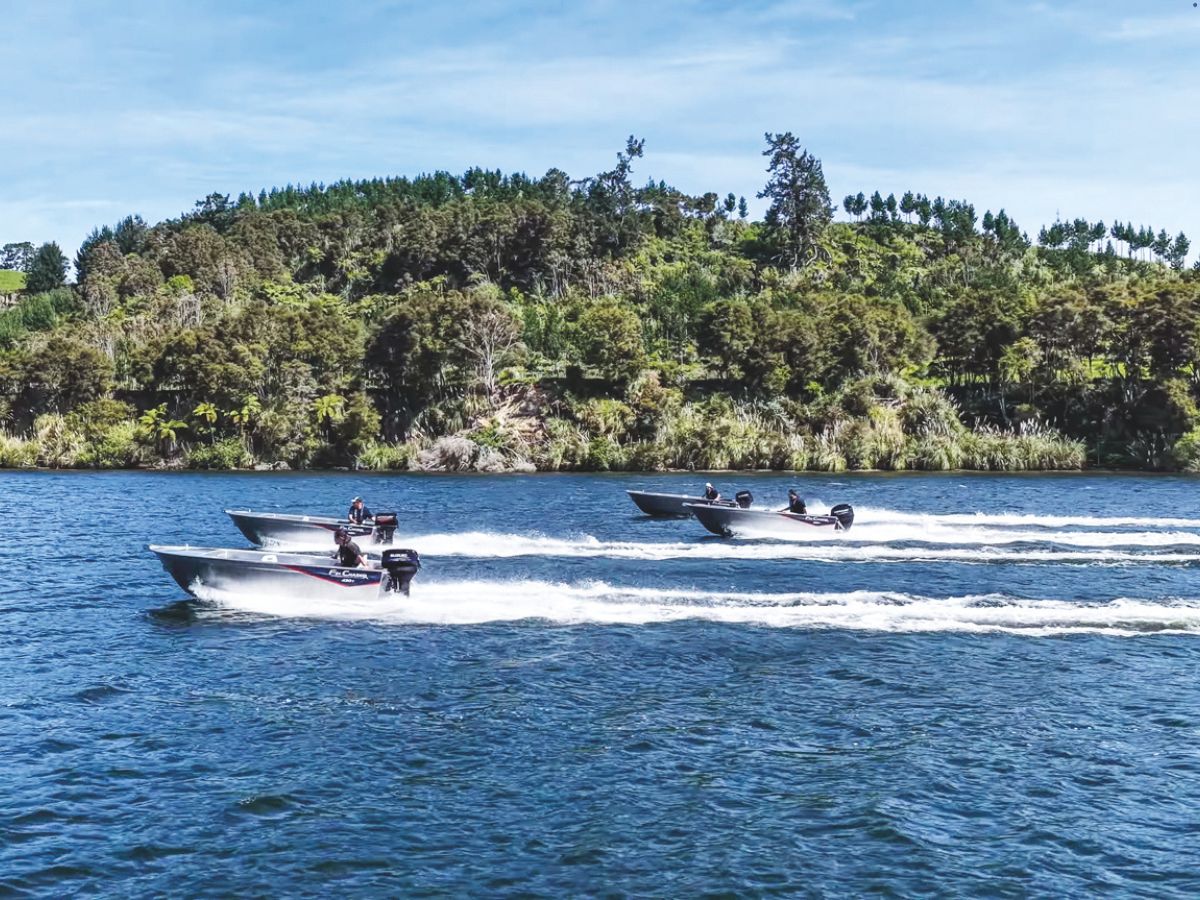
The four strokes were compared against one another, then the two strokes, and finally the two strokes versus the four strokes. In the interest of consistency and fairness, each run was repeated after swapping drivers and crews. Each boat was then tested to determine how far it would travel at 5,000rpm on a measured litre of fuel.




The results from the day were interesting but far less conclusive than expected. As Ross put it, “There’s very little between them. 40hp seems to be 40hp.”
Four stroke shootout
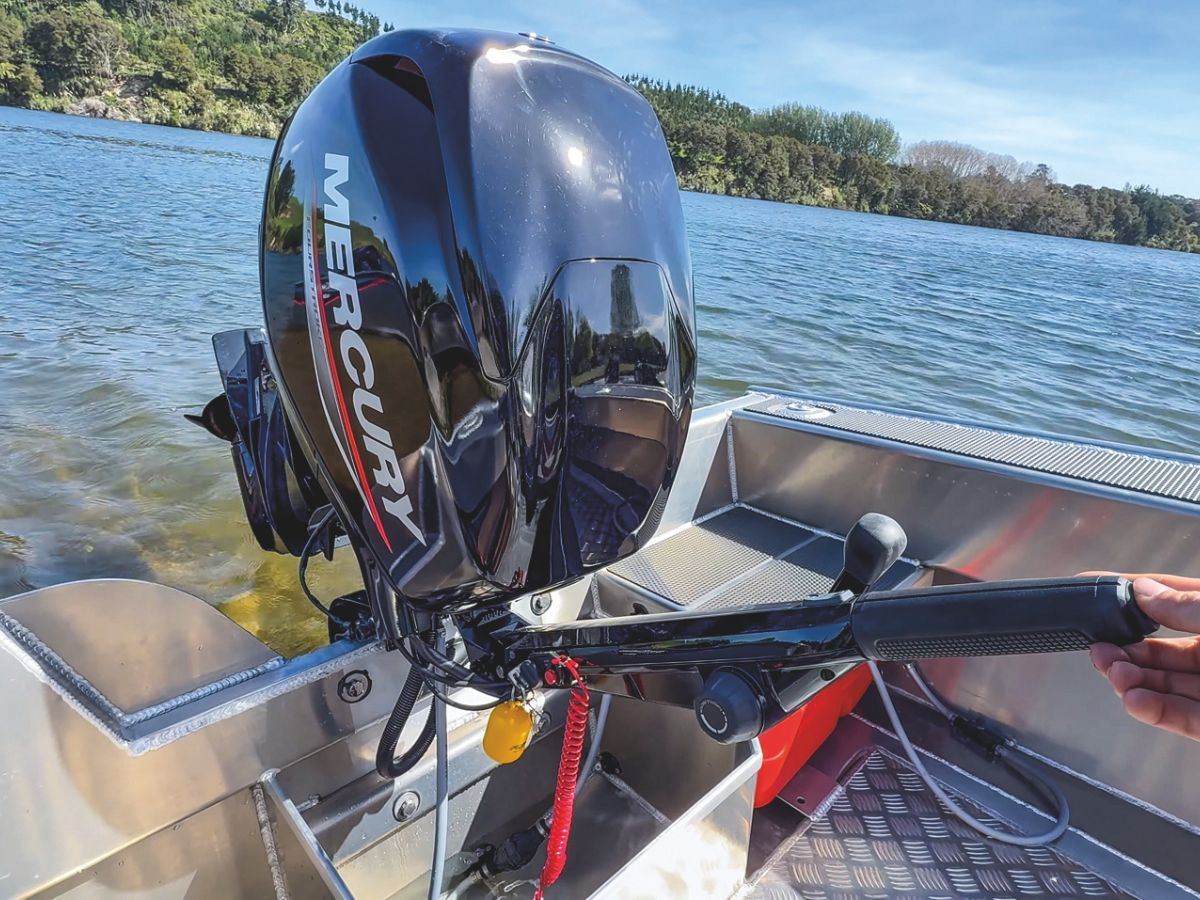
The boats were warmed up before lining up for a standing start to test acceleration, followed by several runs to test top speeds. Both engines ran standard out of the box propellers selected by FC Boats to suit the FC430. Both motors have tiller mounted trim and tilt controls, allowing drivers to adjust trim during their runs.
The Suzuki had the advantage of a digital rev counter on the tiller arm. Max, driving the Suzuki, reported 6,000rpm trimmed right out on the speed run, with any additional trim causing the motor to hit the rev limiter and scrub speed. The Mercury’s revs had to be judged by feel, and Ross reported that too much trim caused the propeller to ventilate, also reducing speed.
On the first run the Suzuki jumped ahead of the Mercury off the start. Ross closed the gap by moving Gary from the forward seat to the seat platform in the aft quarter, an old boat racing trick. Max responded by shifting his passenger, Wayne, aft as well, maintaining a slight lead and possibly increasing it. The Suzuki held a marginal speed advantage.
On subsequent runs, with drivers and crews swapping boats, both drivers used the same ballast shifting technique and the results were closer. Both drivers agreed there was probably less than half a knot between the boats in top speed, with similar acceleration. Any difference was likely influenced by the combined weight of the driver and passenger. Passengers noted that the Suzuki felt smoother, while the Mercury sounded gruntier.

Two stroke shootout
Both two stroke outboards are run out models, but they remain popular options, particularly for budget conscious boaties.
Of the two, only the Mercury has power trim and tilt, which proved advantageous. Ross noted that trimming the Mercury slightly higher than the Suzuki resulted in more speed and more efficient hole shots. He suggested that the Suzuki’s slight deficit in speed and acceleration could likely be addressed with a different propeller choice.



“The Suzuki is premix, and the Mercury’s oil injected. The Suzuki has manual trim, and the Merc has electric trim and tilt. They’re both electric start, so it basically comes down to your budget. What you pay for is what you get,” said Ross. “You’re looking at about $1,500 to $2,000 less for a Suzuki with no power trim and tilt compared to the Merc two stroke.”
Max said many boaters would see the Mercury’s electric trim and tilt, along with oil injection, as worthwhile upgrades, removing the need to premix fuel. Overall performance between the two was very similar. The Mercury was slightly quicker on average, but the difference was less than a knot, with similar acceleration. Both passengers commented that the two strokes were noisier than the four strokes. Drivers agreed the Mercury’s electric trim was far more convenient than Suzuki’s manual trim, although the trim control on the side of the Mercury motor was less accessible than tiller mounted controls on the four strokes.
Four stroke vs two stroke
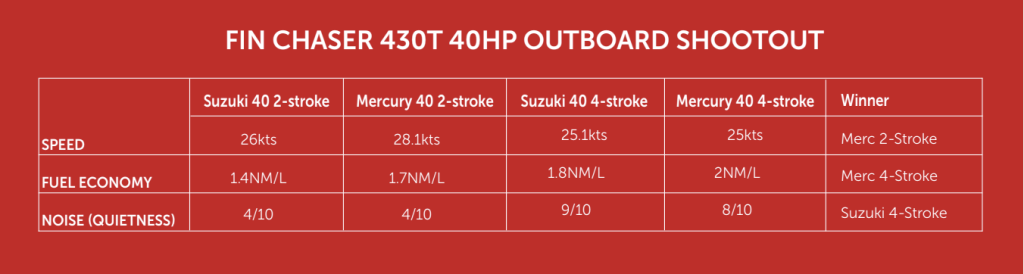
The two strokes were quicker than the four strokes. The Mercury two stroke was the fastest overall with the strongest acceleration, edging the Suzuki two stroke by less than a knot. The Suzuki two stroke was a couple of knots faster than the Suzuki four stroke, while the Mercury four stroke ran almost neck and neck with its Suzuki equivalent. The overall difference between the fastest and slowest 40hp outboards tested was around three knots.
Ross attributed this largely to power to weight ratio. The lighter two strokes felt more responsive, particularly the Mercury, which delivered a noticeably snappier throttle response while still maintaining strong top speed.
He also commented favourably on the four strokes’ large tillers with trim and gear selection, describing them as more comfortable and adjustable than the two stroke setups.
Economy test
For the fuel economy test, the tote tanks were replaced with a custom one litre tank. Each boat was run down the lake at around 20 knots until the fuel was exhausted, with distance measured by GPS.
The two strokes ran first. The Mercury achieved 1.7 nautical miles per litre, while the Suzuki covered 1.3 nautical miles, though the Suzuki boat carried a heavier driver passenger combination.
The four strokes followed. The Suzuki four stroke travelled 1.8 nautical miles per litre, while the Mercury four stroke was the most economical, covering exactly two nautical miles on a litre of fuel.
On average, the four strokes travelled about 10 percent further than their two stroke counterparts of the same brand, equivalent to around 0.2 nautical miles per litre. However, the most economical four stroke travelled 0.7 nautical miles further than the least economical two stroke, representing a difference of roughly 35 percent.
Ross said he was surprised the difference was not greater. He suggested the tests were conducted at a cruising speed of around 5,000rpm, which sits in the efficiency sweet spot for two strokes, helping explain why the gap was smaller than expected.
Conclusion
Overall, there is little to separate these motors in outright performance or fuel economy. Ross summed it up by noting that four stroke technology is quieter and smoother, but the older two strokes still perform well. In the 30 to 40 horsepower range, running a two stroke will not stop anyone from catching fish, though four strokes are more refined and more expensive.
The Suzuki, lacking power trim, remains the cheapest option, but Ross said he would personally choose the 40hp two stroke Mercury, describing it as a sweet motor that has always performed well.
Between the Suzuki and Mercury four strokes, Ross said brand preference would likely be the deciding factor, as there is little between them. Max agreed, noting the Mercury’s slight edge in economy and the Suzuki’s nicer feel at the tiller. He added that all four motors have strengths and are priced accordingly.
The final consideration, according to Max, is dealer support. Buying from a supportive dealer with proper service backup remains critical.