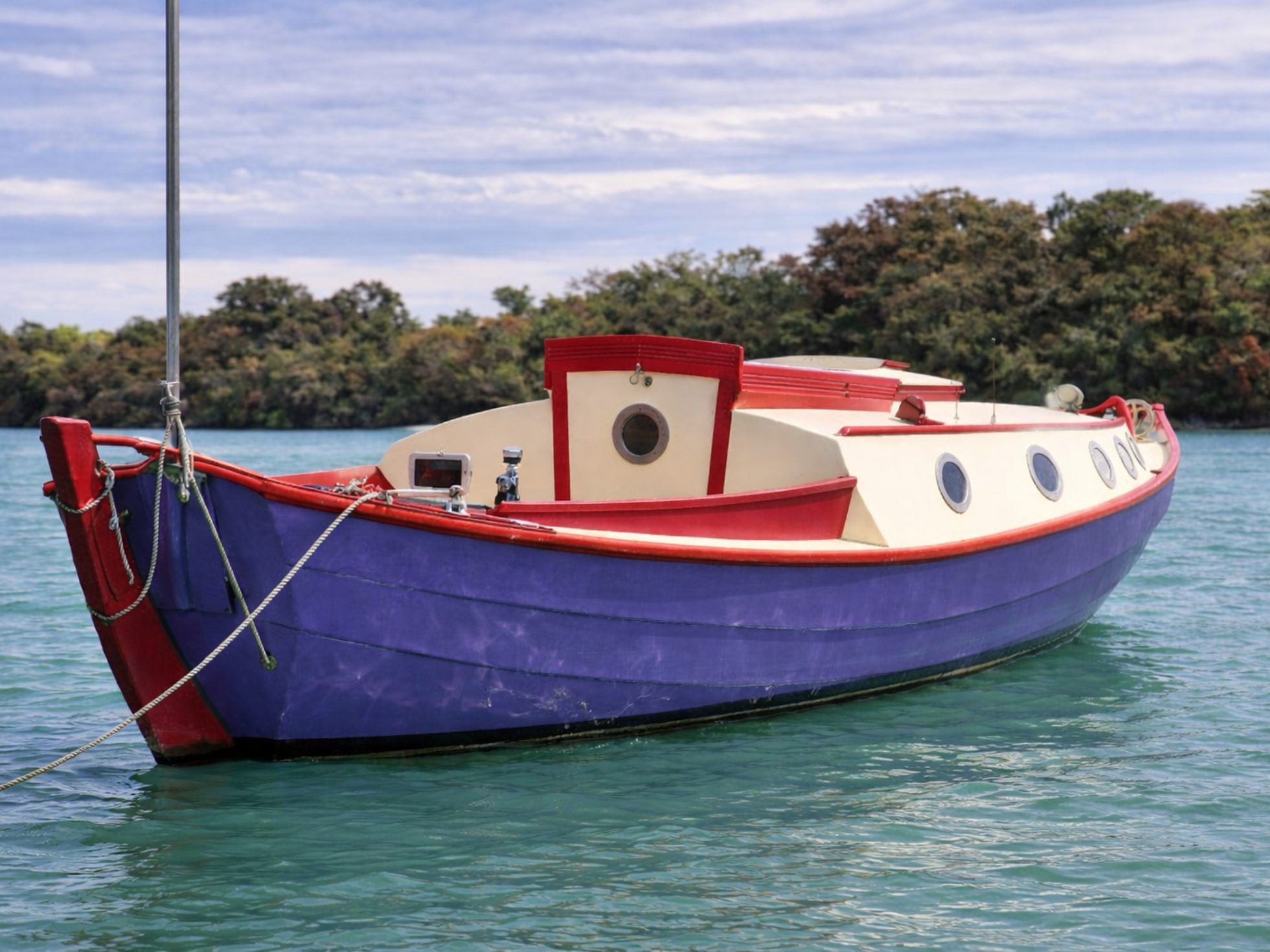
If you walk past Lady Rebecca at the Auckland Wooden Boat Festival and assume she is just another pretty wooden boat, you will miss the point entirely.
She is, in fact, a Swampscott dory. The name alone is enough to make you stop and ask what on earth that means.
What is a Swampscott dory
I was intrigued, and that curiosity sent me back to the mid nineteenth century North Shore of Massachusetts, to the fishing village of Swampscott. This was no sheltered harbour tucked behind a headland. It faces straight into Massachusetts Bay.
Swampscott sits about fifteen miles northeast of Boston, along a largely rocky stretch of coastline broken by small sandy beaches and exposed, dramatic shoreline. It is a place defined by its relationship with the Atlantic, where boats were launched through surf, not eased off marina pontoons.

Around 1840, Theophilius Brackett refined the basic dory form into a lighter, more seaworthy craft for beach launched fishing and hauling lobster pots.
Unlike the heavy, slab sided Banks dories used offshore on the Grand Banks, the Swampscott is more refined. She carries a narrow flat bottom so she can sit upright on the beach. Her flared, rounded topsides provide buoyancy when driving through breaking surf. A small ‘tombstone’ stern gives control when running home with a following sea.
These boats were typically between 14 and 18 feet long and rowed by one or two oarsmen. They were light enough to drag above the tide line yet capable enough to work in exposed coastal conditions.
Over time, the design evolved into sailing variants. Simple rigs, often a leg of mutton mainsail and small jib on an unstayed mast, turned the working dory into an inexpensive recreational sailboat that could still handle open water.
Every element of a Swampscott dory serves a purpose
The flat bottom reduces draft and makes beach launching practical. The absence of a deep keel prevents the hull from being tripped sideways by surf. The flared sides add stability as the boat heels and increase reserve buoyancy in rough water.
Because she heels easily, a fisherman could roll a heavy catch aboard rather than lift it high over the gunwale. It is a practical solution born of experience.
The design has long been described as the aristocrat of the dory family. It rows more easily, tracks better, and handles with more balance than the heavier working dories that followed.
Lady Rebecca in a Kiwi context
In New Zealand, the Swampscott concept suits our coast well. Surf beaches, exposed headlands, and a culture of row and sail exploration make it relevant beyond nostalgia.
Lady Rebecca reflects that adaptation. Rebuilt by Roger Mills (I have to add, this Roger Mills is not the Boating New Zealand photographer), who added her cabin and rig, she measures 9.14 metres overall with a beam of 2.75 metres. Her flat bottom remains central to the design, complemented by twin drop keels that improve windward ability under sail while preserving shallow draft.
She is not a grand harbour racer and not a heavy cruising launch. She sits somewhere in between, capable and beach friendly.
At the Auckland Wooden Boat Festival, Lady Rebecca will sit as a reminder that many wooden boats were built to meet surf head on, to work close to shore, and to bring their crews home safely.
Learn more
https://en.wikipedia.org/wiki/Swampscott_dory
https://dory-man.blogspot.com/2012/08/a-swampscott-dory-in-auckland-new.html