Electric hydrofoil specialist Candela has raised €30 million in fresh capital while announcing a strategic partnership aimed at transforming vessel charging across the Asia-Pacific. Together, the developments signal a rapid shift toward scalable, zero-emission water transport.
The funding round, Candela’s largest to date, lifts total investment in the company to €129 million and includes backing from the International Finance Corporation, part of the World Bank Group. The capital will support expansion of production capacity, including a second manufacturing facility in Poland, as demand for electric ferries accelerates globally.
Candela’s flagship P-12 electric hydrofoiling ferry sits at the centre of this growth. Already operating in Nordic public transport networks, the vessel has demonstrated reduced travel times and significantly lower operating costs compared to diesel ferries. Its computer-controlled hydrofoil system lifts the hull clear of the water, reducing drag and cutting energy use by up to 80 percent while producing virtually no wake.
Founder and CEO Gustav Hasselskog describes the shift as fundamental.

“We’re redefining waterborne transport by creating a new category of vessel. This allows cities and operators to use waterways efficiently without being tied to fossil fuel costs.”
With more than 65 vessels on order, Candela is preparing for deployments across markets including India, Saudi Arabia, Thailand, and the Maldives from 2026.
Solar-powered charging enters the picture
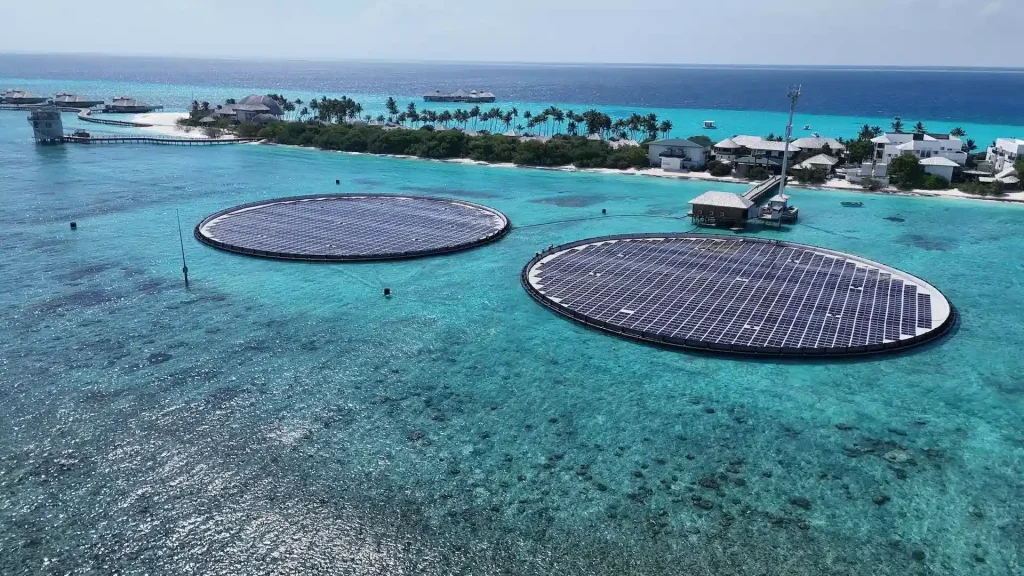
Alongside its manufacturing expansion, Candela has signed a memorandum of understanding with renewable energy company Canopy Power to deliver floating solar charging infrastructure across the Asia-Pacific.
The partnership brings together Candela’s P-12 ferries with Canopy Power’s microgrid systems, which integrate floating solar arrays and battery storage. Using technology developed by Ocean Sun, these floating platforms generate electricity directly on the water, allowing vessels to be charged without reliance on diesel-powered shore infrastructure.




The result is a fully integrated “sun-to-sea” transport system, designed for island resorts and coastal communities where fuel logistics remain a major cost and environmental burden.
“Fossil fuel dependency is the single biggest cost driver for remote island operators,” said Björn Antonsson, Candela’s Regional CEO for APAC. “We’re not just offering a boat, we’re delivering an ecosystem that turns sunlight into high-speed transport.”
A new model for island transport
The collaboration is aimed squarely at regions where diesel generators and conventional ferries dominate. By linking local energy generation with vessel operation, the system reduces both operating costs and emissions while improving reliability.
For the tourism sector, the appeal is immediate. Electric hydrofoils eliminate engine noise, vibration, and exhaust fumes, offering a quieter and more premium on-water experience. At the same time, reduced fuel consumption improves long-term return on investment.
Canopy Power sees the model as a turning point.
“Combining floating solar charging with ultra-efficient electric vessels is a game changer,” said Strategy Director Mahasti Motazedi. “For the first time, island operators can adopt clean water transport without relying on diesel.”
Scaling beyond early adoption
Candela’s approach also signals a broader shift in boatbuilding. By moving toward serial production of carbon fibre vessels rather than one-off builds, the company aims to reduce costs and scale more rapidly across global markets.
Despite a wider slowdown in climate-tech investment, strong backing for Candela reflects confidence in solutions that deliver both environmental gains and commercial performance.
Taken together, the funding and the Canopy Power partnership position Candela at the forefront of a new marine transport model, one where energy generation, vessel design, and operational economics are tightly linked.
For operators across the Asia-Pacific, particularly in remote and tourism-driven regions, that combination could prove decisive.
www.candela.com
www.canopypower.com
www.ibinews.com