


With the confronting reality of climate change and the climbing cost of fuel, electric vehicles are finally gaining traction on our roads. But progress on electric-powered boats has been much slower, despite the obvious savings to be made for both the environment and our wallets.
Designer and boatbuilder Tim Clissold, whose talents have mostly been put to work on sail-powered craft, and more recently on set-building for international movie and TV projects being filmed in New Zealand, has set out to change that.
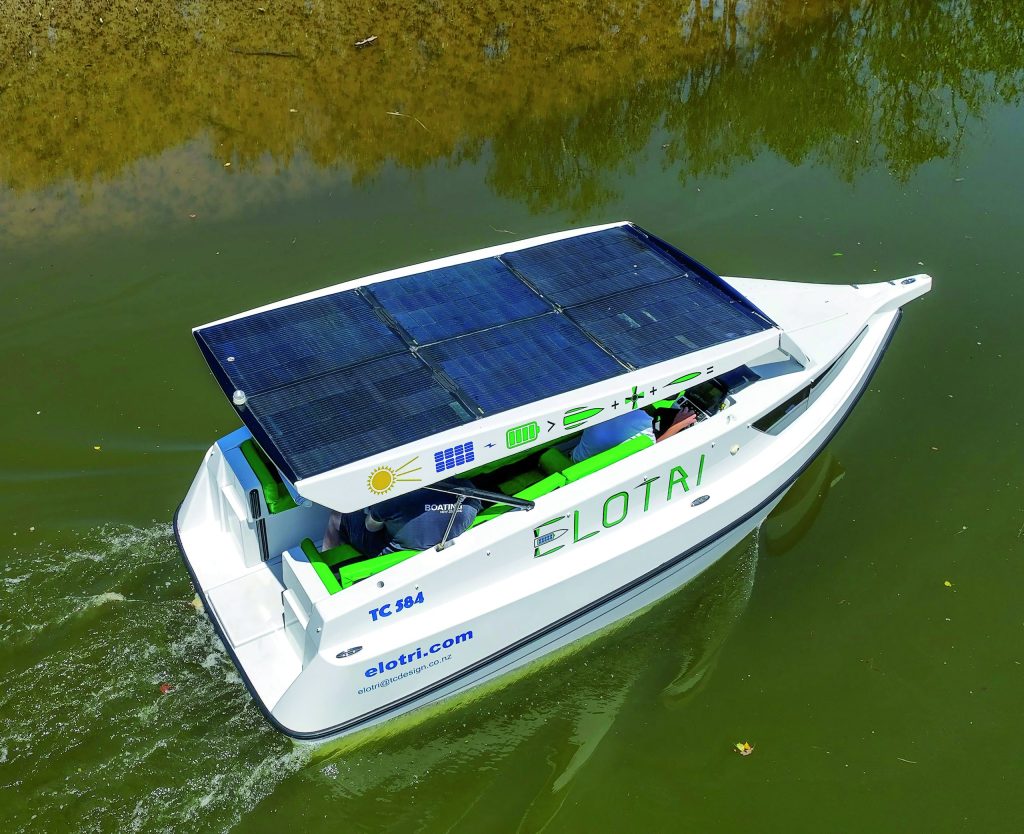
For Clissold, his six-metre solar-powered Elotri (Electrically Operated Trimaran) isn’t just a one-off boat: it’s a challenge for the industry and boat owners to take up, to spark a conversation and encourage the development of more electric boat options.
“‘Clean, green New Zealand’ shouldn’t be waiting for another country to do something like this; we should be doing it ourselves,” he says. “In terms of fuel usage, cars do about 6-10 litres per 100km, an outboard for this size of boat would use about 60 litres of fuel per 100km, and an 18m powerboat would do 300 to 400 litres per 100km. We are just fuelling
a carbon climate-change catastrophe.”
Clissold, who lives on the Mahurangi Harbour north of Auckland, first started drawing lines for what would become the Elotri nearly 20 years ago. Some international clients – one in the US, one in the Netherlands – were interested in a small, fully electric dayboat which could be used on lakes and canals. He notes that while there have been some improvements in solar systems and batteries over the time the boat has been developed, progress has been “evolutionary, not revolutionary.”
Clissold set himself the challenge of finding out the most efficient way to create such a boat, doing a deep dive into power systems, propellers, hull shapes, and even investigating foiling. He wanted it to be light and easy to tow and store, the popular six-metre size allowing both of these factors. With solar panels fitted to the cabin roof, the boat’s batteries can charge when the boat is parked at home or at the boatyard.
“Most people have to work and can only go boating on the weekend, so as long as it’s charged up and ready to go by then, you’re fine – and it’s cost you nothing to charge it,” Clissold says. “The more and more electric cars you have, the more power generation for chargers you need. I don’t see why pleasure boating should impact on the national grid.”
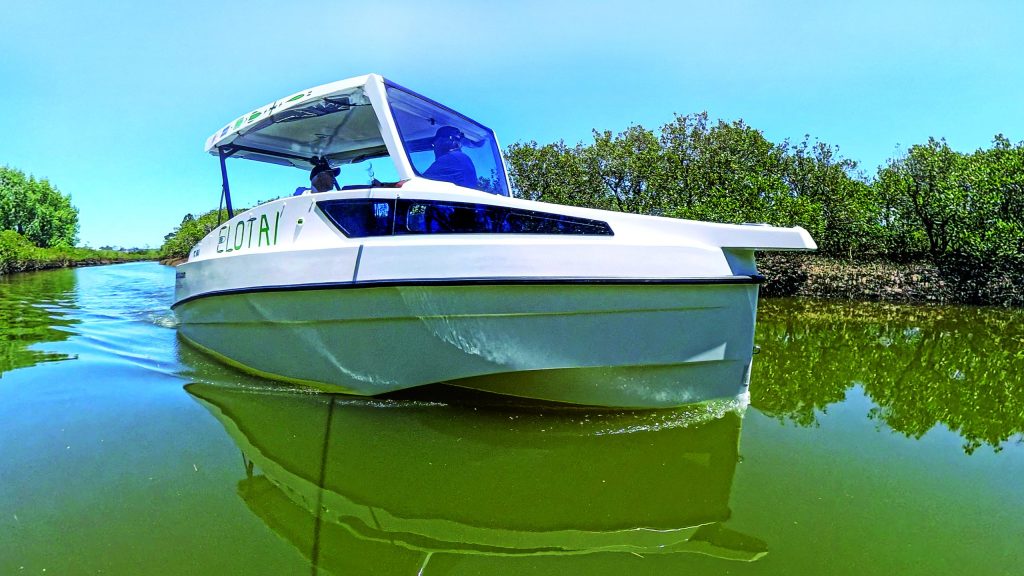
A long-time multihull sailor and designer, Clissold chose to go with a trimaran hull shape. While on board it appears to be a traditional monohull, with a single central cabin, below the water there is a fine-bowed central hull with chines developed into floats on either side, for minimum drag and maximum efficiency.
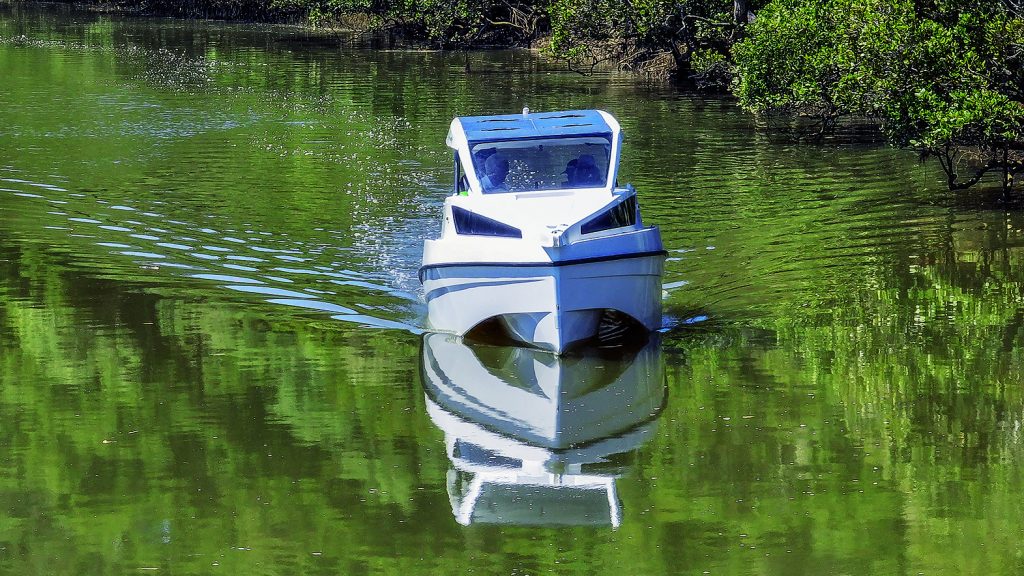
“When you look at a fizz boat trying to go out of the harbour at five knots, right on displacement speed, it’s using a lot of horsepower to go not very fast,” Clissold says. “This boat had to have really low resistance, otherwise it was going to need lots of batteries and a big engine. It didn’t need all the horsepower to come back from Tiri in rough weather at 30 knots. It’s a sheltered-water boat, and it needed to have an easily pushed hull.”
The hull is made of foam and glass, with some carbon components, and weighs around 800kg all up, with about 100kg of that in the batteries. It has a top speed of around 5 knots, and a cruising speed of around 4.2knots – leisurely, sure, but also silent and easy on the environment, reflective of Clissold’s philosophy that recreational boating shouldn’t have to mean charging from point A to point B at high speed, making a huge noise and burning fossil fuels.
One of the longest and most complex development processes was around the propeller – critical for translating the energy provided by the electric battery system into forward motion. Clissold used a 3D printer to produce a series of experimental prototypes.
“If you’re doing something completely different, you’ve got to think differently,” he says. “I can afford to be experimental – it only costs $40 a prop to print them.
I would love to do tank tests but you can tell from the wake and speed how effective they are.”
Originally the boat was also designed to foil, to further reduce drag and increase efficiency. Previously working with Core Builders Composites in Warkworth on America’s Cup boats, Clissold admits, “I got a rush to the head. But it was going to take years of development to get foiling perfected, so I decided what the boat was really good at was going slowly upriver. And when you see the number of people who can’t even drop an outboard to start it, how would they remember to drop the foils? So I decided that while it’s great for America’s Cup boats, it’s not needed here.”
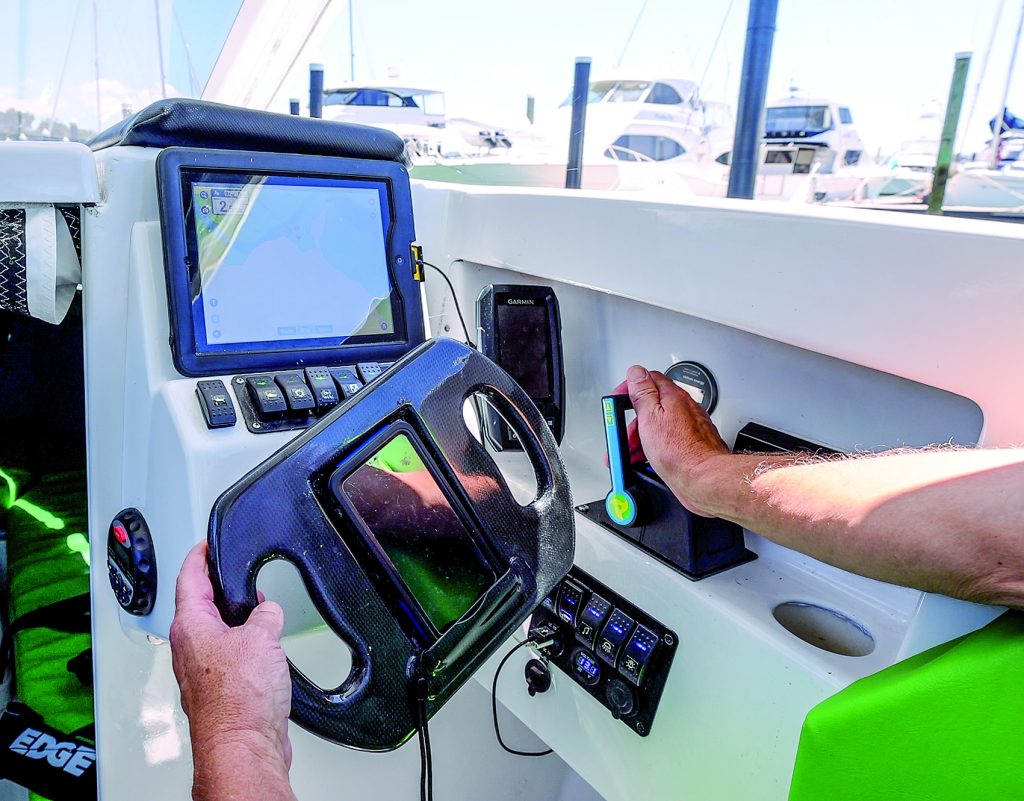
Clissold sourced the 3kW electric engine from China, and wired up the boat himself (another learning curve). The boat has 48-volt power for propulsion, 24-volt for the linear actuators that lift the solar lid, and 12-volt for other systems. Energy from the solar panels is stored in standard lithium phosphate ion batteries, with four 12-volt batteries in series. Charging is not rapid – about 10% per day – but it is continuous, as long as the sun is shining, meaning you can stay out for extended periods without worrying about running out of juice.
“People talk about range anxiety, but I can get to Kawau and back from Sandspit [about 6.5 nautical miles each way] and spend the whole weekend there, and the batteries are going up not down. If you are away for a few days, it’s always charging while you’re at anchor.
“The most I’ve got down to is about 40% charge, and that was doing abut 25 nautical miles over the weekend.”
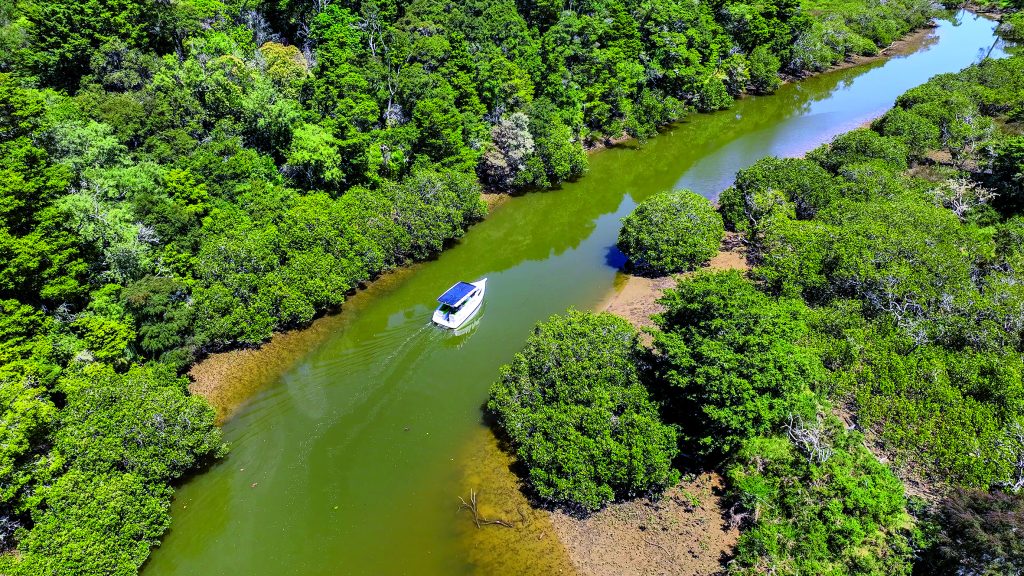
On the day we head off up the Matakana River aboard the Elotri, the solar panels are generating 100 watt-hours of power, while the engine is drawing around 500 watts to do four knots. Unlike an internal combustion engine, which just drinks fuel until it’s empty, as soon as the boat stops moving, the battery is accumulating charge.
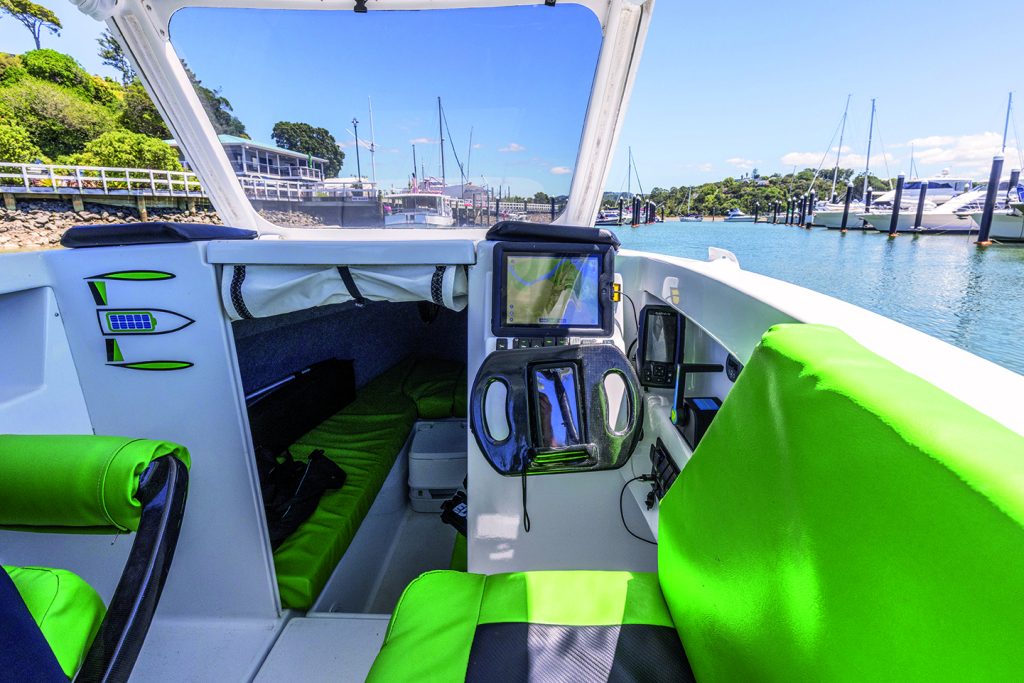
Tied up to the dock at Sandspit, the Elotri converts from trailer mode, with the roof right down, to its on-water form at the push of a button, via a Clissold-developed ram system. It can be popped right up to ‘barbecue height’, providing full standing headroom, or set at an intermediate height, with seated headroom and the windscreen raked to reduce windage when passage-making. Tinted clear sides can be rolled down to add shelter.
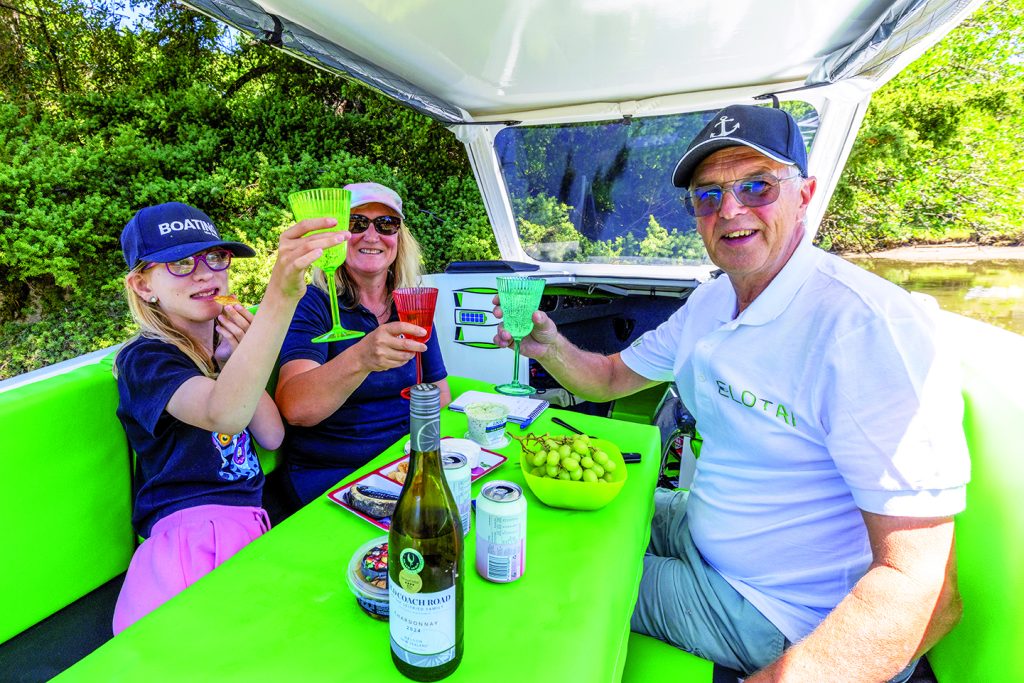
Clissold has also turned his inventive brain to kitting out a practical interior which provides all the necessities in a compact space. Raised cruising with his parents and two siblings on a six-metre trailer yacht, he understands the value of making the most of what you’ve got.
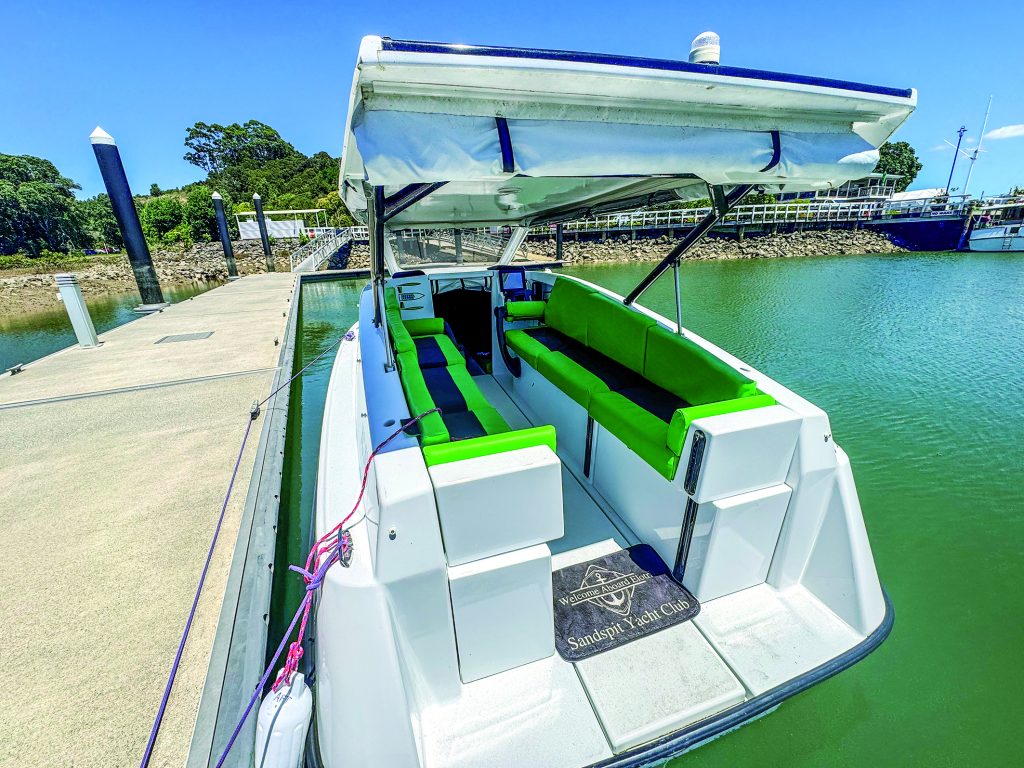
There’s a long squab down each side, with a pivoting backrest at the front which creates a driver’s and front passenger’s seat. At the aft of these long seats is a panel which folds up to create a day-bed-style recliner (popular with our boat-test assistant Natalie). In the bow cabin is a v-berth with an insert to create a double, under which the compact cassette toilet can be stowed. All the upholstery is bright green – a nod to the boat’s environmental credentials but also, Clissold admits, because it looks cool.
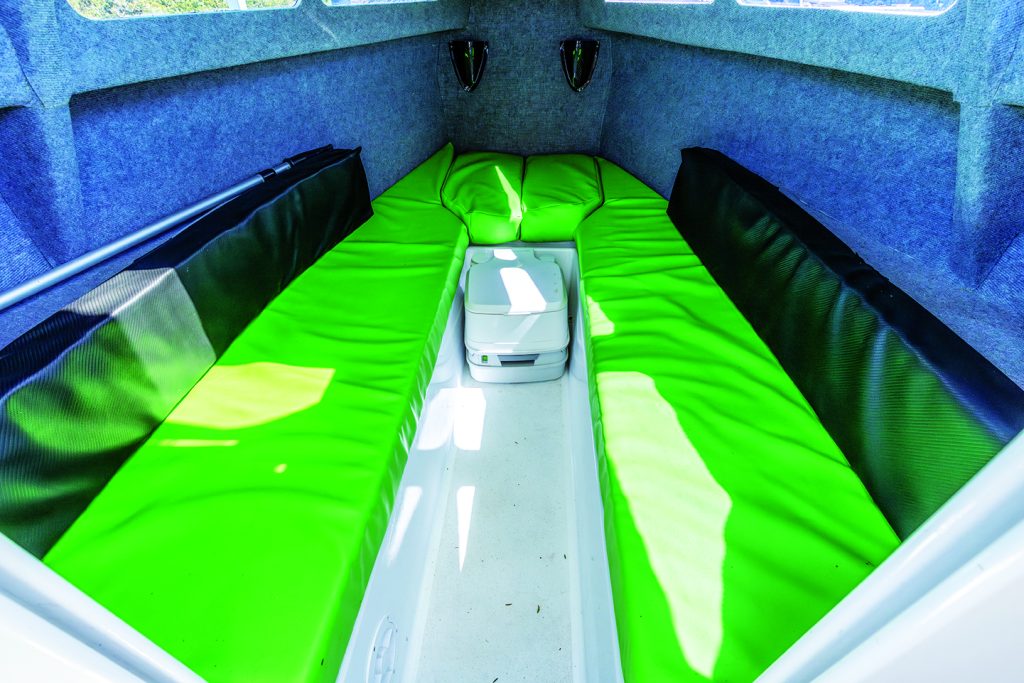
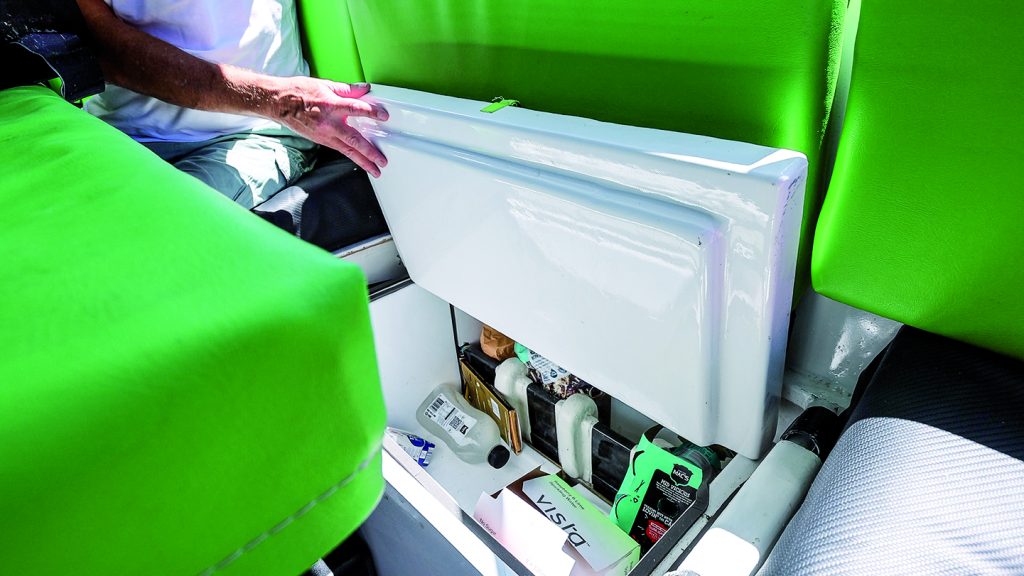
Under the seats are storage lockers containing such essentials as a 160-litre chiller and the components to mount a long central table. The squabs can be taken off the aft sections of the seats to create a pair of tables aft for meal prep and barbecuing, or the bases removed entirely and stowed to provide a large open cockpit, complete with
a deliciously warm hand-held shower (thanks again, solar panels).
Getting underway is easy: we climb aboard, untie from the dock, and push the throttle forward – there’s no key or even a push-button start, the boat is just powered up and ready to go. The electronics are simple: an iPad for navigation, a Garmin depth sounder and Tim’s phone sitting in a custom cradle in the carbon steering wheel using apps to display electrical charging and battery level information.
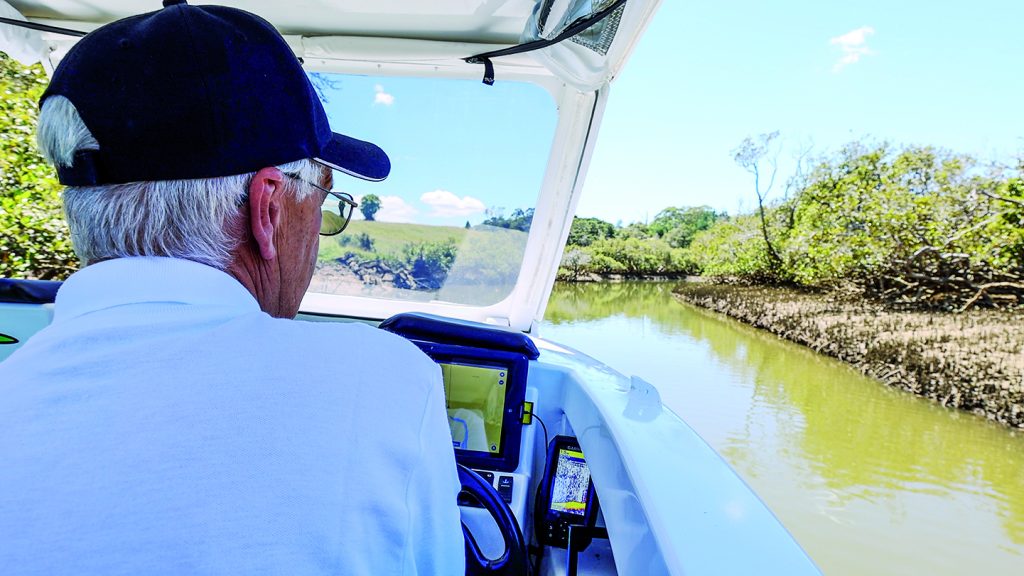
The first thing you notice is that the boat is almost completely silent, the only sound the lapping of the waves against the hull. Our plan is to navigate up the Matakana River to the village. We are pushing our luck a little bit with the state of the tide, but the Elotri draws just 400mm and we can easily cruise up the channel, wending through the mudflats. It’s a peaceful and comfortable cruise, with plenty of time to take in the riverside sights. When we spot something interesting – a cruising kingfish, some shags, a colony of royal spoonbills nesting in a riverside tree – we can just turn the boat off and float along admiring them.
Unfortunately the tide is still a little low for us to go ashore at the wharf at Matakana, but we can easily tie up to an overhanging tree and enjoy our boat picnic under the shade of the cabin roof, before heading back downriver again to the sea. By this time, the tide has turned the estuary into a single glistening sheet which we can glide across.
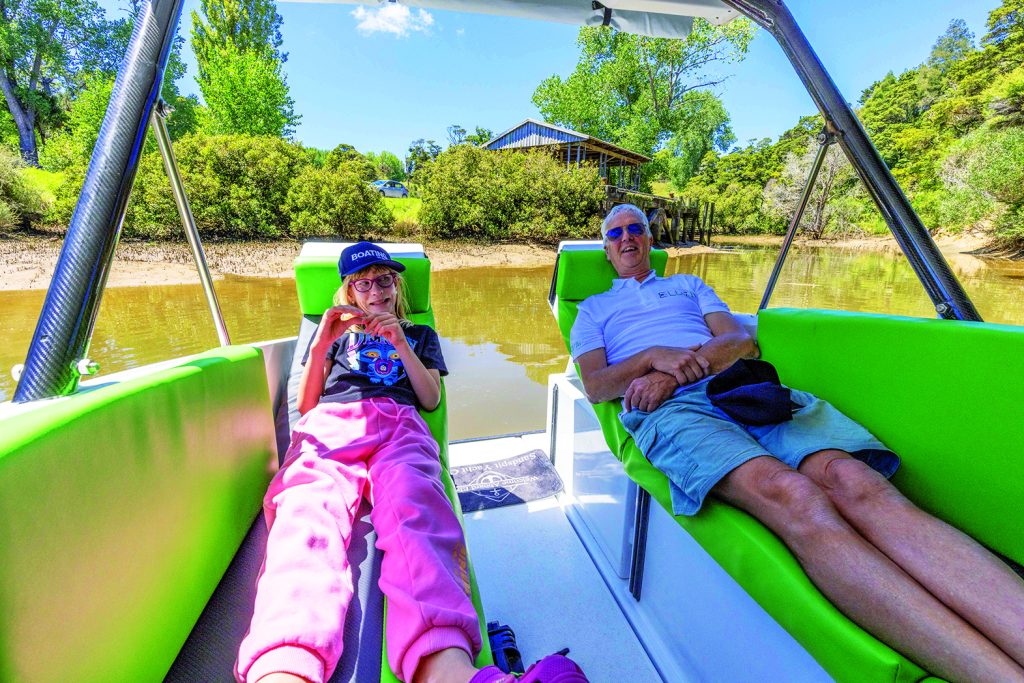
With the Elotri, Clissold has achieved his goal of creating a practical, liveable boat for both day-tripping and overnighters, which operates with zero impact on the environment. He’d like to see it or something similar go into production, and he has plans for a slightly larger, eight-metre version.
“I think New Zealanders and the rest of the world should have options for buying electric boats, but right now they’re really limited,” Clissold says. “There are a whole lot of areas in New Zealand – sheltered harbours and rivers and lakes – where a boat like this can be used. Most people only go boating on nice days anyway. Why can’t we be doing it utilising solar-powered electricity, rather than the huge fuel and maintenance costs of an internal combustion engine?”
It’s a good question, and one to which the response can only increase in the coming years.

This boat is brilliant. Congratulations!