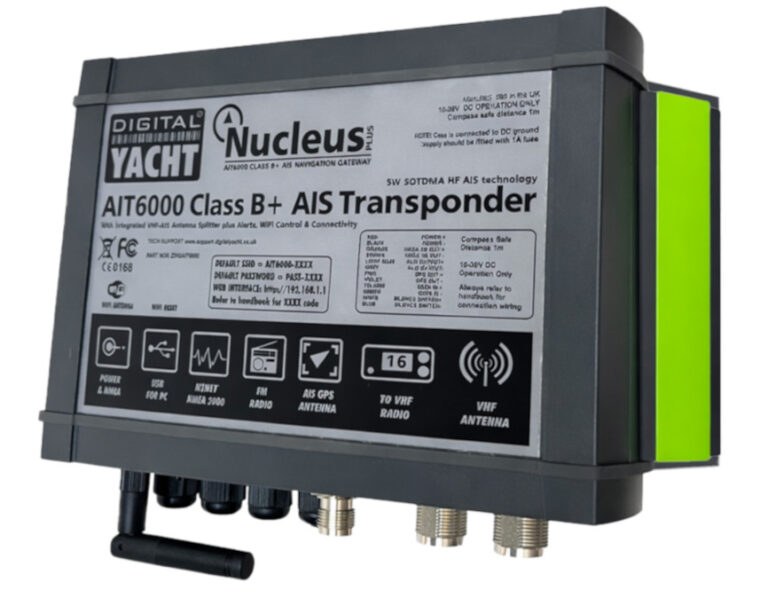
AIS has been around long enough that most boaties know what it does. The AIT6000 is Digital Yacht’s answer to what comes next.
The AIT6000, branded Nucleus, is a Class B+ transponder, the current top tier for recreational vessels, using SOTDMA transmission technology. That’s the same method used by commercial Class A systems, which means it competes for transmission slots on equal terms with ship traffic rather than waiting its turn. Output power is 5W, giving improved range over standard Class B units.
SPAIS, Digital Yacht’s proprietary satellite AIS technology, is what sets this unit apart. When enabled, the AIT6000 optimises its transmissions for reception by AIS satellites, keeping vessel position visible to rescue authorities and tracking services beyond 20 nautical miles from the coast, where land-based stations drop out. For offshore passage makers, that means being trackable by rescue authorities even in the middle of the Tasman.
The unit is built around a zero-loss integrated VHF antenna splitter, so the main VHF antenna handles AIS, VHF radio and FM/DAB simultaneously with no signal degradation. A separate GPS antenna is supplied on a 10m cable for the transponder’s own receiver.

The connectivity is where the Nucleus name makes sense. NMEA 0183 covers legacy chart plotters. NMEA 2000 connects to modern navigation networks. USB handles PC and Mac. And an onboard password-protected Wi-Fi network supports up to seven devices simultaneously, pushing AIS targets, GPS position and full NMEA 2000 instrument data, including depth, heading, speed and wind, to any connected tablet, phone or laptop. Navigation apps including Navionics, TZ iBoat, Savvy Navvy and OpenCPN all work straight off the network. The Wi-Fi is bidirectional, so navigation data from apps can also be pushed back out to other onboard equipment, including the autopilot.
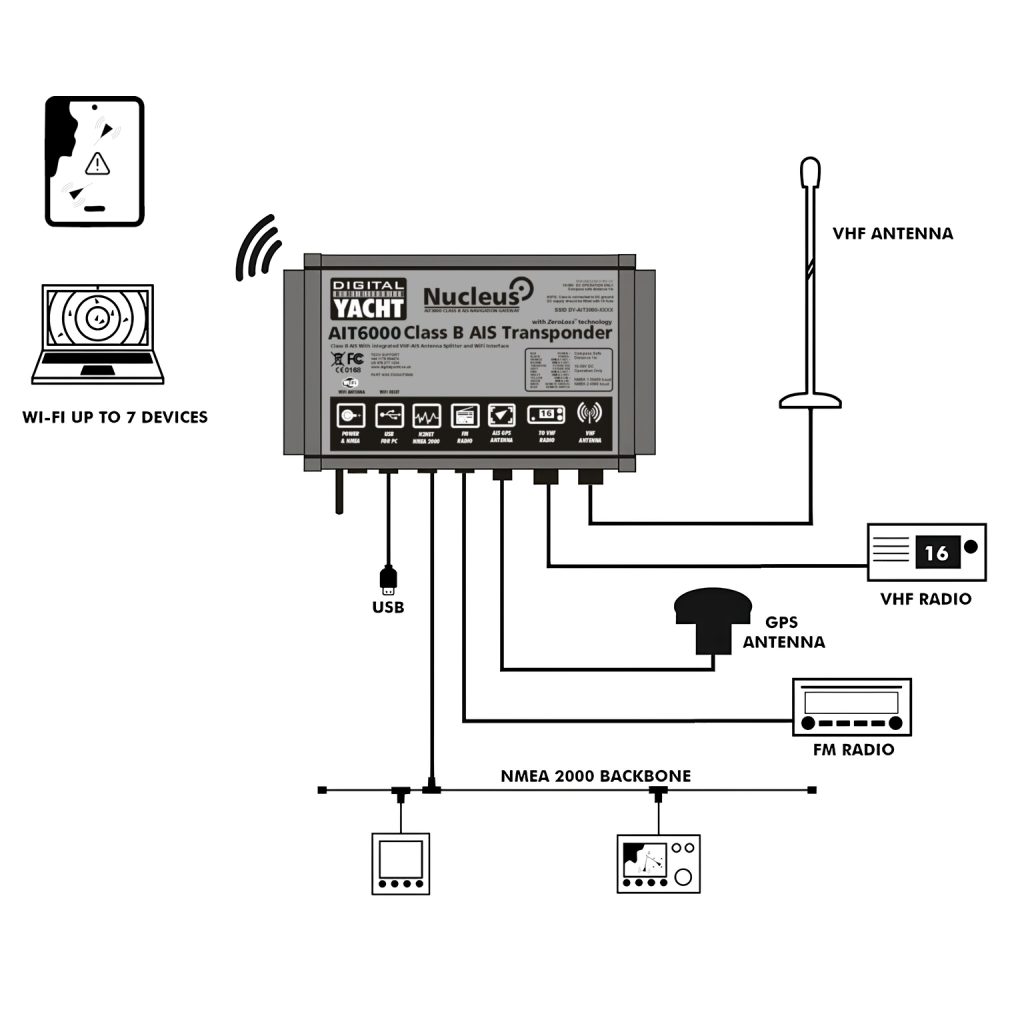
Built-in CPA and TCPA collision alarms run independently of any chart plotter, so watch-keepers get warnings without needing a screen active. CPA, Closest Point of Approach, calculates the minimum distance at which an incoming vessel will pass based on its current speed and heading. TCPA, Time to Closest Point of Approach, tells you how many minutes until that moment arrives. Together they give you a clear picture of developing risk without having to interpret a cluttered plotter screen. An anchor watch alarm calculates drift radius based on depth and chain scope. All of it is configured through a browser-based web interface, no software to install, no app required.
Everything is configured through a browser. Connect to the AIT6000’s Wi-Fi from any device, open a browser, and you’re in. MMSI programming, Wi-Fi settings, alarm thresholds, AIS silencing and diagnostic monitoring, all in the browser, nothing to install.