Built to last: Seven decades of Kiwi boats at the Auckland Showgrounds
From Bill Hamilton’s first jet boat to a freshwater runabout still under 500 hours, the heritage display at this year’s show is a masterclass in what New Zealand builds.
It started with a few boats tucked into a corner of the Easter Show at the Auckland Showgrounds in 1956. Nobody predicted the sideshow would still be running seventy years later, let alone that it would outgrow every venue it occupied, outlast multiple name changes, and survive a High Court battle over the future of the Showgrounds themselves. The 2026 Hutchwilco New Zealand Boat Show, running 14 to 17 May, is a genuine milestone for New Zealand’s marine industry, and this year’s curated heritage display makes the most of it.
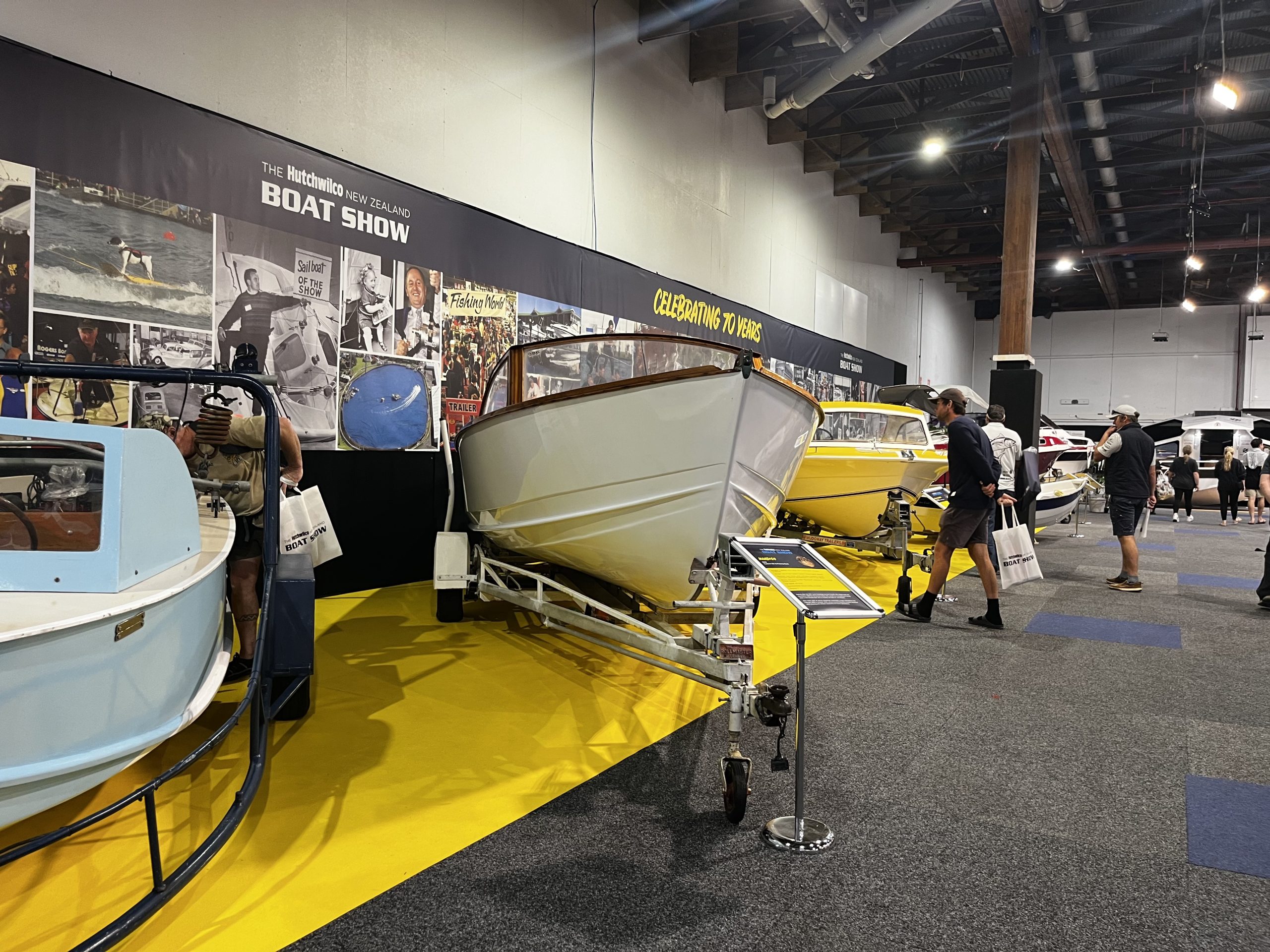
Six boats. Spanning 1954 to 1990. Each one carrying a story that reaches well beyond its hull. Together, they trace something larger than a simple timeline of design and manufacture. They map the geography of how New Zealanders have always used the water, from South Island braided rivers to the Hauraki Gulf, from Whangarei Harbour to Lake Taupo, and they reflect an industry that has always punched above its weight.
Where it begins
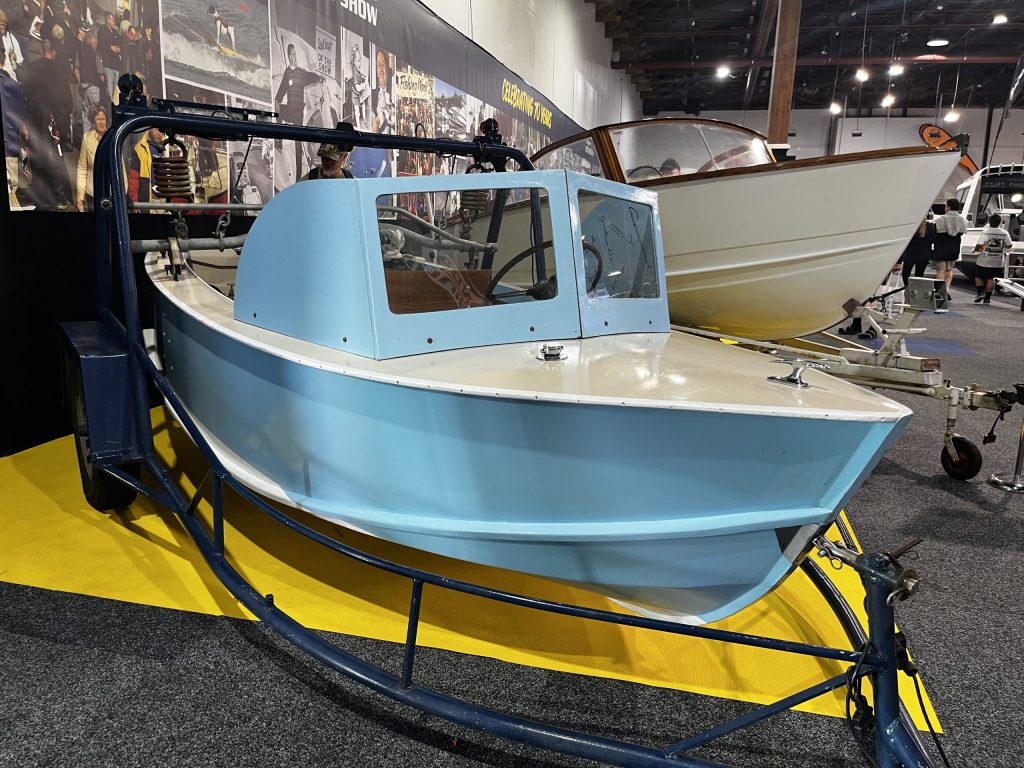
The oldest boat in the heritage display predates the show itself. Saucy Jane, a 1954 plywood rebuild of Sir Bill Hamilton’s very first jet boat, sits at the root of a technology that New Zealand gave to the world. When Hamilton ran the original up the Ohau River at 17mph in 1954, he was solving a problem unique to New Zealand’s geography: shallow, fast-moving braided rivers that conventional propeller-driven craft simply could not navigate. The Quinnat waterjet unit he developed, expelling water above the waterline and eliminating all underwater appendages, was exactly that solution. HamiltonJet today supplies jet propulsion systems to navies, rescue services, and recreational boaters on every continent, but the lineage runs directly back to this boat.
| The Hutchwilco Boat Show | Heritage Display |
| Construction | Plywood (exact rebuild) |
| Water jet | Quinnat unit |
| Engine | Ford E93A, 30hp |
| Trailer | C.W.F Hamilton & Co. |
| Builder | Jim Lapsley (rebuilt 2024) |
An exact rebuild of the original hull and jet unit, completed in 2024 with parts salvaged from the original and guidance from engineer George Davison, who worked with Sir Bill Hamilton at the inception of the modern jetboat. The first tests achieved 17mph upstream on the Ohau River in 1954. The Quinnat waterjet was revolutionary: by expelling water above the waterline and eliminating all underwater appendages, it gave Hamilton the shallow-water performance he needed to explore New Zealand’s rivers. Today owner and builder Jim Lapsley uses her on the Waimakariri and surrounding South Island rivers.

Today’s HamiltonJet uses an axial-flow design that eliminates the original gearbox for greater efficiency, but the engineering principle that changed river boating worldwide began here.
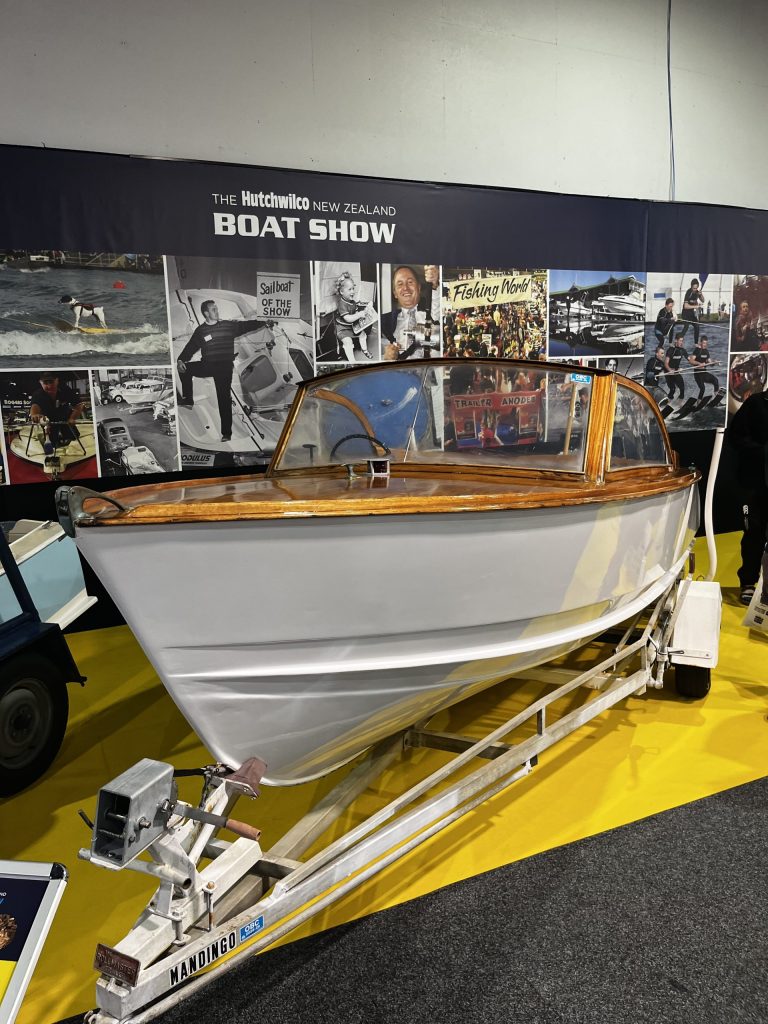
Five years after Hamilton’s river breakthrough, a different kind of New Zealand craftsmanship was on display in Penrose. Max Carter of M.C. Carter Boats was building custom timber runabouts to individual commission, and the Gowan family of Auckland had ordered something special. Mandigo, launched in 1959, was one of Carter’s ‘Healey Sprite’ designs: kauri-framed, with a solid mahogany transom and screen, its hull later fibreglassed to the chine in the late 1960s to extend its working life. It fished the Hauraki Gulf and skied Lake Rotoiti over decades of family use, and after three owners and a major restoration running from February 2018 to October 2020, it stands as a textbook example of what well-maintained timber construction can achieve.
| The Hutchwilco Boat Show | Heritage Display |
| Designer | Max Carter (M.C. Carter Boats, Penrose) |
| Design | Custom ‘Healey Sprite’ |
| Materials | Kauri frame, mahogany transom & screen, mahogany ply (fibreglassed to chine, late 1960s) |
| Motors | 1973 Mercury 800 “Blueband” + 1959 Seagull auxiliary |
| Top Speed | 30 knots |
| Owners | 3 (commissioned by Gowan Family, Auckland) |
Named after the 1957 Kyle Onstott novel, Mandigo was launched for the Gowan family and served as both a recreational fishing boat in the Hauraki Gulf and a family ski boat on Lake Rotoiti. After many years of service she underwent a major restoration from February 2018 to October 2020, preserving her beautiful wooden character while ensuring she remains seaworthy for future generations.
The Fibreglass Transition
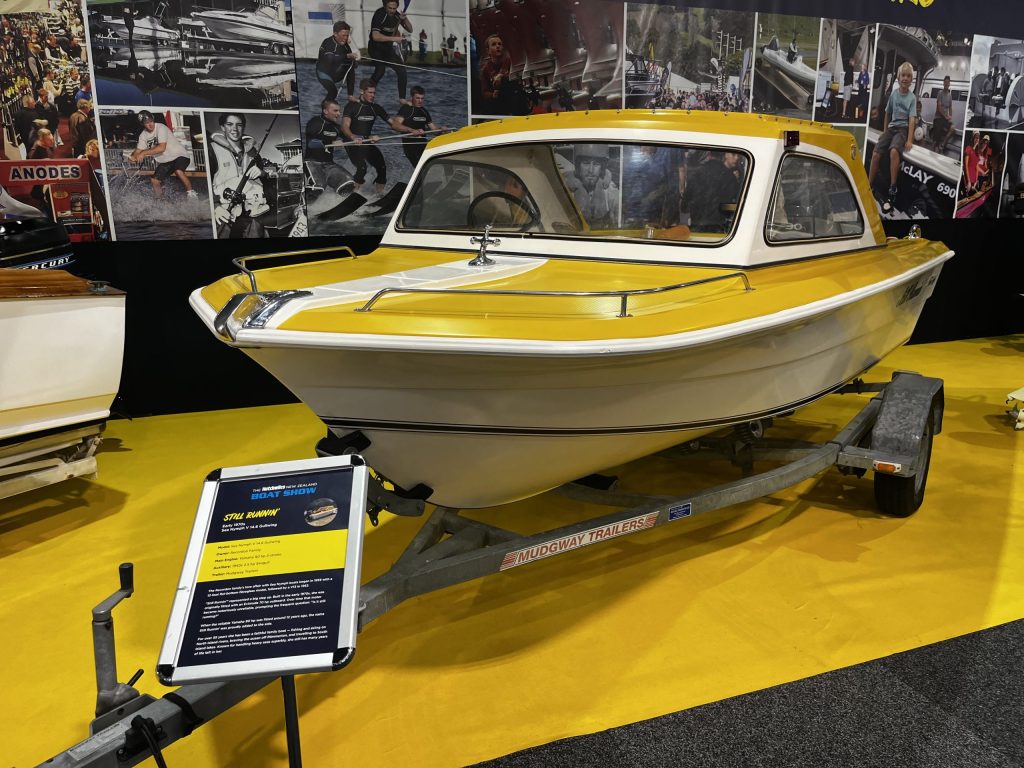
The 1960s and early 1970s brought fibreglass to New Zealand boatbuilding, and the Sea Nymph represented the new generation of production runabout that families could actually afford. Still Runnin’ is an early 1970s V 14.6 Gullwing, and her story is as much about a family’s relationship with a boat as it is about the boat itself. The Recordon family’s connection with Sea Nymph started in 1959 with a 12-foot flat-bottom fibreglass model, progressed through a V13 in 1963, and reached this bigger, more capable V 14.6 in the early 1970s. The boat was originally fitted with an Evinrude 70hp outboard, which became notoriously unreliable, prompting the question that eventually became her name. When a Yamaha 90hp replaced it around 12 years ago, the name was painted on the side as a statement of vindication. Over 55 years she has fished and skied on North Island rivers, handled heavy seas off Plimmerton, and made the crossing to South Island lakes.
| The Hutchwilco Boat Show | Heritage Display |
| Owner | Recordon Family |
| Main Engine | Yamaha 90hp 2-stroke |
| Auxiliary | 1950s 2.5hp Seagull |
| Trailer | Mudgway Trailers |
The Recordon family’s love affair with Sea Nymph boats began in 1959 with a 12-foot flat-bottom fibreglass model, followed by a V13 in 1963. Built in the early 1970s, Still Runnin’ was originally fitted with an Evinrude 70hp outboard that became notoriously unreliable, prompting the frequent question: “Is it still running?” When a reliable Yamaha 90hp was fitted around 12 years ago, the name was proudly added to the side.
For over 55 years she has been a faithful family boat, fishing and skiing on North Island rivers, braving the ocean off Plimmerton, and travelling to South Island lakes. Known for handling heavy seas superbly, she still has many years of life left in her.

“This show has always been more than what’s on the water. It’s about the people who live for it. Seventy years on, that passion is stronger than ever.”
Helen Kay, General Manager, XPO Exhibitions
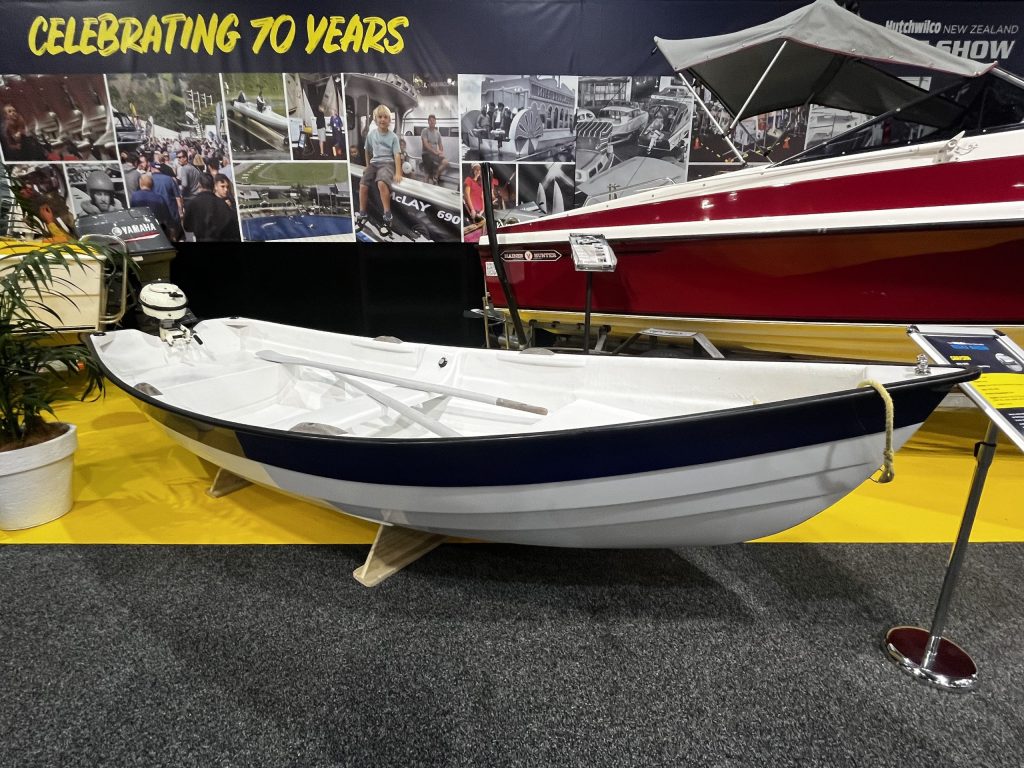
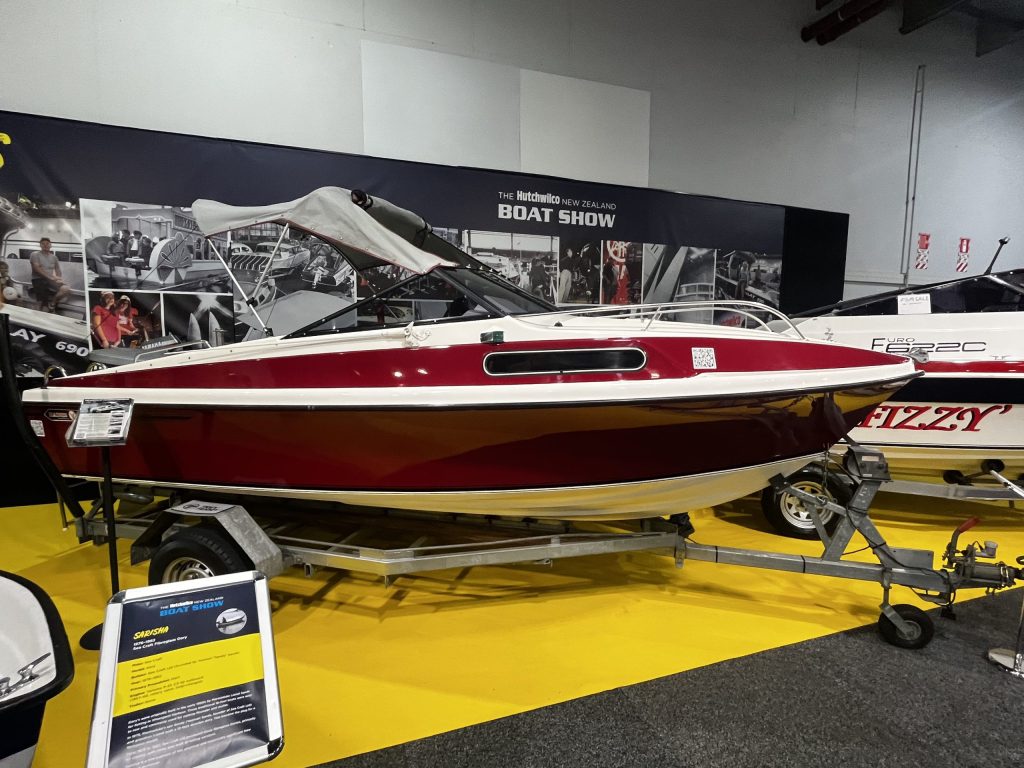
While the Sea Nymph was being run on North Island rivers, a different kind of New Zealand boat was being made in the Far North. The Whangarei fishing dory has a history that reaches back to the early 1900s, when Marmaduke Lionel Sands was building 16-foot wooden dories for netting flounder and mullet in Whangarei Harbour. The design was practical, easy to row, and proven in local conditions. In 1975, Marmaduke’s son Sandy, later to found Sea Craft Ltd, and grandson Lionel built a 13-foot wooden dory and used it as the plug for a fibreglass mould. From 1976 to 1982, Sea Craft Ltd produced fibreglass versions of that same design: Sarisha is one of those boats, and she carries four generations of New Zealand boatbuilding heritage within a hull that never strayed far from its working-boat origins.
| The Hutchwilco Boat Show | Heritage Display |
| Make | Sea Craft |
| Model | Dory |
| Builder | Sea Craft Ltd (founded by Yoeman “Sandy” Sands) |
| Propulsion | Oars (primary) |
| Engine | Yamaha P-35 3.5hp outboard (1967–68, rotary valve, loop-charged) |
Dories were originally built in the early 1900s by Marmaduke Lionel Sands for fishing in Whangarei Harbour. These traditional 16-foot boats were easy to row and commonly used for netting flounder and mullet. In 1975, Marmaduke’s son Sandy (Yoeman Sands, founder of Sea Craft Ltd) and grandson Lionel built a 13-foot wooden dory, which became the plug for a fibreglass mould.
From 1976 to 1982, Sea Craft Ltd produced these fibreglass dories, primarily for rowing, with some also built as sailing versions. Sarisha is a fine example of this practical and historically significant New Zealand workboat.
Sea Craft Ltd produced Sarisha at its base at what was 8 Cawley St in Ellerslie in 1946 (street numbers have changed now.) As was the Haines Hunter V17L.
The Haines Hunter V17 was produced in two versions, the V17L cabin model and the V17R runabout, with the company producing 50 to 60 boats a year for around six years. Over 300 were built in total, with the cabin version the more popular of the two. The V17 was the direct forerunner of the Haines Hunter 535, a model of which over 2,000 were eventually built, and one of the most successful trailer boat designs in New Zealand history. The 1983 example on display was built for Trevor Geldard, former Chairman of Epiglass NZ and the New Zealand International Yachting Trust, who supplied the distinctive Epiglass gelcoat and colour (added by Tim Porter, Boating New Zealand publisher) used on his own boat.
| The Hutchwilco Boat Show | Heritage Display |
| Make | Haines Hunter |
| Model | V17L (Low Line Cabin) |
| Builder | Sea Craft Ltd, Ellerslie, Auckland |
| Engine | Yamaha 140hp AETO 2-stroke (152 hours) |
| Trailer | Home-built |
The Haines Hunter V17 was produced in two versions, the V17L cabin model and the V17R runabout. Built by Sea Craft Ltd in Ellerslie, Auckland, the company produced 50–60 boats per year for around six years, with over 300 built in total (mostly the popular cabin version). This model was the direct forerunner to the hugely successful Haines Hunter 535, of which over 2,000 were eventually built.
This particular boat was commissioned in 1983 for Trevor Geldard, former Chairman of Epiglass NZ and the New Zealand International Yachting Trust. Trevor supplied the distinctive Epiglass gelcoat colour used on his own boat.
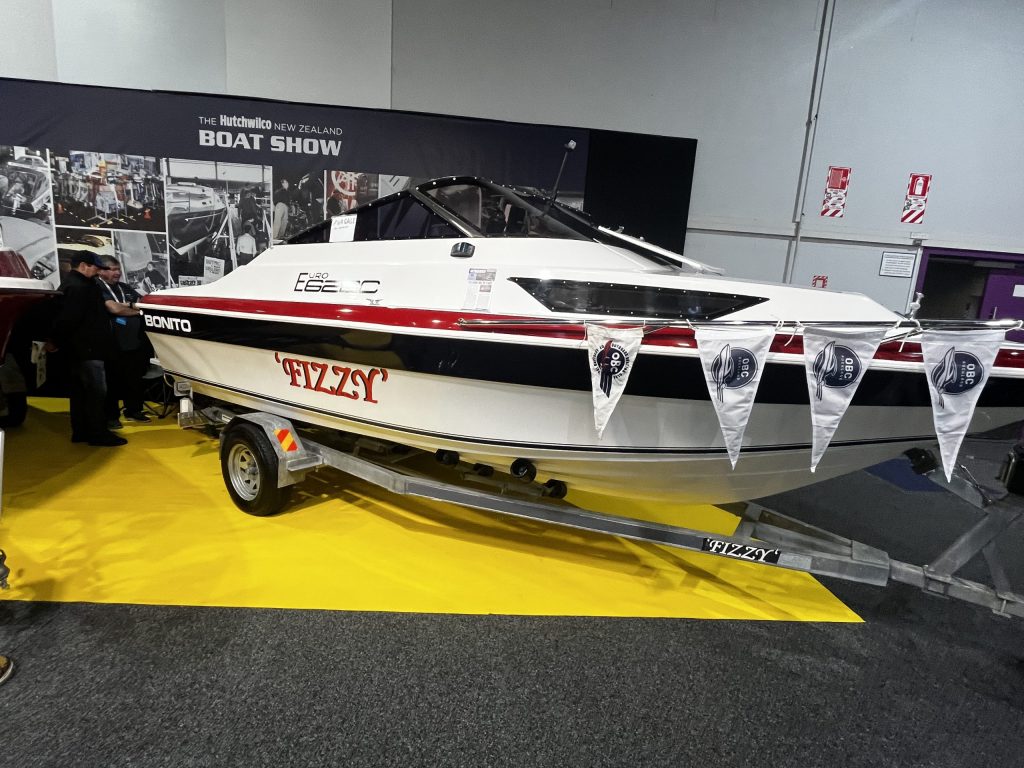
The final boat in the heritage display is also the newest, and in its own way the most remarkable. Fizzy, a 1990 Bonito 622 Euro, has spent her entire life on Lake Taupo and carries fewer than 500 hours on her main engine. Garaged when not in use, purchased in 2008 from the southern end of the lake and relocated to Auckland, she now operates from the Outboard Boating Club on Tamaki Drive. Her excellent condition is the product of freshwater use and the kind of careful ownership that boats rarely benefit from over a 35-year span. The 9.9hp auxiliary Yamaha is used for trawling specifically to reduce wear on the 175hp main engine. It is a level of care that shows.
| The Hutchwilco Boat Show | Heritage Display |
| Year | 1989/1990 |
| Engine | Yamaha 175hp 2-stroke (oil injection) |
| Auxiliary | Yamaha 9.9hp 4-stroke (remotes & electric start) |
| Trailer | Original DMW |
| Hours | Main engine under 500 hours |
New in 1990 and spent her entire life on Lake Taupo in freshwater. When not in use, she was always garaged. Purchased in 2008 from the southern end of the lake and relocated to Auckland, where she now enjoys the facilities of the OBC boat club on Tamaki Drive.
Primarily used for family boating, the Yamaha 9.9hp auxiliary is used for trawling to reduce wear on the main 175hp engine. Her excellent condition is a testament to careful ownership and freshwater use.
What the display adds up to
Put these six boats in a room together and what you have is not just a display of vintage hardware. You have a portrait of New Zealand’s relationship with its water. Hamilton’s jet boat solved the problem of the South Island’s braided rivers and created a global industry. The timber craftsmen of the 1950s built by hand to individual commission, producing work that has outlasted most of the production boats that followed. The fibreglass revolution of the 1960s and 1970s democratised boating, putting capable family boats within reach of ordinary households. And the production builders of the 1980s refined and scaled those designs into models like the Haines Hunter that became fixtures of New Zealand’s coastal culture.
That story is still being told at every Hutchwilco Boat Show, by every new model on display. The heritage fleet is its foundation.
Seventy Years at the Showgrounds
The Hutchwilco New Zealand Boat Show began in 1956 as a collection of boats in a corner of the Easter Show at the Auckland Showgrounds. By 1957 it was running under its own name. By 1962 it had a lake. A new pavilion in 1965, a move to Queens Birthday Weekend in 1985, a shift to mid-May in 2007. The name changed several times before landing on Hutchwilco New Zealand Boat Show in 2001. In 2011, it was named best boat show in Australasia.
XPO Exhibitions took over in 2022 and successfully defended the Showgrounds’ future in the High Court, with the show’s 70-year history of community events central to the argument. This year’s 70th marks the anniversary with a heritage display, a one-off Boat Show Movie Theatre screening historic footage, and a Grand Prize package valued at over $380,000. Entry is free with a registered ticket scanned before 4pm on Sunday 17 May.
The Hutchwilco New Zealand Boat Show runs Thursday 14 to Sunday 17 May at the Auckland Showgrounds, 10am to 6pm daily, closing at 5pm on Sunday. Tickets at boatshow.co.nz.