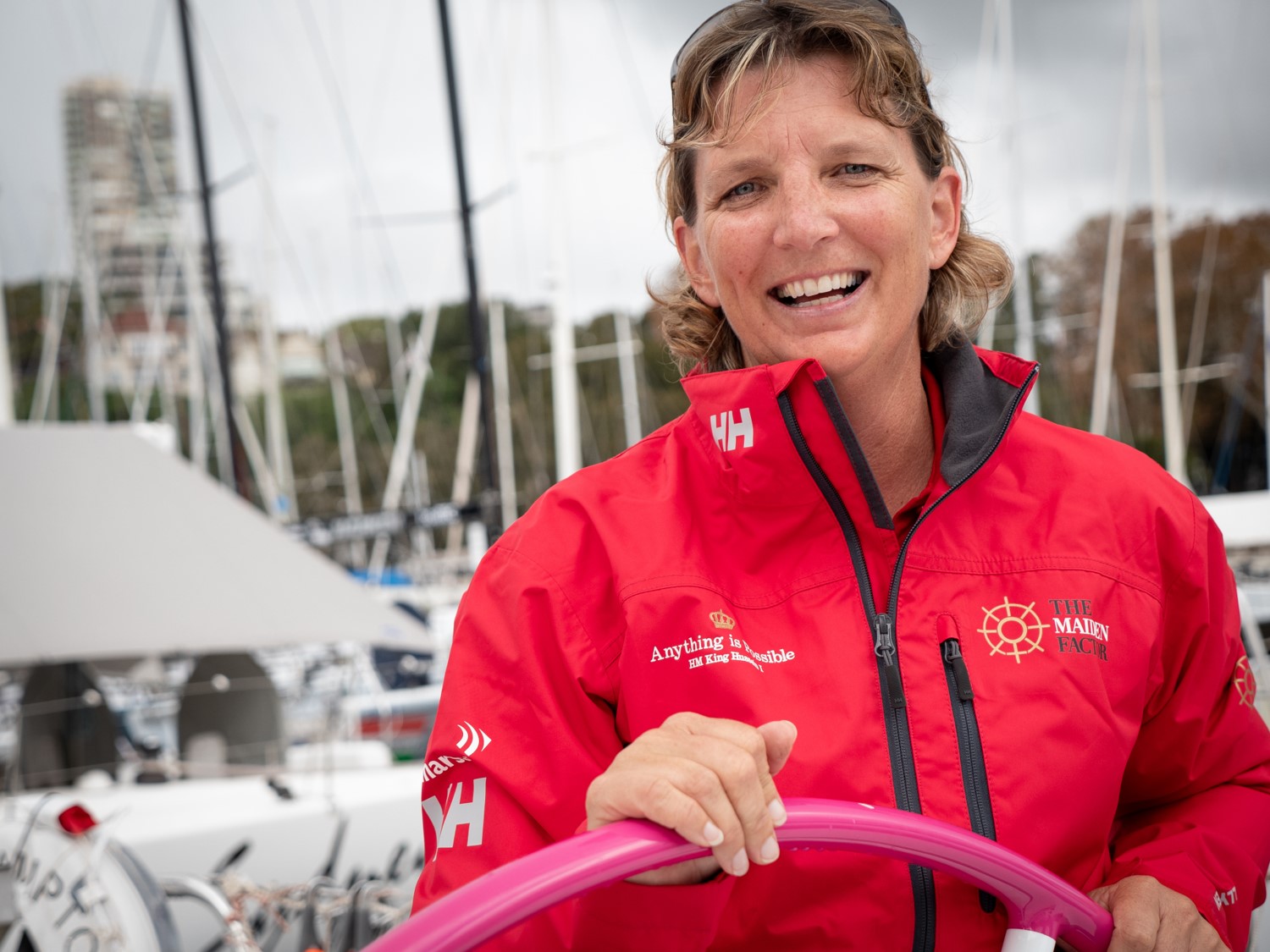
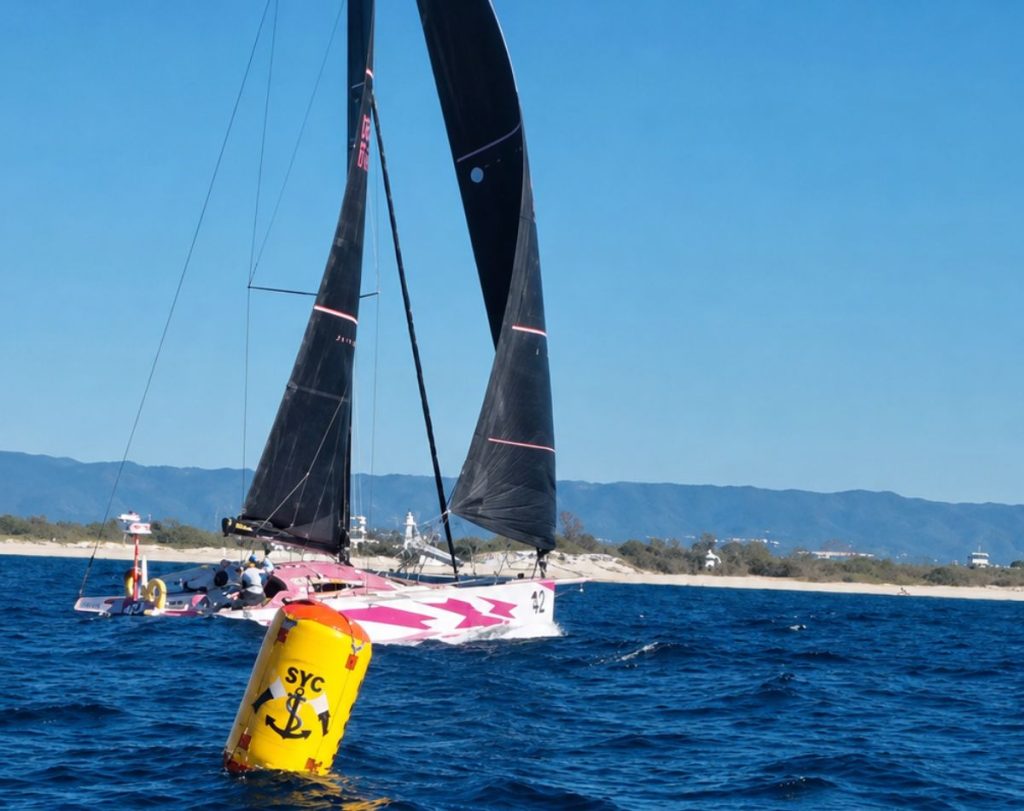
At 12:15pm NZST on Saturday 6 June 2026, Sharon Ferris-Choat crossed the finish line at Southport aboard her Verdier 40 Vixen Racing, completing the 2026 Solo Trans-Tasman Yacht Challenge in 7 days 0 hours 9 minutes and 4 seconds. Second boat home overall. First monohull to finish. The only woman to start this race — and the first woman to finish it since 2014.
She came in with an emergency blanket wrapped around her against the cold, eating chocolate, 21 miles out still talking about coming back to do it again.
Vixen Racing was battered. Sharon Ferris-Choat was not.
When the fleet left Opua on 30 May, Ferris-Choat became only the seventh woman in the Solo Trans-Tasman’s 56-year history to start the race. She arrived at the start line as perhaps the most credentialled competitor in the fleet — two Olympic campaigns, a Jules Verne Challenge attempt that ended with a dismasting in the Southern Ocean, and in 2005 the ORYX Quest, where she and her crew became the first women alongside Karine Fauconnier to win a round-the-world race outright. More than 124,000 offshore racing miles.
Sharon Ferris-Choat to become seventh woman to contest Solo Trans-Tasman

She was clear about what she wanted from this race. “The goal is to get there safely and competitively. The result will be what it will be.”
Two lows, and leaving anyway
The weather picture heading into the start was not encouraging. Two substantial low-pressure systems sat ahead of the fleet — the first arriving as the fleet rounded the top of New Zealand, the second from Tasmania mid-race. PredictWind put gusts at 35-40 knots on the first front’s passage, potentially higher in squalls. Ferris-Choat’s own reading was blunter: “They’re boat-breaking, they’re human-breaking, and they could end your race very, very quickly.”
On whether she’d leave at all: “I always have a saying as a mother. If what I’m about to do has a potential to create motherless children, and if that’s even entering my head, we need to have a serious look at the responsibility of what we’re about to do. We’re not there.”
Saturday at noon, she was on the start line.
Sharon Ferris-Choat: two lows, a routing call, and no regrets about leaving
The race
Day one rounding North Cape was brutal for much of the fleet. Ferris-Choat pressed on. Overnight on day two her J2 wrapped around the forestay in 40-knot conditions. She fixed it and kept going. By day three, after a rough night of thunderstorms and squalls, she filed a video of a stunning sunrise from the cockpit. “What a contrast to last night.” She was among the first three to cross the halfway mark, alongside Guy Chester’s trimaran Oceans Tribute and James Foster’s catamaran Electron. She tacked toward Lord Howe Island on a good lift and told her followers the moon had arrived.
The handicap battle ran tight and rarely settled. For much of the race Malcolm Dickson’s 55-foot Sarau led on PHRF corrected time, with Vixen Racing swapping the lead back and forth as conditions shifted — sometimes separated by as little as three minutes after days at sea. By the final stages Ferris-Choat had pulled clear, and at the time of finishing she sits first on PHRF corrected time with 6 days 14 hours 13 minutes and 49 seconds, with the rest of the fleet still to finish.
The nights were rarely clean. On day five a squall hit without warning. She was below, 12 knots, one reef and the J2 up. “The next thing I know we’ve got 47 knots and torrential rain and the only thing I could do was bear away.” She sorted it. The tow line deployed itself at some point. She cleaned that up too. At 4am later in the race she filmed from the cockpit: hail the size of golf balls, lightning on the horizon, 40-knot squalls running through one after another. “This has been punishing. And these are our mates back there in the rest of the fleet — we hope everybody’s OK.”
In the middle of one of the hardest nights of her race, her first thought was for the people behind her.
The final approach brought one more brutal night — wind off the mountains, conditions she described as almost the coldest sailing of her life. With 21 miles to go she recorded her last transmission before the dock. “Under here I’ve got an emergency blanket wrapped around me just to try and give me some insulation from the dampness and everything’s icicles; it’s just crazy.” She had already worked out what she’d do differently next time.
The finish
She crossed at 12:15pm NZST on 6 June in an elapsed time of 7 days 0 hours 9 minutes and 4 seconds. On PHRF corrected time: 6 days 14 hours 37 minutes and 25 seconds.

Congratulations, Sharon.