They fight hard, they fight long and they fight dirty. Terry Williams King looks at how to catch monster kingfish that could be heading towards the 50kg mark.
I often wonder what an angler’s attraction is to kingfish. What makes them go all warm and fuzzy inside when talking about being harassed or hooked to one of these bullies of the sea? It was not until recently that my love-hate relationship with these green torpedoes got me thinking about why anglers get so excited when recollecting tussling with one of these fish, or their pride in landing one.
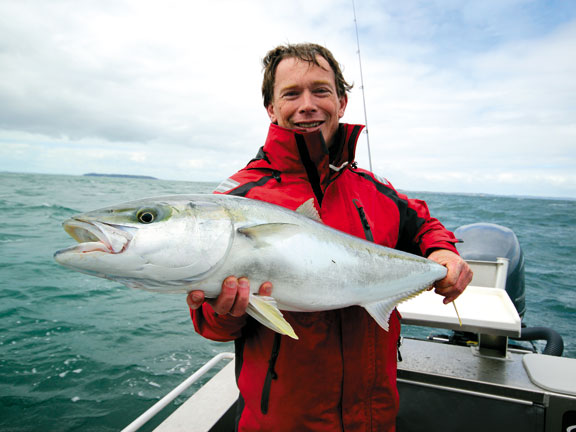

Early into one summer holiday up north, I encountered a brute of a specimen, which gave me one hell of a tussle. At first I was a little annoyed to have hooked a kingfish as the light was fading and I was desperate for a snapper for the table, but as the battle wore on, I became more and more determined to land this fish. It turned out to be a good one of around 25kg, and I happily let it go to fight another day, feeling it had earned its freedom after giving me the heave-ho for a good 50 minutes. Unfortunately, I later had to endure the wrath of my father-in-law, who is a big fan of kingfish steaks on the BBQ!
It was during this scrap that I realised why a lot of anglers are mesmerised by these fish and why so many love to pick your brains on the tactics, how to, where to, etc. The kingfish fishery has really has improved over the last few years, with stories of monster fish up to 50kg chasing stick baits, monster kings taking metal jigs over deep reefs or harassing live baits. I have been very spoilt fishing for them in some of New Zealand’s hottest fishing locations, on some of the best boats with the best local knowledge around. I do tend to take them a little for granted and don’t chase them as hard as I once did, but boy that fire was stoked again after the encounter described above.
In this series of articles I want to discuss some of the tactics and the gear used to find, lure, and catch these wonderful sport fish. The one thing a kingfish can do, and will do, is test both angler and tackle. They fight hard, they fight dirty, and they fight until the very end. Give them an inch and they’ll take a mile, go hard and they’ll go harder – these are just very tough fighting fish.

Mechanical jigging has been around for a while now. Early jig fishing in our waters used heavy, 200-300 gram, fish-shaped lures that were retrieved at speed through the water column and amongst schools of bait. Long, 6’6″-plus rods were used with high-speed reel spooled with heavy, 30 to 50-pound mono line. It’s a very effective method and still used today, but the gear and the techniques have both moved on since then.
The most significant change to the jigging style came with the lure itself, which became longer and was weighted in different parts to offer different actions on both the descent and ascent. Lure weighting and profile helped control the lure’s descent speed, depending on depth and current. Treble hooks were replaced by an assist hook swinging on a cord next to the body of the lure. More recently, engineered resin lures have taken this further again, offering tighter tolerances and more consistent actions than the older metal designs, while still working with the same assist hook rigging.
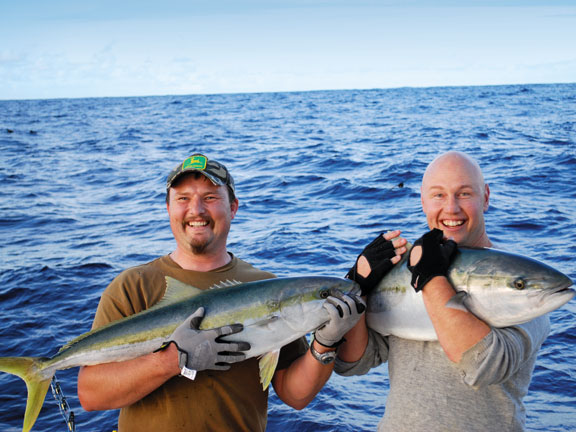
Next, the jigging action was changed, and with it the rods and reels, which became specialist tools designed for this new and very successful lure jigging style first developed in Asia by anglers fishing for dog tooth tuna, amberjack, GTs and the like. It was only a matter of time before this style of jig fishing was adopted here and since then, the style has split further, with slow-pitch jigging now well established as its own discipline alongside the faster mechanical retrieve. Slow pitch jigging uses lighter jigs and a more deliberate lift-and-drop cadence to tempt fish that won’t commit to a fast-moving lure.
Most jigging outfits these days consist of a short 5′-5’6″ fast-action rod, built on PE-rated carbon blanks that are far lighter and more sensitive than the gear we used 20 years ago, paired with a high-performance spinning or overhead reel capable of putting out plenty of drag on thin, multi-coloured PE braid. A length of fluorocarbon leader between the braid and the lure adds abrasion resistance without giving up the sensitivity the braid provides. The gear options are endless in both spin and overhead combos, so talk to your local tackle shop about what suits your style of fishing.
Be prepared once you’ve had a go at jigging to be hooked, and to spend a lot more dollars than cents on some of the extremely high quality gear on the market.
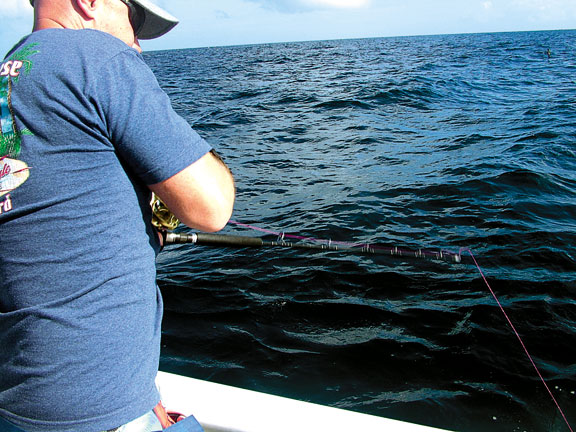
The mechanical jigging action required for success is rather hard to explain and can look totally clumsy when you are attempting it, to begin with at least. Basically, you drop your jig, start bobbing it up and down and work on the technique once you are underway.
The goal of the action is to drop the jig to the bottom, depending on how good you or your skipper is at locating kingfish or marking bait schools. Forward-facing sonar, such as Garmin LiveScope or Lowrance ActiveTarget, has made this side of the game far easier than it used to be, letting you watch fish respond to the jig in real time rather than guessing from marks on a traditional 2D sounder. A trolling motor with GPS spot lock also makes it much easier to hold the boat over a mark or a school of bait once you’ve found it, rather than drifting straight off the spot.
Once you’re set up, use the multi-colour braid to drop your lure to the required depth (the bottom or into a school of fish marked on the sunder). The braid will generally change colour every 10 metres, enabling you to count the colours as the lure descends to where the fish are holding. I’d generally suggest you drop below the marks by some way and thenl work your lure back through the strike zone. Get the jig working through the water column and create more attention/lure action as it moves through the marks. While lifting and dropping the rod, you’re retrieving line, rotating the reel handle on both the up and down stroke. Start off slowly, increasing your speed and aiming to work the rod tip at between 7 and 11 o’clock, no more. Once you have the retrieve coordination worked out, increase your speed. A varied action alters the speed and lure behaviour/action to simulates the prey.
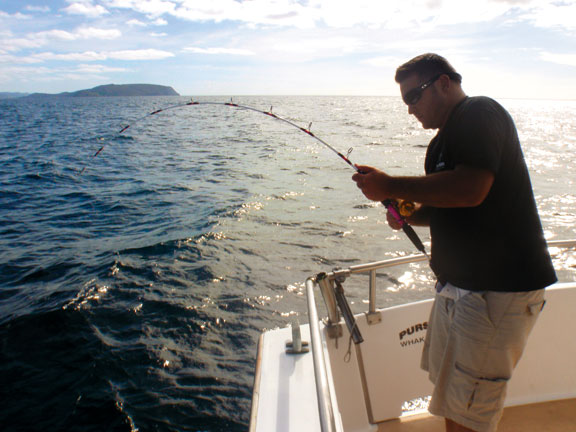
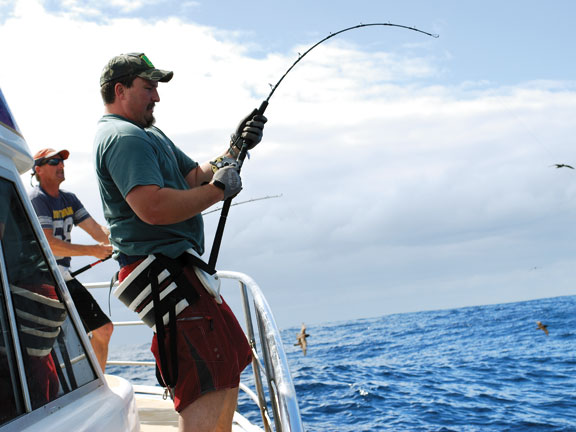
The bite is quite intense. Kingfish hit hard and fast and maker for the nearest underwater structure on which to break you off. Have your drag set tight. A big jig cracking them on the side of the head will drive them a bit nuts so be prepared to see lots of line melt from the spool at speed. Keep your rod at a reasonable angle and retrieve line whenever possible. Unfortunately, unlike many other species of fish, Kingfish don’t rest when you rest, so you need to keep the pressure on and retrieve line at every opportunity. You can rest when the fish is on ice or has been released.
Things to watch out for
- If fishing with multiple anglers, watch for crossed lines. If this occurs, put the rod tips together and uncross the lines; multiple hooked fish will often cross paths.
- Kingies fight till the end, so in the dying stages of battle, be wary of fish charging under the boat – a catastrophic way to bust fish off and/or break rods.
This very exciting fishing style can often be employed at the same time as many of the other techniques used to lure kingfish. Next time, we will look at live baits.