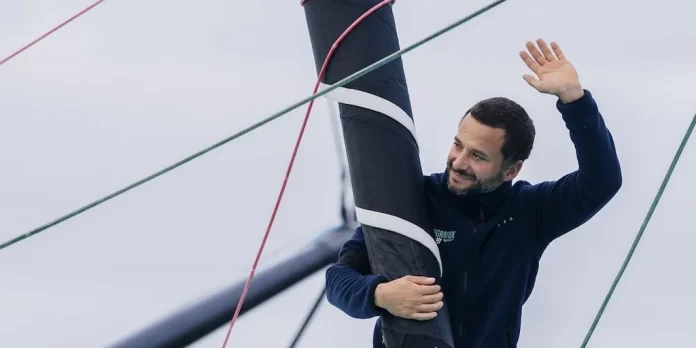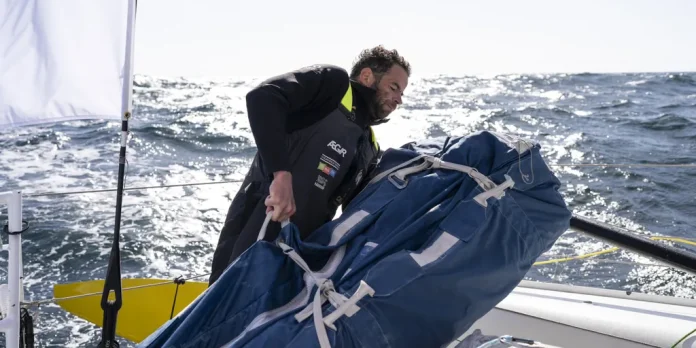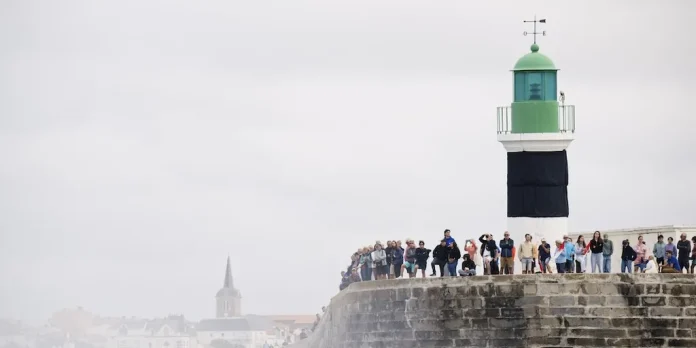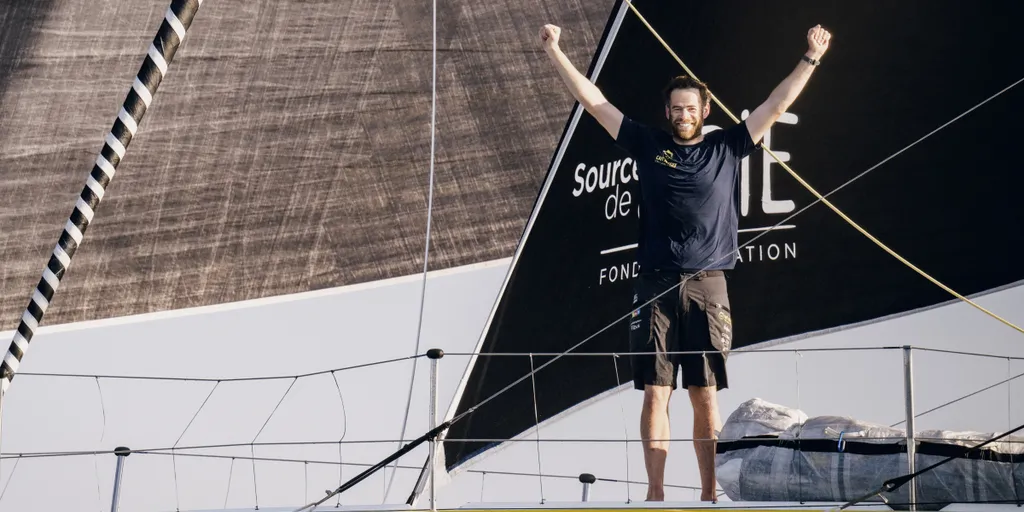
Nico d’Estais crossed the finish line at Les Sables d’Olonne on 18 June at 20:17 NZST, 10 days 7 hours and 15 minutes after leaving port. Sixth place overall. But the position number barely matters. What matters is that d’Estais completed the Vendée Arctique in Café Joyeux, the only boat in the fleet equipped with dagger boards instead of foils, and he did it with his wits intact and his appetite for the work undiminished.
This was his first season racing in IMOCA. The Vendée Arctique sent him north to discover terrain he’d never navigated: the Arctic Circle, days without darkness, successive deep depressions, seas that turned rough and unpredictable. Every skipper knows the Vendée Globe is the ultimate test. This race, hard as it was, offered something closer to that trial than anything d’Estais had faced before.
The Café Joyeux team knew they couldn’t match the foiling yachts on raw speed. So d’Estais built his race differently. He chose the most direct route when it made sense, hunted for weather opportunities without overcommitting, and treated every decision like it mattered, because it did. The approach worked. He stayed competitive through multiple phases and proved he could extract maximum performance from a slower platform. At 3,062.73 nautical miles covered over the course, he averaged 12.4 knots.

The moment he crossed 66 degrees North stayed with him. Damp cold that penetrated bone-deep. He woke shivering inside the cabin. Visibility dropped to almost nothing. “I had the real feeling I was at the end of the world,” he would say later. Eight skippers crossed the Arctic Circle in this race. It was an IMOCA first, historic in its way. D’Estais savoured the strangeness of it.

What the racing taught him mattered more. He discovered he could manage situations he’d never encountered before on a 60-foot monohull: accumulated fatigue, demanding weather, mechanical failures, the constant wet that wears you down. Each one of those moments added something to his understanding. He’d calculated before the start that he might challenge Arnaud Boissières and Manu Taitz for position. His move north to pass Boissières was one he’d imagined before the start line, held in reserve until the weather aligned. When the opportunity came, he took it.
“This race is probably what comes closest to preparation for the Vendée Globe,” d’Estais said at the dock. He spoke of the boat’s solidity, how Café Joyeux had crossed oceans before he ever touched the helm and had earned his trust, except for one afternoon when the rudder kicked up in 30 knots of wind and he spent twenty minutes lying flat on the cabin sole sorting things out. After that, he said, they made peace and everything went fine. He admitted the ocean remains stronger than any sailor who sails it. The humility that came with that knowledge felt important to him. It will serve him well when he points south toward the Southern Ocean.