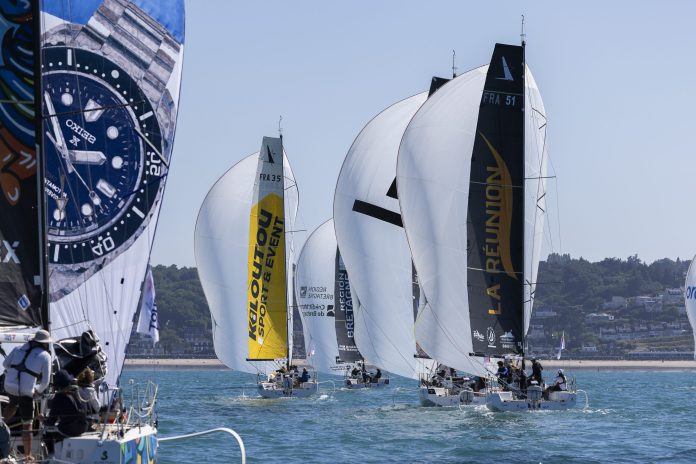
The third and final rallying stage of Tour Voile 2026 arrives not with answers, but with questions. After a rest day in Plérin, nine crews return to the water on Sunday for what promises to be the most tactically demanding leg of the opening week, where wind patterns remain unpredictable, race duration is impossible to forecast, and the finish line itself may be adjusted mid-race depending on conditions.
The crews, meanwhile, are rested. Victor Le Pape, skipper of Région Bretagne – CMB Espoir, said the team is serene—recuperation has done them good. Crew member Paul Morvan is back after missing five days, bringing fresh legs to the deck. That renewal of energy will prove essential for what lies ahead.
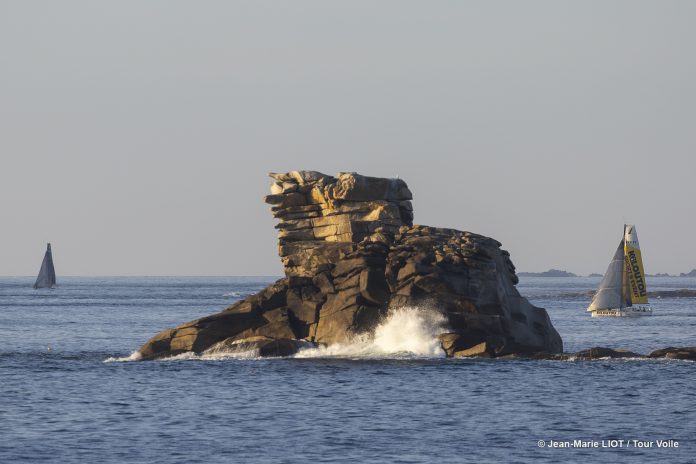
The course from Plérin toward Camaret-sur-Mer (or possibly only as far as Le Four if wind conditions demand it) presents a masterclass in navigational uncertainty. Crews will need to thread through shallow, rocky waters around Île de Batz, read the transitions between thermal and synoptic wind, and manage the treacherous conditions of the Iroise Sea—where tidal currents, coastal effects, and variable thermals can shift a race outcome in minutes. The race direction has deliberately left the course open, inviting each skipper to construct his own route.
Jules Ducelier, who started first on Sunday morning, welcomed the design. For him, this is exactly the kind of stage that rewards the thinking sailor: a blank canvas where continuous decision-making about wind location and coastal tactics will separate winners from the rest. The distance may sound modest on paper, but it conceals one of the most complex tactical puzzles of the campaign. Routings continue to shift hourly; estimates for race duration swing between just over a day and closer to thirty-six hours.

No Lead Is Safe Until Camaret Bay
The Iroise Sea—notorious for its currents, tidal effects, and unpredictable wind—means that no advantage holds weight until boats reach the finish. Le Pape, currently holding provisional race leadership, knows this better than most. Even with several miles in hand, a crew can be caught in the final stretch. Ducelier echoed the sentiment: wind remains the determining factor throughout, and it can vanish at multiple points along the route. Concentration cannot flag for a moment.
This uncertainty carries particular weight for newer crew members. Aenaël Costa-Marrec, aboard digiLab x RORC, will experience his first night race on a Figaro Beneteau 3—a foundational milestone for any offshore sailor. Skipper Joss Creswell, a British sailor accustomed to solo racing, sees the leg as an opportunity for teaching. Each rallying stage brings a new combination of crew, and close-quarters coastal navigation is an excellent proving ground. For Creswell himself, the exercise of articulating decisions he normally makes instinctively has become a tool for structured thinking—a form of progression he hadn’t anticipated. The light wind expected could even become an unexpected ally, providing time for mentorship. There is no classical watch roster when everyone must be on deck in delicate sectors, stealing rest during rare calm moments.
As Tour Voile enters its final week, the question that lingers is simple: how long will this stage actually take? Bodies have recharged. Certainties remain tied to the dock.