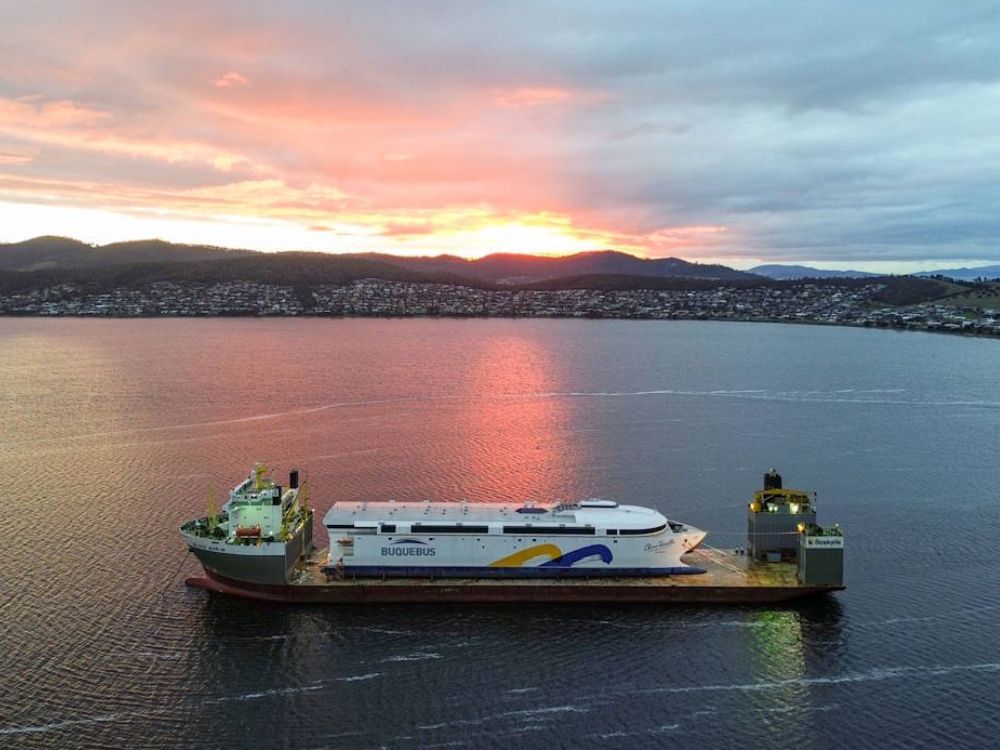
The world’s biggest battery-electric ship has left Tasmania, riding piggyback on one of the largest heavy lift vessels afloat as it starts a roughly 40-day haul to South America. Incat, the Hobart shipbuilder that’s spent the best part of a decade turning fast catamarans into a genuine decarbonisation story, watched Hull 096 leave the River Derwent aboard the semi-submersible ship Black Marlin on the morning of 5 August.
Hull 096 will be known once it’s working as China Zorrilla, named for the Uruguayan actress who died in 2014. It’s a 130-metre aluminium catamaran built for South American operator Buquebus, rated to carry up to 2,100 passengers and 225 vehicles, and it’s the ninth vessel Incat has built for that operator. The relationship goes back to HSC Francisco, an LNG dual-fuel catamaran delivered in 2013 that was, for a time, the fastest turbine ship in the world at 58 knots. China Zorrilla is a very different kind of record holder.
It started life in 2019 as a dual-fuel LNG and diesel ferry, designed to cruise at 20 knots with a set of Wärtsilä engines and cryogenic fuel tanks. Buquebus changed its mind partway through the build. In January 2023, with the hull already under construction, the two companies renegotiated the contract to make the ship fully battery-electric instead, a decision that meant reworking the structure to carry a very different kind of cargo.
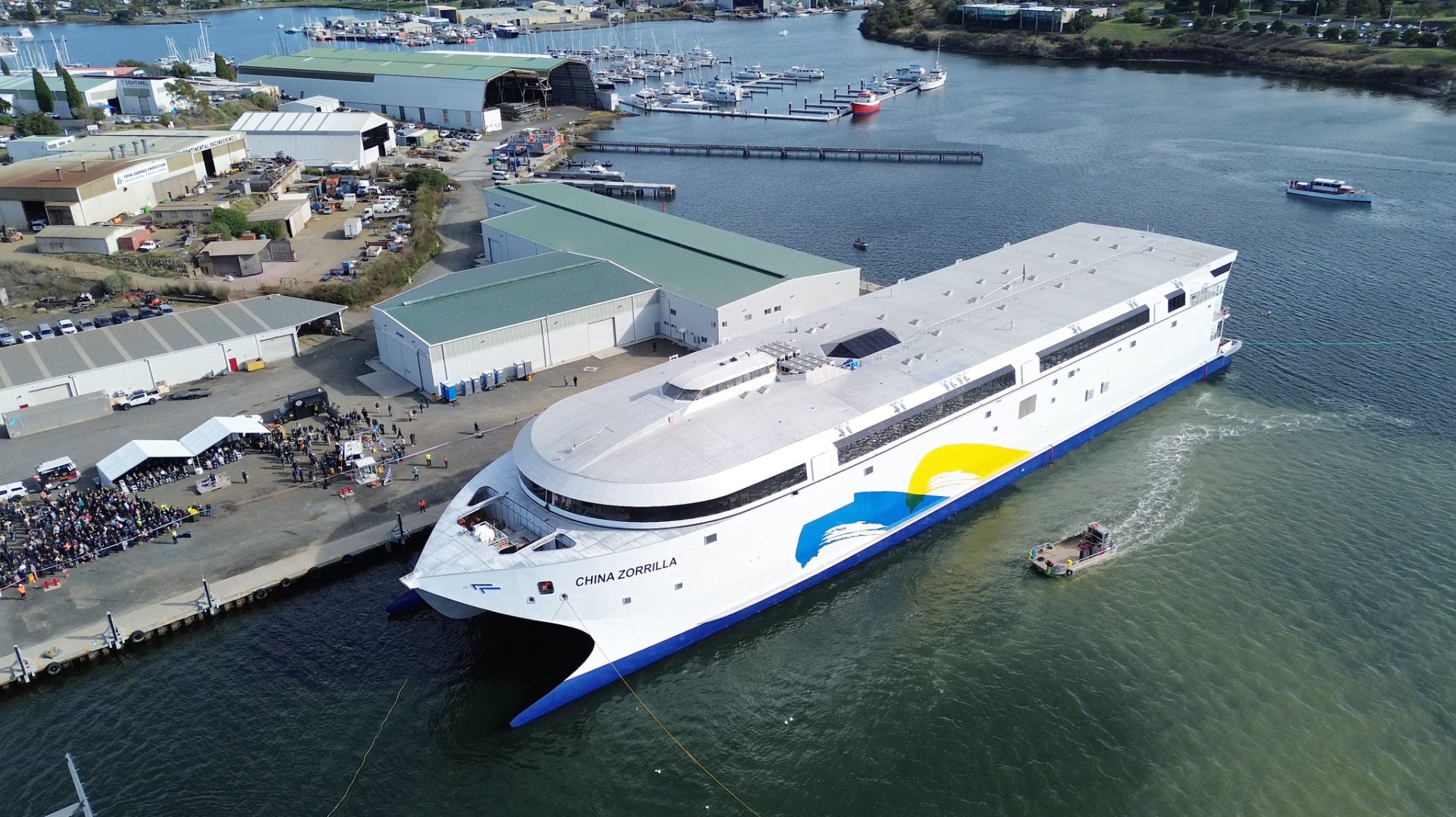

What went in its place is more than 40 megawatt-hours of installed battery capacity, a Corvus Energy Dolphin lithium-ion system built in Norway and supplied through Wärtsilä, weighing over 250 tonnes. Incat says it’s four times larger than any previous maritime battery installation. It’s split across four insulated battery rooms holding 5,016 individual battery units, each one fan-cooled and isolated so a fault in one module can’t spread to the next, according to IEEE Spectrum’s reporting on the system. Eight electric waterjets, two fixed and two steerable per hull, do the work that diesel engines would once have done.
The ship was launched in Hobart in May 2025, and its first proper test came on 14 December that year, when Incat Chairman Robert Clifford powered the waterjets in front of Australian Trade Minister Don Farrell, Tasmanian Premier Jeremy Rockliff and Governor Barbara Baker. “This is the first time a ship of this size, anywhere in the world, has been trialled under 100 percent battery-electric propulsion,” Clifford said at the time. “It’s a remarkable achievement by our workforce and a turning point for shipbuilding.” Sea trials in Hobart’s harbour followed in January, with the ship reaching 29 knots at 600 tonnes of cargo, comfortably above its planned 25-knot service speed.
Getting the finished ship to South America was never going to be simple. It’s designed for shallow water crossings, not open ocean, so it needed a lift. Black Marlin, a 217-metre semi-submersible heavy lift ship, was booked for the job, but the original March departure was pushed back for months after the transport ship got caught up in the Strait of Hormuz crisis earlier this year. It finally reached Tasmania in late July, ballasted itself down, floated Hull 096 into position above its deck, then pumped the water back out to lift both vessels clear of the waterline.

“Today is a proud day for everyone at Incat,” Clifford said as the ship departed. “Hull 096 has been the biggest and most ambitious project in our company’s history, and its departure is a testament to the skill, dedication and innovation of our entire workforce.” Once it reaches South America the ship will be unloaded, commissioned and readied for the Buenos Aires to Colonia run, a short, high-frequency crossing where the 2,300 square metre duty-free shop on the middle deck is as much a part of the business case as the propulsion system.
| SPECIFICATION | DETAIL |
| Builder | Incat, Hobart, Tasmania |
| Length | 130 m |
| Passenger/vehicle capacity | 2,100 passengers, 225 vehicles |
| Propulsion | 8 x 2.4 MW electric waterjets |
| Battery capacity | 40+ MWh, over 250 tonnes |
| Trial speed reached | 29 knots |
| Service speed | Around 25 knots |
| Route | Buenos Aires, Argentina – Colonia, Uruguay |