“They were nothing but a bunch of pirates” Stuart Cranfield said, as he leant back against the cushions of my old boat’s settee, juggling a glass of wine. Story by Rob Weatherburn.
This wasn’t the sort of remark you might expect from someone whose family – particularly whose great-grandfather – had been among the most skillful and sought-after sailors and yacht captains Britain ever produced.
“What do you mean about your family being a bunch of pirates?” I asked.
“Well they were,” he said emphatically. “What else would you expect of a family of East Anglian fishermen? Smugglers and pirates, the lot of them. It was the way of the world. But it’s all history anyway – gone.”

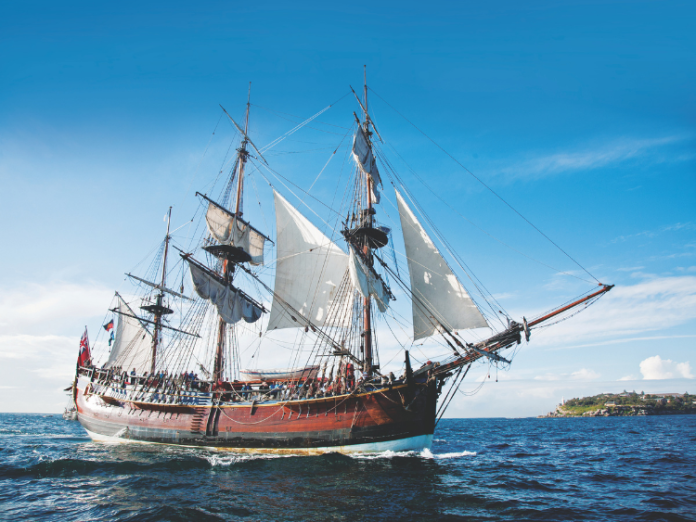
The yachts Stuart’s great-grandfather skippered were the great racing yachts of yesteryear; thoroughbreds such as the Prince of Wales’ Britannia, arguably the most successful and popular racing cutter ever built, and all three Valkyries – as well as Lord Dunraven’s other magnificent vessels.

But how was it so easy for a fisherman to cross the clearly-defined boundaries of Victorian society’s class-consciousness and become the friend and confidant of the aristocracy and the Royal Family? It was all because of a bit of silverware – the race for the America’s Cup.
The America’s Cup still dominates today’s high-tech yacht-racing world, but for most it’s a world observed from afar – a world for the wealthy and elite. But more than any other race, it has fired the imagination of sailors and yachtsmen. The dissimilar spheres of sport, commerce and war all sought the fastest of vessels – and the expertise of each inevitably influenced the others – in design, material and seamanship.

Yacht-racing as a sport developed from about the end of the 18th century and in the UK its popularity spread from the coasts of Essex, North Wales and the Solent. The east coast of Ireland may have seen the sport even earlier.

It rapidly became a sport for the wealthy. But such people rarely had much sailing knowledge or skill, and although they may have loved the sport they needed to employ experienced seamen to crew and sail their yachts for them.
The latter half of the 19th century saw enthusiasm for yacht-racing sweep across the world, from Southampton Water to Sydney Harbour. The sport proved an ideal outlet – and a continuing source of challenge – for man’s competitive nature.
Yet the America’s Cup is not merely a race of boat against boat, or crew against crew: the personalities involved became fiercely nationalistic. As a result, it’s a race of both personal and national endeavour. When the British lost the first race (and the trophy) on their own stretch of water, it was a blow to their national pride. In striving to recapture the Cup, men like the Prince of Wales (later King Edward VII), Lord Dunraven and Thomas Lipton had the vision and required depth of pocket to build magnificent yachts such as Britannia, the Valkyries, Shamrock and Endeavour.

Building the yachts was all very well, but sailing them was another matter, one that called for inherent and traditional skills rather than money. As the wealthy cast around for men with the expertise to sail their yachts, the fishermen of Essex became an obvious choice.
They all carried deep experience in sailing and working their vessels around the shifting sands and tricky channels of the Thames estuary and the North Sea. Having learnt to draw every ounce of advantage from wind and tide, their expertise was beyond doubt. And so they became yacht captains in the summer and went back to fishing in the other months. With time some became full-time yacht captains.


By the end of the 18th century yachts were being built in the east coast yards at Ipswich, Brightlingsea, Rowhedge and Wivenhoe. The dove-tailing of yachting and fishing led to the improvements in both types of craft, and by mid-19th century an East coast fishing smack was a beautifully-designed topsail cutter that looked very much like the similar-sized racing yachts of the period.
The Cranfield family lived in the village of Rowhedge on the River Colne and its men had an enviable reputation both as fishermen and sportsmen. Sunbeam was their most famous racing smack, and the brothers William and Lemon were coveted by the owners of the great yachts. In stepping from fishermen to yacht captains they crossed the great divide of Victorian society and settled into a new profession.

William sailed Britannia for the king, and all three Valkyries for Dunraven. You’ll find his portrait in the clubhouse of the Royal Yacht Squadron at Cowes on the Isle of Wight, as well as in the entrance of the clubhouse of his great rivals in New York. He never won yachting’s most prestigious prize, but as skipper of Valkyrie III he came closer than any other British captain to wresting the America’s Cup from the US.
William’s crews were largely made up of his fellow Essex fishermen, and Stuart recalled the story of how – during a lull between racing in Italy – Lord Dunraven decided they should all take some time off. He would personally do something about educating and widening the horizons of his famous and hardworking crew.
It was a decision that didn’t work out too well. His organised tour to some of the world’s great classical sites only proved that although his Essex fishermen appreciated the classic lines of his yacht, they had little interest in the ruins of classical civilisations.
“He should never have expected otherwise,” Stuart scoffed. “Those fishermen probably had no idea what they were supposed to be looking at. They’d have been lucky if they’d had even a rudimentary education – let alone a classical one.”

Meanwhile, back in Essex, William Cranfield’s son, Adolphus Reuben was a sickly child and the family decided that – no matter what the local doctor said to the contrary – the sea would be the best place for his lungs.
And it was. The sea air did the trick for Adolphus and he lived to the ripe old age of 94. By comparison, William – apparently worn out by the strain of racing – died when he was 41.
The history of yacht racing is spread right across the board of man’s achievements, and most encompass not only those who foot the bills for building and maintenance, but also all those whose skills culminate in the end results: from the designers, shipwrights, and workmen, to the crew and helmsman.
Men such as William Cranfield, the Essex fisherman whose expertise allowed him to bridge the abyss of Victorian class-consciousness, proved that the sea will always be an exemplary leveller of mankind.