Only the light wind gods got up to some positive trickery. They decreed a big zig-zag to get to the winterless north. (Skyborne prefers light airs downwind sailing with the apparent wind for’ard of the beam, necessitating wide gybes). All fine with me – extra headlands to see, new parts of the ocean to traverse, more dolphins to talk to.
So it turned out that half a day of gentle sailing got us to Port Jackson at the tip of the Coromandel, with our trusty gennaker (named Jackson Pollock for its colourfulness) doing most of the work. And like last year’s Matariki weekend, we again found ourselves the only sail visible in the Hauraki Gulf. Just like last time, it was splendid.
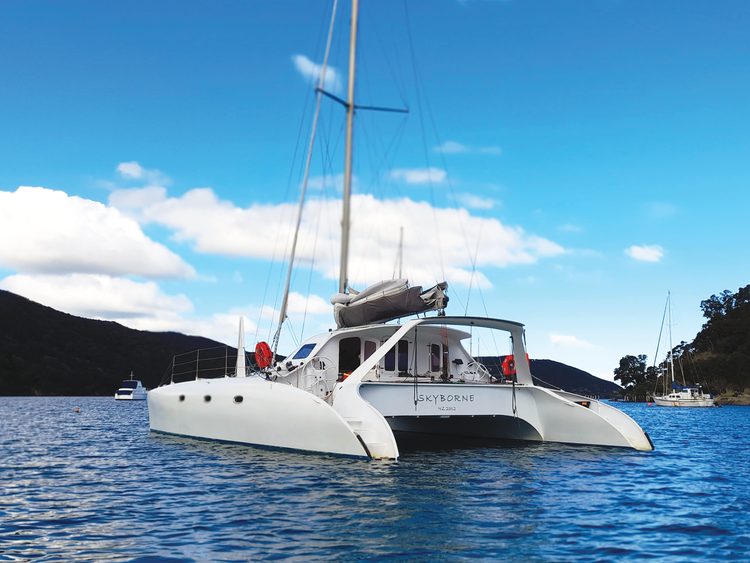
That zig put us in touch with Aotea Great Barrier Island, via a nice reach next morning with the gennaker, Skyborne doing 12 knots in just under 10 knots of breeze.
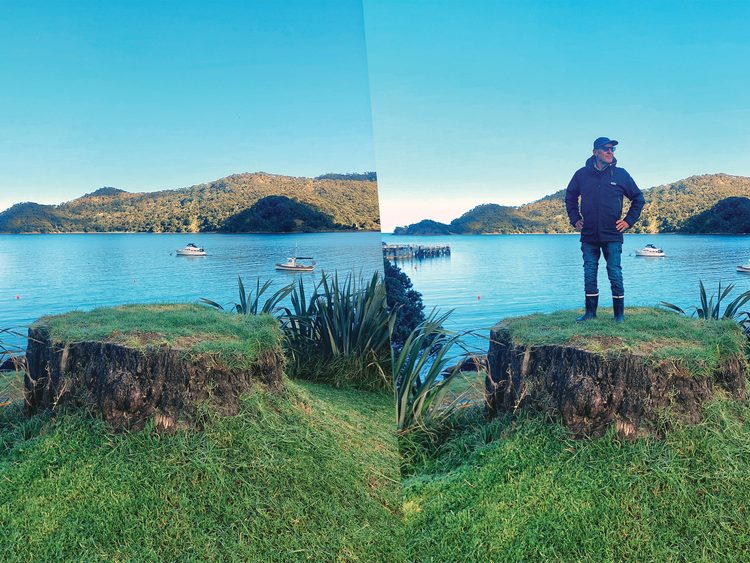
I recalled another adventure, eons ago, when another mate Jan and I had done the interpretive signage for the Aotea Track, the spectacular hiking trail all around the island. I remembered the extraordinary stories we could tell about the deep inlet at Whangaparapara, and wondered how our signs were faring. Also, ego, wanted to see if my small scratch on the surface of its history was still visible. It was. More on that later.

Tony assured me we could anchor there in the current exotic invasive caulerpa seaweed scare. It’s marked yellow alert – to wit: ‘In yellow zones anchoring is now allowed, however, before moving location, you must check your anchor and chain. Any seaweed found must be stored safely on a vessel and disposed of onshore.’
We found the bay bathed in clear winter light. We did a wee venture up a creek heading north at the top of the bay. In the true magical Barrier way, there were fish aplenty to see in the clear water as we traversed the flooded sand flats.
Puttering up past the Green (read, very basic) Campsite, that creek went from a winding mangroves avenue to a covered bush portal, with us ducking under widow-makers in the overhanging pōhutukawa branches.
Fortunately, by the time the dinghy was stopped, the creek was too shallow for me to try another mid-winter dip. I was happy to chicken out.

It was quiet. Lovely. But somehow, the many voices of Whangaparapara’s rich history kept whispering to us.
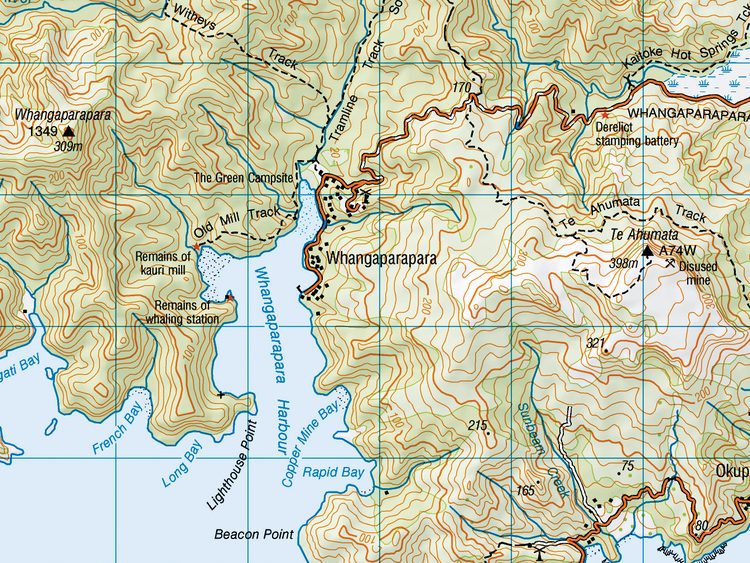
The topo map of the area reveals much of this shore-based history – more than a nautical chart – including ‘Remains of whaling station’, ‘Remains of kauri mill’ (near where we had anchored Skyborne), ‘Disused mine’, ‘Derelict stamping battery’. Stories aplenty!
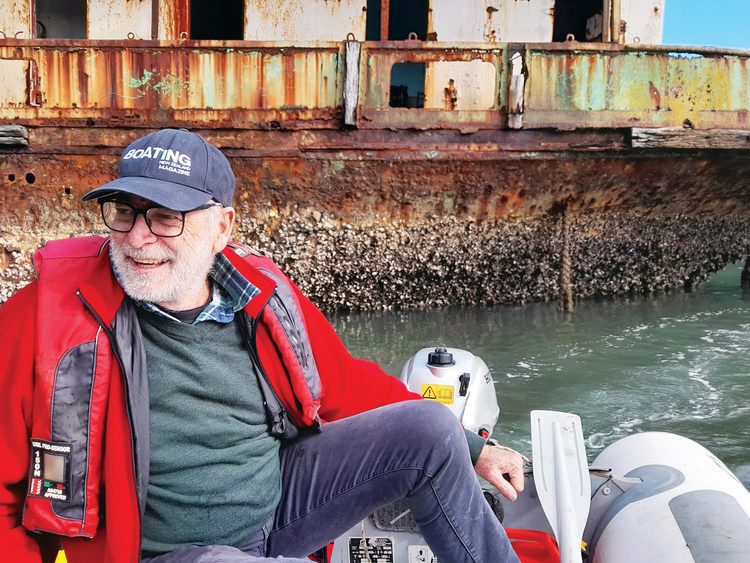
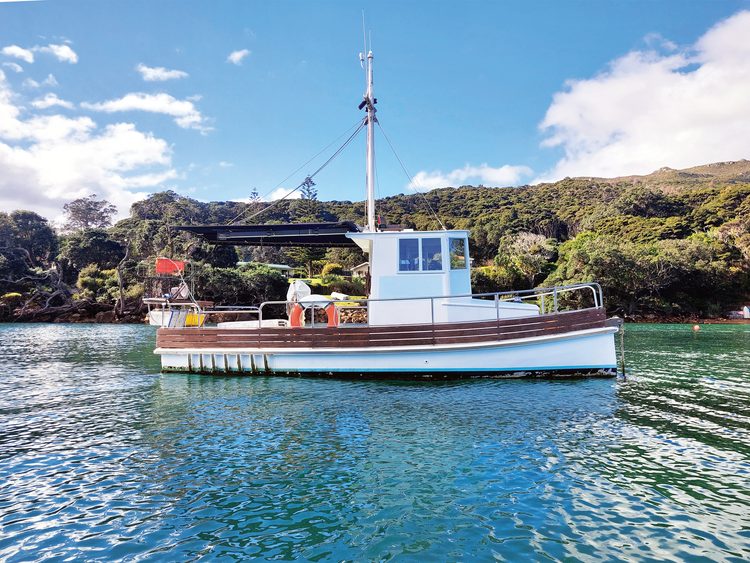
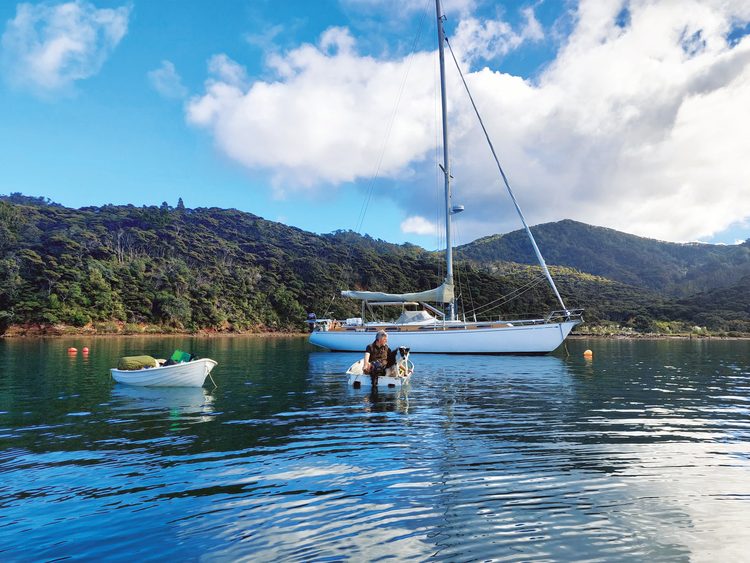
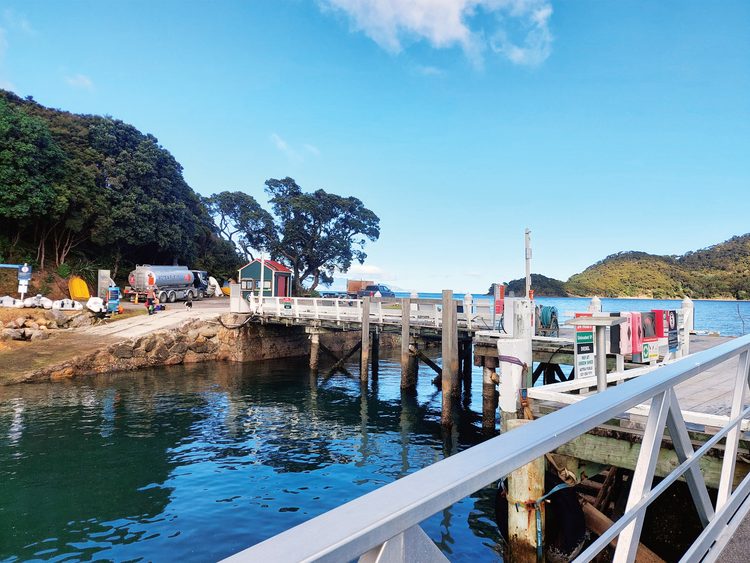
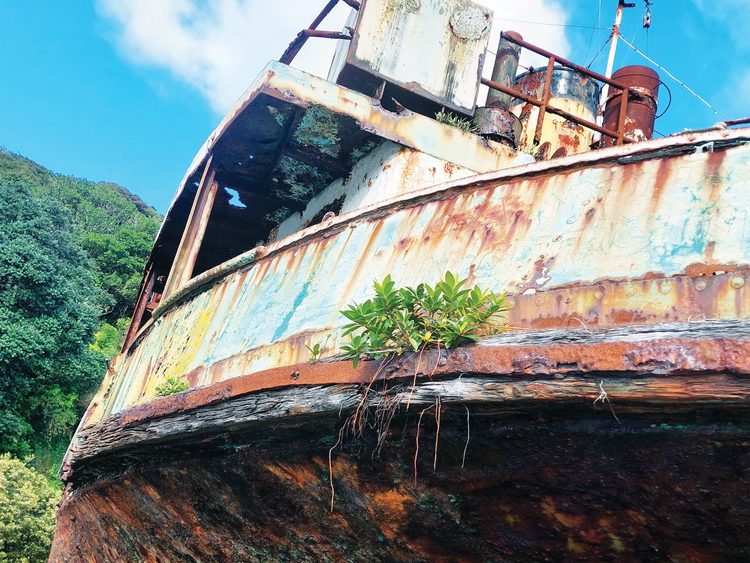
We perused the ruins and a shipwreck. We went ashore at the wharf. Chatted to boatie locals, owners of some very handsome yachts. One, named Monet, designed and built by the legendary Des Townson, and his personal favourite boat. And Miles, with his canine shipmates Marty and Jack, the last being more formal and needing to be addressed as Jackson. We learned he had bought and was about to sail another good-looking boat – a Norwalk Islands Sharpie cat ketch – from Waiheke Island to Whangaparapara.
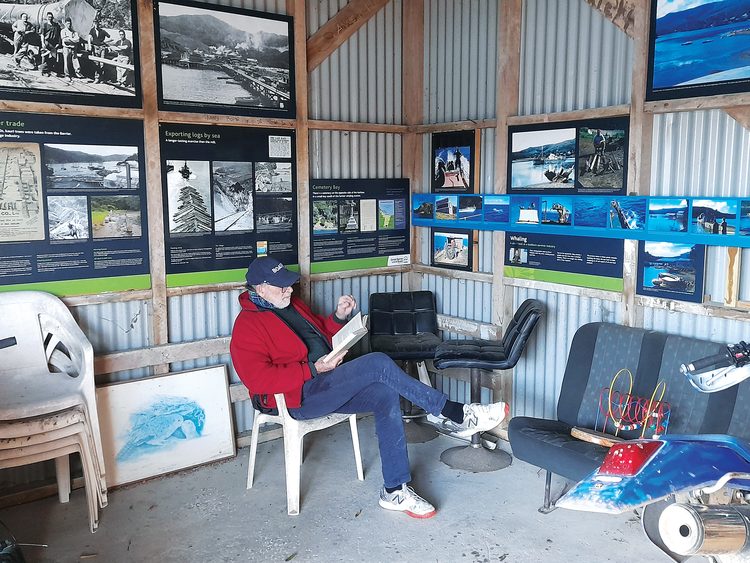
We found the info signs. I remembered how Jan and I didn’t want them cluttering the landscape, so we had discretely placed them inside the corrugated iron shed on the wharf. A kind of impromptu, informal museum. For visitors to find, as a surprise.
I was most impressed to see how they still looked new, and how the locals had accepted them into this community space, with the signs sharing the shed with someone’s water-skis, a couple of bicycles, kids’ toys, the shared barbeque, a free library, some bloke’s gumboots, a clock stopped at five past noon. Which, coincidentally, was exactly when we were there. I couldn’t resist finding an intriguing book to dip into. Tony was bemused by my reading room rest-up, while he caught up with my previous potted history of the bay.
Big stuff, short-lived
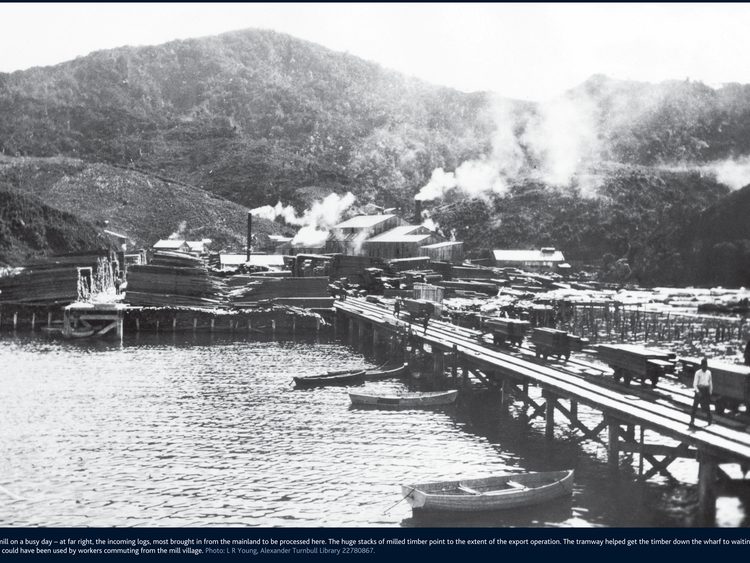
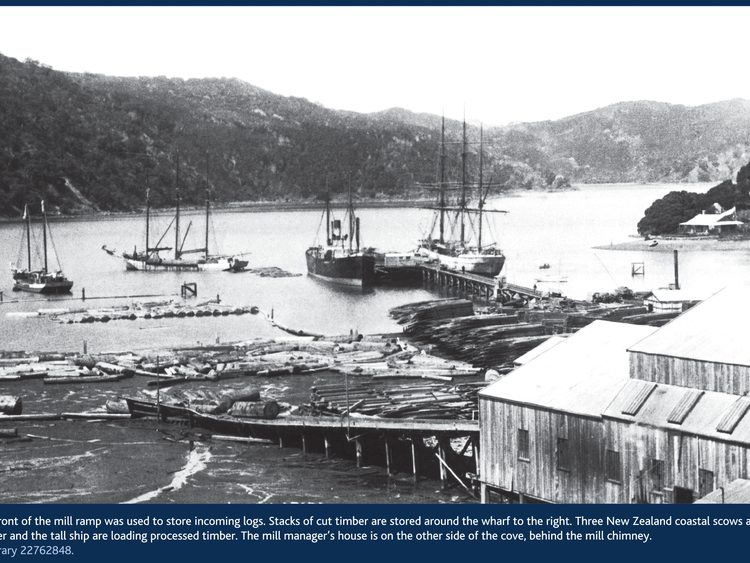
The timber mill at Whangaparapara was the biggest in the southern hemisphere, but was in action only 1909-1914. It was the result of a big business deal, with a Melbourne-based company buying out local interest; and took advantage of the fact that being on an offshore island, it was exempt from government export levies. The mill mostly processed logs rafted in from the Bay of Islands and the Coromandel Peninsula.
Twenty million feet of sawn timber came out of the mill, and huge piles of sawdust were used to reclaim land around the bay, this extra space used for stacking timber.
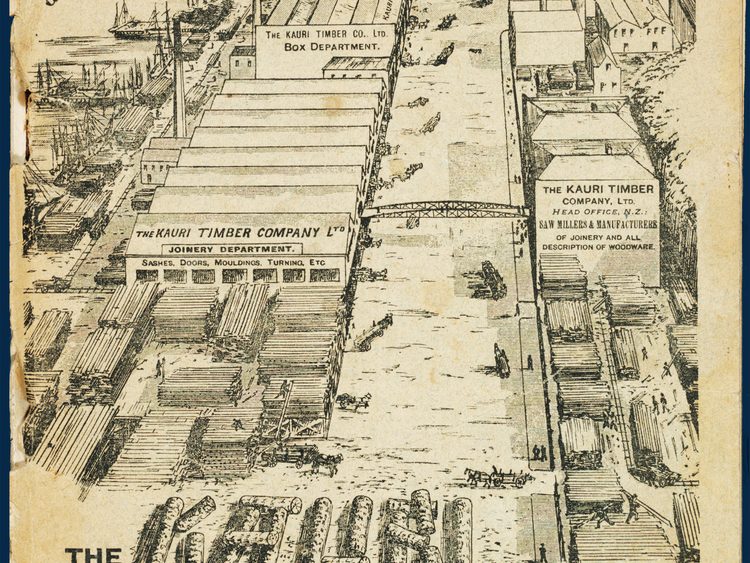
The 400m-long wharf allowed ships of up to 6,000 tons to load timber for export to Australia and the USA. Much kauri timber was used in the rebuilding of San Francisco after the 1913 earthquake, and the rapid development of Sydney, Australia.

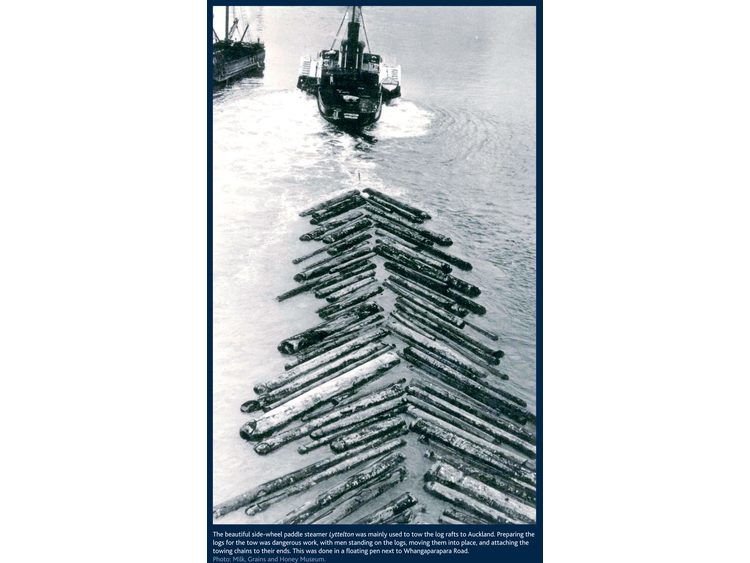
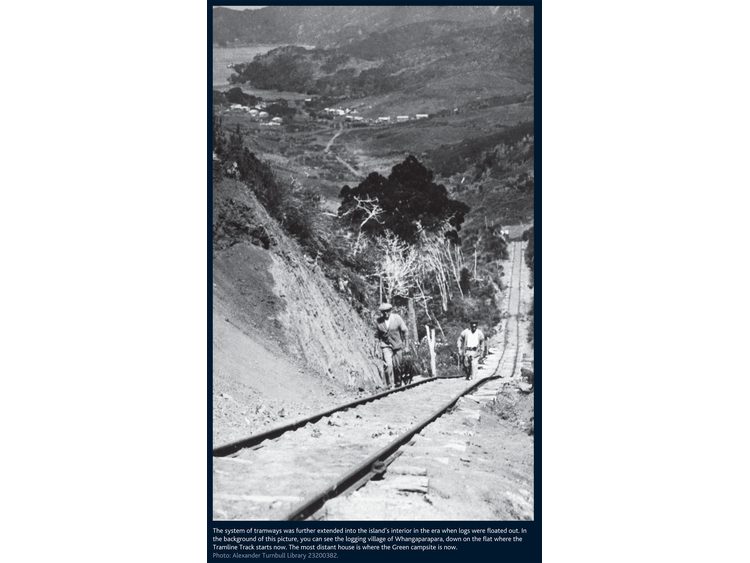
While the mill worked for only a short time, the export of logs from Whangaparapara continued over a longer period. They were brought by tramway, floated in pens at the head of the bay, just beyond where French Road is now.
The logs were then tied together in huge herring-bone shaped rafts, and towed to mills in Auckland by steamers. The last raft left in December 1940.
Living here – then & now
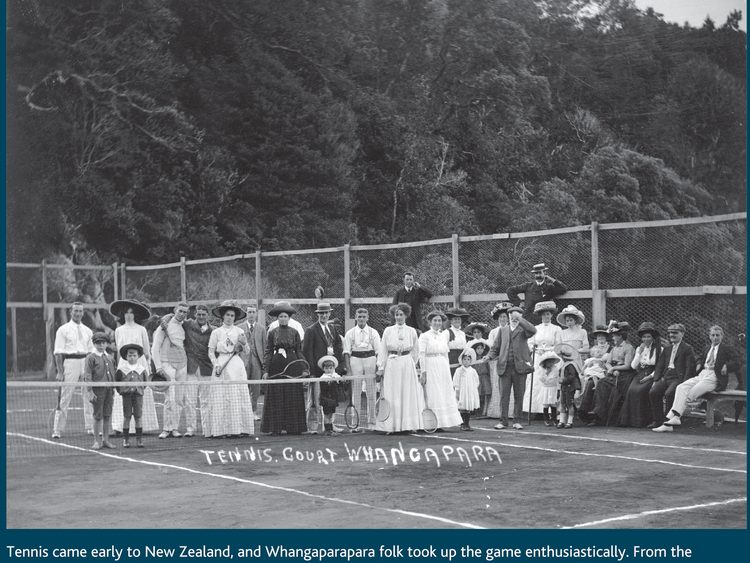
The township that supported the timber industry was on the flat at the head of our creek. In aerial photos you can still see some rectangular house markings. The settlement grew to around 200 people, and had two stores, a bakery, school, butchery and telephone exchange, reached by a weekly passenger steamer service from Auckland. The social centre was the tennis court, next to the mill manager’s house.
Gold! In them thar hills
But first, matā (obsidian) was a rare and valuable commodity in the traditional Māori economy. This volcanic rock, like very-hard glass, makes sharp cutting blades. Matā was mined and exported from Te Ahumatā, a mountain on the east side of Whangaparapara.
In the 1850s European settlers sent exploratory shafts into the hills here, looking for copper.
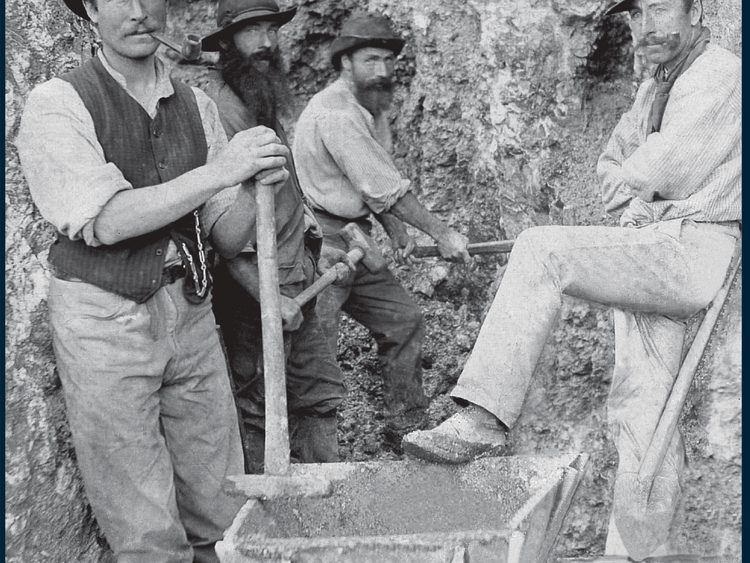
In 1892, the Sanderson brothers (two locals) found silver ore, which also had gold in it, at Te Ahumatā. Then followed the usual rush, and soon the Barrier’s biggest mining company built a stamper battery (for crushing the rock to extract the gold) at Oreville, just over the hill from Whangaparapara on the road to Claris. The mines and the stamper had closed by 1920. You can still see the concrete foundations of the stamper battery alongside the road, just near the walking track to Kaitoke Hot Pools.
Whaling
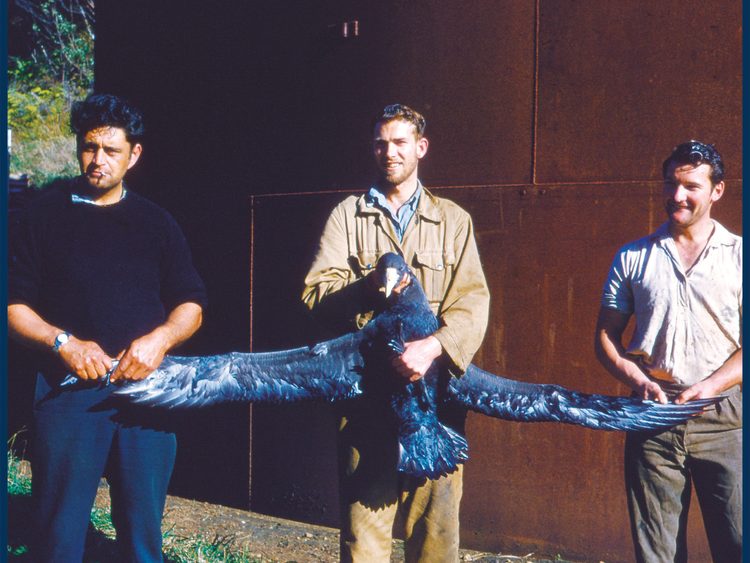
Then the whaling. Ships had been hunting the great mammals around Great Barrier Island since the 1800s, but there was no shore-based whaling station. This was established at Whangaparapara in 1956 and it lasted until 1962.
My text in the sign is terse: “Three different companies tried their luck. They all failed. The station stopped operating because of declining catches. At first they caught over 100 whales per season. In the last year less than 30. Huge and efficient foreign whaling vessels contributed to the decline in whale numbers.
“The whales caught were mostly humpbacks during their migration past the island in June to August.
“There were lookout stations at Cape Barrier (on the south of the island) and Rakitu Island (on the east). They would call out the fast chase boats which hunted and harpooned the whales. Once the whales were dead they were inflated with air and towed back here.”’
There’s a striking, long panel of many whaling pictures, all in colour, taken by a local who worked there, David Medland. I got queasy looking at the images of the butchering.
Pigeon post
In the early days of European settlement, it took more than two weeks for Great Barrier Islanders to receive answer to letters posted (via steamer) to Auckland.
When the Wairarapa was wrecked at Miner’s Head, at the far NE of the island in 1894, with 135 lives lost, the idea of a carrier-pigeon service came about.
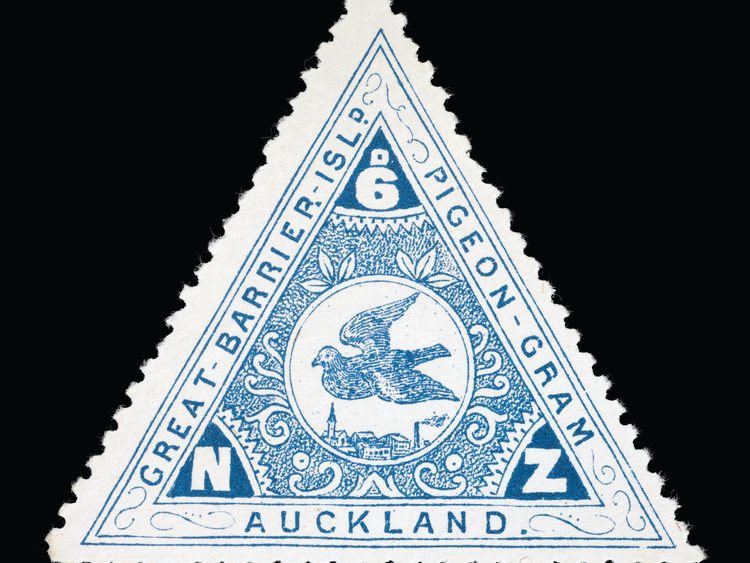
Walter Fricker, a pigeon fancier in Auckland, reckoned the mining and logging operations on Hauraki Gulf islands needed quicker, better communications with Auckland.
Fricker (or rather his birds) made experimental flights from the island to Auckland in 1896 and the next year opened the first regular service from Okupu on Great Barrier, where Miss Springhall, the postmistress, was the agent. The small triangular stamps are now very rare collectors’ items.
A rival service sprung up, mischievously named ‘The Original’ began and eventually Mr S. Holden Howie of Newton Road extended it to include Port Fitzroy, Whangaparapara, Port Charles, Waiheke and the Hen and Chickens Islands. The weird part is, his pigeons even delivered post to an ostrich farm at Whitford Park, near Papakura.
Both services – the first regular airmail in the world – ended when a telegraph line was laid between Great Barrier and the mainland in 1908.
Shipwrick on the airwaves
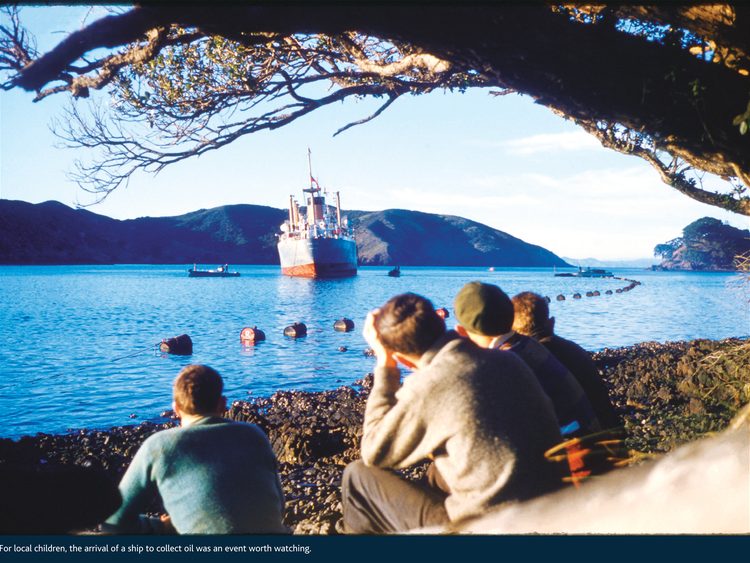
As if Whangaparapara didn’t already have enough history, along came the ‘Outlaws on Air.’ Radio Hauraki was a pirate radio station which, in an attempt to break government monopoly on commercial broadcasting (and bad taste in music), had to broadcast from beyond five miles offshore. So David Gapes started Radio Hauraki, and they went on air in November 1966 in the Colville Channel. Too rough, so they moved to near Whangaparapara.
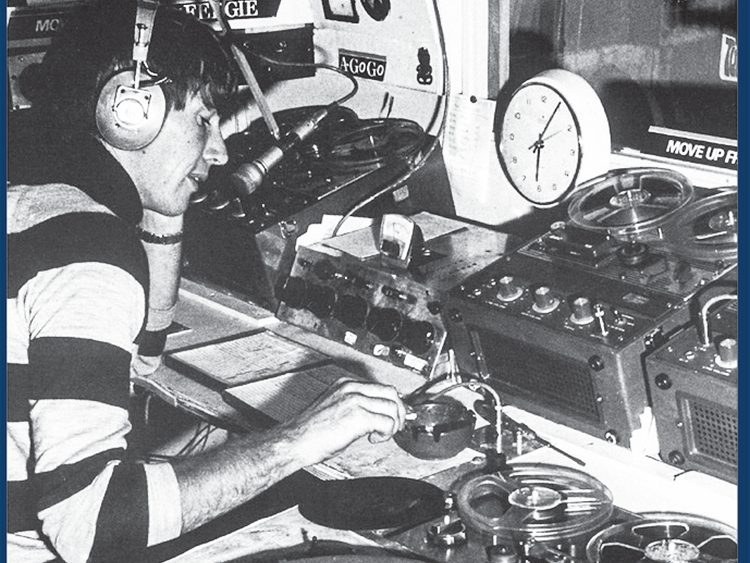
But the radio jocks weren’t exactly flash shipmates. In January 1968, their first boat Tiri, went aground on the rocks of Whangaparapara Harbour. The DJ on air at the time amped up the deal, blurting “The rocks are within swimming distance…I love you Mum and Dad.” Even The Times of London picked up the story.
Not learning, their second boat Tiri II ran aground several times.
New Radio gear for Tiri II was bought in Fiji by Bill Calvert of Radio Hauraki, and returned on the sly to New Zealand in the yacht Aqualas. Barrier locals were on-side with the pirates, helping them in any way they could.
The saga came to an end after 1,111 days at sea, when in 1970 Radio Hauraki won New Zealand’s first broadcasting licence.
Cemetery adrift
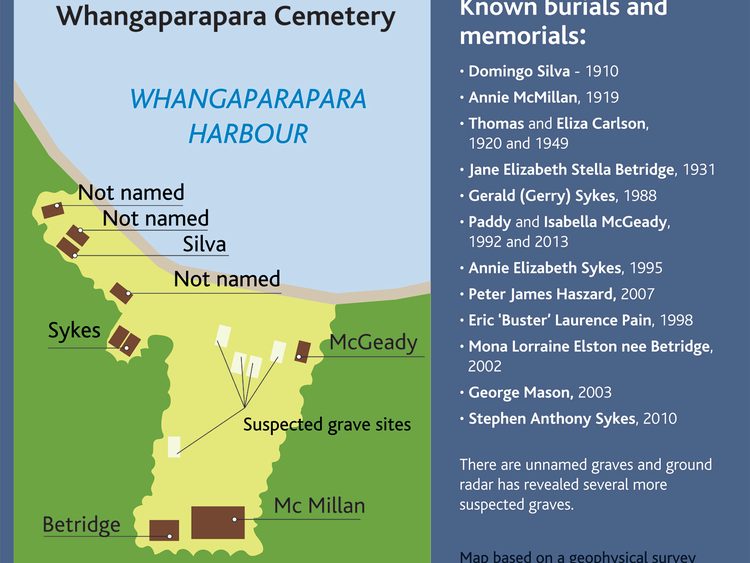
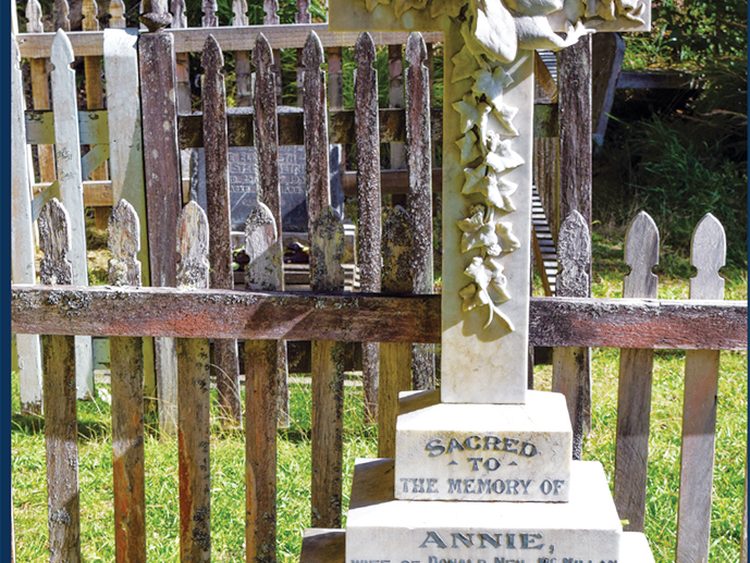
At the mouth of the harbour, on the port side coming in there’s Cemetery Bay. Not a good anchorage. The cemetery was probably established in the late 1800s, pre-dating the mill. There are nine known graves there, and ground radar has found possibly several more.
The first survey done of the cemetery had co-ordinates that put it in the sea. This was corrected in a new survey in the mid-1900s.
A weather bomb that hit the Barrier in 2014 destroyed many historical sites on the island. Some of the headstones were washed away, but later put back in place.
A stroll
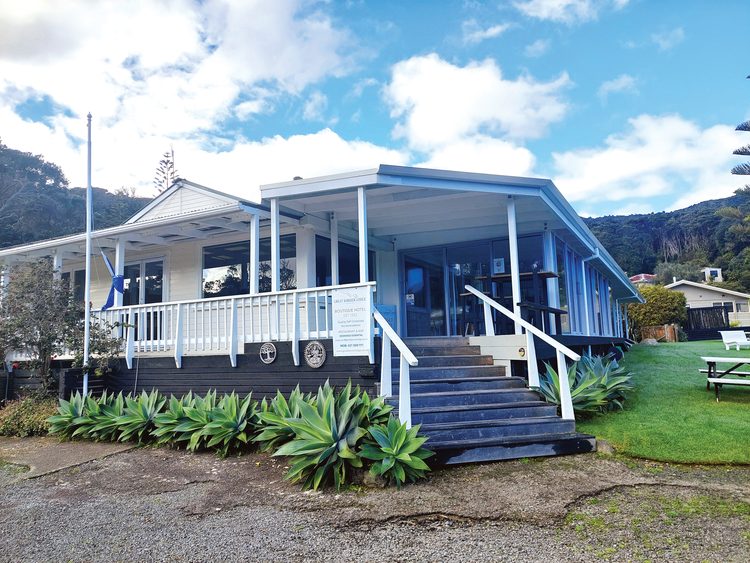
We took a wander along the shore, to the Great Barrier Lodge, a great place for getaway family or social group gatherings. Up to 33 guests, and as they say on their website, great for corporate retreats and team building, weddings and anniversaries, yoga retreats and workshops, family reunions and celebrations.
A testimonial from Marie Andrews of Yoga Retreats: “Great Barrier Island has so many natural attractions and a very nurturing energy, our group loved the retreat experience, we have already booked to go back!”
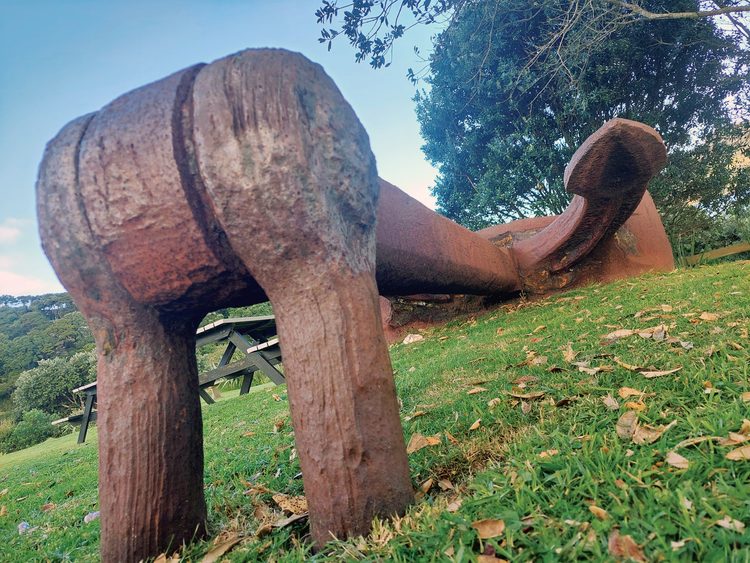
On the front lawn there is the huge anchor of the ship SS Wiltshire, shipwrecked at Rosalie Bay on the other side of Great Barrier Island in May, 1922. The story was so dramatic that I rendered it in breathless comic-book style on the sign: “On a dirty, black night”, “MAYDAY! MAYDAY!”, “No lifeboat could live,” “Desperate Dash”, etc. And in all my research, I still couldn’t find out by who/how/when the heavy anchor was moved to this far side of the island. All updates welcome.
Skyborne, Tony and I left in a perfect dawn, still heading for Whangarei. Breakfast on the move.
This is an Up the Creek adventure that has it all. Worth waiting for. Worth every minute, aye…