After spending six-and-a-half years sailing around the world aboard their Tennant Jayar catamaran Moonwalker, the couple returned to New Zealand in late 2012 with one young daughter, another baby on the way and very little money. What they did have was something far more valuable: an intimate understanding of how people use their tenders every single day.
The Carlyons shared anchorages with hundreds of cruising sailors, exchanging ideas over sunset drinks and listening to stories about the equipment they relied upon every day. One subject surfaced time and again: the tender. It seemed clear there was still room for a different way of thinking and Russell’s background in advanced composite construction gave him a different perspective.
Instead of adapting an existing design, why not start with a blank sheet of paper and build the tender they wished they had owned while cruising? The answer to that simple question became Offshore Cruising Tenders. Built by cruisers Before leaving New Zealand, Russell had established himself as one of New Zealand’s leading custom windsurf board builders with Styrotech, working with advanced foam sandwich composites.

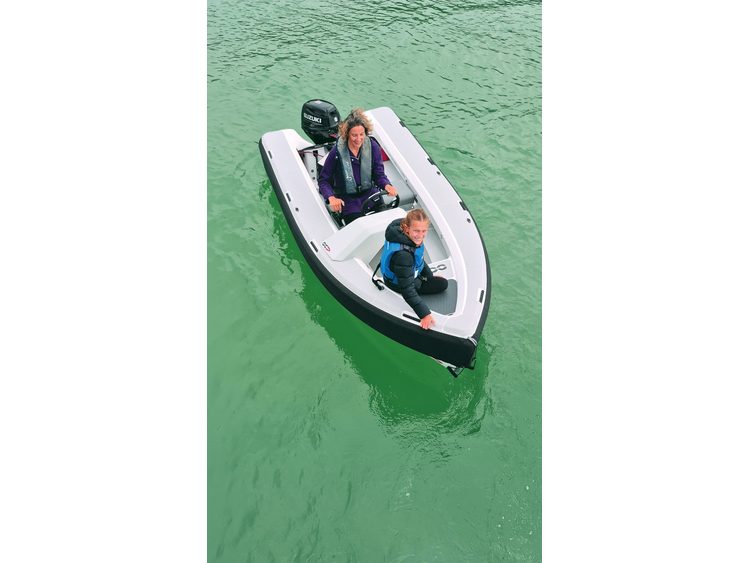
“I wasn’t a boatbuilder,” Russell says. “I built the boat the same way I built windsurf boards.”
Back in New Zealand, designer Kevin Trotter (also a partner during Styrotech years) worked alongside Russell to refine the original concept into the first production-ready prototype.
Working from a small shed down a dirt road in the bush in Paihia, Russell built the first prototype by hand while Karin laid the foundations of what would become the business. Russell concentrated on design, engineering and manufacturing while Karin focused on building the customer relationships, developing the marketing, and creating the direct-sales model that would eventually allow a small Bay of Islands company to sell tenders throughout the world. Neither imagined just how far that journey would take them.

Built in the Bay of Islands
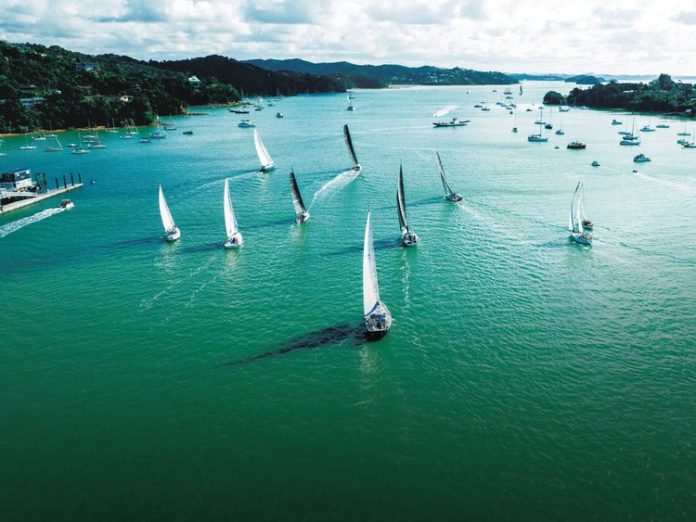
Starting a manufacturing business with limited capital would have been daunting almost anywhere else. Fortunately, the Bay of Islands offered something unique: every year hundreds of international cruising yachts arrive in Opua after completing the Pacific crossing. Those sailors weren’t simply visitors – they were exactly the people Russell and Karin had built the boat for.
“Our market came to us,” Karin recalls, “that was a great way to distribute them, especially when we were just starting out.”
Russell agrees: “They’re taking an OC Tender with them. Then they’re into our marketplace straight away, which is every anchorage, everywhere. Like a floating billboard! We were super lucky to be from this area.”
Every departing yacht carrying an OC Tender became another ambassador to cruising grounds throughout the world. Long before social media became a reliable marketing tool, the company’s reputation was already travelling the world – one satisfied owner at a time.
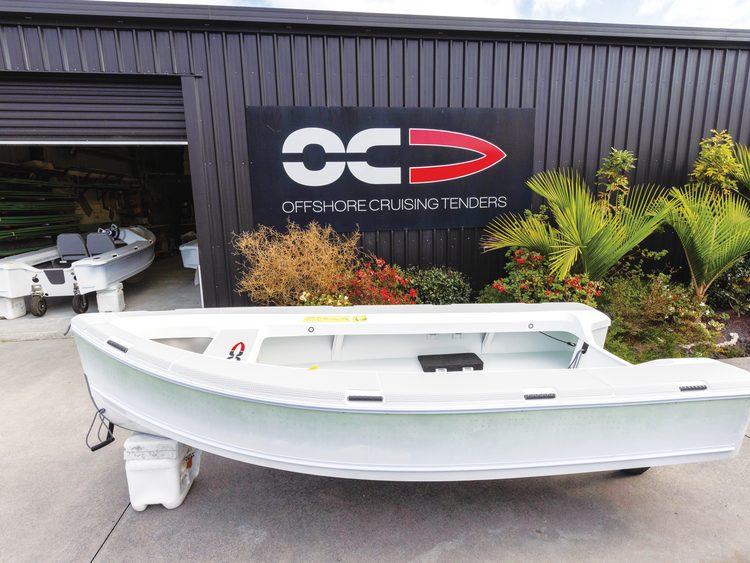
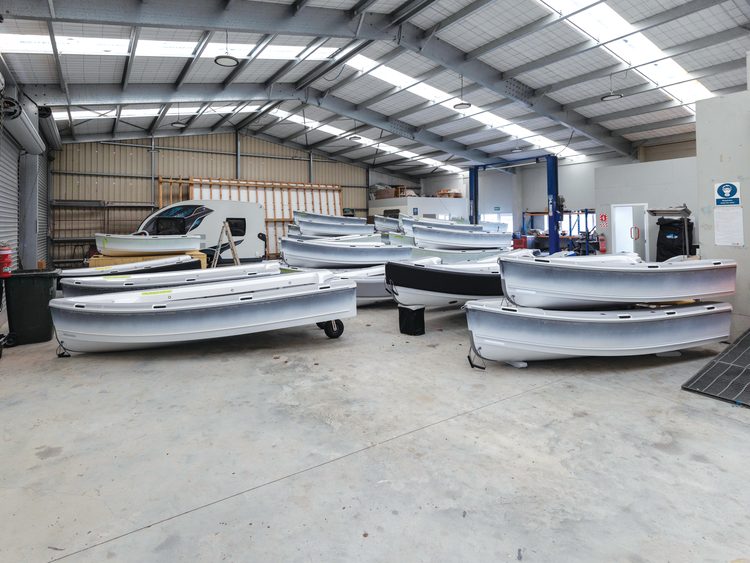
The organic growth remains one of Offshore Cruising Tenders’ greatest strengths. As demand steadily grew, Russell and Karin moved Offshore Cruising Tenders to a much larger property near Haruru Falls, transforming it into the purpose-built factory the company operates from today. The company employs a skilled team of 11 full-time staff and builds around four tenders a week across a growing range of models, a far cry from the one tender a month in its earlier days.
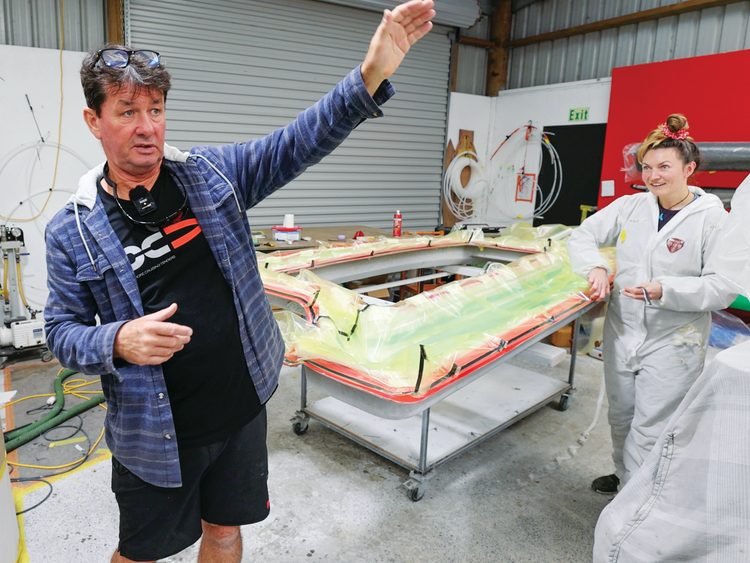
Every OC Tender is built using advanced closed-cell foam sandwich composite construction, with customers able to choose fibreglass (with plenty of carbon reinforcements), or full-carbon laminates depending on their priorities for weight, performance and intended use. Construction combines traditional craftsmanship with modern composite manufacturing techniques including vacuum bagging and resin infusion, producing boats that are exceptionally light while maintaining the strength required for years of hard use.
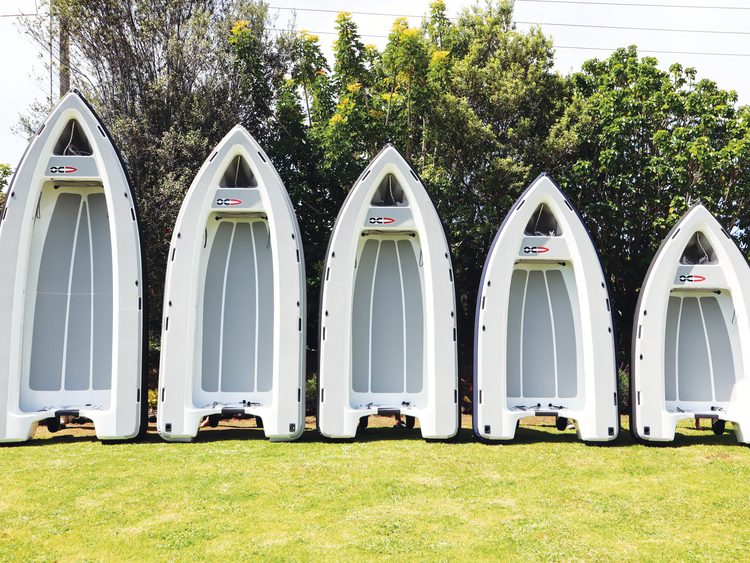
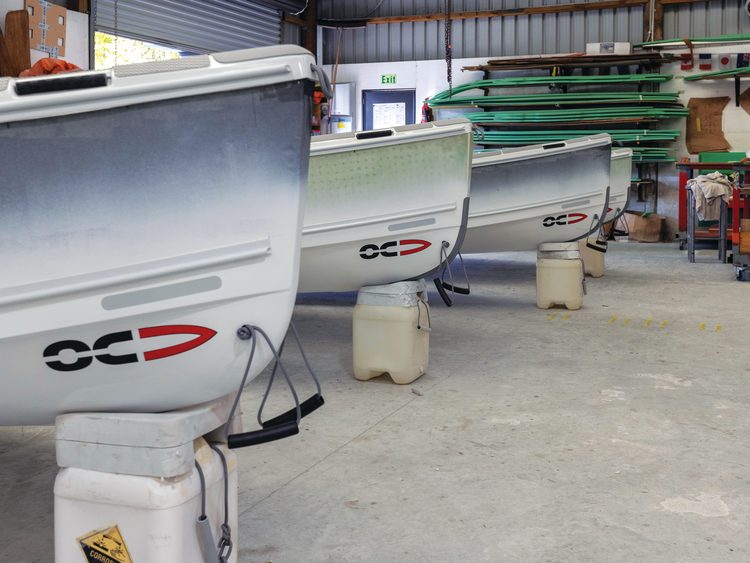
One of the first things visitors notice is that the boats are built upside down, a legacy of Russell’s years building high-performance windsurf boards. “My guys build the boats standing up, rather than bending over or crawling around inside a female mould with toxic fumes,” he explains. “That’s less fatiguing and healthier on their bodies.”
Like many of Russell’s ideas, it solves more than one problem. “The inside is the part you see and touch,” he says. “It’s easy to wipe out, like a kitchen bench.” It’s a simple observation, but one that perfectly captures the company’s approach. Everything has a purpose.
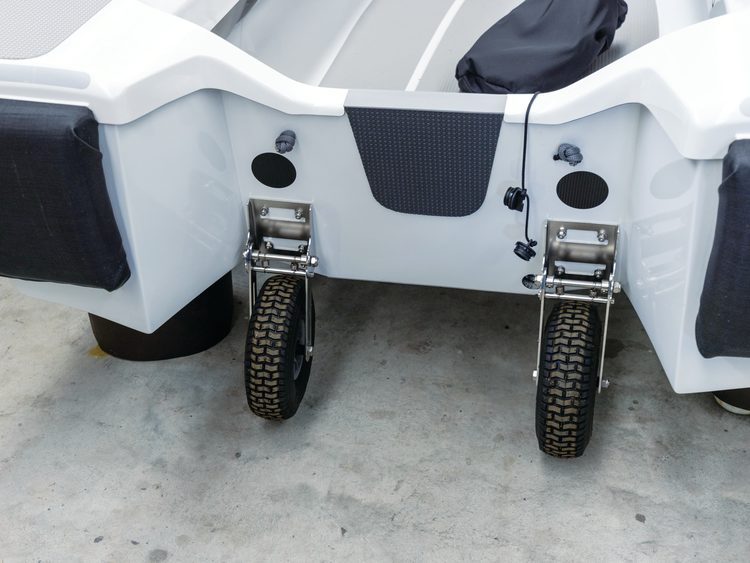
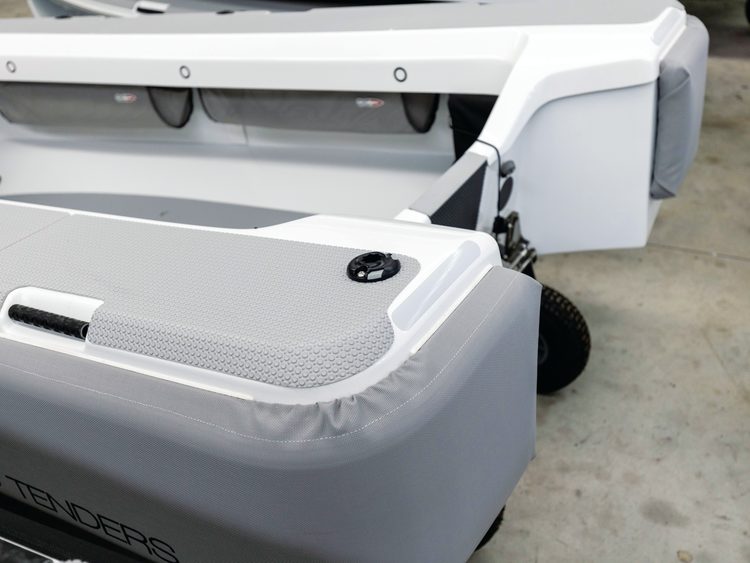
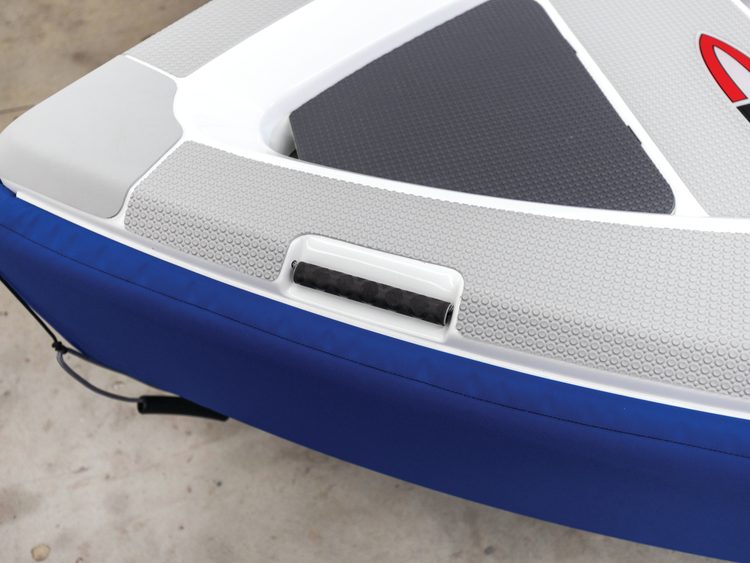
Details such as the aluminium plate in high abrasion areas like the transom is available for owners who regularly beach their tenders, especially if they cannot deploy the wheels which are sold as an accessory. Or the distinctive wrap-around high-density foam bumper that provides protection for the tender and the yacht. Covered with durable, replaceable fabric, the system can be refreshed after years of use without replacing the bumper itself.
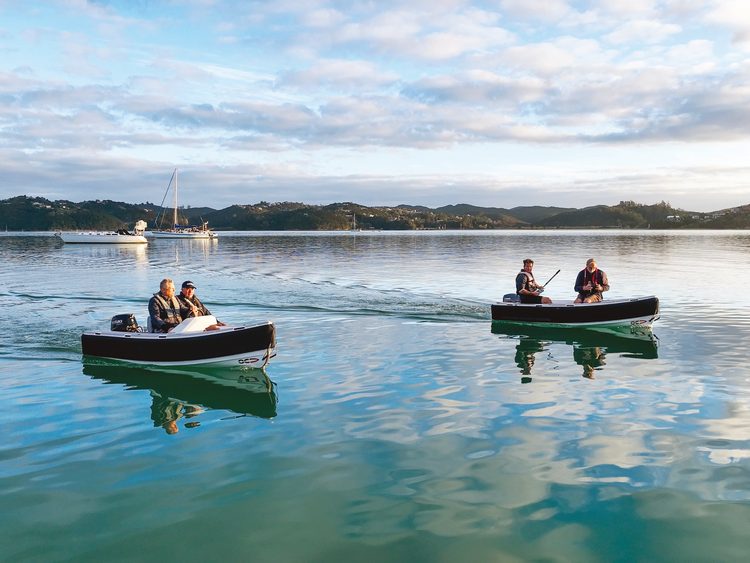
Many of their innovative range of accessories have been developed from customer feedback and creative suggestions. “Customers are always giving us ideas,” says Karin. “They’re using these boats in every imaginable environment, and that feedback has become one of our greatest resources.”
Walk through the factory and another philosophy quickly becomes apparent: vertical integration. If Offshore Cruising Tenders can make something better themselves, they usually do, designing and manufacturing many of the accessories and support products in-house rather than relying on outside suppliers. The same thinking extends to the way the business itself operates.
Sourcing materials directly wherever practical, simplifying production, reducing unnecessary components and eliminating middlemen whenever possible is the core mandate. The result is not only greater control over quality, but also greater resilience. That philosophy proved invaluable during the COVID-19 pandemic.
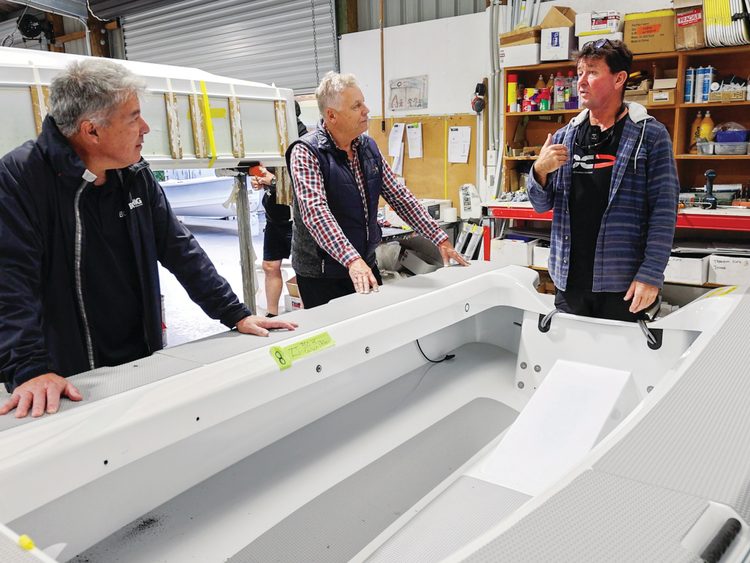
“When we went into lockdown, local supply chains shut down,” Russell recalls. “But because we’d invested in raw materials and carried inventory, we experienced minimal disruption in our production and delivery times.”
It reinforced a strategy the company continues to follow today. In an increasingly uncertain trading environment, carrying inventory and maintaining control over the supply chain has become an important competitive advantage. Apart from resin, oars, paint and non-skid from trusted New Zealand companies, very little of the company’s supply chain relies on New Zealand manufacturers/suppliers. Most key materials are imported directly, allowing the business to maintain consistent quality while reducing dependence on disrupted supply chains.
OC Tenders is in fact in the unique category of producers actually importing raw materials and exporting the finished products to the countries the raw materials came from!
Purpose before luxury
One of the most significant developments in recent years has been the introduction of the HC centre-console range. At first glance it could be mistaken for a move towards a more luxurious tender. In reality, it was designed to solve a problem.
The idea had been championed by Karin for years.
“My wife had been pleading with me for ten years to build a console version,” Russell laughs. “I was perfectly happy with the range as it was; Karin saw something different!”
Having spoken with thousands of customers over the years, she recognised that many people – particularly women – simply lacked the confidence to drive a tiller-steered tender. “I’ve always wanted women to feel independent,” she says. “If your partner wants to stay on the boat, you should feel completely comfortable taking the tender ashore yourself. A steering wheel is familiar. Most people have driven a car all their lives, so it immediately feels more natural.”
She also noticed another trend. The cruising community is ageing. Many owners continue exploring well into their seventies and even eighties, but twisting around to operate a tiller while watching ahead becomes increasingly uncomfortable.
“They still want to explore every bay and every beach. They just need better back support and a more comfortable driving position,” observes Karin’
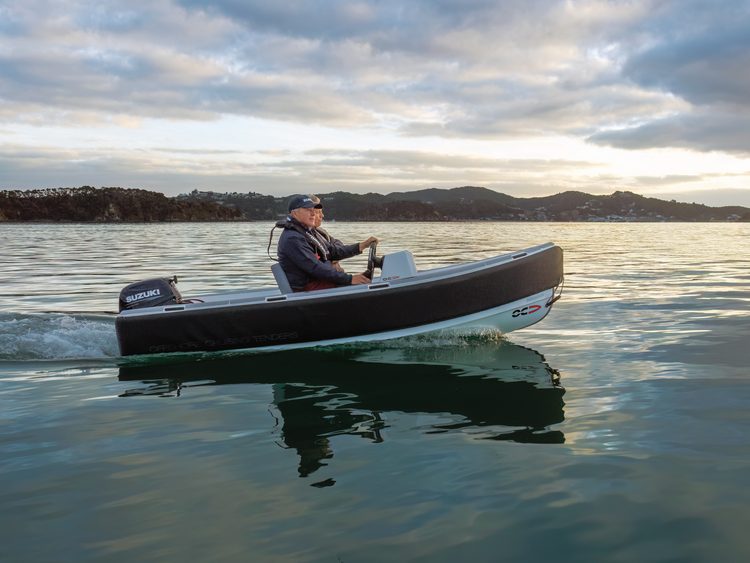
The HC became the answer. The lightweight carbon console places the helm naturally in front of the driver, while removable seating allows owners to configure the boat to suit the way they use it. Customers can choose one seat, two seats or just a cushion, maintaining the versatility that has always been central to the OC Tender philosophy.
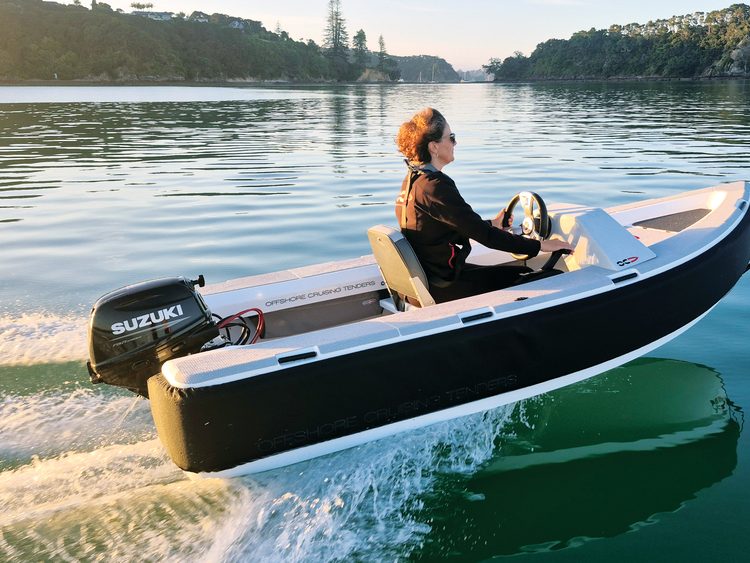
Far from being a luxury addition, the HC embodies the company’s design philosophy: every feature exists for a functional reason.
Growing through relationships
Russell and Karin have deliberately built the business around direct relationships with their customers. It’s a model that reflects their own experience as cruisers.
“When you’re buying equipment while cruising, you don’t want to deal with layers of distributors who don’t know much or care about what they are selling. You want to speak to the people who designed and built it,” explains Karin. That direct connection with customers has become one of the company’s greatest strengths. Questions, feedback and ideas flow both ways, helping shape the next generation of products and helping to create an unusually loyal customer base.
Word of mouth, a bit of social media, and up until 2024, attending only local New Zealand boat shows, was the only marketing the company did. These days OC Tenders is attending more international boat shows and featuring in some big YouTube sailing channels like Sailing La Vagabonde and Gone With the Wynns, introducing the brand to millions of viewers around the world. More recently, world surfing champion and passionate sailor John John Florence chose an OC Tender for his own sailing adventures on Instagram and his Vela series on YouTube. The tenders are not heavily marketed or advertised on these platforms, they are simply used and the images speak for themselves.
Quiet growth
While more than 1,100 OC Tenders have been delivered to customers around the world, the Carlyons have resisted the temptation to chase volume at the expense of quality. Instead, they have chosen to grow steadily, investing in better products, better systems and better customer service.
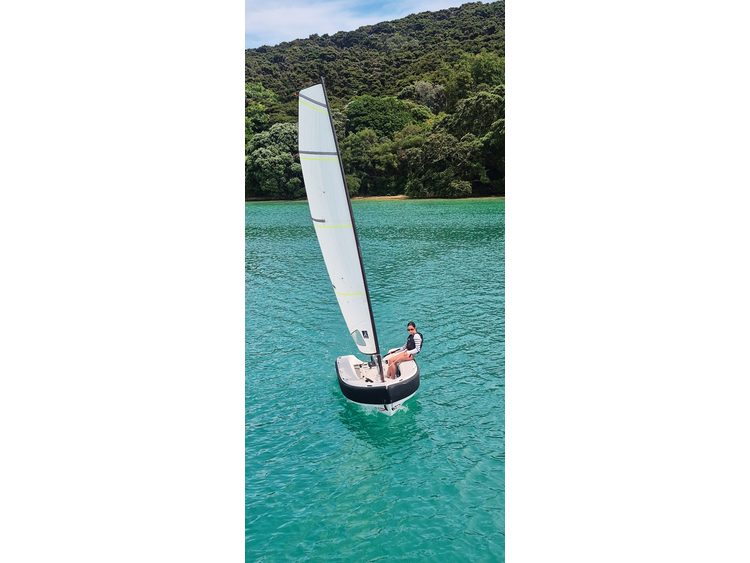
The range has grown from a single OC300 prototype into the OC270, OC330, OC350 and OC400. From sailing tenders to the HC centre-console range and the latest electric propulsion packages developed with ZeroJet, each model reflects the same philosophy that shaped the first boat built all those years ago.
Did they expect this level of success? No, not really, they both agree. “We didn’t know if the market was ready for our concept – we spent years explaining to people there were no inflatable parts, the boat could float by itself, and the fendering just added extra floatation,” says Russell.
They still find boat shows entertaining: “People to this day come to the boats for the first time and we split them into three categories: the knockers (on the laminate), the pockers (on the fender) and the strokers (anywhere in our nice gel-coated finish inside)”.
The market clearly got them – OCT have created an entirely new segment for tenders worldwide!
Staying true
Success hasn’t changed the couple’s philosophy but rather reinforced it.
“We built the tender for us,” Russell says. “That’s not to say it is perfect for everybody – and we are not aiming at everybody – just the people that share the same values as us and who see the point of keeping it simple, easy to fix and lightweight.”
Those words describe the business too. There is no ambition to become the biggest tender manufacturer in the world. No desire to build products for every possible customer. Instead, the focus remains on building the best lightweight composite tenders they know how, looking after customers long after the sale and continuing to manufacture proudly in New Zealand.
Russell believes that by staying true to those principles, the company has found its place. “By tapping into a worldwide market directly from New Zealand,” he says, “that’s plenty of people – more than enough to keep the orders coming with the resources we’ve chosen to apply.”
Still cruisers at heart
Outside the factory, a container load is being prepared to be freighted, leaving a double line of tenders prepped. In the other corner are the plywood boxes for orders to be shipped, bound for owners in Europe, Asia, Australia and beyond.
It’s hard not to draw a parallel with Moonwalker and the voyage that first inspired the business. For most sailors, returning home marks the end of the adventure. For Russell and Karin Carlyon, it marked the beginning of another.
More than a decade after stepping ashore, the lessons learned during their cruising continue to shape every boat that leaves their Bay of Islands factory. Because they still think like cruisers. And perhaps that’s the real secret to Offshore Cruising Tenders’ success.
After spending six-and-a-half years sailing around the world aboard their Tennant Jayar catamaran Moonwalker, the couple returned to New Zealand in late 2012 with one young daughter, another baby on the way and very little money. What they did have was something far more valuable: an intimate understanding of how people use their tenders every single day.
The Carlyons shared anchorages with hundreds of cruising sailors, exchanging ideas over sunset drinks and listening to stories about the equipment they relied upon every day. One subject surfaced time and again: the tender. It seemed clear there was still room for a different way of thinking and Russell’s background in advanced composite construction gave him a different perspective.
Instead of adapting an existing design, why not start with a blank sheet of paper and build the tender they wished they had owned while cruising? The answer to that simple question became Offshore Cruising Tenders. Built by cruisers Before leaving New Zealand, Russell had established himself as one of New Zealand’s leading custom windsurf board builders with Styrotech, working with advanced foam sandwich composites.
“I wasn’t a boatbuilder,” Russell says. “I built the boat the same way I built windsurf boards.”
Back in New Zealand, designer Kevin Trotter (also a partner during Styrotech years) worked alongside Russell to refine the original concept into the first production-ready prototype.
Working from a small shed down a dirt road in the bush in Paihia, Russell built the first prototype by hand while Karin laid the foundations of what would become the business. Russell concentrated on design, engineering and manufacturing while Karin focused on building the customer relationships, developing the marketing, and creating the direct-sales model that would eventually allow a small Bay of Islands company to sell tenders throughout the world. Neither imagined just how far that journey would take them.
Built in the Bay of Islands
Starting a manufacturing business with limited capital would have been daunting almost anywhere else. Fortunately, the Bay of Islands offered something unique: every year hundreds of international cruising yachts arrive in Opua after completing the Pacific crossing. Those sailors weren’t simply visitors – they were exactly the people Russell and Karin had built the boat for.
“Our market came to us,” Karin recalls, “that was a great way to distribute them, especially when we were just starting out.”
Russell agrees: “They’re taking an OC Tender with them. Then they’re into our marketplace straight away, which is every anchorage, everywhere. Like a floating billboard! We were super lucky to be from this area.”
Every departing yacht carrying an OC Tender became another ambassador to cruising grounds throughout the world. Long before social media became a reliable marketing tool, the company’s reputation was already travelling the world – one satisfied owner at a time.
The organic growth remains one of Offshore Cruising Tenders’ greatest strengths. As demand steadily grew, Russell and Karin moved Offshore Cruising Tenders to a much larger property near Haruru Falls, transforming it into the purpose-built factory the company operates from today. The company employs a skilled team of 11 full-time staff and builds around four tenders a week across a growing range of models, a far cry from the one tender a month in its earlier days.
Every OC Tender is built using advanced closed-cell foam sandwich composite construction, with customers able to choose fibreglass (with plenty of carbon reinforcements), or full-carbon laminates depending on their priorities for weight, performance and intended use. Construction combines traditional craftsmanship with modern composite manufacturing techniques including vacuum bagging and resin infusion, producing boats that are exceptionally light while maintaining the strength required for years of hard use.
One of the first things visitors notice is that the boats are built upside down, a legacy of Russell’s years building high-performance windsurf boards. “My guys build the boats standing up, rather than bending over or crawling around inside a female mould with toxic fumes,” he explains. “That’s less fatiguing and healthier on their bodies.”
Like many of Russell’s ideas, it solves more than one problem. “The inside is the part you see and touch,” he says. “It’s easy to wipe out, like a kitchen bench.” It’s a simple observation, but one that perfectly captures the company’s approach. Everything has a purpose.
Details such as the aluminium plate in high abrasion areas like the transom is available for owners who regularly beach their tenders, especially if they cannot deploy the wheels which are sold as an accessory. Or the distinctive wrap-around high-density foam bumper that provides protection for the tender and the yacht. Covered with durable, replaceable fabric, the system can be refreshed after years of use without replacing the bumper itself.
Many of their innovative range of accessories have been developed from customer feedback and creative suggestions. “Customers are always giving us ideas,” says Karin. “They’re using these boats in every imaginable environment, and that feedback has become one of our greatest resources.”
Walk through the factory and another philosophy quickly becomes apparent: vertical integration. If Offshore Cruising Tenders can make something better themselves, they usually do, designing and manufacturing many of the accessories and support products in-house rather than relying on outside suppliers. The same thinking extends to the way the business itself operates.
Sourcing materials directly wherever practical, simplifying production, reducing unnecessary components and eliminating middlemen whenever possible is the core mandate. The result is not only greater control over quality, but also greater resilience. That philosophy proved invaluable during the COVID-19 pandemic.
“When we went into lockdown, local supply chains shut down,” Russell recalls. “But because we’d invested in raw materials and carried inventory, we experienced minimal disruption in our production and delivery times.”
It reinforced a strategy the company continues to follow today. In an increasingly uncertain trading environment, carrying inventory and maintaining control over the supply chain has become an important competitive advantage. Apart from resin, oars, paint and non-skid from trusted New Zealand companies, very little of the company’s supply chain relies on New Zealand manufacturers/suppliers. Most key materials are imported directly, allowing the business to maintain consistent quality while reducing dependence on disrupted supply chains.
OC Tenders is in fact in the unique category of producers actually importing raw materials and exporting the finished products to the countries the raw materials came from!
Purpose before luxury
One of the most significant developments in recent years has been the introduction of the HC centre-console range. At first glance it could be mistaken for a move towards a more luxurious tender. In reality, it was designed to solve a problem.
The idea had been championed by Karin for years.
“My wife had been pleading with me for ten years to build a console version,” Russell laughs. “I was perfectly happy with the range as it was; Karin saw something different!”
Having spoken with thousands of customers over the years, she recognised that many people – particularly women – simply lacked the confidence to drive a tiller-steered tender. “I’ve always wanted women to feel independent,” she says. “If your partner wants to stay on the boat, you should feel completely comfortable taking the tender ashore yourself. A steering wheel is familiar. Most people have driven a car all their lives, so it immediately feels more natural.”
She also noticed another trend. The cruising community is ageing. Many owners continue exploring well into their seventies and even eighties, but twisting around to operate a tiller while watching ahead becomes increasingly uncomfortable.
“They still want to explore every bay and every beach. They just need better back support and a more comfortable driving position,” observes Karin’
The HC became the answer. The lightweight carbon console places the helm naturally in front of the driver, while removable seating allows owners to configure the boat to suit the way they use it. Customers can choose one seat, two seats or just a cushion, maintaining the versatility that has always been central to the OC Tender philosophy.
Far from being a luxury addition, the HC embodies the company’s design philosophy: every feature exists for a functional reason.
Growing through relationships
Russell and Karin have deliberately built the business around direct relationships with their customers. It’s a model that reflects their own experience as cruisers.
“When you’re buying equipment while cruising, you don’t want to deal with layers of distributors who don’t know much or care about what they are selling. You want to speak to the people who designed and built it,” explains Karin. That direct connection with customers has become one of the company’s greatest strengths. Questions, feedback and ideas flow both ways, helping shape the next generation of products and helping to create an unusually loyal customer base.
Word of mouth, a bit of social media, and up until 2024, attending only local New Zealand boat shows, was the only marketing the company did. These days OC Tenders is attending more international boat shows and featuring in some big YouTube sailing channels like Sailing La Vagabonde and Gone With the Wynns, introducing the brand to millions of viewers around the world. More recently, world surfing champion and passionate sailor John John Florence chose an OC Tender for his own sailing adventures on Instagram and his Vela series on YouTube. The tenders are not heavily marketed or advertised on these platforms, they are simply used and the images speak for themselves.
Quiet growth
While more than 1,100 OC Tenders have been delivered to customers around the world, the Carlyons have resisted the temptation to chase volume at the expense of quality. Instead, they have chosen to grow steadily, investing in better products, better systems and better customer service.
The range has grown from a single OC300 prototype into the OC270, OC330, OC350 and OC400. From sailing tenders to the HC centre-console range and the latest electric propulsion packages developed with ZeroJet, each model reflects the same philosophy that shaped the first boat built all those years ago.
Did they expect this level of success? No, not really, they both agree. “We didn’t know if the market was ready for our concept – we spent years explaining to people there were no inflatable parts, the boat could float by itself, and the fendering just added extra floatation,” says Russell.
They still find boat shows entertaining: “People to this day come to the boats for the first time and we split them into three categories: the knockers (on the laminate), the pockers (on the fender) and the strokers (anywhere in our nice gel-coated finish inside)”.
The market clearly got them – OCT have created an entirely new segment for tenders worldwide!
Staying true
Success hasn’t changed the couple’s philosophy but rather reinforced it.
“We built the tender for us,” Russell says. “That’s not to say it is perfect for everybody – and we are not aiming at everybody – just the people that share the same values as us and who see the point of keeping it simple, easy to fix and lightweight.”
Those words describe the business too. There is no ambition to become the biggest tender manufacturer in the world. No desire to build products for every possible customer. Instead, the focus remains on building the best lightweight composite tenders they know how, looking after customers long after the sale and continuing to manufacture proudly in New Zealand.
Russell believes that by staying true to those principles, the company has found its place. “By tapping into a worldwide market directly from New Zealand,” he says, “that’s plenty of people – more than enough to keep the orders coming with the resources we’ve chosen to apply.”
Still cruisers at heart
Outside the factory, a container load is being prepared to be freighted, leaving a double line of tenders prepped. In the other corner are the plywood boxes for orders to be shipped, bound for owners in Europe, Asia, Australia and beyond.
It’s hard not to draw a parallel with Moonwalker and the voyage that first inspired the business. For most sailors, returning home marks the end of the adventure. For Russell and Karin Carlyon, it marked the beginning of another.
More than a decade after stepping ashore, the lessons learned during their cruising continue to shape every boat that leaves their Bay of Islands factory. Because they still think like cruisers. And perhaps that’s the real secret to Offshore Cruising Tenders’ success.