In last month’s Vintage Perspectives I described how a contingent of New Zealand yachtsmen, including Charles Webster, had been selected for the Royal Navy and were on their way by steamer to England in late 1916.
They were required for anti-submarine work around the coast of the United Kingdom and in the Mediterranean, principally in the Royal Navy’s new US-built Elco Motor Launches (MLs), but also in trawlers impressed for the work. In the initial batch, 75 men were chosen as deck officers with the rank of Lieutenant, RNVR, and 75 mechanics as Petty Officers to run the complex engines. They joined volunteers from all over the Empire.
At the start of World War I in August 1914 the effectiveness of the German submarine campaign caught the Admiralty by surprise, and worse was to come when that campaign morphed into unrestricted warfare. By February 1915 the British Government was in negotiation with Elco, the long-established manufacturer of motor launches at Bayonne, New Jersey, for the supply of 50 75ft high-speed motor launches. The Americans called them ‘sub chasers’, the Brits just ‘motor launches’ or ‘MLs’. After the sinking of the Lusitania in May 1915, Winston Churchill cleared the way for the order to be increased by another 500, larger, 80-footers to be fitted with twin 220hp Standard engines. The order for 1,100 220hp Standard engines to power them was one of the biggest single orders for marine engines ever made.
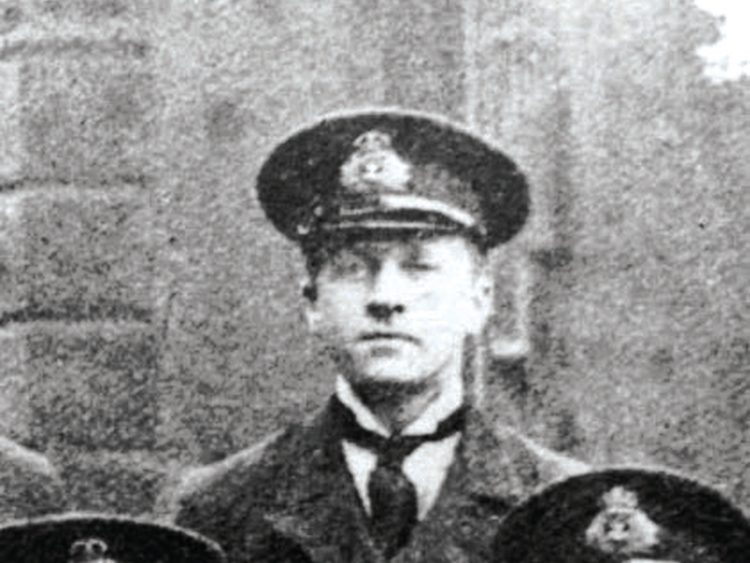
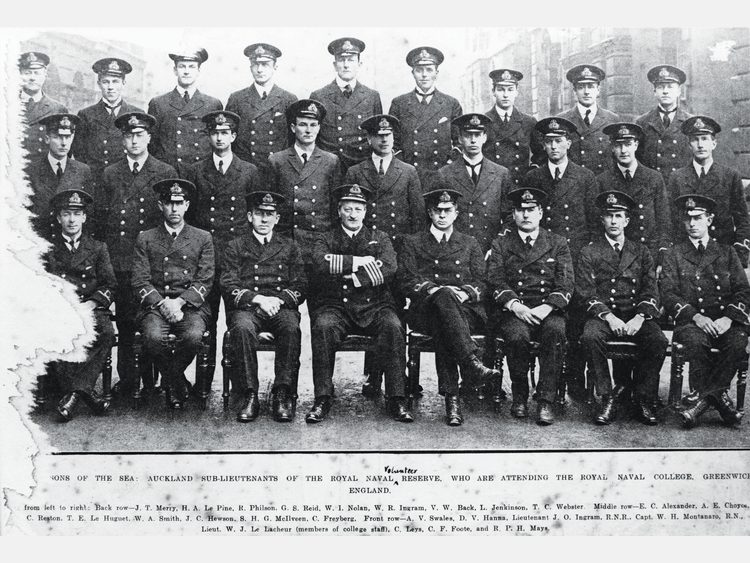
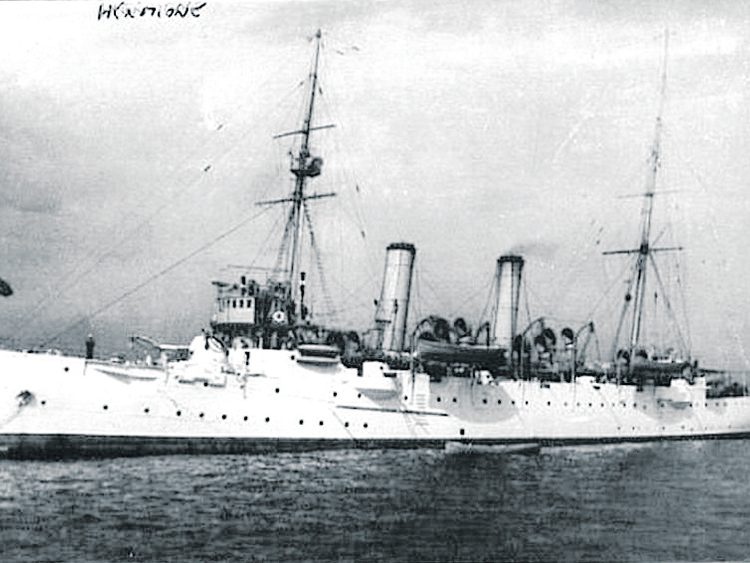
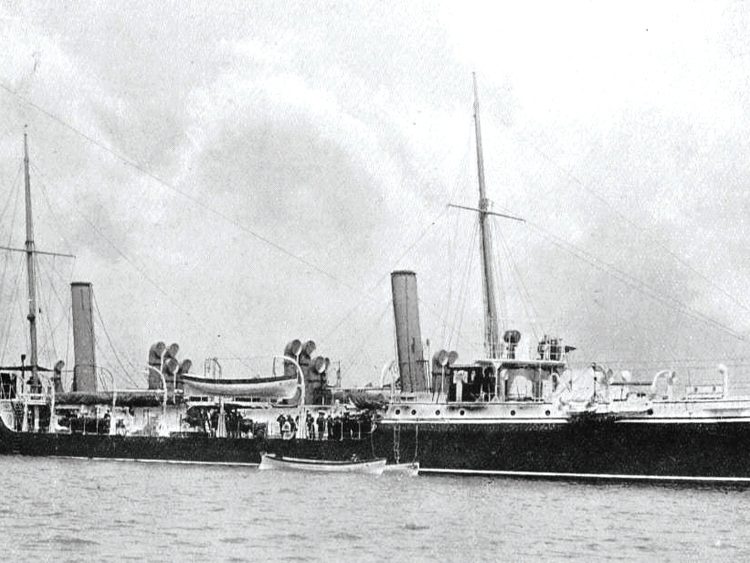
Along with his fellow New Zealanders, Charles Webster’s initial training was carried out at HMS Hermione, a pensioned-off cruiser stationed at Southampton where the men were introduced to the basics of running the MLs. On February 2, 1917 they proceeded to the Royal Naval College at Greenwich for officer training. The photograph shows 23 of the New Zealand RNVR sub-lieutenants at Greenwich with some well-known yachtsmen amongst them; W.R. Ingram who owned the Logan Bros yawl Ethel at the time, 40-year-old Cecil Leys of the Auckland Star with the launch Petrel, Cuthbert Freyberg of Wellington, Ted Le Huquet who had built and owned Marangi, Albert Swales with the launch Sceptre, J.C. Hewson the Secretary of the RNZYS and the Auckland Regatta Committee and Roy ‘Cob’ Mays of the Ariki’s crew.




On April 11, 1917 Webster was assigned “for service in MLs” to HMS Gunner the Naval Base at Granton, in Edinburgh, which was responsible for anti-submarine patrols and minesweeping in the Firth of Forth and in a broad band eastwards into the North Sea. On July 13, 1917 he was posted on ML297. Three months later he was on ML268 at HMS Zaria at Longhope, South Walls, Orkney with the patrol area the Orkney Islands and eastwards. On November 10, 1917 he was back at HMS Hermione and promoted to Lieutenant. In January 1918 he was posted to HMS Halcyon at Yarmouth for service on ML210 patrolling east out to the coast of Belgium and Holland but missed out on the daring raids on Zeebrugge and Ostend in which the MLs, mainly from the Dover Patrol, featured heroically.
In June 1918 Charles Webster was at HMS Victory at the Portsmouth dockyard “for instruction in CMBs” (Coastal Motor Boats) and on October 10, 1918 he received an order from the Admiralty to report to the Royal Naval Air Service Station at Portland Island for “research for CMBs in command”.
This promised to be an exciting project which involved the far boundaries of contemporary technology.
The MLS
Steam pinnaces and launches had been used by navies around the world for liaison work, liberty boats for many years. From the 1870s, more sophisticated small steamers, like the four Thornycroft boats stationed in New Zealand in the early 1880s, carried spar torpedoes for ramming or swinging sideways on to the hull of enemy warships or, far more effectively, if they ran true, self-propelled Whitehead torpedoes. Steam launches were handicapped by the huge weight and bulk of their boilers and engines in relation to their displacement and by the time it took to get working pressure of steam.

It was only when the internal combustion engine had matured enough to be reliable and with a serious power output that naval forces could use motor launches to carry out all of the tasks normally allotted to steam-powered launches and torpedo boats. However, by around 1905, petrol marine engines had achieved the reliability of steam plants of equivalent output with half the weight and with instant starting.
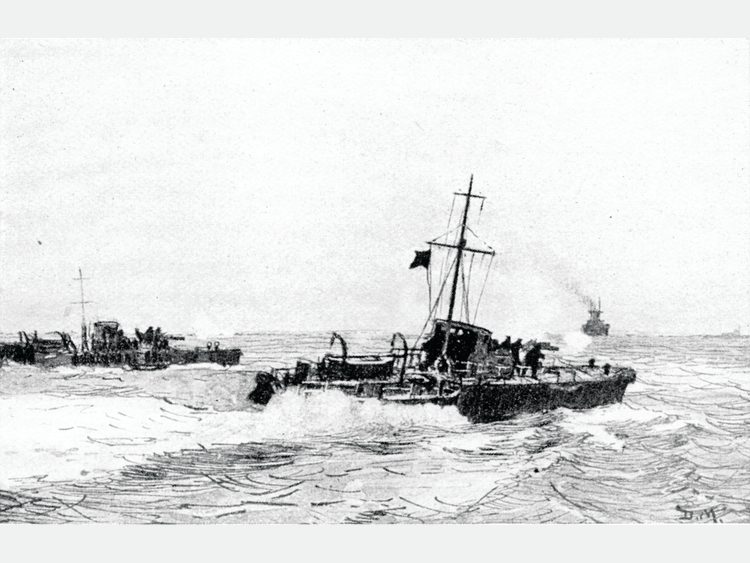
The Russian Navy was first to put this into practice during the Russo-Japanese War of 1904-5. It ordered a series of steel torpedo boats from the Standard Motor Construction Company of Jersey City, New Jersey powered by their very large petrol engines. Since 1903 Standard had been producing a six-cylinder, 48-litre, 110hp engine which weighed just 3,200lb (1,450kg). They had grabbed worldwide interest when they installed one in their 60ft displacement speedboat Standard and took her over 30mph, an amazing achievement at the time.
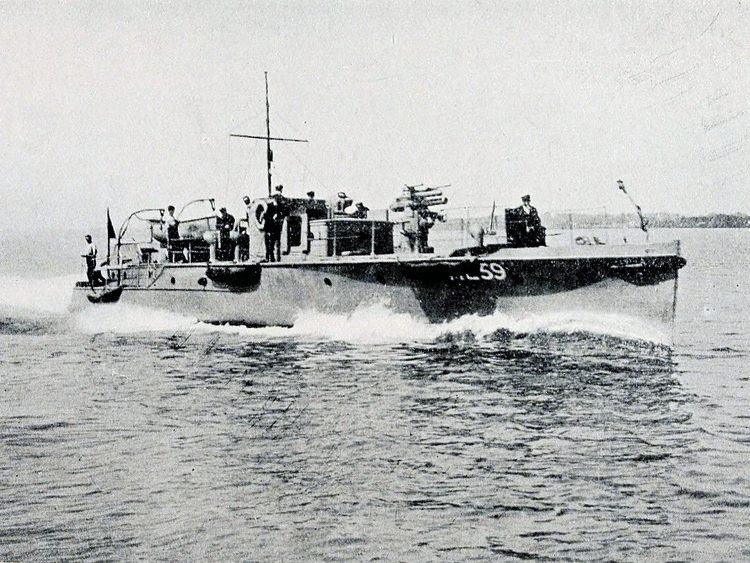
Elco’s manager Henry R. Sutphen later claimed that it was all his idea for the Royal Navy to procure “a number of small speedy motor launches for use in attacking and destroying submarines. …to have a mosquito fleet big enough thoroughly to patrol the waters of Great Britain, each of them carrying a quick-firing gun.” Although there are significant doubts about this claim which I have discussed in the past, it was fantastic publicity for Elco, who shortly after secured a large lucrative order for similar craft from the U.S. Navy, but there’s no doubt that Elco did a quite incredible job in producing 550 MLs in 488 days.
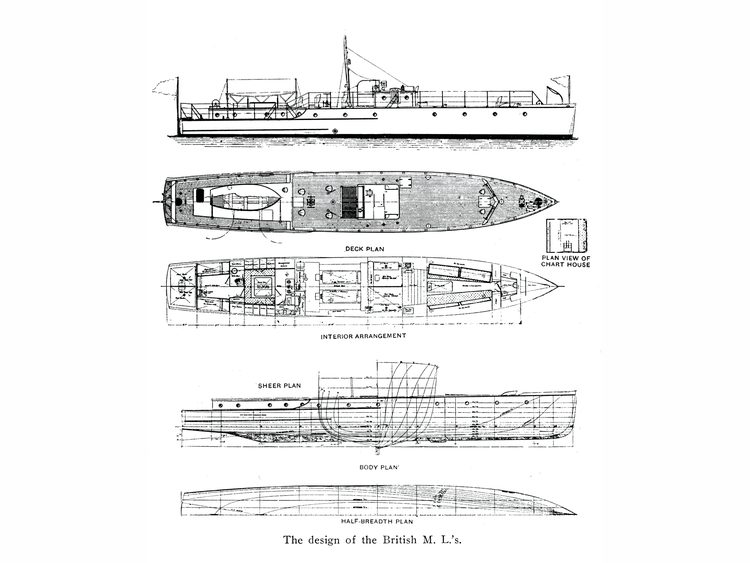
Designed by Elco’s Irwin Chase, they were a compromise between speed and seaworthiness; the flat run aft was good for speed, up to 19 knots, but gave an uncomfortable motion and poor seakeeping especially in a following sea. Their crews called them “the Movies”. The were powered by twin Standard 83.6-litre petrol engines, rated at 220hp at 400rpm plus they had a two-cylinder Standard auxiliary engine driving the air compressor, generator, and bilge and fire pumps.
The main engines had compressed air starting and reverse, and clutchless direct drives, requiring the engines to be stopped, the camshafts slid along, and restarted in reverse. This feature caused many a collision while manoeuvring in port. They had a fuel tank capacity of 2,100 gallons, giving an operating radius of 750 nautical miles at 19 knots and 1,000 nautical miles at 15 knots. The unarmoured wooden construction and their large petrol tanks made them highly vulnerable to gunfire. In effect they were a floating bomb.
Elco mass-prefabricated the wood-planked MLs at Bayonne, New Jersey but, because of American neutrality issues, most were assembled in Montreal and Quebec City and shipped to England on freighters, four at a time. The whole 550 were delivered this way without a single loss in the Atlantic.

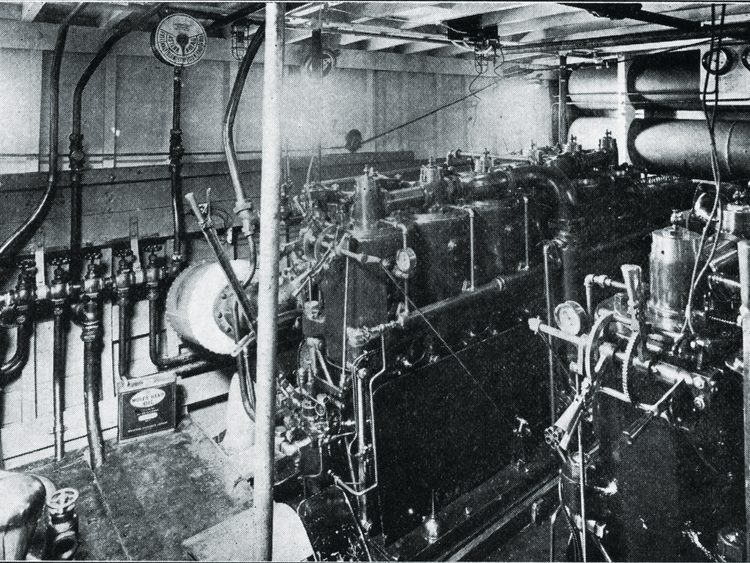
In 1915 the Standard engines were already quite archaic in design with a big dose of steam-engine technology. F.R. Banks served on MLs as a young man and described their operation: “They were open crankcase jobs with drip-feed lubrication via slinger rings, to plain bronze main bearings and big ends. They had automatic inlets and cam and pushrod-operated exhaust valves with a sliding camshaft for directly reversing the engine, initiated by compressed air … Sometimes, due to hurried wartime workmanship, the keying of the exhaust cams to the shaft was not always well done and an order to reverse the engines was rendered ineffective owing to the cams sliding off their keys!
Great care had to be taken to avoid pieces of cotton waste getting caught in the adjustable drip feeds to the big end slingers, since, if one feed was diverted, this would quickly cause a complete seizure of the particular big end on its pin bringing the whole engine to a dead stop”.
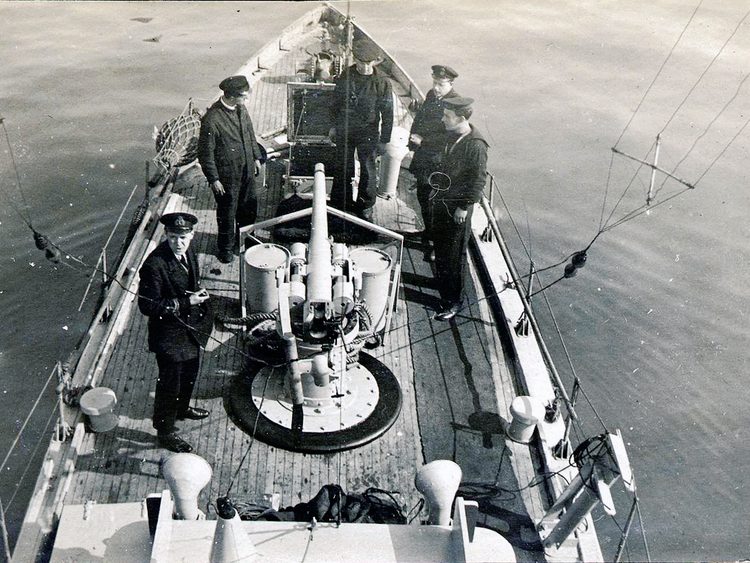
The MLs served an extremely useful purpose in anti-submarine patrols, mine-sweeping, laying smokescreens for larger ships, like the monitors which pounded the Belgian coast, and general message-bearing for the ‘real’ ships of the Royal Navy, roles that had not been anticipated before hostilities commenced. Although their kill-rate of U boats was low, the hundreds of MLs at sea, equipped with hydrophones and radio and armed with torpedoes, depth charges and quick-firers of useful calibre proved to be a huge deterrent to German submarine and minelaying activities.
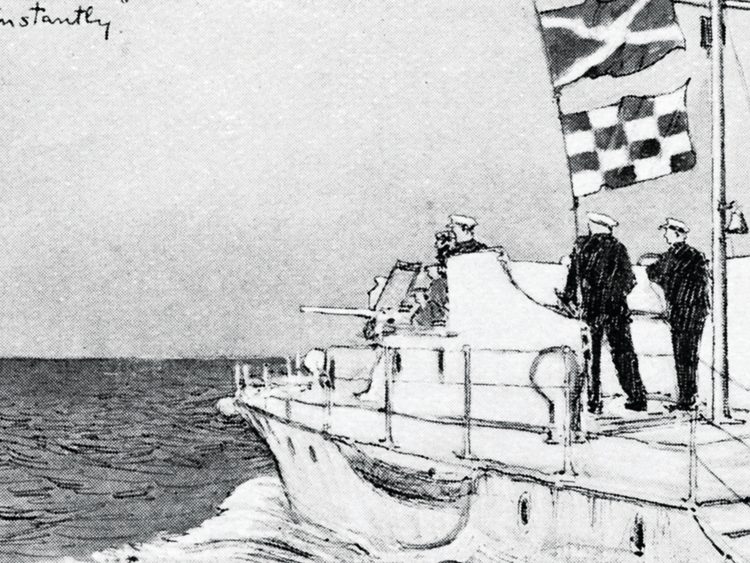
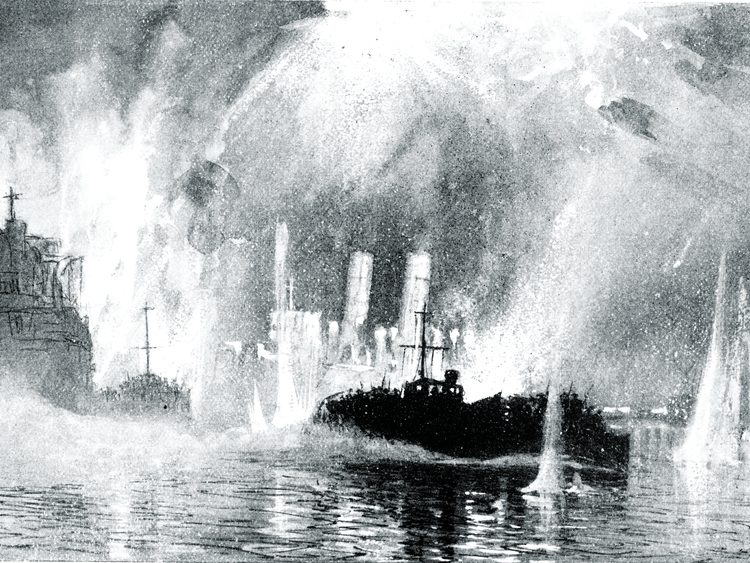
Perhaps the greatest wartime triumphs for the MLs were during the raids on the Belgian ports of Zeebrugge and Ostend in April/May 1918 designed to sink blockships at the entrances, preventing German submarines from using the ports and canals inland. While these hugely daring raids were a tactical failure, they proved to be a propaganda triumph for the Royal Navy. ML personnel received many awards for gallantry in these actions, including two Victoria Crosses, in the final months of World War I. After the Armistice, Royal Navy ML flotillas penetrated deep into the heart of Europe along the Rhine and the Danube, serving a vital role in the control of the collapsed Central Powers.