Satellite tracking has revealed some impressive coastal journeys by green turtles, including one that travelled almost 3,000km. And they are visiting harbours familiar to many Kiwi boaties.
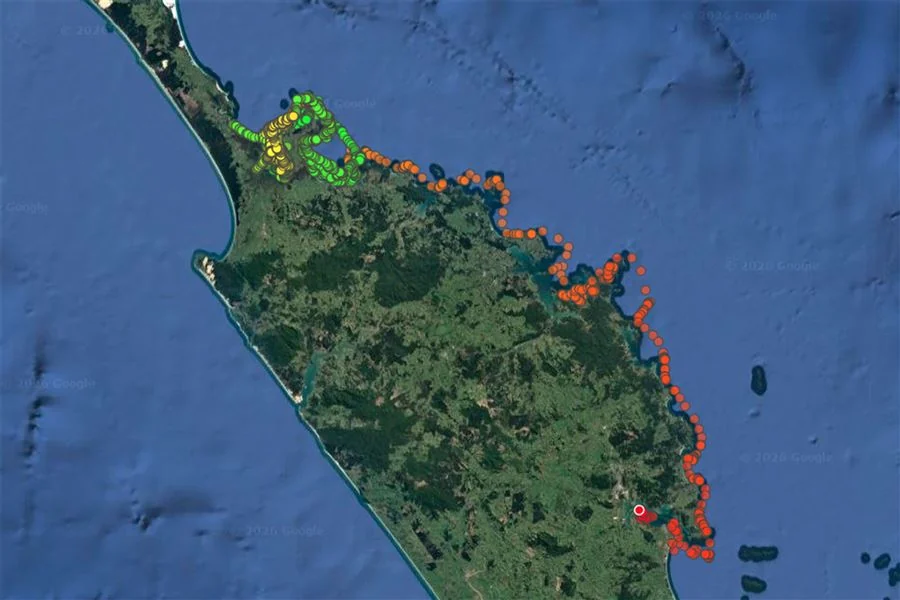
Green turtles are proving to be enthusiastic coastal travellers, with one recently clocking up almost 3,000km in just four months. Its itinerary included Rangaunu Harbour, Wellington and a month enjoying Manukau Harbour before heading north again.
The turtle, known as 3K, is one of 11 rehabilitated green turtles tracked by the Department of Conservation (DOC) since 2025. Using satellite technology, researchers are discovering where these marine wanderers go after rehabilitation and which stretches of coastline attract their attention.
The results, released on 29 October, show that green turtles are frequenting some of our favourite boating destinations, including the Bay of Islands, Whangārei Harbour, Pārengarenga Harbour and Rangaunu Harbour.

Another turtle released at Taupō Bay headed south to the Coromandel before turning north towards Rangaunu Harbour.
Green turtles in New Zealand are no strangers
Although turtle sightings can still be a pleasant surprise, green turtles have been visiting New Zealand waters for many years. Research published in 2016 confirmed their year round presence in northern waters.
More recent drone surveys in Rangaunu Harbour recorded 27 confirmed turtle sightings in January 2025, potentially involving 18 individuals. Researchers also observed turtles feeding on five occasions.
Seagrass beds are particularly important feeding grounds for green turtles, making sheltered northern harbours attractive places to spend time.

DOC’s Team Turtle programme, involving Auckland Zoo, SEA LIFE Kelly Tarlton’s and iwi, is now helping researchers understand their movements in greater detail. Led by DOC Marine Senior Science Advisor Dr Karen Middlemiss, the programme aims to track 20 turtles.
The findings are valuable, although researchers caution that rehabilitated turtles may behave differently from animals that have never required treatment.
Sharing the harbour
Of course, turtles are not the only ones enjoying our northern waterways. Recreational boats, fishing vessels and other harbour traffic share these waters, sometimes with unfortunate consequences.
In July, Auckland Zoo reported the death of a green turtle named Waewae Toru, found stranded on a Whangaparāoa beach. Her shell injuries were consistent with a boat strike, although the location of the suspected collision remains unknown.
Spotting a turtle from a moving boat isn’t always easy. A head breaking the surface can be surprisingly difficult to distinguish from the surrounding water, particularly when there’s glare.
Auckland Zoo recommends slowing down in turtle habitat, keeping a careful lookout, using polarised sunglasses and considering a propeller guard.
There’s no need to abandon a favourite anchorage or fishing spot. A little extra attention, particularly around shallow seagrass areas, can make a difference.
DOC hopes its tracking results will eventually help inform coastal management plans, although no new boating restrictions have been announced through this research.

For now, boaties can contribute simply by reporting turtle sightings to turtles@doc.govt.nz. Injured or stranded turtles should be reported to 0800 DOC HOT (0800 362 468), with DOC providing advice before anyone attempts to handle them.
And if you happen to spot a green turtle while cruising Northland’s coastline, give it some space. It might be taking a short break from a considerably longer voyage.