


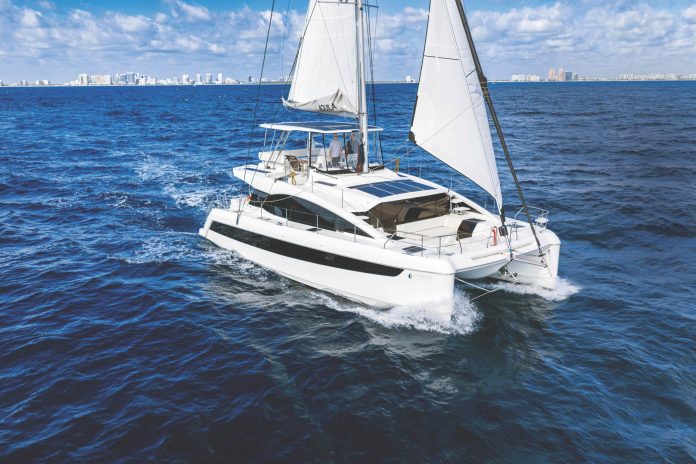
Aquila’s domination of the power catamaran market has prompted the American-Chinese builder to move into the sail arena with the launch of this new range, writes Kevin Green.
The first to arrive in Australia is the Sail 50, which was the clear standout at the Sanctuary Cove International Boat Show, where its vast decks were thronged with visitors, along with staff from company headquarters in Fort Lauderdale, from where Nick Harvey, chief revenue officer, had flown.
“A major reason for launching this new range is the fact that the sailing catamaran market is about twice as large as the motor catamaran market and given the clear synergies between both, it was important we enter this segment,” Harvey told Boating NZ.
After the Sail 50 model, a 45 and a 65 are also coming from the American run Chinese yard.
Having just spent an afternoon on the Aquila 50, including a rough voyage off the Gold Coast, I can see the similarities between the power and sail ranges. Borrowing experience and ideas from the power range, the flybridge sailing model gives a similar level of comfort but with fewer carbon emissions and many of the power range’s layout advantages, such as up to six ensuite cabins with their own individual entrances. Other comforts include the company’s signature saloon-foredeck access and a large flybridge for navigation and relaxation.
First look
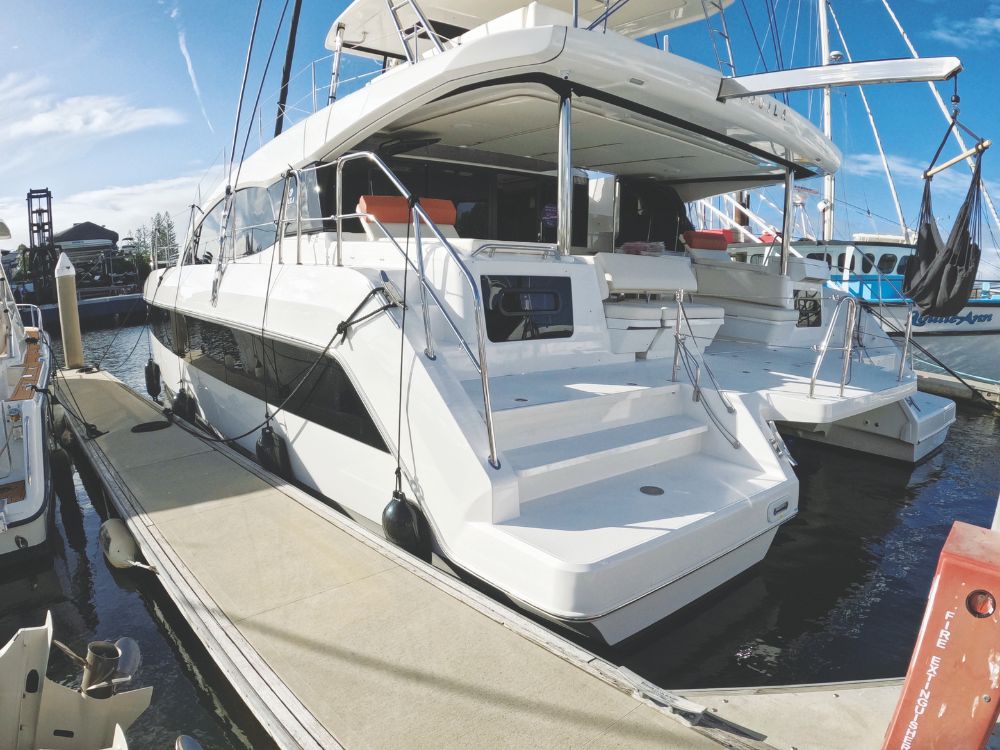
Aesthetics are very much personal taste, but for branding purposes they are important. The Sail 50 clearly is an Aquila with its sloping side profile and company signature elongated hull windows. Stepping aboard is easy via the wide hull steps, onto a transom that joins both hulls behind the transom bench seat. Clearly, there is a lot of structure in this hull, with solid fibreglass in the bow cockpit as well – it’s around 20 tons lightship. The vast hull has three living levels that include large cockpits fore and aft, along with a flybridge lounge.
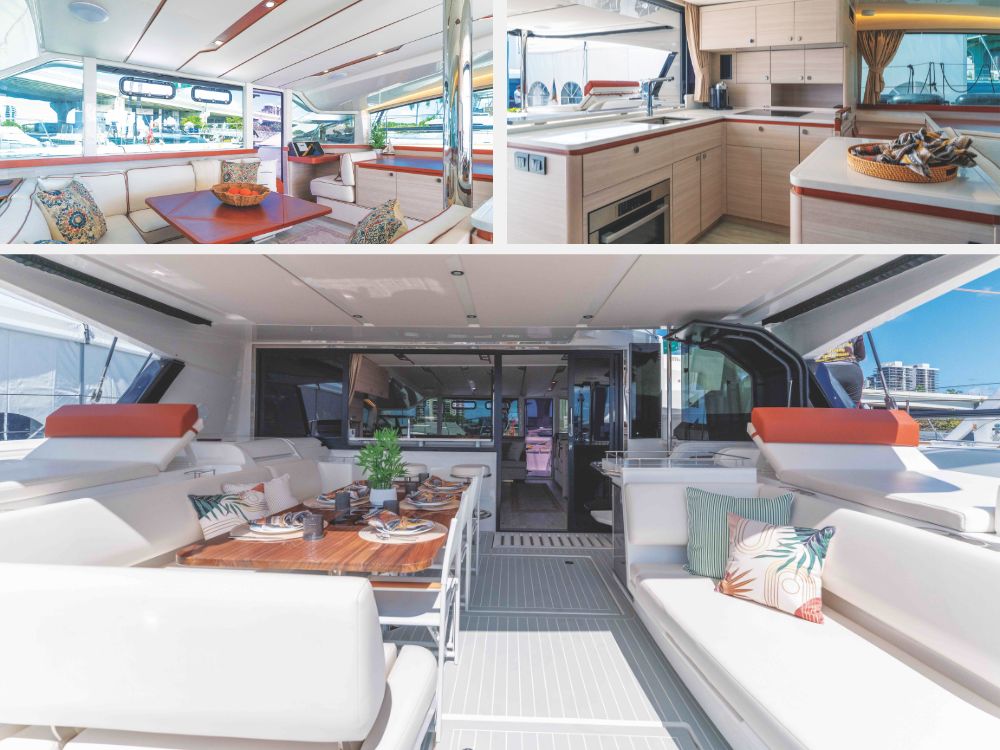
Another Aquila signature is foredeck-saloon access, but on the Sail 50 access is also provided by a sloping teardrop walkway from the flybridge. The saloon uses the large nacelle to maximise living space, while avoiding acres of emptiness. There’s a large stern galley to port with the lounge forward. Here, there’s a U-shaped settee on the port quarter with a bench opposite and the navigation station between them beside the door leading to the foredeck.
Also welcome is the mast compression post in the middle – a handy support for crew when at sea. Saloon layout options are limited but include replacing the bench with cabinets. Large side windows and vertical surrounding bulkheads give clear views when seated, while a fibreglass eyebrow blocks direct sunlight. However, relatively small front windows reduce natural ventilation – larger would be better.
In the galley, notable details include the rear window with drop-down bar top, huge double-door Samsung household fridge, and an island bench with wine chiller. It’s big enough for several crew to prepare food together. Gas or electric (as on the review boat) can be optioned for the cooktop, with the oven beneath. There’s generous cabinetry space, including room for a microwave and dishwasher, with the washer-dryer down in the hull. The finish of the light wood veneers and fixtures is excellent throughout.
Flybridge helm
The flybridge is a vast entertaining and navigation area, reached via a walkway to starboard from the cockpit. Dominated by the centre helm station with a lounge area behind it, the optional hardtop bimini provides shelter and shade. Around the helm are four electrical Harken winches and associated jammers with rope bins, allowing the crew to operate all running rigging from there, including the mainsheet and track (located on the aft part of the flybridge). An electric wheel dominates the helm station with Volvo throttles and the bow thruster paddle nearby. Engine gauges are also prominent on the console, so functional ergonomics throughout.
Six cabins
The voluminous hull allows for up to four double cabins and two singles, or an owner’s version that uses most of the port hull with another cabin or utility room forward. Even more flexibility is offered because one partition can be removed, so the owner who charters the boat but then reclaims it for private cruising can enjoy more space in the main cabin when required.
Privacy is a key feature because each cabin has its own entrance and door. There are gullwing doors on the fore and aft cabins, while inside the saloon the port owner’s and starboard guest’s cabin also have their own doors. The six cabins on our review boat were all well-appointed, with ample volume, decent ventilation (via opening skylights) and spacious bathrooms. On the owner’s version, there’s an athwartships double bed aft, a central lounge and a bathroom forward. Ahead of this would be a utility room with washer-dryer – ideal for cruising.
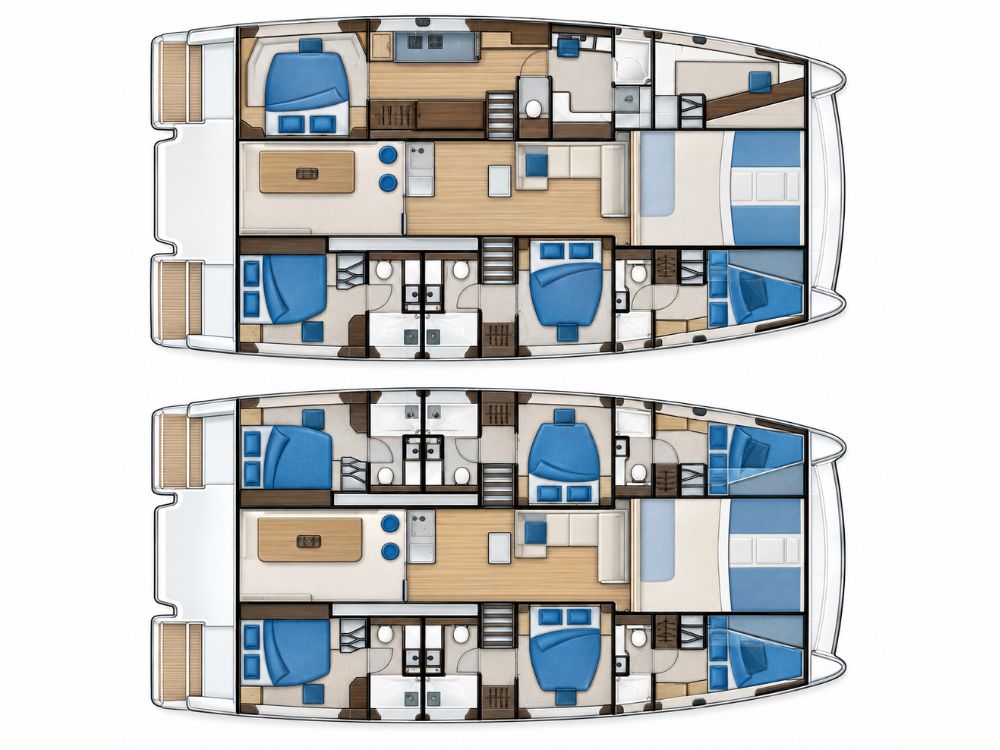
All beds are semi-island or island, so easily accessible, and use thick memory foam mattresses. Storage space is sufficient and looks particularly generous in the owner’s layout.
Deck and rig
Deck space is maximised throughout the Sail 50, with a large sunken foredeck lounge, its area maximised by offsetting the saloon door to starboard. The direct access allows crew to quickly reach the vertical windlass – a wee bit undersized – and easily deployed 32kg Delta anchor mounted below the lip of the foredeck. Sizeable cleating all round is good as well, as are the traditional raised skylights that minimise any chances of leakage.
The flybridge shape means the mast is mounted high, but still easily reached from the helm via those sloping walkways which provide easy crew access to the boom on the Z-Spars mast.
A standard slab-reefed Doyle Mylar sail was used on the review boat, paired with a roller-furled genoa. Given the weight of this boat, I’d also opt for the bowsprit to fly a Code 0 spinnaker.
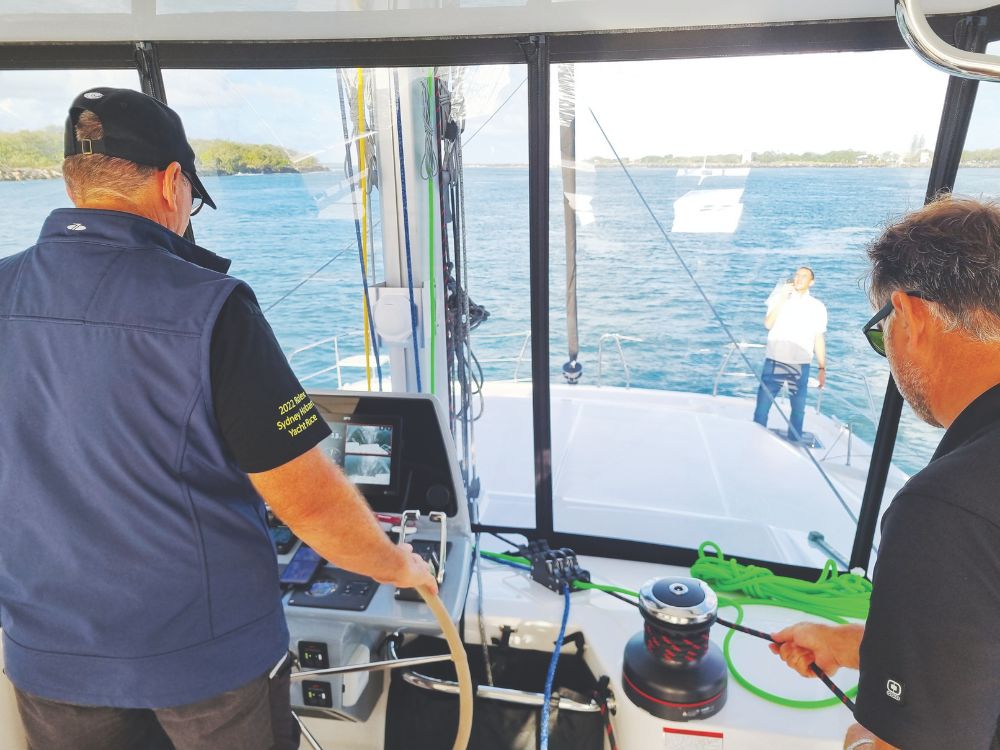
All sail controls are clustered around the helm, so the runs from the mast are short, while the mainsheet and track run from aft of the bimini, with dual sheets for good control.
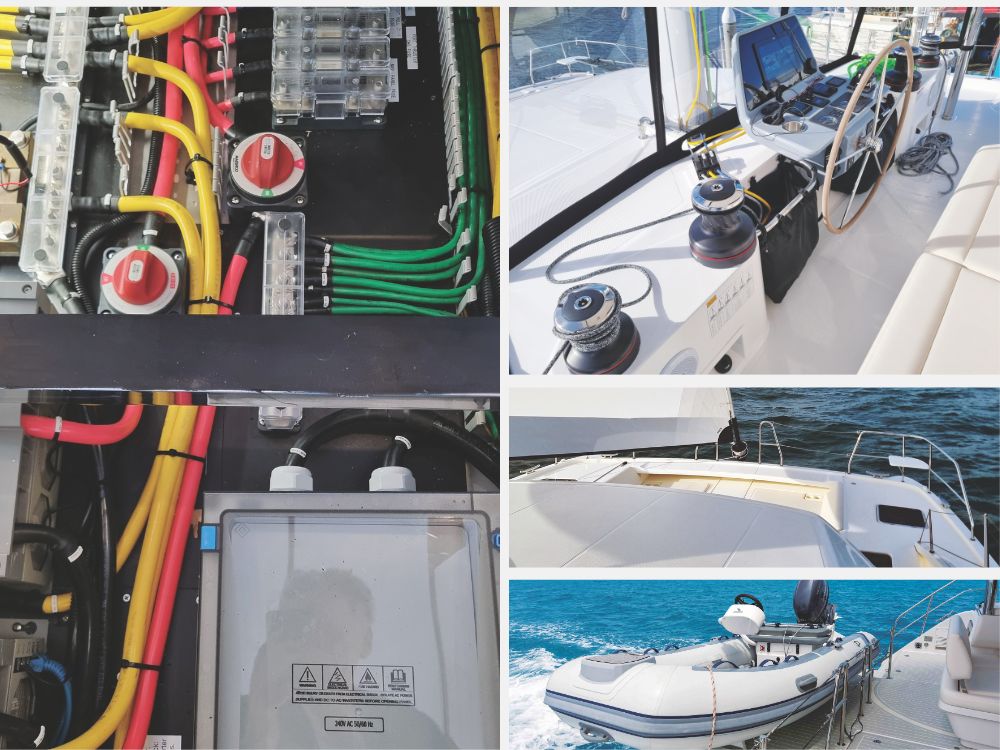
Equally good is the size of the four Harken winches, with 60.2 and 46.2 models used, along with large diameter halyards and sheets. The aft cockpit is often the most frequented place on cruising catamarans, and the Sail 50 caters especially well in this area with a combination of comfy benches and sunbeds. Cleverly, the transom bench has a reversible backrest, allowing guests to watch the swimming party. Another innovative idea is the extendible single davit arm. It projects behind the boat to hoist the rigid inflatable on a harness and onto the aft deck.
Hull and systems
The hull is made in only two parts, so it’s a fairly rigid build-type. There’s one entire base section with a second mould for the deck. This negates the need for a traditional bow crossbeam; a sturdy hull-deck joint lip is used to attach the forestay.
Bridgedeck clearance looked to be nearly a metre, and I noted the lack of wave slap when sailing offshore, despite the rough conditions. Construction is resin-infused Vinylester throughout the hulls, deck and bulkheads with PVC foam core throughout in varying density. Twin rudders behind the saildrives feature emergency access to the quadrants, with a steel tiller for emergencies in a nearby locker.
Engine access is via hatches in the aft decks and both compartments are fairly busy with equipment – hot water systems, aircon and electrics. The space is tight because of the stern cabins, but the compact saildrive Volvos occupy minimal engine room space. Engines on our review boat were twin 50hp Volvo Penta saildrives with fixed propellers (folding props are an option), complemented by a tunnel bow thruster in the port hull. Engine options include Deep Blue Torqeedo inboard electric motors instead of diesels.
Tankage is distributed through the hulls, with water tanks near the bows and fuel aft; which aids trim. The 4 x100-amp AGM battery bank is sensibly located in the centre of the nacelle, with 17kWh generator located in the bow lazarette. A CZone digital switching system is used for DC-powered components, which allows for easy error checking and menu driven modes e.g. harbour mode, marina mode, etc. Cabling runs under hatches in the nacelle and appears well constructed.
Offshore sail
Tight marina berths are the bane of many skippers, so the first test of the Sail 50 was edging out of a Runaway Marina berth on the Gold Coast, which was easily done by professional skipper David McDonald using only the throttles to pivot the hull, “But having the bow thruster on is a good insurance policy, just in case,” explained David.
Motoring across the busy Broadwater was easily done, the saildrive Volvos pushing us quietly along at seven knots. A strong breeze was blowing offshore so exiting the Seaway would be the first major test of the hull because three-metre swells awaited us outside. Before tackling the Seaway, we hoisted the mainsail by motoring into the wind inside the channel, using the big Harken 46s and lazyjacks to hoist the Doyle mainsail, which was easily completed from beside the helm. To see the hoist, I opened the bimini skylight curtain above the helm before putting the mainsheet on another winch for trimming.
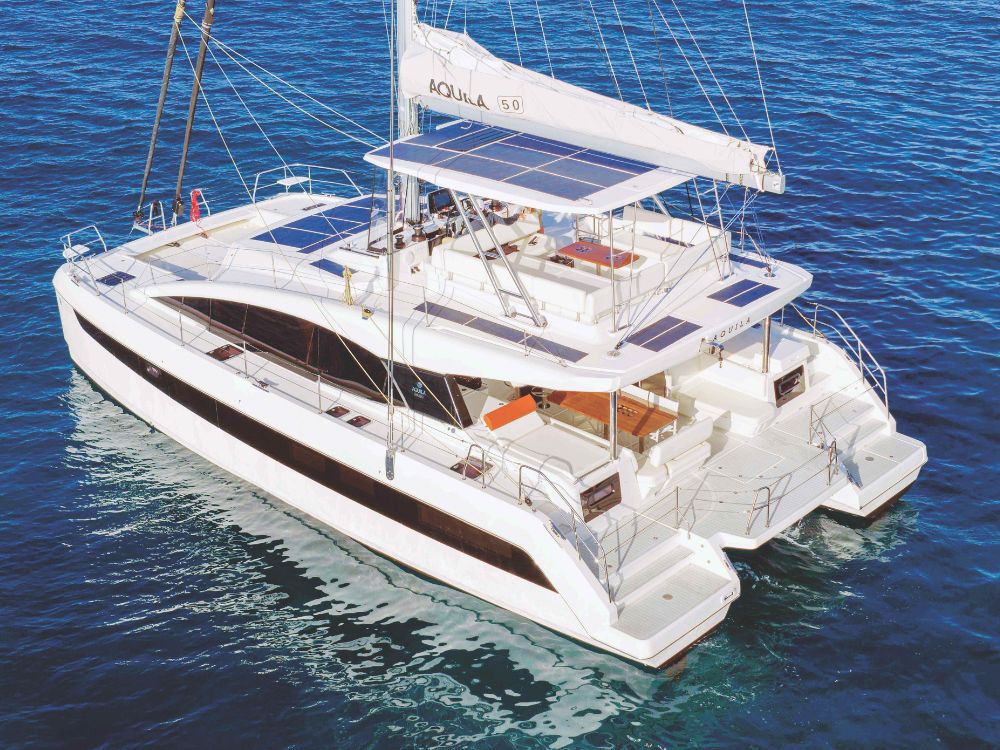
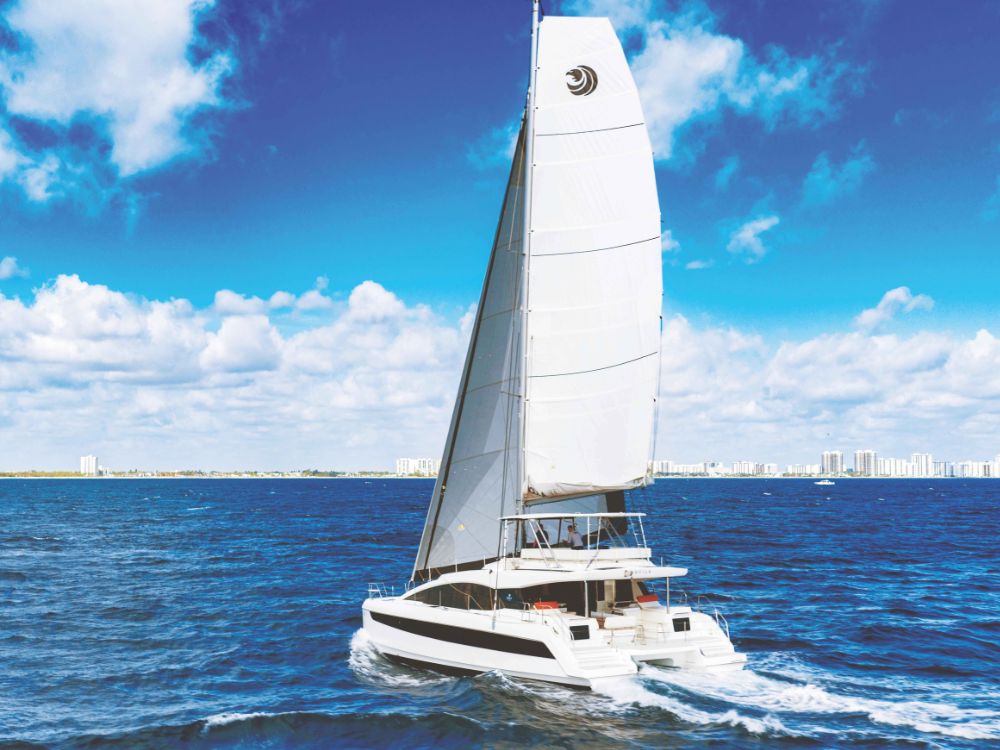
Out at sea, swells broke across the sandbars of the Seaway and no other vessels were braving the conditions. With all hatches battened down, we motor-sailed into the swells, plunging and rising, yet no spray came aboard – at times 20 tons displacement is useful. Once clear, we tacked off the wind to unfurl the genoa and began what was to be a stern test of the Sail 50. A small sail area, heavy hull, and mini-keels is not the best recipe for sailing off a lee shore and so it proved. However, we managed to make way against the conditions, reaching six knots at 80 degrees apparent in the 17-knot breeze. Ideally, we would have run with the weather, which would have better suited the Sail 50, but we managed several tacks nonetheless, with all sheets running cleanly and easily managed.
It proved that while the Sail 50 probably won’t win too many races, it will still get you to where you want to go and do so in considerable comfort.
| Highlights |
|---|
| All the comfort of Aquila’s powercats, but with sails |
| Vast flybridge and expansive entertaining areas |
| Dry boat that will transport you in considerable comfort |
| Specifications | |
|---|---|
| LOA | 14.97m (49’1″) |
| Beam | 7.86m (25’9″) |
| Mast height | 25.15m |
| Sail area | Mainsail 90m²; genoa 66m² (options 96m² main) |
| Draft | 1.45m |
| Displacement | Light 19,270kg; loaded 24,000kg |
| Engines | 2 x 50hp Volvo Penta Saildrives (60/75hp options); hybrid 32/40kW Torqeedo |
| Fuel | 865 litres |
| Water | 880 litres |
| Holding tank | 340 litres |
| Cabins | 4–6 |
