


Trailerable powercats are rare beasts in this country, with only a handful of models available from an even smaller number of manufacturers. But for Kingfisher Boats, powercats are its core business, and if the impressive new 670 Powercat is any indication, the Tauranga aluminium boat builder is surely onto something.
The boat reviewed here is the passion of Spec Media’s Sam Pillidge, who looks after marketing for Kingfisher Boats. He’s owned several smaller Kingfisher models over the years, but this 670 Powercat is by far his most ambitious, a project supported by Kingfisher Boats, Honda Marine and BLA, and many others. It is a highly spec’d vessel that showcases product and tech from these suppliers.
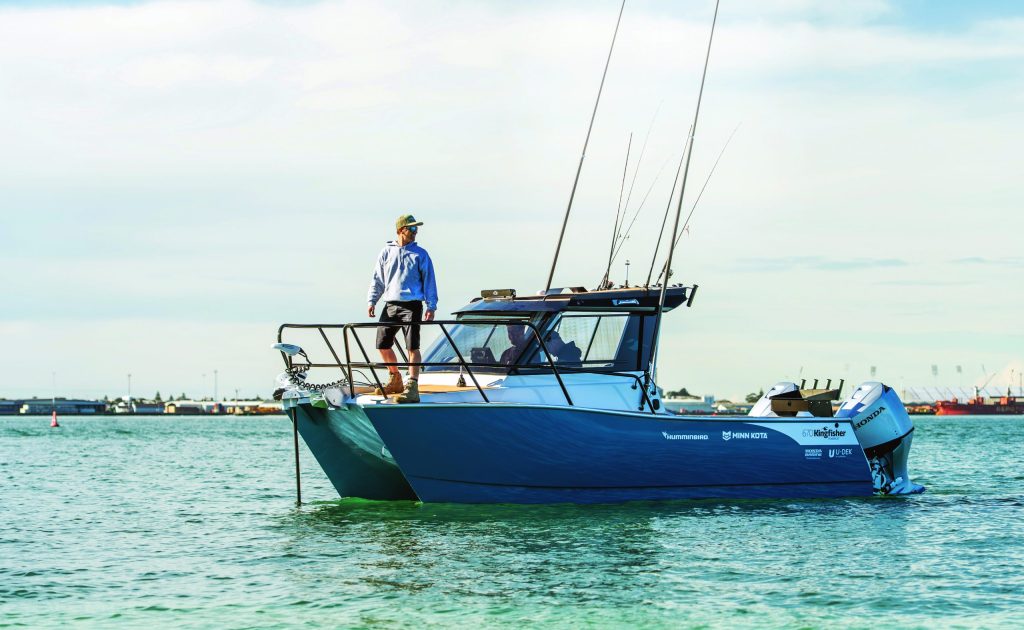
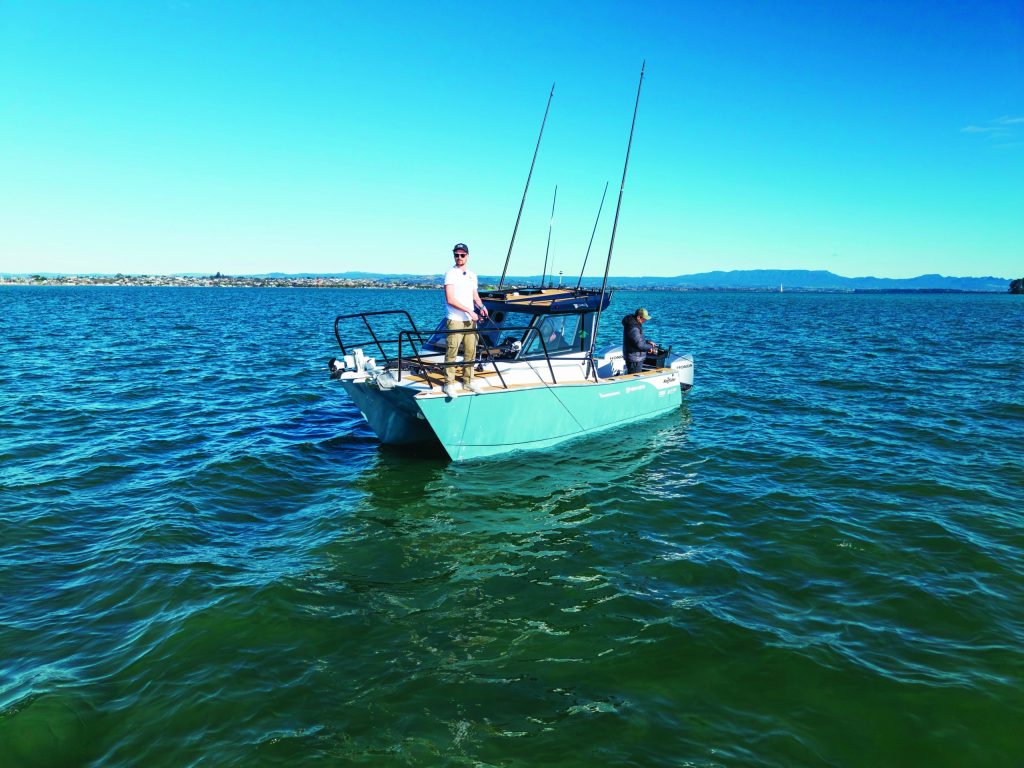
Carried on an impressive Kingfisher aluminium custom trailer with alloy wheels and braked on both axles, it tows extremely well, says Pillidge, who trails it behind a Ford Ranger ute – this winter he towed it all the way to Waihau Bay to chase bluefin tuna. It’s a big thing on the trailer, but all-up towing weight is a manageable 2.6 tonnes or so and its 2.5m beam falls within the legal towing limit, also for Australia.
The grunt work of winching the boat onto the trailer is undertaken by a powerful Runva electric winch, a type more commonly seen bolted to the front bumpers of serious 4WD offroad vehicles.
The rig is tall on the trailer – it’s a tall boat anyway and it rides on two sets of rollers supporting the keels with frame-mounted skids guiding the boat straight onto the trailer and securing it laterally on the road.
Like many other powercats the Kingfisher 670 is imposing, although the nicely painted hulls avoid looking slab-sided, as is sometimes the case with alloy catamarans. This boat is nicely finished and meticulously detailed, with sparkling paintwork and acres of U-Dek, much of it embossed, covering virtually every horizontal surface. Sam opted to have Kingfisher fair the boat’s sides with epoxy prior to painting, so it really looks the business.

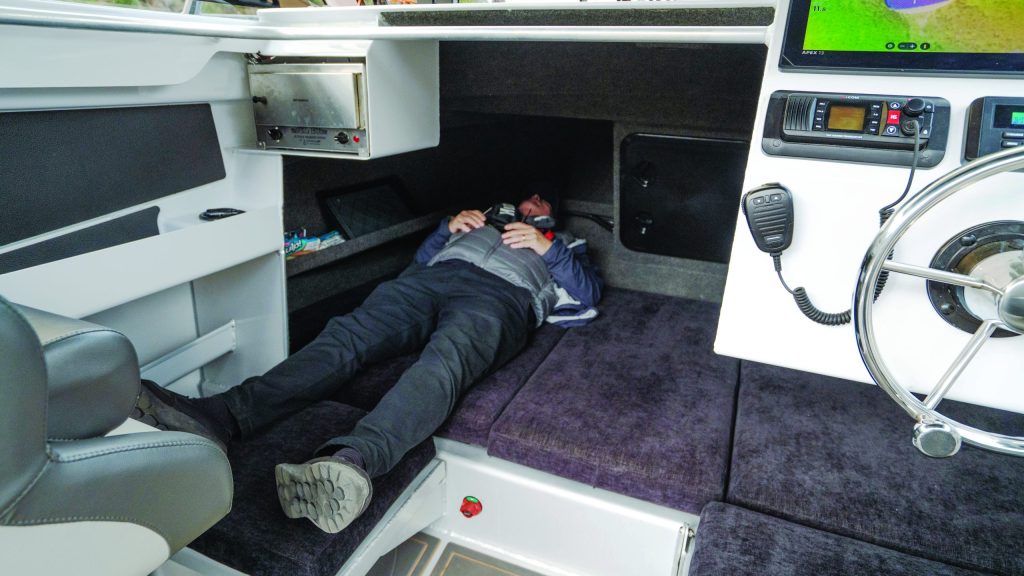
Upon stepping aboard, my initial impression was of space – lots of it. This is a big boat for under seven metres in length. In part that’s because its catamaran hull carries the beam all the way forward, which is particularly evident in the forward cabin. It is roomy enough to sleep two people lying either fore and aft (utilising drop-down berth extensions into the wheelhouse) or across the beam, there’s useful storage in the shelves and under the squabs and good access through a hatch in the forward bulkhead to the Savwinch drum winch.
There’s plenty of space in the self-draining cockpit too, which features high sides and plenty of freeboard, along with twin tier-shelving and a practical seating arrangement: twin adjustable pedestal seats on aluminium bases forward with a fold-down rear facing seat to starboard and cushions on the 70-litre Icey Tek chilly bin under the seat base to port. The bin stows under the seat base, leaving half of it clear to sit on – or pull it out completely to use as a transom seat. The split lid allows you to access its contents without pulling it all the way out.
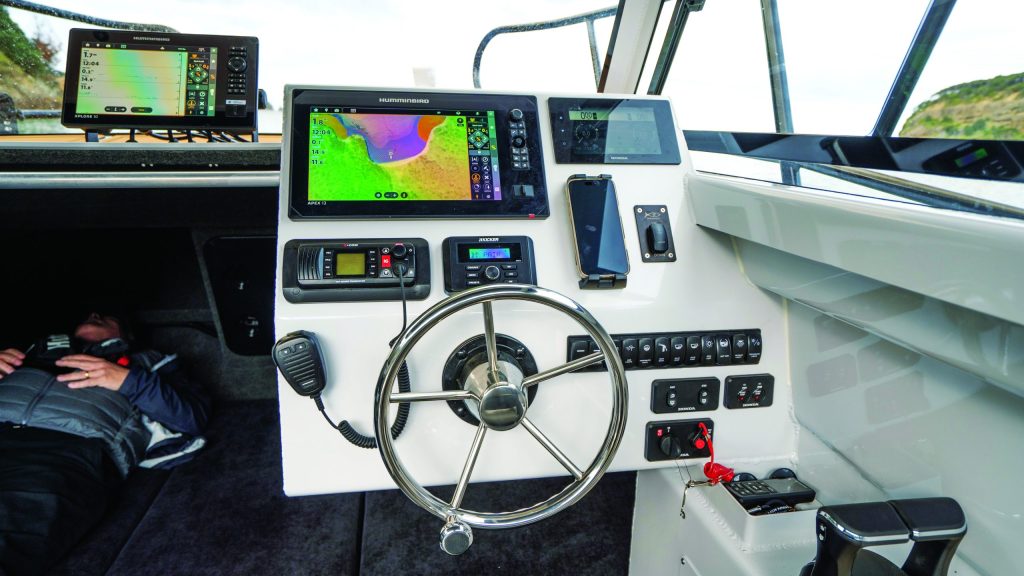
| The helm console has ample room for various displays, switches, anchor controls, the stereo head unit, and the VHF radio. |
At the stern a pair of transom lockers contain the vessel’s three batteries – one each for the twin outboards, plus a house battery – along with isolation switches, pumps etc. There’s another dedicated lithium battery under one of the berths forward for the bow-mounted trolling motor.
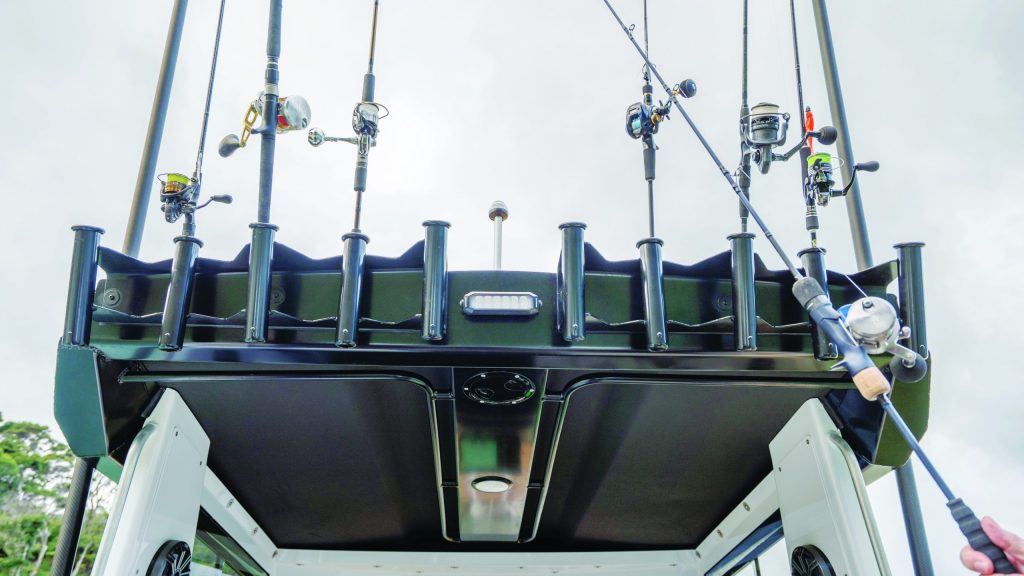
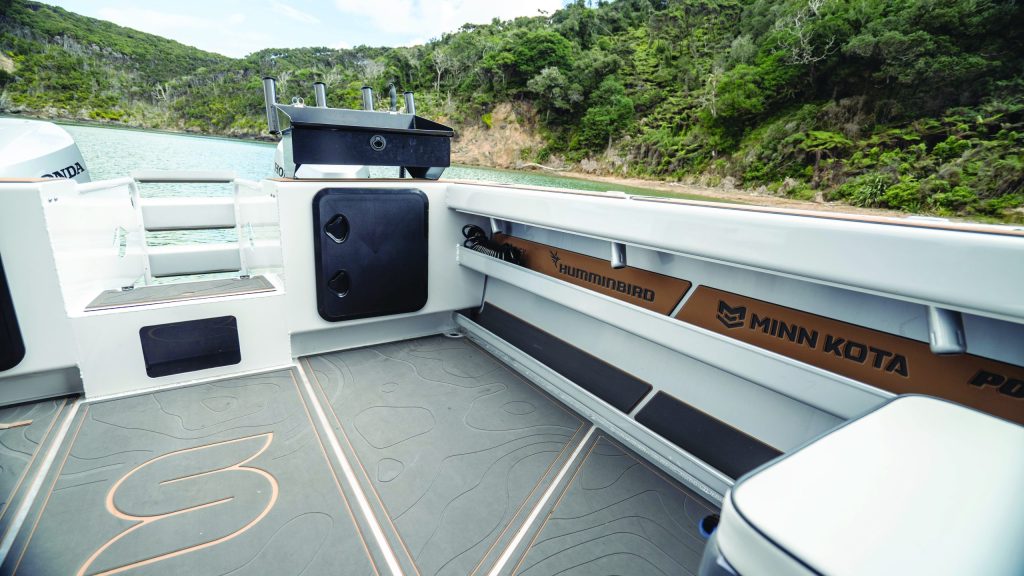 Along with a saltwater washdown aft, there’s a good-sized livebait tank under the central transom walk-through (with a Perspex observation window) and a bait station on the port side. This has four rod holders and a tackle drawer as well as a HDPE cutting board and a couple of knife/tool slots.A sturdy platform extends aft between the outboards. It’s a great place for a stand-up battle with a large fish or to finish gearing up before a dive. The boarding ladder at the back also forms a security gate in the secured position – a bonus with young kids onboard, says Pillidge.Taking on large gamefish offshore is well within this vessel’s gambit. Three sturdy through-coaming rod holders each side are suitably angled for trolling duties, the boat is equipped with Reelax outrigger mounts and telescopic Kilwell poles which stow in the top shelf along the boat’s portside extending under the side deck, and the rocket launcher with its staggered rod holders (10) can accommodate large gamefishing outfits without the reels knocking together underway. They are angled steeply enough that the rods stored there don’t overly interfere with anglers fishing from the cockpit.
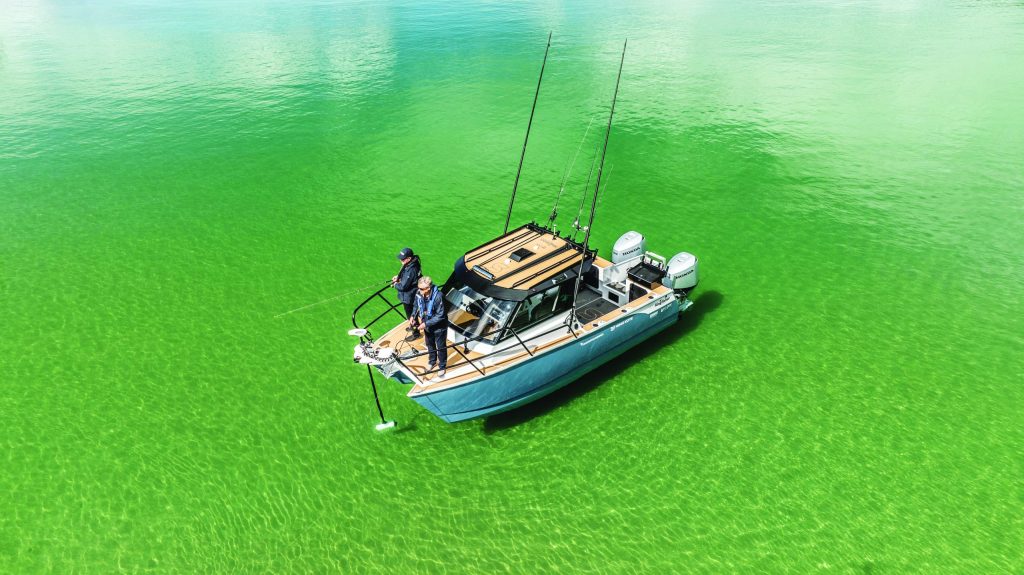
 We spent a bit of time on the expansive foredeck as well, two of us casting lures without getting in each other’s way. Tall painted bow rails keep anglers safe and secure and because the boat is so stable it feels comfortable up there. Access forward is okay, though the side decks are quite narrow. The bow rails extend well aft, though, and there are grab rails on the hardtop roof. Side decks and the hardtop roof are covered in U-Dek.
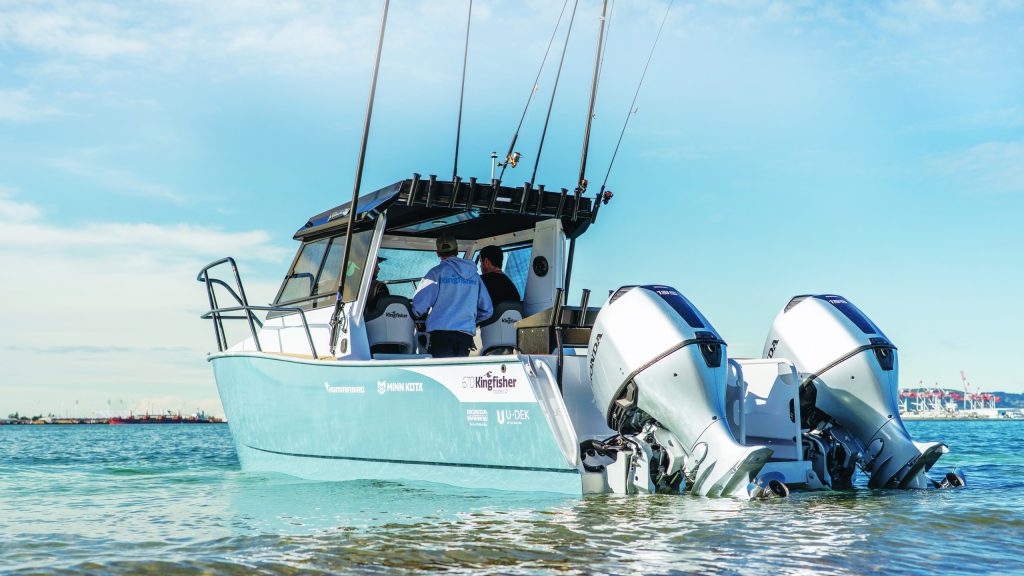
 The boat is powered by a pair of new Honda BF135 DBW 135hp outboards, matched to Honda’s latest Drive-by-Wire electronic controls and the seven-inch version of Honda’s new multifunction display (see sidebar). Steering is hydraulic – Seastar by Dometic (Ultraflex is standard) – and I found it to be reassuringly positive with good feedback. It’s firm without being stiff or heavy, though it can’t match the lightness of electric steering systems.
 The helm position is good with excellent vision through the single-pane glass windscreen and flush glass side windows (with opening sliders for ventilation). This is an open-backed hardtop design, fully lined, including the ceiling, and well-appointed with storage cubbies and USB-C and 12V outlets to ensure enough charging capacity for Pillidge’s tools of the trade. There is lighting galore, including cockpit and foredeck floods and hardtop mounted side lights all by Narva. The pie warmer is a Kingfisher exclusive.
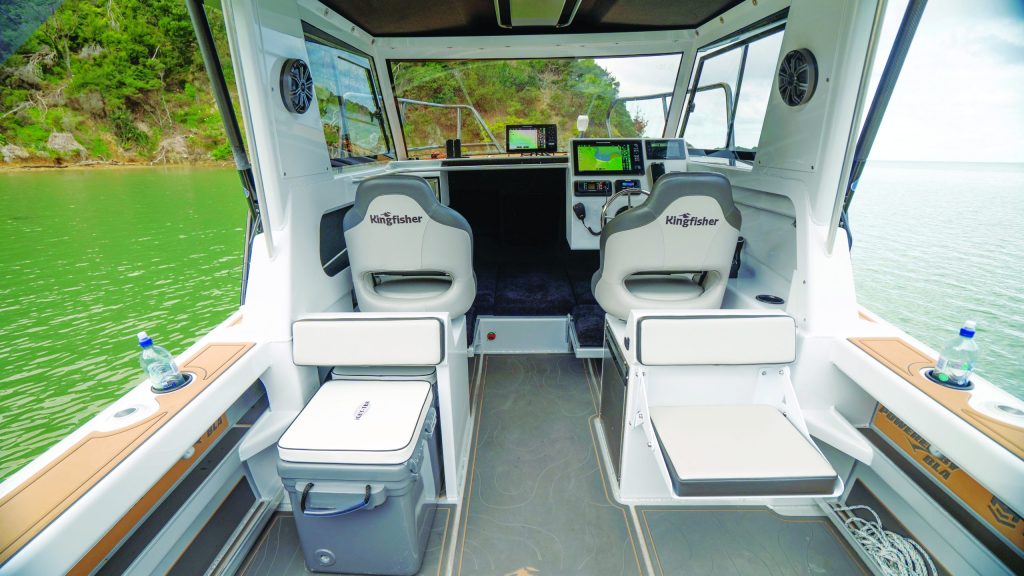 The helm console has ample room for various displays, switches, anchor controls, the stereo head unit, and VHF radio. The console’s Humminbird 16-inch display’s sounder module can switch between the 1kW through-hull transducer and the transom-hung 600W skimmer transducer, as can the 10-inch Humminbird MFD bracket-mounted on the dashboard. The Minn Kota Terrova Instinct can be deployed, programmed and controlled from either of the two Humminbird displays or the handheld Humminbird remote.
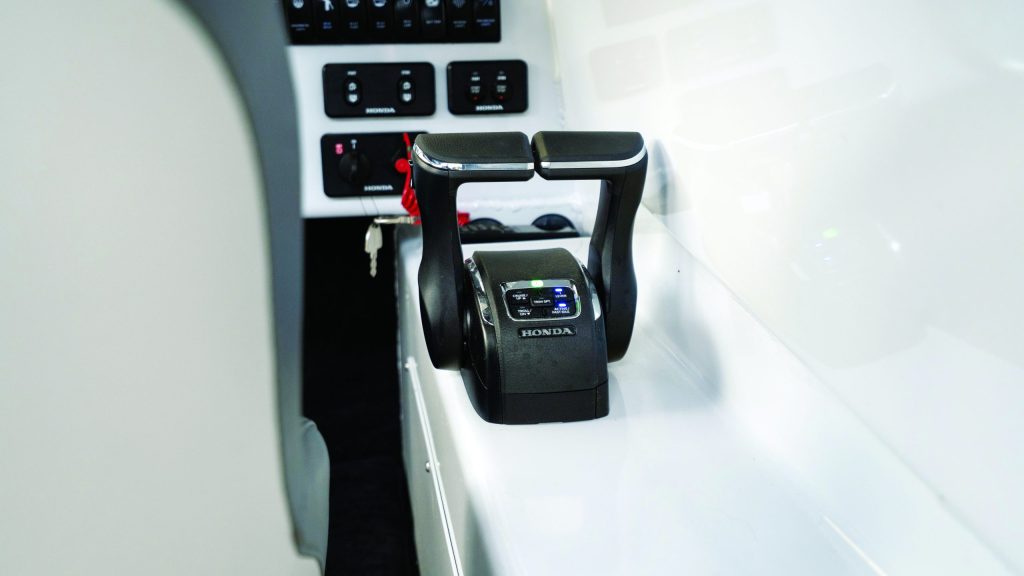
Honda’s new twin-binnacle Drive-by-Wire remote falls easily to hand, whether standing or sitting to drive. The twin Hondas spin 17-inch stainless steel propellers and seem well matched to this hull, providing snappy acceleration and a respectable 40-knot top speed. Fuel consumption is very reasonable, too, especially cruising at 17-18 knots where total burn is only around 40 litres per hour. These are 2,354cc four-cylinder DOHC engines, Honda using the same large displacement block for its BF150 and BF115 models as well. Running on 91 octane petrol, the engines feel torquey and responsive throughout the rev range, quickly boosting the beefy powercat onto the plane. The engines provide 100W of charging.
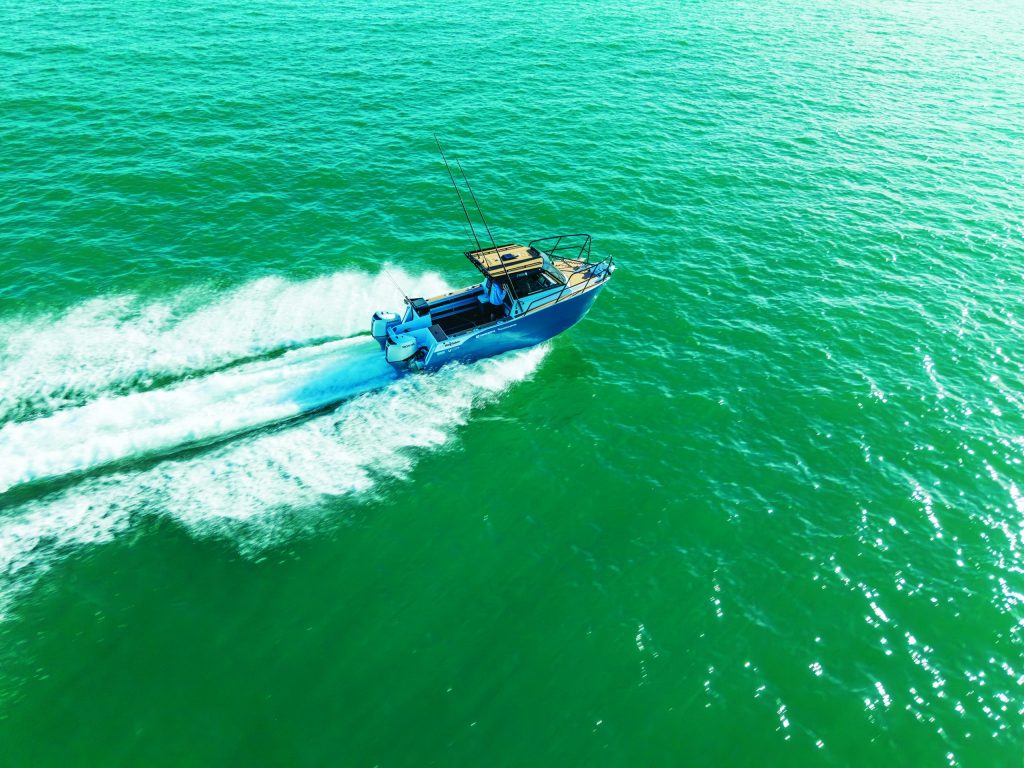
A powercat like Kingfisher’s 670 doesn’t handle like a conventional monohull and getting the best from it takes a little practice. If you are new to power catamarans, you need to get used to the fact that they lean out rather than heeling into a turn like a monohull. When we threw the wheel over at full throttle the 670 leaned hard onto its outboard hull, exerting considerable G-forces on everyone inside. The degree of lean was initially a little disconcerting, but Sam assured us that the boat only leans out so far, and so it proved. Provided you are hanging on and loose objects are well secured, you can turn the boat as tightly as you dare.
The 670 is also quite sensitive to motor trim, handling best with the outboards trimmed halfway out on the gauge or more; the boat tends to squirm a little if the motors are trimmed in too far, splashing spray over the foredeck in rough conditions. The engines can also be set up to take advantage of Honda’s trim assist, automatically moving the engine(s) towards the optimum preset trim position. Trim Support can then help maintain an efficient running attitude as speed changes and the trim maps can also be customised to suit the particular hull and operating conditions – having taken delivery of the vessel only three weeks prior, Pillidge and Honda had yet to set this up.Since it is a powercat, there’s also the option to adjust engine trim independently for each motor, lifting one hull’s angle of attack relative to the other to compensate for sea conditions and crosswinds – easy enough to do using Honda’s push-button engine trim panel on the dashboard. Provided you start off with the motors trimmed all the way down (automatic with a double press of the down button), both engines can be trimmed in unison via the trim button on the active throttle lever.
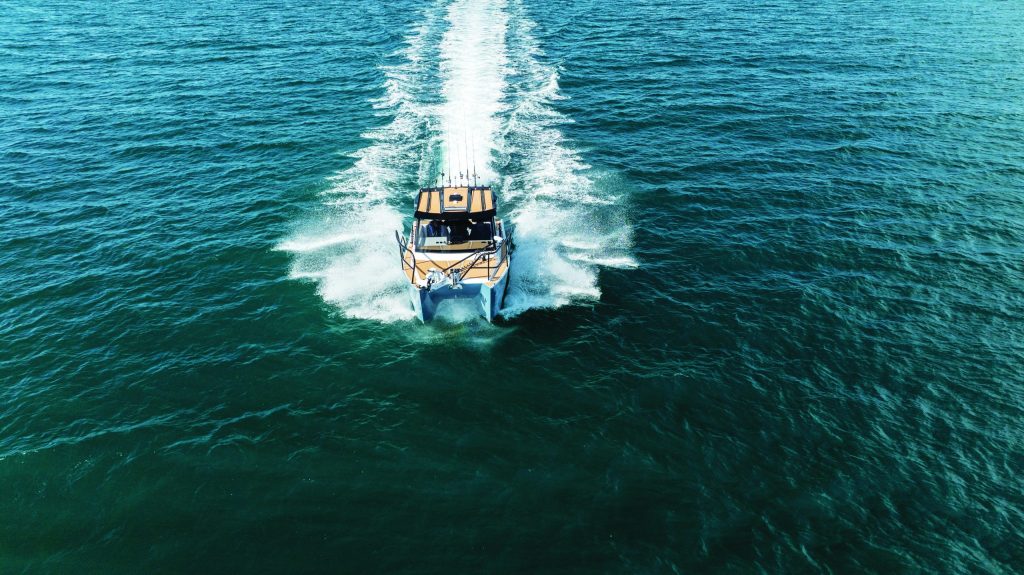
Once the trim is sorted and the boat nicely balanced, it rides extremely well, easily dealing with the chop a 15-knot sou’ wester dealt us while cruising at 25 knots. It’s quiet, too, and a dry runner when trimmed correctly. Nor did we note any appreciable slamming between the hulls, nor any ‘sneezing’, a common powercat trait. Given the volume of the hulls, the bridgedeck is quite narrow, which makes slamming less likely. I was also impressed at how well the boat tackles a head sea – not always a powercat’s strongest suit. Indeed, the 670 was comfortable and felt assured regardless of the angle of attack. It will easily eat up the sea miles, and with 400 litres of fuel underfloor (2 x 200 litres), you can travel a long way or make multiple trips before needing to refuel. Nor should you need to be too concerned if the sea gets up over the course of a day – the 670 will get you back home safe and sound, and in comfort too. Passages are made even easier with Honda’s new Cruise Control function, which sets the engine to maintain certain RPM or GPS speed. This is also a great function when trolling.Kingfisher Boats is enjoying considerable success in the Australian market where powercats have long been popular. Smaller, trailerable powercats are perhaps less familiar here, though more boaters are seeing the advantages they offer. These include unmatched stability at rest, twin-engine safety, superior interior volume, and the ability to cruise comfortably even in unpleasant sea conditions.
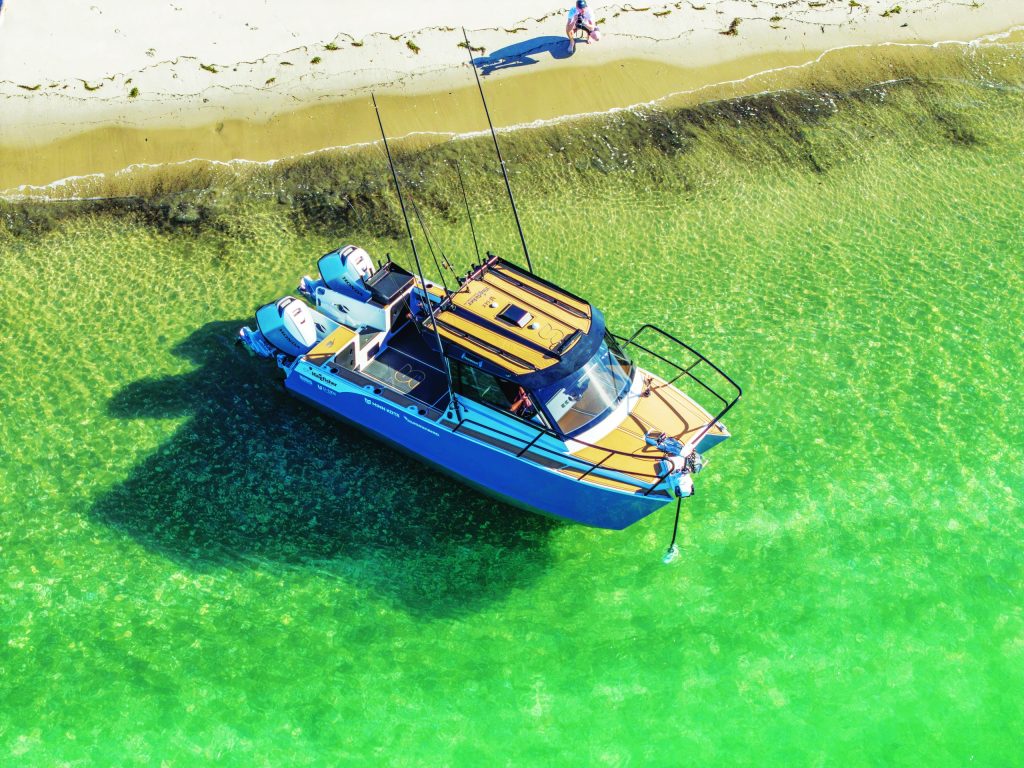 The Kingfisher 670 Powercat offers all of that and more in a well finished package that feels like a much bigger boat than its length would suggest. With its space, comfort and the security offered by its high sides and railings, it’s a family friendly boat, says Pillidge, but also suitable for hardcore sportfishing or diving. With the boat attracting attention wherever it goes, Sam Pillidge couldn’t be happier with his Kingfisher 670 Powercat – and rightly so.
| Highlights
Spacious, stable platform, Well appointed vessel Easy enough to trailer, Looks, feels and behaves Serious sportfisher |
| Honda’s new drive-by-wire twin-binnacle remote offers improved engine integrationDrive-by-wire
Electronic controls communicate with the engine’s ECU to provide smoother shifting, precise throttle response and allow a range of intelligent functions to be integrated directly into the remote control system. For twin-engine applications, Honda’s Twin Binnacle Drive-by-Wire remote provides control of two to four engines from the same control system. The electronic system also eliminates the maintenance associated with conventional mechanical control cables. Cruise control With the push of a button, the operator can set the engine to maintain a consistent GPS speed or RPM. This is particularly useful when travelling long distances, towing, trolling or operating in rough unpredictable sea conditions. The system can operate using either engine RPM or GPS boat speed. For anglers, this can be particularly useful when trolling, allowing the skipper to establish a precise trolling speed and maintain it without constantly adjusting the throttle. Automatic tilt Tap the trip button up or down twice to automatically tilt the engine all the way up or down. The system can be configured to automatically tilt the engine to a predetermined position. Honda describes the function as allowing a default trim angle to be set, helping prevent the need to manually manage engine position every time the boat is docked or moored. Trim support / trim assist Honda’s Trim Support system uses either GPS boat speed or engine RPM to automatically adjust engine trim according to a pre-programmed trim map. As the boat accelerates and changes speeds/RPM, the system can automatically move the engine towards the optimum preset trim position. This is particularly useful during acceleration and the transition onto the plane, where the attitude of the boat changes rapidly. Trim Support can then help maintain an efficient running attitude as speed changes. The trim maps can also be customised to suit the particular hull and operating conditions. Honda 7” multi-function touchscreen Key gauge functions include:
Together, the new Drive-by-Wire control system, Honda MFD and intelligent control functions transform the new generation of Honda outboards from simply an engine into a much more integrated propulsion system. |
