


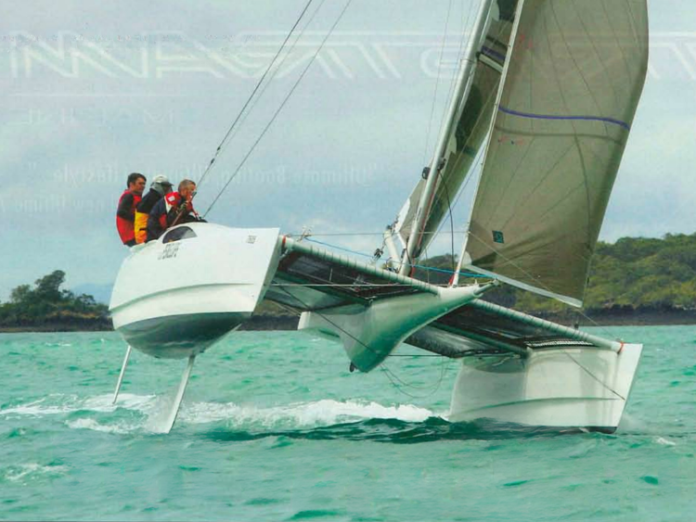
Multihull designer Tim Clissold’s no stranger to regular Boating readers – in recent years we’ve reviewed several of his designs including X-Factor, Pulse, Wizzard and Tarantella.
However, boatbuilding tutor Matthew Stewart will be new to most readers. Stewart’s passionate about building and sailing multihulls. Together, he and Clissold have created the excitement machine the SS Penelope.
CONCEPT
The New Zealand Multihull Yacht Club (NZMYC) 8.5m class rules – see page 39 – allow catamarans or trimarans. Conventional multihull wisdom is that trimarans are usually quicker upwind but catamarans often have an edge downhill.
One major reason for the trimaran’s upwind advantage is that its central hull gives greater longitudinal stiffness, and therefore a tighter forestay. Stewart owns the racing trimaran Dragon, and started wondering: if a catamaran could be made as longitudinally stiff as a trimaran, would it have a winning edge in both directions?
Armed with this concept and two pages of likes and dislikes, Stewart commissioned his good friend Clissold to design a catamaran specifically for racing under the NZMYC 8.5m rules.
The new design is called the TC 8.5, as part of Tim Clissold’s range of multihull designs.
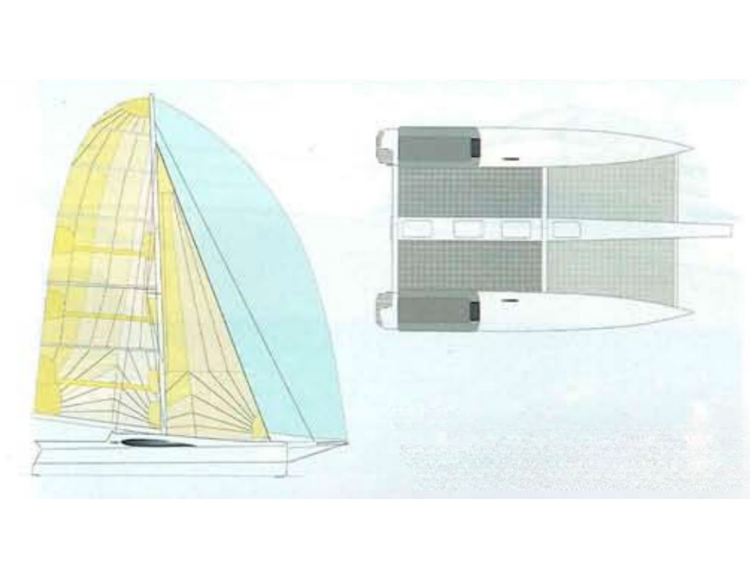
To achieve the required longitudinal stiffness, Clissold designed a one-piece structural pod through the centre of the TC 8.5, a system he had already used when designing X-Factor. This pod acts as a compression strut which prevents the fore beam pumping, thereby causing forestay sag.
Also, because the running masthead and fractional backstays terminate on the rear of the pod instead of the hulls, tensioning the backstay increases forestay tension.
This is in contrast to many alloy-beamed catamarans where the backstay(s) terminate on the rear of the windward hull. When such catamarans crank on backstay tension, the hulls twist diagonally, causing forestay sag and pushing the lee bow further into the water. Neither is conducive to upwind speed.
As well as stiffness upwind, Stewart wanted the ability to drive the TC 8.5 hard downwind. Clissold addressed this with powerful, buoyant hulls with full bow sections and additional reserve buoyancy gained by his trademark spray rails. Because the boat is designed to a length rule, Clissold used virtually plumb bows to maximise hull length.
CONSTRUCTION
Stewart tutors the Certificate in Marine Technology at Auckland’s Unitec, where students get to build real boats. These are often sold afterwards as bare hulls for the cost of the materials. It’s not hard to see where this is going – Stewart persuaded Unitec’s management to take on the TC 8.5 as a course boat and oversaw his students as they built two bare hulls. The course seeks to give students experience with all forms of boatbuilding so the TC 8.5 was constructed in strip-planked cedar below the waterline, with foam/GRP sandwich above.
Unfortunately after the hulls had been finished, Stewart realised finances precluded him finishing the boat to the standard he wanted.
He eventually sold the hulls to businessman Len Light, who in turn commissioned Stewart and his then-boat partner Todd Burrough to finish it. No expense was spared and SS Penelope has the dubious honour of being the most expensive NZMYC 8.5 class boat. Clissold points out this was a matter of choice – SS Penelope didn’t have to cost so much.
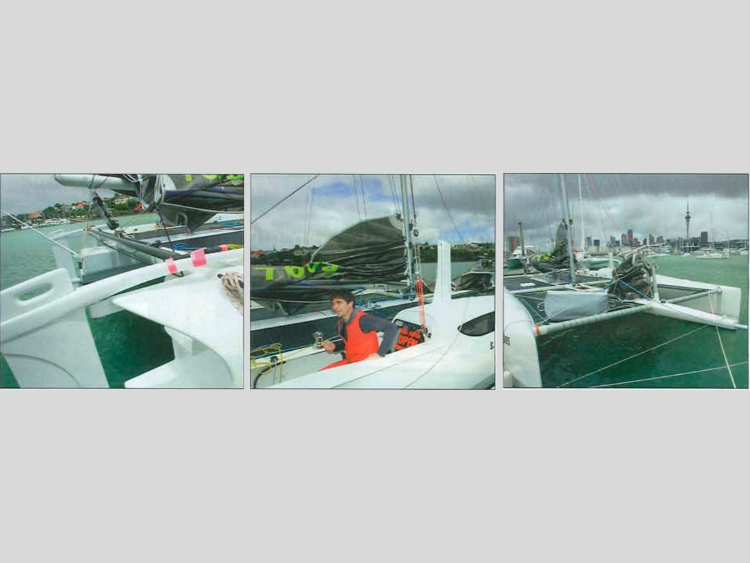
It’s easy to see where many hours went – the finish is superb and there were obviously many hours long boarding to get all the surfaces fair, smooth and shiny. Examples of immaculate detailing are everywhere, including the manner in which the three alloy cross beams are held to the hulls through integral GRP/carbon clamps. The extra width of these clamps on the hulls and pod further stiffens the boat diagonally.
The central pod was vacuum bagged Nomex/carbon fibre, and its triangular shape is designed to resist bending.
There’s more to the pod than just stiffness. It holds an extendable aluminium prod, the anchor and warp, the engine, fuel and battery, and aft, two storage lockers. The rear of these is a dedicated safety locker with access top or bottom. Midships, just aft of the mast, the pod also has a small crew cockpit from where the halyards are operated.
Due to the generous hull beam, the hull cockpits are longer and wider than on most catamarans of this size. There’s an easy step down to the twin boarding platforms. The rudders are stern mounted with cut-outs on their housings to save weight.
Despite their higher resistance to surface ventilation issues, Clissold believes it’s hard justifying the extra complexity of under-hull rudders on a boat this size. To minimise ventilation issues, Clissold uses relatively slim NACA 6410 foils for rudders and daggerboards, and on SS Penelope these are built massively strong in carbon/epoxy.
Stewart put many hours of thought into the deck layout. As far as possible, all sailing loads have been transferred to the boat in a fore and aft direction, rather than sideways, which would introduce a twisting component to the structure.
There’s a small fortune’s worth of roller bearing blocks, stainless winches, flash jammers and slick ropes on board. If anything, many of the fittings seem over-specified, but that’s from choice as Stewart was adamant that nothing should break, an attitude that paid off in SS Penelope’s 100 percent reliability in the 119-mile Coastal Classic race.
The rotating rig is from JT Spars, and held in column with spreaders and a forward facing jumper strut. The running backstays are Dynex to save weight. The mainsheet is double-ended, with course and fine tune purchases. The course-tune end is free to travel to either cockpit. The fine-tune end, with multipart purchase under the boom, can be operated from either cockpit. This has a minor downside: the crew needs to remember to bring the course-tune end of the mainsheet to the new windward cockpit when tacking.
Standard Weaver hatches are set into the sloping rear bulkhead and there’s no sliding hatch in the cabin top. This is great from budget and aesthetic viewpoints, but going below is certainly a wiggle, especially for those of middle age and stiff backs.
However, the hatches allow the boat to be shut up and remain watertight in any conditions – in fact, the hulls are so airtight that there are prominent warning signs about the risk of asphyxiation if you go to sleep with the hatches closed.
Although SS Penelope has been in the water for some months, there’s been little time for sailing. Her first race was the Coastal Classic, where she came second in class and fourth multihull on line, as well as being the first NZMYC 8.5m boat home. Considering the short work-up time, this was an excellent effort from Stewart and his crew of Chris Skinner and Jeremy Barrow.
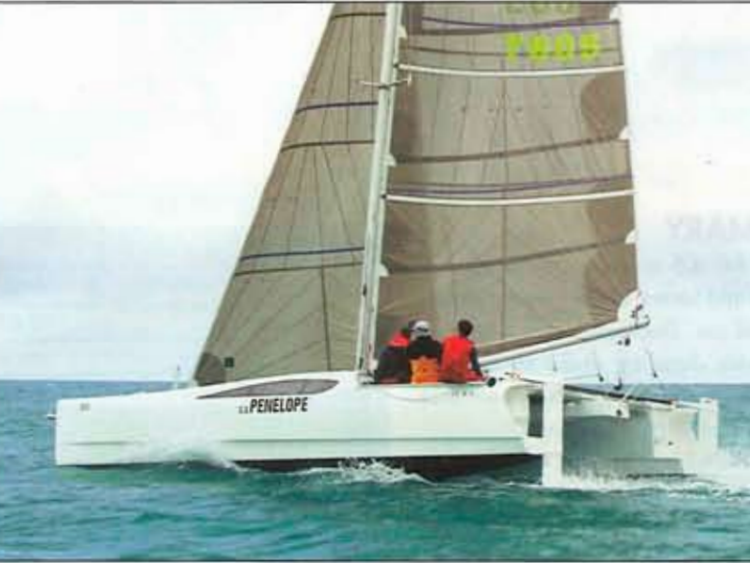
SAILING
Conditions for our sailing trial were a coolish sou-west breeze of 10 to 15 knots and reasonably flat water. Moisture from an upcoming front gave bite to the breeze and sufficient pressure for hull flying.
Powering off the dock, the four-stroke 9.8hp Tohatsu started easily, ran quietly and provided considerable low down torque.
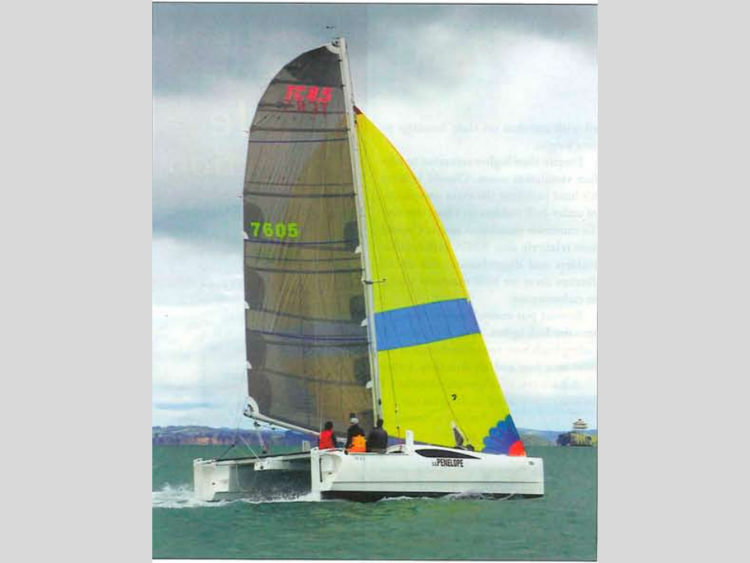
However, sailing is what SS Penelope is all about. The full sail wardrobe includes main, genoa, working jib, storm jib, jib-top, screecher, masthead and fractional gennakers. We hanked on the big genoa for later use then, after clearing the Westhaven moles, turned downwind and hoisted the fractional gennaker.
No question – the TC 8.5 is a brilliant downwind boat. Wind gusts were immediately translated into boatspeed and there was no trace of the lee bow digging in. This is partly due to the relatively full bows and spray rails, but the high degree of diagonal stiffness is also responsible. Gybing was easy – the gennaker is gybed between its own luff and the forestay. The cockpits are generously long and three crew have plenty of room to work the winches without tangling elbows.
Initially, I found the helm heavy but this eased when the daggerboards were raised. Despite the firm helm, the boat goes where it’s pointed and control was never an issue.
Our best speed downwind was 18.6 knots, with long periods of 12 to 14 knots. At these speeds, the Waitemata harbour becomes small awfully quickly – it seemed only minutes before Rangitoto Island forced a course change. We dropped the gennaker, hoisted the genoa and hardened up northwards on a close reach. Now playing for the camera and in a good breeze of around 12 to 15 knots, we had little difficulty flying a hull. We soon discovered the TC 8.5 is sensitive to headsail trim, this being the critical sail to ease when the windward hull leaves the water. Two crew are best on the headsail – one winching, one tailing – with the helmsperson riding shotgun on the main traveller.
Nearing Rangitoto Light we turned for the beat home. Hard on, the boat was slightly overpowered with the genoa and we downshifted to the working jib. In those conditions the jib proved just as quick as the genoa, well as being considerably easier to trim.
Upwind, the TC 8.5 can be steered high to eight to 10 knots boat speed, or low to 12 knots. According to Stewart, the best VMG is achieved at the higher boat speed and he aims to keep the boat on 12 knots upwind. However, with the breeze moving around in speed and direction and the windward hull lifting all too easily, on the helm I felt more comfortable steering high. The boat is tender upwind and while feathering through the gusts helps, the key driver to keeping the boat on its feet is aggressive headsail trimming. We all felt this was a product of the light weight of the hulls – 245kg apiece.
Naturally, there are some minor issues. Initially, the deck layout appears confusing, although it began to make sense after an hour or two’s practice. There are adjustments for every possible function and hence a fair amount of running rigging, so good housekeeping is critical. We experienced a couple of minor snarl-ups, which would have cost us dearly if we’d been racing.
Much of this was due to Clissold and myself not being familiar with the layout, but rope tail bags on the inboard side of the cockpits might help. The other issue relates to the power of the TC 8.5 – the helm and trimmers need to concentrate all the time to keep the boat on the boil. The slightest wavering of attention results in a loss of boat speed. This was especially noticeable when flying a hull – after an ease, the jib needs immediate re-trimming while the windward hull is still in the air, otherwise boatspeed drops excessively. However, complex controls and the need for maximum concentration are traits entirely appropriate for a racing catamaran.
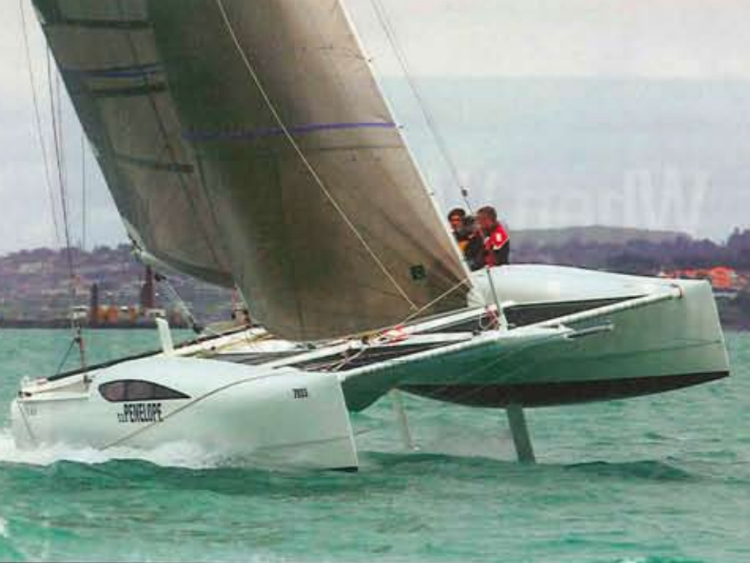
SUMMARY
The TC 8.5 is no soggy moggy – Clissold and Stewart have created a taut, powerful cat. Dockside, its styling and impeccable detailing make an impressive package. But it’s on the water that the boat really strikes a chord.
The TC 8.5 is at its best when reaching and sailing downwind, but upwind the structural pod helps make the boat feel like a one-piece structure, which is rare in this style of catamaran.
Whether the TC8.5’s stiffness gives enough of an edge to beat the trimarans upwind is a question best answered on the race-track – it’s early days but so far the TC 8.5 has one from one.
This level of finish, detailing, engineering and structure has come at a high price in hours and dollars. Experience the TC 8.5’s surging performance downwind and those prone to a rush of blood to the chequebook could be in trouble.
The TC 8.5 is a seriously addictive machine.
TC 8.5 CRUISER
Tim Clissold offers the TC 8.5 in two configurations – a racing version or a cruiser. SS Penelope is the racing version and is built to the minimum headroom allowable to the rules. However, the hulls are big enough for two bunks apiece and are suitable for weekending or modest cruising. The cruising version has a simpler, slightly smaller rig to tone down the performance, plus solid rear decking and slightly higher headroom to improve usability. Optionally, chamfer panels can be installed on the inboard side of the hulls aft to give room for a double berth aft in each hull. The cockpits are not possible with this later feature so the seating is moved inboard of the hulls.
NZMYC 8.5M CLASS RULES
Max loa: 8.5m
Max boa – trimarans: 6.5m
Max boa – catamarans: 5.5m
Max mast height: 11.5m
Headroom: min 1.6m height over min 1.0m length of boat
Engine, min: 8hp
Weight: no minimum
Sail area: unlimited
The boom shall not overhang the transom and the boat must be capable of reaching Yachting New Zealand Category 3 requirements.
SPECIFICATIONS
Boat name: SS Penelope
Design name: TC 8.5
Type: racer
LOA: 8.5m
LWL: 8.3m
BOA: 5.5m
Draft, board up/down: 0.3/1.6m
Sailing weight: 850kg
Disp: 1200kg
Sail area, upwind: 48m²
*Bruce #: 1.71
Designer: Tim Clissold
Engine: Tohatsu
Horsepower: 9.8hp
*Edmund Bruce measurement of power to weight ratio for multihulls can be used to compare boats of different sizes. Calculated by the square root of working sail area (m²), divided by the cube root of sailing displacement (kg), multiplied by 2.53.
