


First tip – take it easy. Even if your boat’s carrying sophisticated navigational aids, actual visibility is very limited. Objects won’t come into view until they are fairly close, so it’s important to go slow. If you see something in the water, you’ll need enough time to stop or change course to avoid a collision.
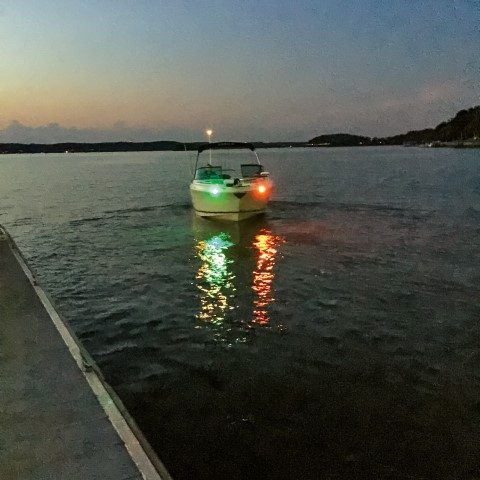
Speeding at night can have dire consequences. Earlier this year, a boatie at Cooks Beach ploughed onto rocks while heading back to shore after a night’s fishing. He was travelling incredibly fast – and not using any navigational aids.
While it was a calm night, with no visible moon it was very dark, making it impossible to see what was ahead. The vessel smashed into the rocks and both the skipper and his friends were severely injured.
Travelling slowly – and consulting navigational aids such as a chart/radar/GPS – could have avoided the issue.
NAV LIGHTS
Nav lights make you visible to other boaties and help you make the right decisions and judgements relating to other vessels.
For example, you can work out if you’re overtaking someone if you only see the stern light, or if you’re crossing someone if you see a green or red light. Also, depending on the lights another boat is carrying, you’ll be able to work out if it’s a power-driven vessel, a rowboat or a yacht.

Correctly-fitted nav lights are essential, and different kinds of vessels need different types of lights. A sailing vessel is only required to display side lights (the red and green lights) and a stern light (1, 2 & 4).
Power-driven vessels must also show a white masthead light (3). But if you have a powerboat less than 12m in length, an all-round white light can replace the stern and masthead lights (3 & 4).
A power-driven vessel (e.g. dinghy) smaller than 7m whose speed does not exceed seven knots can exhibit an all-round white light.
BACKGROUND LIGHTS
Finding your way around a busy harbour at night usually adds an additional layer of complexity to navigation.
There are often plenty of background land lights – red, green and white – and it can be hard distinguishing channel markers and other navigation lights from land-based lights.
Note, too, that a flashing light could be a navigation mark – but it could also be a high-speed ferry.
Analysing the lights on a vessel not only help you to determine its direction of travel, but also what type of vessel it is, its length, and whether you – or it – are obliged to give way.
LEARN MORE To improve your night navigation skills, consider doing a Coastguard Boating Education Boatmaster course. Visit www.boatingeducation.org.nz for more information.
Boating at night
Written by
Share this
Person taken to hospital after boat capsizes at Manawatū beach
One person has been hospitalised after emergency services responded to rep...

Suddenly in Charge workshops – helping more boaties stay safe on the water
What would you do if you were suddenly in charge on the water? It's a question C...

Nelson Harbours team completes jet ski training with veteran educator
Nelson's Harbours team has completed two days of training in personal watercraft...
Comments
This conversation is moderated by Boating New Zealand. Subscribe to view comments and join the conversation. Choose your plan →
This conversation is moderated by Boating New Zealand.
