The literally ground-breaking history of the Napier Sailing Club.
The regular (Eurocentric) history of sailing fast boats says that everything changed with the advent of the first planing monohulls, designed by Uffa Fox in England in 1928.
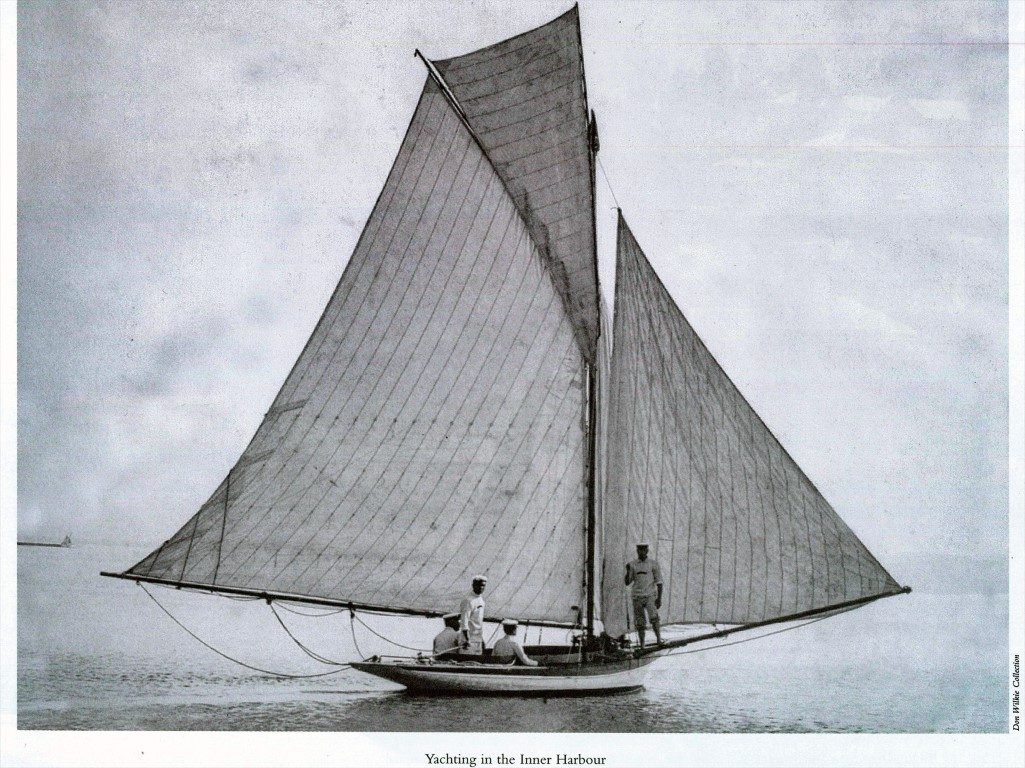
But see this – here’s a picture of Kahurangi, a Patiki Class pointy scow, a unique New Zealand development class, doing exactly that (probably faster) decades before in the inner harbour at Napier.
This picture is imperfectly dated, but it is well before 1928.
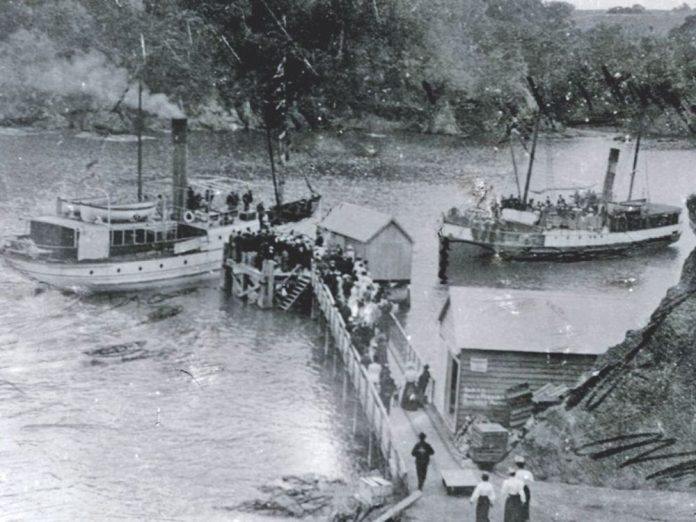
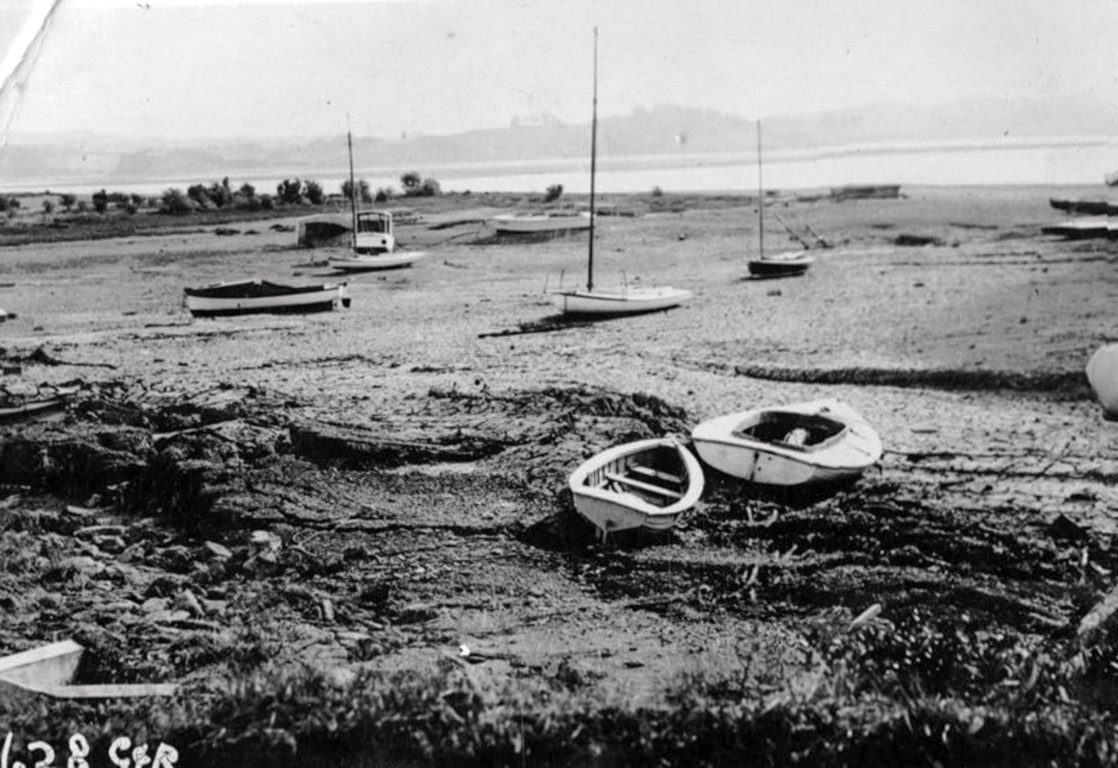
For further proof, there’s the fact that Kahurangi was photographed in the Napier Sailing Club’s previous waters of the inner harbour. That was before this large expanse of estuary was lifted out of sight in the February 1931 earthquake.

Where the Napier Sailing Club once was – right where this picture was taken – is now the runway of the Napier Airport.
Other pictures from the archives of the Napier Sailing Club show the distinctive shallow, softly-curved hull forms of the Patiki class boats in action in the early 1900s. The good sailing folk of Napier’s inner harbour were planing, even before the word was invented.
Going back even further, the Hawkes Bay Sailing Club was formed in 1881. It had 18 members. It’s nice to know that the Hawkes Bay Herald reported on their first cruise, naming all the participating yachts, ‘gaily decked with bunting.’ They were ‘the flagship Mystery, the Try Again, the Lorna Doon, the Booloobaloo Ghah (I’d love to learn where that name comes from!), the Kelpie, the Little Wonder, the Nymph, the Ruby, the Flirt, the Swan and the Johnson, beside a number of others which had no names.
In those days, they unabashedly raced for prize money. The winner would usually get £5, the purse for the whole season £100. But the club folded after seven years, due to a crippling economic recession caused by a slump in wool prices.

Times got better, and the Napier Sailing Club was re-formed in February 1891 at a meeting at the Criterion Hotel. By 1905, the club had expanded: a fleet of 15 yachts and ‘several oil launches.’
A clubhouse and jetty were built on land owned by the Commodore and local big man J Vigor Brown (he was also the town’s mayor).
The Patiki class was developed in these early days, as the answer to sailing in the tidal estuary. With shallow skimming hulls, a centreboard, and a towering gaff rig with a jib on a boom, they were very exciting, very efficient sailing boats. The Napier Paitikis were a larger version, a refinement of the Auckland Patiki class: “In 1898 came the first recognisably ‘modern’ class of home-grown unballasted centre-boarders, the 18ft 6in Patikis. Even then, these clinker half-decked yachts were inspired by an American ‘half-rater’ owned by Capt. Pearce of the American barque Sea King which put into Auckland in distress after a rough Tasman crossing in 1897.”
A few Auckland Patikis were imported to Napier. Then they were built locally, stretched to 28 feet long. See www.boatingnz.co.nz/tag/patiki-class/
The most famous of them, Kahurangi, was carvel-planked from kauri, the timber also imported to Napier. They were identified by simple symbols on their sails: Kahurangi was the star, naturally – others sported birds, like swallows.

And yes, it didn’t take long for them to get up on the plane. Long before 1928. Only the world didn’t really know about them. Certainly Uffa Fox didn’t, otherwise he wouldn’t have designed his ‘breakthrough’ International Fourteen dinghy Avenger as he did, with its deeper and rounded clinker-built hull. If he’d known, he would have copied the Patiki.
Fox’s own description of Avenger, complete with its 18kg bronze (!) rudder, would give modern yacht designers the wibblies:
“Her V sections run down to give her deep chest forward of midships and run right throughout her length…The V-d sections for the first third give her an angle of attack to the water….so as Avenger’s shaped bow was driven through the water, its shape and angle of attack caused it to lift. The two-thirds of length in her long run aft ran fast and easily in the groove cut by the sharp V bow perhaps 3” less in depth than her waterline at rest. She changed trim and went along at double the speed of any other dinghy at this time. It was this planing ability that made her invincible in winds of over 12 miles an hour, and so the first sea-going, planing sailing boat was born.”
Well, not so. For the Patikis were better planing boats. And had been there, done that, long before.
Napier Sailing Club’s rich history continued after the great disruption of the earthquake, though the Patiki class died out, being less suited to sailing offshore in a seaway as the club’s sailors now had to do. The last Patiki was taken up the creek and beached in the 1960s. None survived. Perhaps that’s why they had become half-forgotten.
Except by the Club’s historian Graeme Robinson, a consulting engineer turned sailing (and sailing history) boffin. “I have a dream to build a Patiki.”
And might just do it, being well-versed in reconstruction. He worked as an EQC engineering assessor in Christchurch after their recent earthquakes.
But it was the big one, that occurred at low tide on 3 February 1931, that changed everything for the Napier Sailing Club. The land was upthrust 2 to 2.5m, wiping out the huge estuary. Take a look at the 1865 map, showing how big it was. And the photos of Patiki boats sailing way up to Maraetara Bay. Which is now farmland, a few miles inland from Bayview.
As the Patiki fleet broke up, literally, it was replaced by the other Kiwi classics, the Idle Alongs, which predominated in the 1950s.
But the Club wasn’t done with earthquakes yet. In 1960, an earthquake in Chile sent a tsunami across the Pacific, which floated the caretaker’s caravan across the road, and washed the rescue boat out to sea.
Napier’s sailors kept their spirits up by winning the Moffat Cup in 1962, New Zealand’s inter-provincial regatta, always hotly contested.
Then in 1979, Napier’s Flying Fifteen sailors Tom and John McKenzie won their first international championships in Fremantle, Western Australia. And Ian Norrie and Barry Finlayson won the World Championships at Hayling island in the UK in 1980 (ironically, the Flying Fifteen is an Uffa Fox design). Flying Fifteens and many other classes proliferated at the club. In 1982, Napier hosted the Flying Fifteen Worlds. They had already hosted the 1973 Moth class World Championships. These big regattas were followed by the OK Dinghy Worlds in 1994, Flying Dutchman Worlds in 2010, the Optimist Worlds in 2013, and another Flying Fifteen Worlds in 2017.
Along the way, Napier Sailing Club sailors – especially the younger ones – kept winning up large, in national and international regatta and ocean races.
Napier is a sailing club that can win through anything – even earthquakes.